
Enterprise Clinical Risk & Accountability Framework for Healthcare Voice AI
A practical, jurisdiction-neutral operating framework for deploying Voice AI safely in patient access and contact-centre workflows — architecture, controls, procurement choices, and measurable outcomes.
1. Scope and safe boundaries
Define what Voice AI will (and will not) do before any technical design or procurement. A precise scope both reduces risk and focuses integration and QA effort.
Operational scope
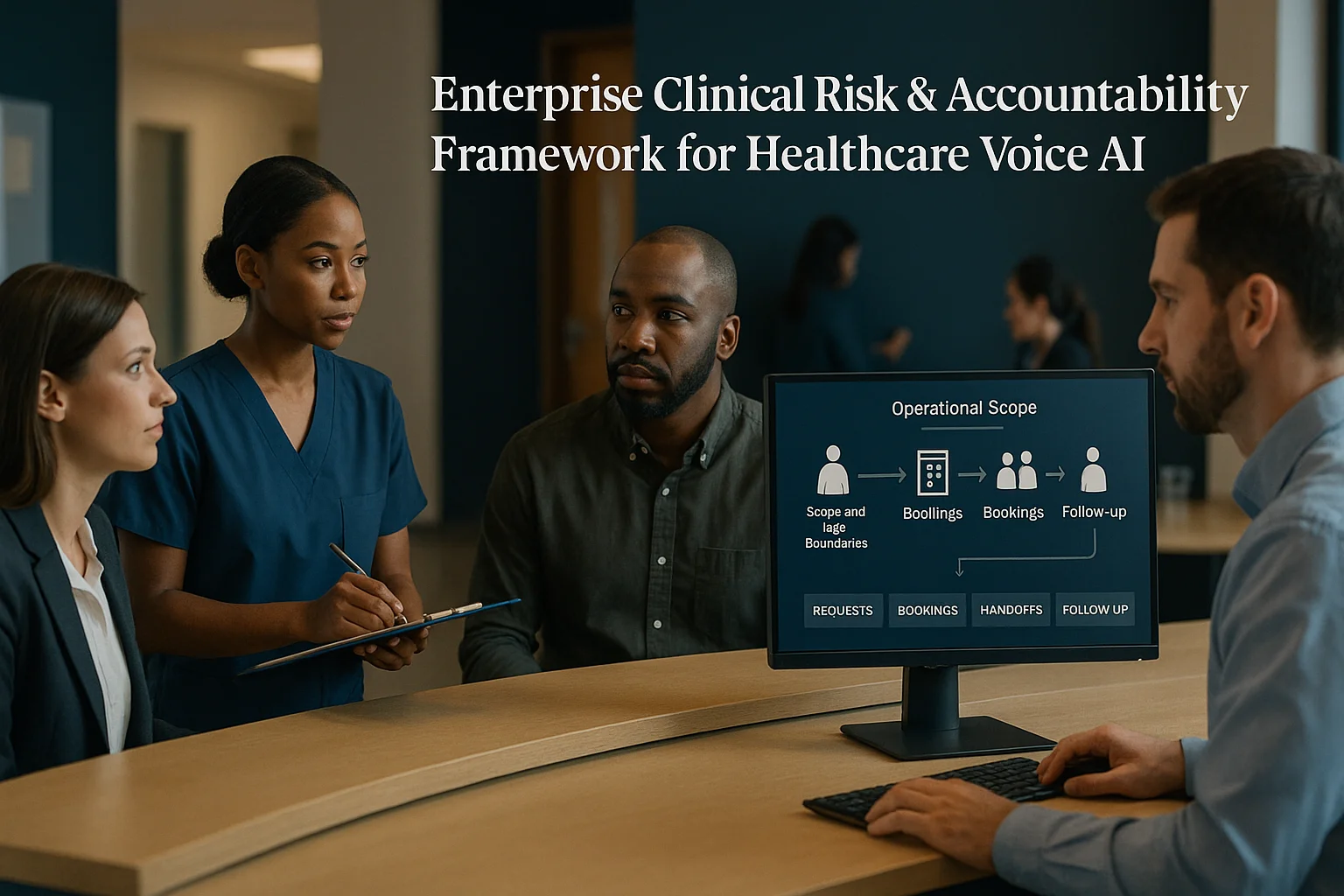
Limit Voice AI to administrative and access tasks: appointment booking and confirmation, pre-visit administrative intake (insurance, demographics, consent capture), routing to appropriate service lines, basic eligibility checks, and scripted patient communications. Explicitly exclude clinical triage, diagnosis, prescription, or clinical decision-making. Design the system so any utterance that could imply clinical assessment triggers immediate human escalation and is logged for review.
- Allowed: scheduling changes, referral routing, address/phone updates, basic FAQs about hours and locations.
- Not allowed: medical advice, triage for acute symptoms, interpretive clinical summaries.
Regulatory and jurisdiction limits
This framework is jurisdiction-neutral. Policies covering consent, recording, data residency, and breach notification vary by country and jurisdiction — organisations must confirm obligations with legal and compliance teams. Where data flows cross borders, document subprocessors, transfer mechanisms, backup geography, and remote-support access prior to procurement.
- Define hosting region(s) and backup region explicitly in contracts.
- Specify subprocessors and whether they can use remote support or offsite maintenance.
- Capture and store consent evidence for recordings and automated decisions.
2. Recommended operating architecture
A practical, defensible architecture arranges capabilities to minimise risk while preserving automation value.
Canonical workflow
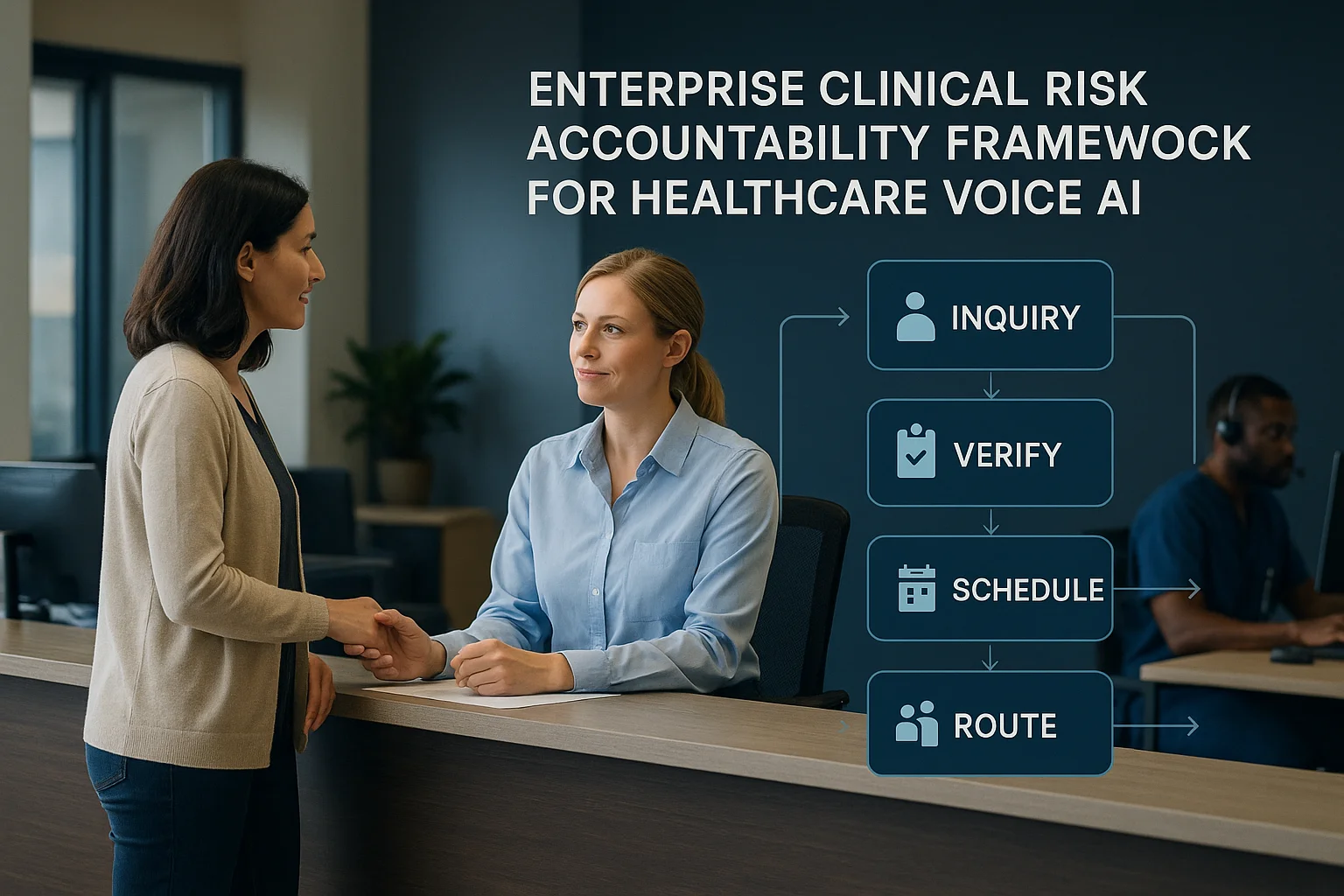
Patient/caller → Voice AI (speech recognition + intent resolution) → Validation & identity controls → Orchestration layer with approved scheduling/service API → Confirmation or human handoff. The orchestration layer enforces policy (what actions are permitted per caller identity and context), routes requests to backend systems (EHR/PM, scheduling engine, CRM), and records an immutable audit trail.
- Voice AI performs intent detection and structured-slot capture; it never writes directly to clinical records.
- Validation layer confirms identity (two-factor voice PIN, SMS link, knowledge-based challenge, or system-matched attributes) before allowing schedule or update actions.
- Orchestration layer maps intents to approved API actions and enforces role-based rules and rate limits.
Integration touchpoints
Integrate using approved APIs and controlled adapters. For large EHRs (for example Epic), implement a thin, auditable adapter that translates orchestrator calls into EHR-approved operations. Maintain a separation of concerns: the Voice AI handles conversation; the adapter enforces business logic, RBAC, and error handling.
- Use read-only EHR queries where possible for validation; writes should follow staged approval and logging.
- Ensure idempotency for scheduling calls to avoid duplicate bookings.
- Design adapters for circuit-breakers and graceful degradation to human service agents.
3. Identity, consent, and data controls
Access and data controls are core to safety and trust. Implement layered identity validation and explicit consent capture with auditable storage.
Identity and validation
Adopt a risk-based identity model. For low-risk lookups, caller ID plus a confirmation question may suffice; for scheduling changes or access to protected health information, require stronger verification (one-time passcode, account-linked PIN, or integration with enterprise SSO where available). Log each verification step and its outcome.
- Record verification type, time, and the verifier result to the audit trail.
- Enforce stricter validation for schedule changes, cancellations, and access to invoices or clinical documents.
- Allow agents to perform manual override only with documented justification and a secondary auditor.
Consent and recording
Obtain explicit consent for recording and for automated decision-making at the start of interaction. Present consent in plain language and store evidence (timestamp, wording presented, response). Allow callers a clear opt-out path to human assistance.
- Persist consent records linked to interaction IDs and retention policies.
- If recordings are shared with subprocessors or analysts, document onward transfers and retention.
- Implement mechanisms for callers to request deletion where local law permits, and document limits for system backups and logs.
4. Governance, QA and risk management
Governance combines policy, technical controls, and ongoing assurance. Adopt recognised risk management practices while tailoring to clinical boundaries.
Policy and oversight
Establish a cross-functional governance board (patient access lead, clinical safety officer, privacy officer, IT, contact-centre lead) that approves scope, escalation rules, and change control. Document acceptable use, escalation thresholds, and human review quotas.
- Board approves test plans, release criteria, and post-deployment monitoring.
- Maintain a signed accountability matrix describing vendor and internal responsibilities.
Risk framework and QA
Implement a continuous risk management loop: identify, measure, control, monitor, and report. Apply the NIST AI Risk Management Framework for operationalising controls (data governance, model performance monitoring, explainability where feasible, and incident response). Use standard QA sampling and scenario-based tests that reflect multilingual, noisy, and accented speech conditions.
- Define KPIs (containment, escalation/hand-off rate, utterance error rate, time-to-resolution, and audit coverage).
- Run adversarial tests for hallucination triggers and sensitive utterances.
- Keep a documented rollback plan tied to SLA triggers.

5. Procurement, service model and Peak Demand differentiation
Procurement signals who owns integration, observability, and failure modes. Be explicit in contracts about responsibilities.
Buy vs build vs managed service
Choose based on internal capability and integration complexity. A managed service can reduce operational burden but must provide transparent observability, audit logs, and documented subprocessors. If building in-house, budget for ongoing QA, model update controls, and 24/7 operational support.
- Ask vendors for sample audit logs and an extractable audit schema.
- Require clear SLAs for containment, false-action prevention, and human handoff latency.
- Clarify who owns adapter code for EHR/PM integrations and who is responsible for updates when downstream APIs change.
Peak Demand role and capabilities
Peak Demand offers custom Voice AI development tightly integrated with scheduling and intake adapters, identity verification, field validation, safe escalation pathways, complete audit trails, and structured human review processes. Our approach emphasises adapter-based integrations to EHR/PM systems and explicit ownership of subprocessors and observability to support regulated buyers.
- Custom Voice AI tuned for clinic phrasing and multilingual environments.
- Scheduling & intake adapters that implement idempotency, RBAC, and circuit-breaker patterns.
- Operational handoff models: agent-in-the-loop, warm transfer, or full takeover depending on containment and risk.
Contract must-haves
Require detailed statements of work that list hosting region and backup region, processor/subprocessor lists, data retention and deletion procedures, remote-support access, incident notification timelines, and the right to audit. Avoid ambiguous language about data use for model training; require opt-in for training datasets.
- Specify data residency and cross-border transfer mechanisms explicitly.
- Mandate breach notification timelines and post-incident remediation artifacts.
- Include performance testing and acceptance criteria tied to production KPIs.
6. Implementation roadmap and measurable outcomes
Launch in controlled phases with measurable gates. Avoid wide releases until the system demonstrates stability across metrics and scenarios.
Phased rollout
Start with a pilot that restricts Voice AI to low-risk clinics or a subset of call types. Move through staged expansion: pilot → controlled rollouts across sites/languages → enterprise scale. Close the feedback loop: use QA sampling and clinical oversight to tune intent models and dialog flows.
- Pilot scope: one site, limited call types, human backup on every call.
- Gate criteria: containment > X% (organisation-defined), escalation latency < Y seconds, audit coverage at least Z% of interactions.
- Post-rollout: monthly review of KPI trends and incident logs.
Operational KPIs
Use SLA-driven operational metrics: containment rate (calls completed without human handoff), safe escalation rate (ambiguous or clinical calls routed to humans), intent accuracy, time-to-confirmation for scheduling actions, and audit coverage. Track adverse events and near-misses with root-cause analysis and remediation timelines.
- Containment and escalation KPIs must be tied to business and clinical tolerances.
- Measure false-action incidents (automated actions requiring reversal) separately from recognition errors.
- Use trend analysis to detect model drift and environmental failures (e.g., network, ASR degradation).
7. Failure modes, incident response and safe fallbacks
Design for failure. The safest deployments assume some interactions will require human review or rollback.
Primary failure modes
Common failure modes include: incorrect identity verification, hallucinated or fabricated responses, unintended scheduling writes, ASR failure in noisy environments, and third-party API outages. For each failure type, define automatic containment logic and human escalation paths.
- Identity failure: block transactional actions; route to agent with verification transcript.
- Hallucination-like responses: capture interaction, pause automated actions, escalate to human-review queue.
- Third-party outage: switch to read-only mode or queue requests for human processing.
Incident response and forensic readiness
Maintain an incident response playbook covering detection, containment, eradication, recovery, and post-incident review. Ensure logs, recordings, and verification artifacts are preserved for forensic review and regulator requests, subject to retention policy and legal constraints.
- Define who can access forensic artifacts and under what approvals.
- Preserve immutable audit trails for a defined minimum period linked to legal obligations.
- Report incidents to governance board with remediation plan and timelines.
Related Peak Demand resources
Industry and AI sources reviewed
- Ethics and governance of artificial intelligence for healthWorld Health Organization
- Regulatory considerations on artificial intelligence for healthWorld Health Organization
- Artificial Intelligence Risk Management Framework (AI RMF 1.0)National Institute of Standards and Technology (NIST)
- OECD AI PrinciplesOrganisation for Economic Co-operation and Development
Healthcare privacy, security, clinical-safety, records, and professional obligations vary by jurisdiction and workflow. This article is operational guidance, not legal advice; organizations should confirm applicable requirements with qualified professionals.
Frequently asked questions
Administrative workflows such as appointment booking, changes and cancellations, referral-status intake, approved follow-up, patient-access questions, after-hours overflow, and structured routing are common starting points. Clinical judgment, diagnosis, emergency triage, and prescribing decisions must remain with qualified professionals.
Use the minimum identifiers approved by the organization, validate them against the system of record, avoid exposing unnecessary information, and provide a human-assisted path when verification fails. The system should not infer identity from conversational context alone.
The agent should follow the organization's approved escalation and emergency-routing rules, avoid clinical advice, and transfer or direct the caller to the appropriate human or emergency channel. Those rules must be tested with realistic language and failure cases.
Request identity and privacy controls, scheduling or EHR integration behavior, audit logs, escalation rules, downtime handling, testing evidence, change control, monitoring, and clear separation between administrative automation and clinical decision-making.
Design a safe patient-service workflow before automating it
Peak Demand helps healthcare organizations connect Voice AI to scheduling, intake, patient communication, identity checks, escalation, and reporting with clear operational boundaries.
Schedule a discovery call


