
Standardizing Metrics and QA for Multisite, Multilingual Healthcare Voice AI
Operational guidance for designing QA, analytics, and escalation controls that scale across sites and languages for patient-access Voice AI. Includes governance, procurement checklists, and measurable operating outcomes.
1 — Use case and clear safety boundaries
Define a narrow, operationally-safe Voice AI scope before scaling. The most practical multisite use case is administrative patient-access tasks such as appointment requests, routine follow-ups, and basic intake. Safety and legal boundaries must be explicit: Voice AI can route, capture structured intake, check eligibility, and schedule via approved APIs — but it must not diagnose, triage emergencies as clinical decisions, prescribe, or replace clinician judgment.
Operational use case: after-hours appointment booking and intake
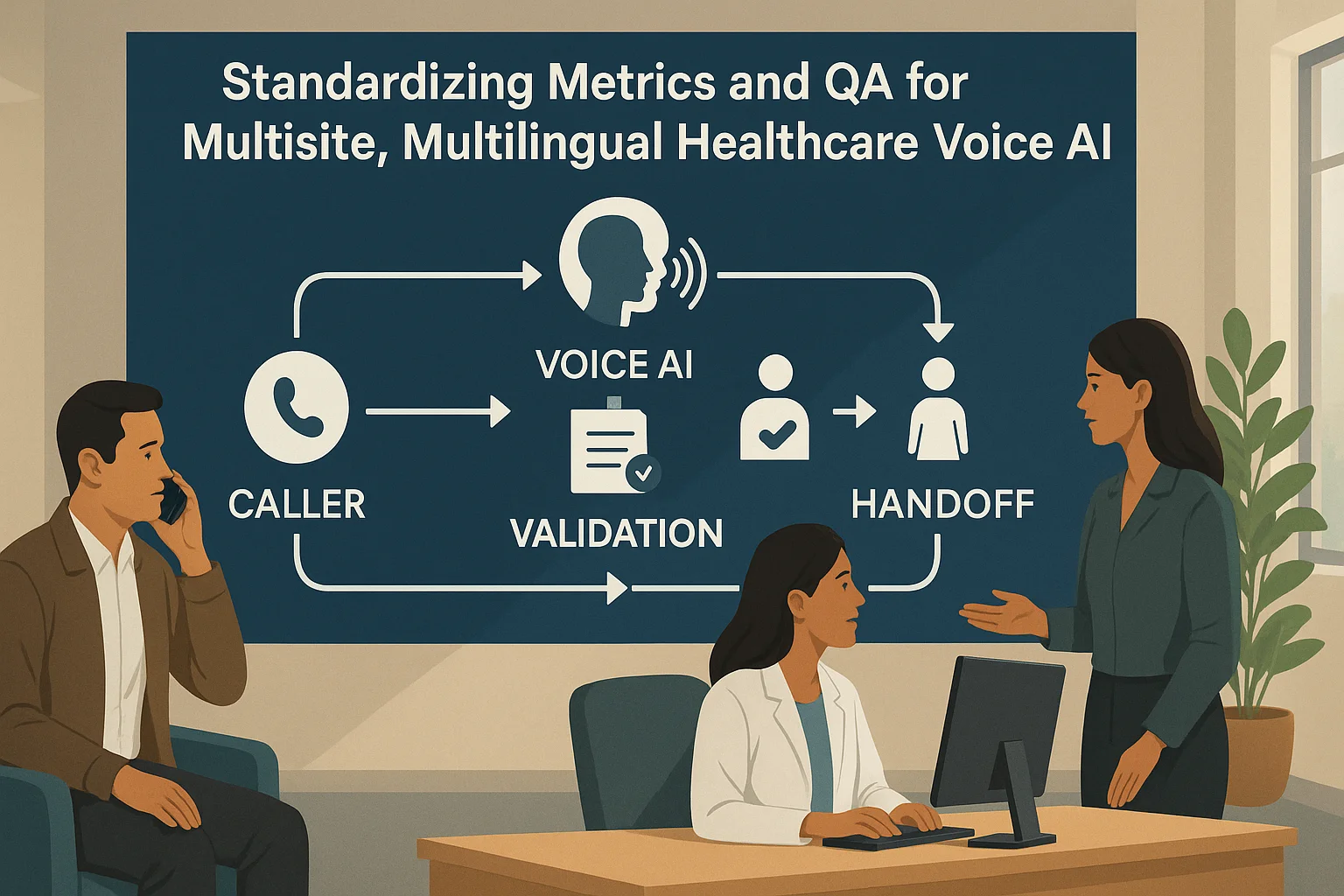
Standardize the caller flow so every call follows the same decision tree: verify identity, capture structured intent and slots, validate scheduling constraints via the scheduling API, confirm booking, or safely escalate. This scope limits clinical risk while delivering high value to patient‑access teams.
- Inputs: Caller voice, language selection, minimal identity tokens (e.g., DOB and phone), intent classification (book, reschedule, cancel, question).
- Gates: Identity match, slot completeness, scheduling availability check.
- Outcomes: Confirmed booking, voicemail/lead capture for manual follow-up, or escalation for ambiguous/urgent cases.
Safety boundary and escalation rules
Define unambiguous escalation triggers: detection of urgent language (e.g., 'chest pain', 'difficulty breathing'), identity verification failures, conflicting appointment data, or any non‑administrative clinical content. Escalation must create a structured handoff with transcript, timestamps, and risk flags for human review.
- Tag and hold any utterance that looks clinical, instruct caller to transfer to clinical staff or emergency services when appropriate.
- Never allow the Voice AI to confirm clinical advice; instead, route to a nurse line or on‑call clinician.
- Log the decision path and last successful validation checkpoint to support audit and post‑event review.
2 — Reference architecture and control points
A consistent architecture reduces variance across sites and languages and makes QA reproducible.
Canonical pipeline
Implement a canonical pipeline: Patient / Caller → Voice AI (ASR/NLU/Dialog manager) → MCP (Model Context Protocol) for prompt and context controls → Validation & identity controls → Approved Scheduling/Service API → Confirmation or Human Handoff. Each transition is a formal handover point with auditable artifacts.
- MCP enforces prompt templates, allowed context window, and variable masking before model calls.
- Validation layer performs field checks (e.g., insurance plan lookup, appointment slot lock) using direct integrations to PM/EHR or scheduling microservices.
- Handover creates a 'case bundle' with audio, transcript, intent, slots, validation status, and recommended next action.
Identity, recording consent, and data residency controls
Before any PHI write or long‑term recording, apply explicit consent scripts and identity checks. Design the hosting and subprocessors in the SOW: primary hosting region, backup region, subprocessors, remote‑support access, retention periods, and export/transfer mechanisms. Confirm obligations with qualified counsel for jurisdictional privacy rules.
- Keep identity validation local to the hosting region when required by policy; log cross-border transfers and subprocessors explicitly.
- Recordings and transcriptions used for QA must be tagged with retention metadata and access controls.
- Define breach notification workflows and responsibilities in procurement documents.
3 — QA framework and governance (MCP in practice)
QA needs deterministic controls over model behavior and reproducible tests. Use a Model Context Protocol (MCP) to lock prompt content, context state size, and allowable system actions.
What MCP enforces
MCP is the operational policy that controls what context and instructions are passed to the model. It includes canonical prompt templates, the maximum context window, whitelists of allowed APIs (e.g., schedule/create), and masking rules to avoid leaking PHI into third‑party model contexts.
- Freeze prompt templates for production, version them, and require change approvals.
- Keep any PII/PHI out of raw prompts; use tokenized references resolved server‑side.
- Log the MCP version per transaction for auditability.
Governance layers
Combine clinical governance, privacy, and technical risk management. Map governance roles: clinical lead vets scope and escalation criteria; privacy officer signs off on recording/retention; CTO defines hosting and remote access; operations owns SRE and QA gates.
- Run regular red-team tests aimed at boundary cases (for example, mixed language, identity spoofing, ambiguous intents).
- Retrospective reviews of escalations to identify false negatives (missed escalations) and false positives (unnecessary escalations).
- Maintain a risk register aligned to an AI RMF and WHO ethical considerations.
4 — Metrics that matter: containment, escalation quality, and cost-to-serve
Measure the right mix of operational and safety metrics. Separate efficiency (cost) from safety (quality) and expose both to site owners and compliance teams.
Containment and escalation quality definitions
Containment quality is the proportion of interactions resolved by the Voice AI that were handled correctly (no subsequent human correction required). Escalation quality measures whether handoffs to humans were appropriate and provided the necessary context to resolve the case rapidly.
- Track corrected handoffs: escalations where the human had to undo or re‑enter information indicate poor containment gating.
- Require structured feedback from agents post‑handover (reason code, missing data, risk level) to close the QA loop.
- Annotate audited samples for both false containment and false escalation to feed model improvements.
Analytics and cost-to-serve
Quantify cost-to-serve at the site and language level by capturing per‑interaction phased costs: ASR/NLU call cost, integration/API call cost (scheduling locks), human escalation handling cost, and downstream no-show or rework costs. Use these inputs to model ROI scenarios and prioritize optimization.
- Report metrics by site and language: containment rate, escalation rate, average handling time pre/post escalation, agent time per escalated case, and percent of escalations.
- Keep a control group or period when measuring behavioral effects like no‑show change or patient satisfaction impacts.
- Use event tagging (e.g., 'validation_failed', 'urgent_flag') to slice analytics for compliance and incident review.

5 — Multisite and multilingual scale operational choices
Scaling is not cloning. Choose a controlled variant approach: one validated template per language and clinical configuration rather than allowing per‑site divergence.
Language strategy and voice variants
Standardize supported locales and voice personas. For each language, maintain a validation corpus that covers site‑specific vocabularies (clinic names, provider names, local procedures). Use locale-aware NLU models or per‑language fine‑tuning but keep the same MCP and validation gates.
- Accept language fallback rules: if ASR confidence falls below a site/language threshold, prompt for language confirmation or immediate handoff.
- Maintain parallel QA corpora per language and run parity checks for containment and escalation quality.
Site configuration and centralization balance
Centralize core logic (MCP, validation services, analytics) and allow controlled site configuration (business hours, provider schedules, local routing) stored as structured feature flags. This keeps testing reproducible while enabling local differences.
- Deploy feature flags for site‑level configs and track feature flag versions with each transaction.
- Use a site onboarding checklist that includes EHR/PM integration tests, local language validation, consent scripts, and escalation contact lists.

6 — Continuous optimization, testing, and procurement controls
A production Voice AI program requires continuous capture, human review, and controlled model updates. Procurement must reflect operational realities.
Continuous improvement loop
Instrument for continuous sampling: regular random audits, targeted audits of high‑risk utterances, and scheduled synthetic testing for corner cases. Feed labelled examples back into model or rule updates via an approved change process and MCP versioning.
- Automate alerts when containment or escalation quality trends change suddenly.
- Schedule quarterly clinical and privacy reviews of retained samples and policy changes.
- Include regression tests for language parity and scheduling API idempotency before any push to production.
Procurement checklist and managed service scope
When contracting vendors, require a clear SOW covering: integration ownership (who writes to scheduling/EHR), audit logs, audio/transcript retention and deletion, subprocessors, hosting and backup regions, remote support access, incident response SLAs, and measurable SLOs for containment and escalation metadata. If buying a managed service, insist on an operations playbook and a documented handoff for support.
- Ask for documented evidence of integration patterns and a runbook for escalation scenarios.
- Define acceptable subprocessors and require notification for any changes.
- Specify who owns identity verification and any third‑party identity checks; require the vendor to support local data residency obligations where necessary.
7 — Implementation checklist and Peak Demand differentiation
Practical next steps and where Peak Demand differentiates in execution.
Implementation checklist
Follow a phased rollout: pilot one language and two sites, validate containment and escalation quality, stabilize integrations, then scale by site cohorts. Deliverables per phase should include a validated MCP, integration test results, QA audit reports, and a staffed escalation pathway.
- Phase 0: Scope, governance sign‑off, MCP draft, privacy and clinical review.
- Phase 1: Pilot (1–2 sites, 1 language) with daily QA sampling and weekly retrospectives.
- Phase 2+: Multi‑site rollout by cohorts with central analytics dashboards and local ops training.
Where Peak Demand adds operational value
Peak Demand builds custom Voice AI integrations with scheduling and intake systems, implements identity verification and field validation gates, designs safe escalation playbooks, and provides audit trails and human review workflows as part of a managed offering. Our engineering approach emphasizes reproducible MCP versioning, site feature flags, and language validation corpora to control drift as you scale.
- Custom Voice AI tuned to site vocabularies and scheduling constraints.
- Prebuilt connectors for PM/EHR and scheduling APIs with idempotent write patterns.
- Managed QA program with human-in-the-loop reviews and secure audit trails.
Related Peak Demand resources
Industry and AI sources reviewed
- Ethics and governance of artificial intelligence for healthWorld Health Organization
- Artificial Intelligence Risk Management Framework (AI RMF 1.0)National Institute of Standards and Technology (NIST)
- OECD AI PrinciplesOrganisation for Economic Co-operation and Development
Privacy, telecommunications, recording-consent, cybersecurity, consumer-protection, employment, and records obligations vary by jurisdiction and use case. This article is operational guidance, not legal advice; organizations should confirm applicable requirements with qualified professionals.
Frequently asked questions
Administrative workflows such as appointment booking, changes and cancellations, referral-status intake, approved follow-up, patient-access questions, after-hours overflow, and structured routing are common starting points. Clinical judgment, diagnosis, emergency triage, and prescribing decisions must remain with qualified professionals.
Use the minimum identifiers approved by the organization, validate them against the system of record, avoid exposing unnecessary information, and provide a human-assisted path when verification fails. The system should not infer identity from conversational context alone.
The agent should follow the organization's approved escalation and emergency-routing rules, avoid clinical advice, and transfer or direct the caller to the appropriate human or emergency channel. Those rules must be tested with realistic language and failure cases.
Request identity and privacy controls, scheduling or EHR integration behavior, audit logs, escalation rules, downtime handling, testing evidence, change control, monitoring, and clear separation between administrative automation and clinical decision-making.
Turn Voice AI infrastructure into a managed enterprise operation
Peak Demand designs, integrates, deploys, monitors, and improves Voice AI systems across customer service, enterprise systems, governance, escalation, and reporting.
Schedule a discovery call


