
Drafting SLAs, Liability & Performance Schedules for Manufacturing Voice AI
Practical guidance for manufacturing and service leaders to draft SLAs, allocate liability, specify performance schedules, and evaluate vendors for Voice AI used in parts intake, warranty, field service routing and ERP‑integrated operations.
1. What the SLA must cover for manufacturing Voice AI
An effective SLA for Voice AI used in manufacturing and field service separates availability from outcome accuracy, prescribes validation points against ERP/CRM, and sets escalation paths. Avoid vague promises—specify what success looks like in operational terms.
Service categories and measurable outcomes
Break the contract into discrete service categories: telephony connectivity and call routing, speech recognition and intent classification, parts and warranty intake, ERP/CRM queries, case creation, and human escalation. For each category define 2–4 measurable outcomes. Examples: intent classification F1 score for defined intents; parts‑match precision at N (top‑1/top‑3); routing accuracy (percentage of calls correctly routed to field service vs dealer); mean time to human handoff for failed intents.
- Availability SLA: telephony session success rate and mean call setup time.
- Accuracy SLA: intent recognition and parts identification measured on agreed test sets.
- Operational SLA: escalation latency, order/case creation success, and duplicate case rate.
Error budgets, credits and remediation
Codify an error budget that distinguishes transient failures (telephony downtime, endpoint outages) from systematic model drift or data‑binding errors. Define remediation steps and financial credits tied to the error budget. Require vendor root‑cause reports for repeat breaches and a remediation plan with timelines.
- Define thresholds that consume the error budget (e.g., monthly intent accuracy below X% or telephony uptime below Y%).
- Prescribe remediation windows (e.g., 72 hours for high‑severity faults, 30 days for model retraining).
- Avoid blanket “refunds”; tie credits to business impact metrics such as number of misrouted service calls or missed warranty intakes.
2. Liability, indemnity and risk allocation
Liability clauses must reflect which party controls each risk: hosting, model changes, ERP writes, and data retention. Match indemnity and caps to those control boundaries and to potential business impact.
Control‑based allocation
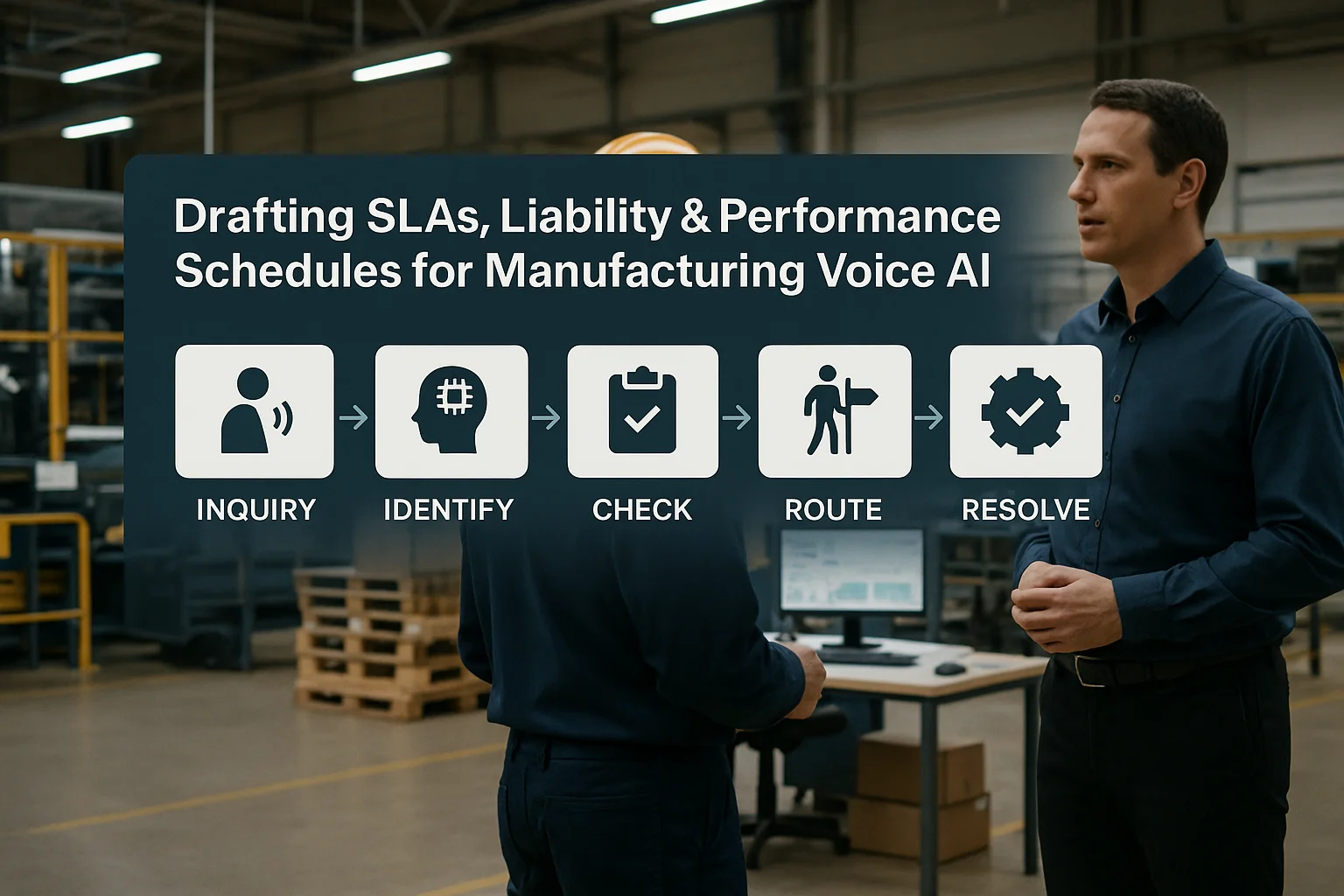
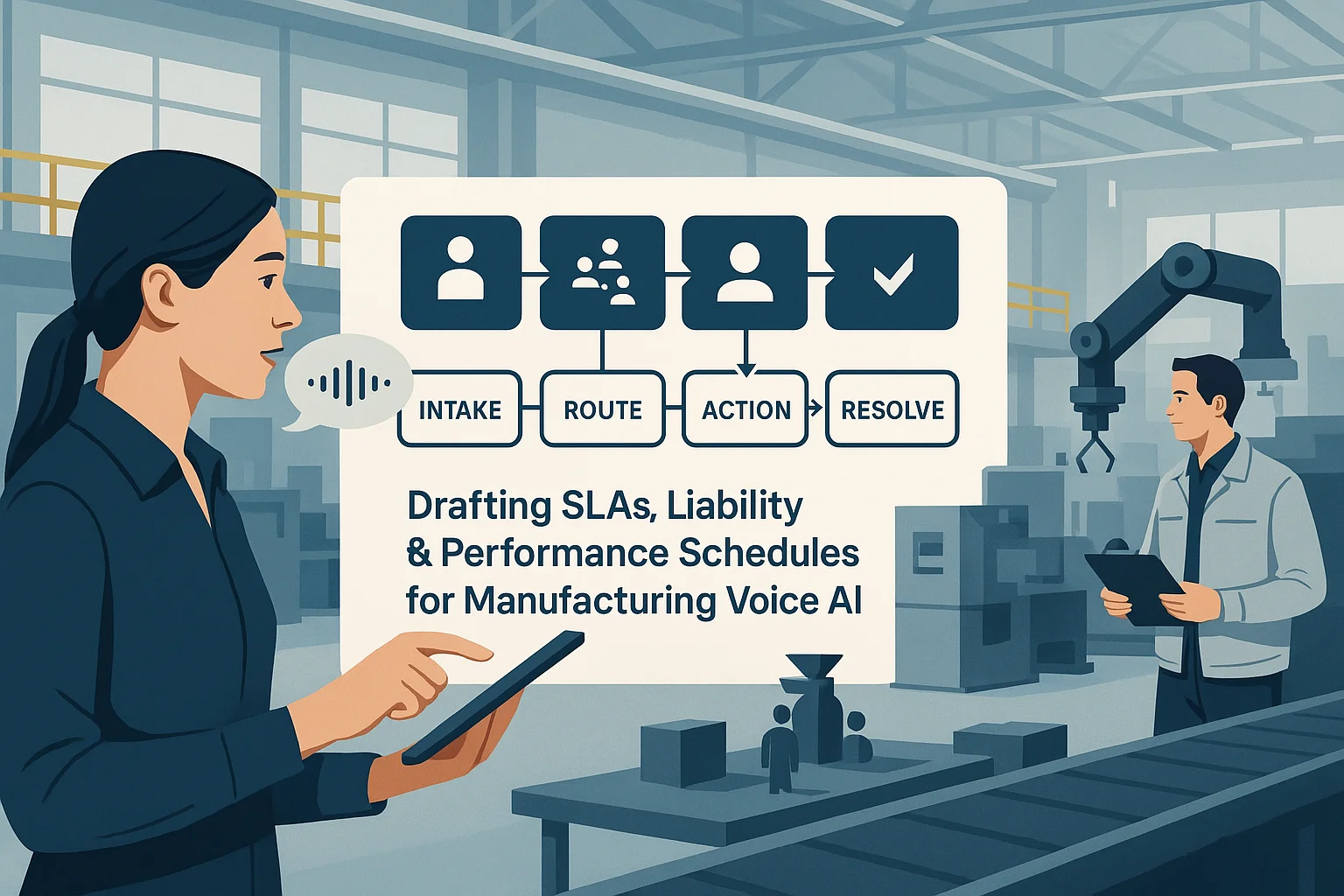
Allocate liability according to technical control. If the vendor manages telephony, model hosting, and ERP adapters, they assume more operational responsibility. If the client controls ERP write privileges or warranty approvals, then liability for incorrect approvals should stay with the client. Map responsibilities to the architecture: Caller → Voice AI → intent & product validation → ERP/CRM/warranty/service API → case/order or specialist handoff.
- Vendor control: system availability, intent classifier performance, data encryption in transit and at rest.
- Client control: business rules for warranty approval, credit holds, and safety/engineering determinations.
- Shared responsibilities: integrations where both sides can change configuration—require change control and test windows.
Caps, carve‑outs and third‑party subprocessors
Set caps on vendor liability proportional to contract value and measurable damages; include carve‑outs for willful misconduct. Require disclosure of subprocessors and contractually enforceable flow‑downs. Specify responsibilities for data breaches, including notification timelines, forensics and remediation costs. Explicitly allocate cost and process for regulatory investigations and customer remediation.
- Limit vendor liability to a multiple of fees for service failures, with exceptions for data breaches and gross negligence.
- Require vendor to maintain appropriate insurance and provide certificates on request.
- Flow‑down obligations to subprocessors involved in speech transcription, recordings storage, or analytics.
3. Performance schedules and acceptance criteria
Performance schedules translate technical goals into stepwise milestones for pilots, UAT and production acceptance. Use objective test plans, representative datasets, and rollback triggers.
Pilot and UAT gates
Define a minimum viable scope for pilots (product families, geography, call volume) and measurable UAT gates: synthetic test coverage for intents, live traffic shadow mode results, ERP lookup success rate, and human escalation rate. Acceptance should require achieving target KPIs on both synthetic and live test traffic over a defined period.
- Pilot scope: up to N SKUs or M dealer lines; shadow mode for at least 2 weeks at 10–20% traffic.
- UAT gates: pass rate on test suite, average time to create a case, and zero critical security findings.
Phased rollout schedule
Phase by risk: start with low‑risk intake (order status, parts availability) then move to warranty intake and finally to service scheduling. Each phase must close QA and runbook checks, and document rollback procedures and monitoring dashboards.
- Phase 1: informational intents and read‑only ERP lookups.
- Phase 2: write actions with human‑in‑the‑loop approvals (case creation, reservation holds).
- Phase 3: expanded coverage including multilingual support and dealer handoffs.
4. Testing, observability and QA
Operational confidence comes from reproducible tests, observability into decision paths, and regular QA. Demand test artifacts and governance processes from vendors.
Test suites and replayable datasets
Require vendors to deliver or accept custody of representative test suites that exercise intents, noisy audio, accents and dialects, and product‑code permutations. Tests must be replayable and signed‑off; maintain versioned datasets for regression tests after model updates.
- Baseline test set for intent and parts‑ID accuracy, with acceptance thresholds.
- Regression test obligation following model or rules updates—documented pass/fail criteria.
Observability, logging and audit trails
Specify the level of logging, retention and access. Logs should include anonymized utterances, inferred intent scores, validation queries and ERP/CRM transaction IDs to allow end‑to‑end troubleshooting. Define retention, redaction, and data access procedures and include monitoring SLAs: alerts for KPI drift, pipeline failures, or integration errors.
- Minimum logs: call metadata, transcribed utterance, intent score, validation steps, ERP/CRM response code.
- Access model: role‑based access for client admins, secure export mechanisms for forensic review.

5. Security, OT boundaries and operational controls
Manufacturing deployments must respect operational‑technology (OT) separation, network segmentation and clearly defined remote‑support access. Include security gates in acceptance criteria and change control.
Segmentation and remote access controls
Voice AI must not be a conduit to OT control. Require network segmentation, minimal privileges for adapters, and strict remote‑support procedures. Define whether adapters are deployed in the client network or vendor‑hosted, and respectively who owns network controls and forensic logs.
- Place orchestration adapters in DMZ or client‑controlled middleware only; avoid direct access to PLCs or OT controllers.
- Use jump boxes, ephemeral credentials, and audit logging for vendor remote access.
- Document backup region and subprocessors for critical logs and recordings.
Manufacturing cybersecurity best practices
Tie contractual security requirements to recognised guidance for industrial environments: regular vulnerability scanning, patch windows, and incident response playbooks that align with plant safety procedures. Require the vendor to support agreed‑upon forensic timelines and to coordinate with the plant’s incident response team.
- Regular security posture reports and proof of remediation for critical findings.
- Incident notification timelines, forensic support obligations and coordination with plant safety leads.
6. Procurement checklist & vendor evaluation criteria
Use a scorecard that weights operational fit, integration depth, governance and commercial terms. Vendors should demonstrate manufacturingspecific workflows, ERP/CRM adapters, parts/warranty intake, and runbook support.
Minimum evidence and deliverables
Require vendors to provide: integration documentation for your ERP/CRM, sample runbooks for escalation and rollback, test suites and pass/fail reports, subprocessors list, service‑level dashboards, and an implementation SOW with phased milestones.
- Proof of integration patterns with ERP (read/write), dealer portal handoffs, and field‑service scheduling.
- Runbooks covering validation, human escalation, multilingual fallback, and rollback criteria.
- SLA template that maps KPIs to credits, remediation steps, and data handling obligations.
Scorecard: how to weight technical and commercial factors
A practical weight example for evaluation: Integration fit 30%, Operational controls & security 25%, Accuracy & QA 20%, Service levels & remediation 15%, Commercial terms & liability 10%. Use demos grounded in your voice samples and live ERP endpoints. Require an implementation pilot in contract before larger payments.
- Ask for a 30–60 day pilot SOW with clearly measurable acceptance criteria.
- Avoid one‑sided change control; require mutual agreement and pre‑production test windows for model updates.
7. Operational runbook essentials and escalation ownership
Operational runbooks turn SLAs into operating procedures: who does what, when, and how. They are the executable link between procurement promises and plant floor reality.
Runbook contents and custodianship
Include playbooks for classification failures, parts mismatch, warranty disputes, and safety‑sensitive calls. Assign custodians: vendor for telephony and model ops; client for business rules and warranty approvals. Define a joint governance cadenced review of KPIs and model drift.
- Clear handoff points with contact details, priority definitions, and timelines.
- Role assignments: vendor on‑call escalation rota, client warranty decision owners, dealer contacts.
Rollback, fallback and human‑in‑the‑loop design
Every write action must have human approval thresholds; critical paths (warranty approval, safety exceptions) should default to a human. Include immediate fallback (route to human) and systematic rollback (switch to deterministic IVR) options in case of KPI degradation.
- Define automatic fallback triggers (e.g., intent score below threshold or repetition > N attempts).
- Document rollback steps to revert to previous models or disable downstream writes.
Related Peak Demand resources
Industry and AI sources reviewed
- Guide to Operational Technology SecurityNational Institute of Standards and Technology (NIST)
- Cross-Sector Cybersecurity Performance GoalsCybersecurity and Infrastructure Security Agency (CISA)
- Cybersecurity Resources for ManufacturersNIST Manufacturing Extension Partnership
Manufacturing cybersecurity, operational-technology, product, warranty, records, and workplace obligations vary by jurisdiction and operating environment. This article is operational guidance, not legal advice; organizations should confirm applicable requirements with qualified professionals.
Frequently asked questions
Strong starting points include parts and order-status requests, distributor or dealer support, warranty and service intake, appointment scheduling, case creation, basic product information, and routing to technical specialists. Keep engineering judgment, safety decisions, and operational-technology control outside the conversational layer.
Official reference: Cybersecurity Resources for Manufacturers
The workflow should collect structured identifiers such as model, serial number, part number, customer account, asset location, and symptoms, then validate them against ERP, CRM, catalogue, warranty, or service systems. The agent should escalate rather than invent a match when confidence is low.
Official reference: Cybersecurity Resources for Manufacturers
Not by default. Customer-service automation should normally use controlled business-system integrations and tightly governed adapters. Any connection near operational technology requires explicit security architecture, least privilege, monitoring, and separation from safety-critical control functions.
Official reference: Guide to Operational Technology Security
Require workflow mapping, integration ownership, test evidence, fallback behavior, auditability, security boundaries, change control, monitoring, human escalation, and a plan for maintaining product, parts, warranty, and service knowledge after launch.
Official reference: Cybersecurity Resources for Manufacturers
Connect Voice AI to real manufacturing service operations
Peak Demand helps manufacturers automate parts, order, warranty, dealer, distributor, and service requests through controlled integrations, validation, escalation, and reporting.
Schedule a discovery call


