
Designing Hybrid Workforce Models with Voice AI for Patient Access
A practical guide for healthcare leaders on designing hybrid workforce models that combine Voice AI and human teams for safe, auditable, and measurable patient access—covering architecture, integrations, governance, and phased rollout.
1. Why a Hybrid Workforce for Patient Access?
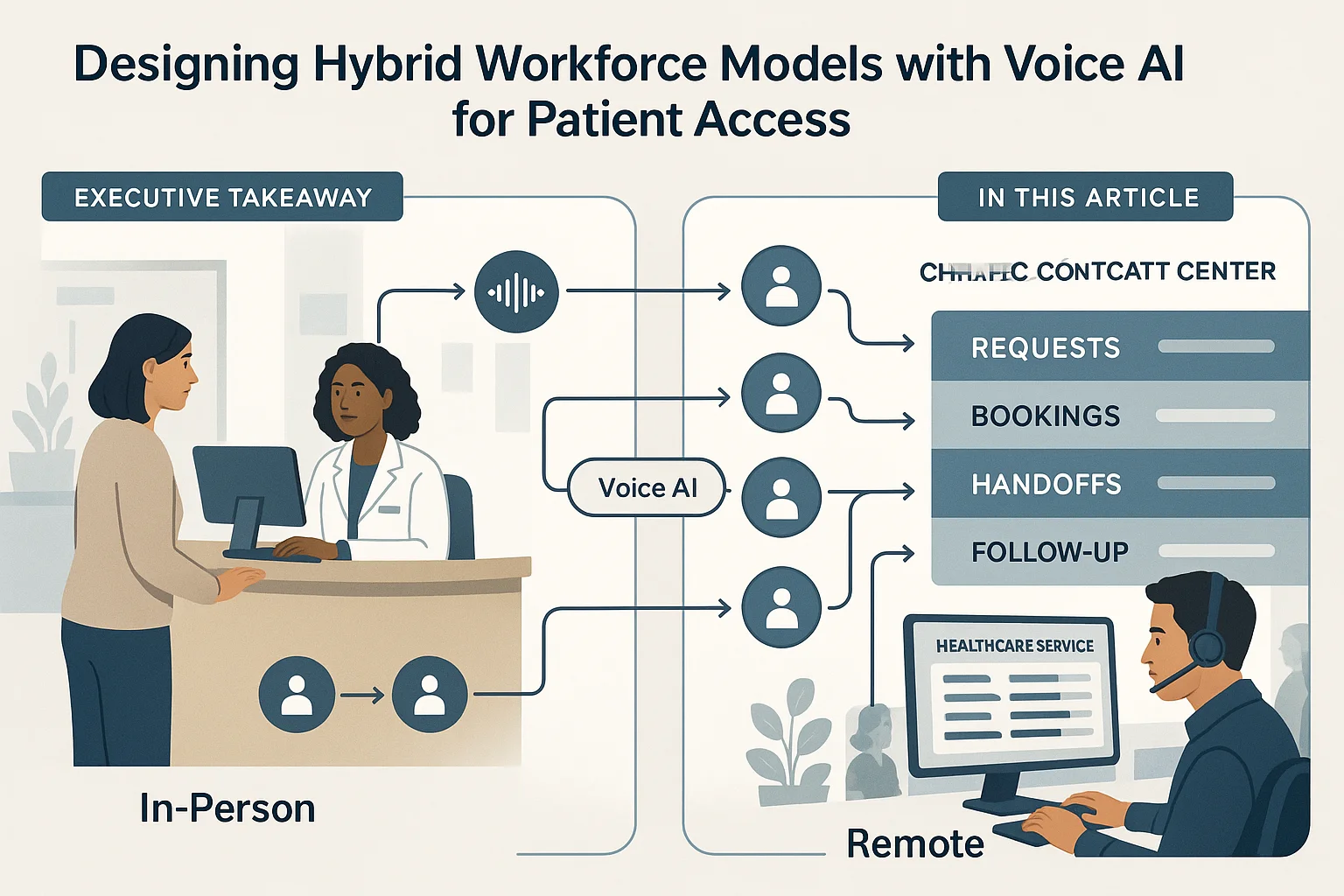
Voice AI can improve access without displacing the control and accountability healthcare organisations require. A hybrid workforce—Voice AI handling routine administrative tasks and humans managing complexity—balances scale, safety, and patient experience.
The operational use case
Apply Voice AI to predictable, repeatable patient-access workflows where rules, discrete data, and deterministic outcomes dominate: appointment booking, rescheduling, basic intake (demographics, reason for visit coded as administrative categories), eligibility checks, preparation instructions, and simple status updates. Avoid using Voice AI for clinical triage, differential diagnosis, or prescription decisions. Implement Voice AI as a first-line for routing and pre-validation that reduces handle time and increases right-routing to clinical teams.
- Appropriate: booking new or follow-up appointments, confirming patient details, providing pre-visit instructions.
- Inappropriate: diagnosing conditions, triaging emergencies, clinical decision-making, or prescribing medicines.
Architecture primer — a safe, auditable flow
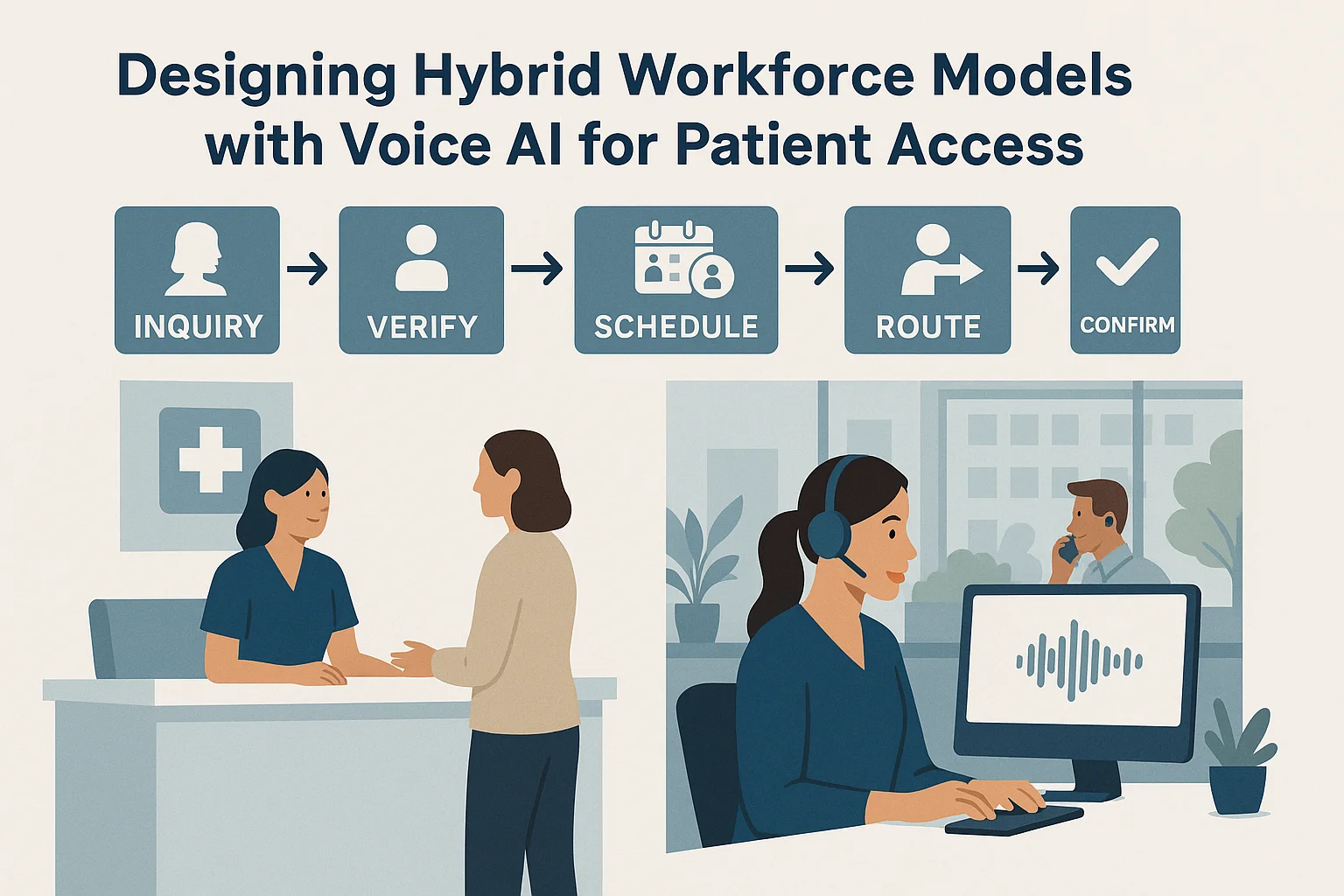
Adopt an explicit architecture: Patient or caller → Voice AI front end → validation and identity controls → approved scheduling or service API → confirmation or human handoff. This keeps all actions traceable and allows the system to block or require human approval for sensitive transactions. Include logging and immutable audit trails for every decision, API call, and human override.
- Front end: telephony SIP gateway or cloud telephony interfacing with Voice AI.
- Validation/identity: OTP, callback verification, or knowledge-based checks before authorising schedule changes.
- Approved service APIs: only allow a constrained set of scheduling operations via controlled adapters.
- Handoff: deterministic escalation to human agents with context and recorded transcript/snapshot.
2. Defining Automation Boundaries and Escalation Policies
Explicit boundaries determine when automation is allowed and when to escalate. Define these as rules that are easy to audit and change.
Role definitions and decision boundaries
Map each task to a role: Voice AI (automatable, low-risk), human agent (exception handling, sensitive or ambiguous cases), clinician (clinical decisions). Base the mapping on concrete criteria—data availability, risk class, regulatory exposure, and patient consent. Create an exclusion list for conditions and phrases that always trigger immediate human transfer (e.g., words suggesting acute distress, suicidal intent, or child protection concerns). Document the rules in the operating manual and embed them in the orchestration layer so the system enforces, logs, and explains each transfer.
- Automate when outcome is deterministic and reversible (e.g., scheduling non-critical appointments).
- Escalate if interaction contains ambiguity, urgency words, or when identity verification fails.
- Always present a clear option to speak to a human at every step.
Safe escalation and human-in-the-loop patterns
Design handoff paths that preserve context: the Voice AI should pass structured data, a time-stamped transcript, confidence scores, intent classification, and any validation evidence to the human agent. Set SLAs for agent pick-up and provide a priority routing for escalations marked urgent by the Voice AI. Use human review for a fixed percentage of automated calls (QA sampling) and for all calls that change critical records.
- Handoff package: summary, transcript, confidence metrics, verification artefacts.
- Escalation SLA: define target time-to-answer and fallbacks (voicemail to triage nurse, callback within defined window).
- QA: continuous sampling for safety and accuracy, with feedback loops to model and rule updates.
3. Integration and Data Controls
Integrations power value but increase risk. Constrain how Voice AI interacts with scheduling, EHR/PM, identity providers, and contact centre systems.
Scheduling and EHR/PM integrations
Connect Voice AI to scheduling and practice-management systems through approved APIs or controlled adapters. Use a thin orchestration layer that enforces business rules (e.g., eligibility, appointment type constraints, booking windows) before API calls are made. Maintain a separation between the Voice AI engine and backend systems: the Voice AI proposes an action; the orchestration layer validates it and issues the call to the scheduling API under a service account with minimal privileges.
- Prefer adapter or orchestration patterns that centralise business rules and reduce vendor lock-in.
- Log every proposed and executed appointment change with requestor identity, evidence, and timestamp.
- Test integration scenarios for race conditions, double-booking, and conflicting updates.
Identity verification and field validation
Before any appointment change or access to protected data, require identity validation. Use progressive verification (call-back, OTP, one-time knowledge checks) proportionate to the action’s risk. Implement field validation logic to prevent bad data—standardised address, date-of-birth formats, and accepted reason-for-visit codes—so the scheduling system receives high-quality inputs.
- Use tiered verification: lower friction for low-risk actions; stronger proof for high-impact transactions.
- Store only the minimal identity evidence needed for audit; consider tokenisation for linking records.
- Make verification failures explicit: log failures, trigger human review after defined thresholds.
4. Governance, Risk Management and Ethical Controls
Risk and ethics frameworks translate into operational controls. Use established guidance to structure governance and QA.
Ethical and regulatory guardrails
Adopt the WHO’s ethics guidance and regulatory considerations as foundational principles for patient-facing AI. These resources emphasise transparency, accountability, human oversight, and clear limits on clinical functions. Use the OECD AI Principles to shape fairness and explainability policies relevant to patient access systems. Ensure your policies specify what Voice AI will not do (diagnose, triage emergencies, prescribe) and how patients can request human review and data access.
- Publish a brief patient-facing notice explaining Voice AI use, data practices, and how to reach a human.
- Document roles, responsibilities, and escalation protocols in a governance manual.
- Align fairness and non-discrimination checks with OECD principles.
AI risk management and controls
Map risks using a framework such as NIST’s AI RMF to identify, measure, and mitigate system-level hazards: accuracy, reliability, robustness, privacy, and explainability. Operationalise the RMF by specifying acceptance criteria for performance (booking accuracy, containment rate), anomaly-detection thresholds, retraining cadence, and incident-response procedures that include data breach duties and patient notification where applicable.
- Define measurable KPIs with clear thresholds and response playbooks (e.g., booking accuracy < X% triggers rollback).
- Implement observability: confidence scores, distribution drift detection, and logging tied to identity/consent.
- Plan for human review and rollback capability for changes impacting clinical workflows or legal documents.

5. Implementation Roadmap and Procurement Considerations
Buy vs build, procurement scope, vendor capabilities, and a realistic rollout plan are business decisions. Structure procurement to protect operational control and auditability.
Phased rollout and evaluation
Run a staged pilot: define a small, low-risk scope (e.g., routine appointment bookings for a select clinic), instrument KPIs, and iterate. Increase scope only after meeting acceptance criteria for safety and accuracy. Use a controlled expansion strategy by clinic, language, or appointment type. See Peak Demand resources on phased rollout and vendor evaluation for practical checklists and trade-offs.
- Pilot: 4–8 weeks with live monitoring, rollback plan, and dedicated human support.
- Expand by appointment type and clinic after repeatable success and QA pass rates.
- Maintain freeze windows for model or rule changes in high-volume periods.
Vendor selection and contract terms
Prioritise vendors that can deliver: integration adapters for your scheduling/EHR systems, identity- and orchestration-layer support, detailed observability, and provision for human review. Contractually require audit logs, subprocessor disclosure, data residency options, and clear ownership of integrations and custom workflow code. Negotiate performance SLAs, maintenance windows, rollback rights, and an exit plan that ensures continuity and data portability.
- Ask for evidence of prior healthcare integrations and references focused on scheduling/intake work.
- Include change-control and security-review provisions for updates to models or flows.
- Require transparency on subprocessors, hosting regions, and remote-support access.
6. Measurement, QA and Continuous Operations
Sustained performance depends on rigorous QA, clear KPIs, and an operational loop for continuous improvement.
Key metrics and monitoring
Track a focused metric set tied to operational objectives: containment rate (percent of interactions completed without human handoff), escalation rate and reasons, booking accuracy (matches intended appointment), speed-to-book, cost-to-serve, patient satisfaction (post-call), and incident rates (misroutes, verification failures). Use cohort analysis to detect drift—by language, clinic, or appointment type—and set automated alerts for threshold breaches.
- Containment rate helps measure automation effectiveness; pair with booking accuracy to ensure quality.
- Monitor confidence score distributions to detect degradation.
- Correlate QA findings with model/rule updates to validate improvements.
QA processes and failure modes
Operate a QA program that mixes automated tests, human review sampling, and root-cause analysis for incidents. Common failure modes include misrecognition in noisy environments, domain mismatch for reason-for-visit, identity verification false positives/negatives, and race conditions on concurrent schedule updates. Mitigations include focused ASR tuning, canonical intents, constrained vocabularies for critical fields, transactional locking at the orchestration layer, and rapid rollback paths.
- Regularly sample calls for human QA; escalate systemic problems to engineering and clinical governance.
- Maintain a playbook for rollback and patient remediation where incorrect bookings occur.
- Use A/B testing for incremental model or rule updates rather than wholesale swaps.
Related Peak Demand resources
Industry and AI sources reviewed
- OECD AI PrinciplesOrganisation for Economic Co-operation and Development
- Ethics and governance of artificial intelligence for healthWorld Health Organization
- Regulatory considerations on artificial intelligence for healthWorld Health Organization
- Artificial Intelligence Risk Management Framework (AI RMF 1.0)National Institute of Standards and Technology (NIST)
Healthcare privacy, security, clinical-safety, records, and professional obligations vary by jurisdiction and workflow. This article is operational guidance, not legal advice; organizations should confirm applicable requirements with qualified professionals.
Frequently asked questions
Administrative workflows such as appointment booking, changes and cancellations, referral-status intake, approved follow-up, patient-access questions, after-hours overflow, and structured routing are common starting points. Clinical judgment, diagnosis, emergency triage, and prescribing decisions must remain with qualified professionals.
Use the minimum identifiers approved by the organization, validate them against the system of record, avoid exposing unnecessary information, and provide a human-assisted path when verification fails. The system should not infer identity from conversational context alone.
The agent should follow the organization's approved escalation and emergency-routing rules, avoid clinical advice, and transfer or direct the caller to the appropriate human or emergency channel. Those rules must be tested with realistic language and failure cases.
Request identity and privacy controls, scheduling or EHR integration behavior, audit logs, escalation rules, downtime handling, testing evidence, change control, monitoring, and clear separation between administrative automation and clinical decision-making.
Design a safe patient-service workflow before automating it
Peak Demand helps healthcare organizations connect Voice AI to scheduling, intake, patient communication, identity checks, escalation, and reporting with clear operational boundaries.
Schedule a discovery call


