
Data & Event Fabric for Predictive Multimodal Transit Voice AI
An operational framework for building a data-and-event fabric that powers reliable, auditable Voice AI across scheduled services and real‑time service alerts, with firm controls for validation, human handoff, and procurement in regulated transit environments.
1. Why a dedicated data-and-event fabric for Transit Voice AI
Transit Voice AI succeeds or fails on two things: the quality and governance of scheduled knowledge and the reliability of real‑time event feeds. This section defines why a fabric—an integrated set of data pipelines, event buses, and validation adapters—is necessary and what it must guarantee.
Operational failures that fabric solves
Most Voice AI problems in transit arise from mixing static schedules and dynamic incidents without rules for provenance, validation, or exposure. A data-and-event fabric provides clear separation and contracts so callers receive accurate, auditable answers and agents only receive validated, actionable cases.
- Prevents conflicting answers when a timetable says a bus runs and an alert shows a detour.
- Reduces duplicated or misrouted service requests by standardizing forms and validation.
- Enables consistent human handoff with full provenance: what was said, which sources were consulted, and what validations passed.
Minimum guarantees for transit operations
Design the fabric to guarantee four operational invariants: data provenance, freshness windows, failure boundaries, and non‑blocking human escalation. Treat these invariants as acceptance criteria during procurement and integration testing.
- Provenance: every answer references the authoritative source and timestamp.
- Freshness windows: define acceptable staleness for GTFS-like schedules vs. real‑time alerts.
- Failure boundaries: degraded mode behaviors (e.g., fall back to schedule only; offer human handoff on ambiguous queries).
- Human escalation: immediate transfer for safety-critical, emergency, or ambiguous scenarios.
2. Core architecture pattern
A compact, decision-useful architecture supports multimodal Voice AI at scale while preserving safety, auditability, and operational control.
Canonical flow: Rider → Voice AI → fabric → outcome
Implement a canonical flow that explicitly bifurcates scheduled knowledge lookups from event-driven alerts and forms. The fabric should offer adapters to authorized APIs and a controlled knowledge base for schedules and static assets.
- Step 1 — Intent & entity extraction: Voice AI identifies whether caller asks about schedule, disruption, or wants to submit a request.
- Step 2a — Scheduled lookup: Query the controlled knowledge base (validated timetable, fare rules, stops) for deterministic answers.
- Step 2b — Real‑time path: Query approved service-alert APIs or ingestion pipelines for detours, delay notices, or temporary stops.
- Step 3 — Validation & enrichment: Apply business rules, confidence thresholds, and cross‑checks (e.g., compare alert to vehicle positions if available).
- Step 4 — Outcome: Return structured response, create a validated case via dynamic form submission, or hand off to human staff with context and.
Adapters, orchestration, and controlled exposure
Use lightweight adapters to integrate agency APIs, schedule stores, and ticketing/back‑office systems. Orchestration should be policy-driven (who can see which field, retention rules, recording consent) and must log both inputs and outputs for audit.
- Adapters encapsulate API credentials, rate limits, and transformation rules; avoid direct vendor-to-voice connections without an adapter layer.
- Orchestration enforces exposure policies: what the Voice AI can say and whether it may submit a request automatically.
- Audit logs must include source timestamps and validation outcomes to support QA and post-incident review.
3. Data strategy: schedules, alerts, and derived predictions
A mature data strategy recognizes three classes of information and applies different ingestion, retention, and QA policies to each.
Class A — Controlled schedule knowledge
Treat published timetables, stop metadata, fare rules, and service patterns as controlled assets. These assets are curated, versioned, and published to the Voice AI knowledge base with clear update protocols.
- Version control all schedule publications and make rollback procedures part of release tests.
- Expose only the curated knowledge to Voice AI for deterministic queries; note the last-verified timestamp in every response.
- Link to data preparedness workstreams such as an AI data readiness checklist during onboarding and integration (see Peak Demand’s AI Data Readiness Checklist).
Class B — Service alerts via approved APIs
Detours, delay notices, and emergency service alerts must arrive via approved, authenticated APIs. Treat these feeds as higher volatility and require cross-checking or operator confirmation for any action that changes operations or generates a case.
- Define acceptance criteria for each alert type (e.g., mandatory fields, originator identity, effective time).
- Use TTL and deprecation markers rather than ad hoc modifications to preserve provenance.
- Voice AI should present alert-based answers with explicit context (source, time) and offer human handoff for requests that would change routing or schedules.
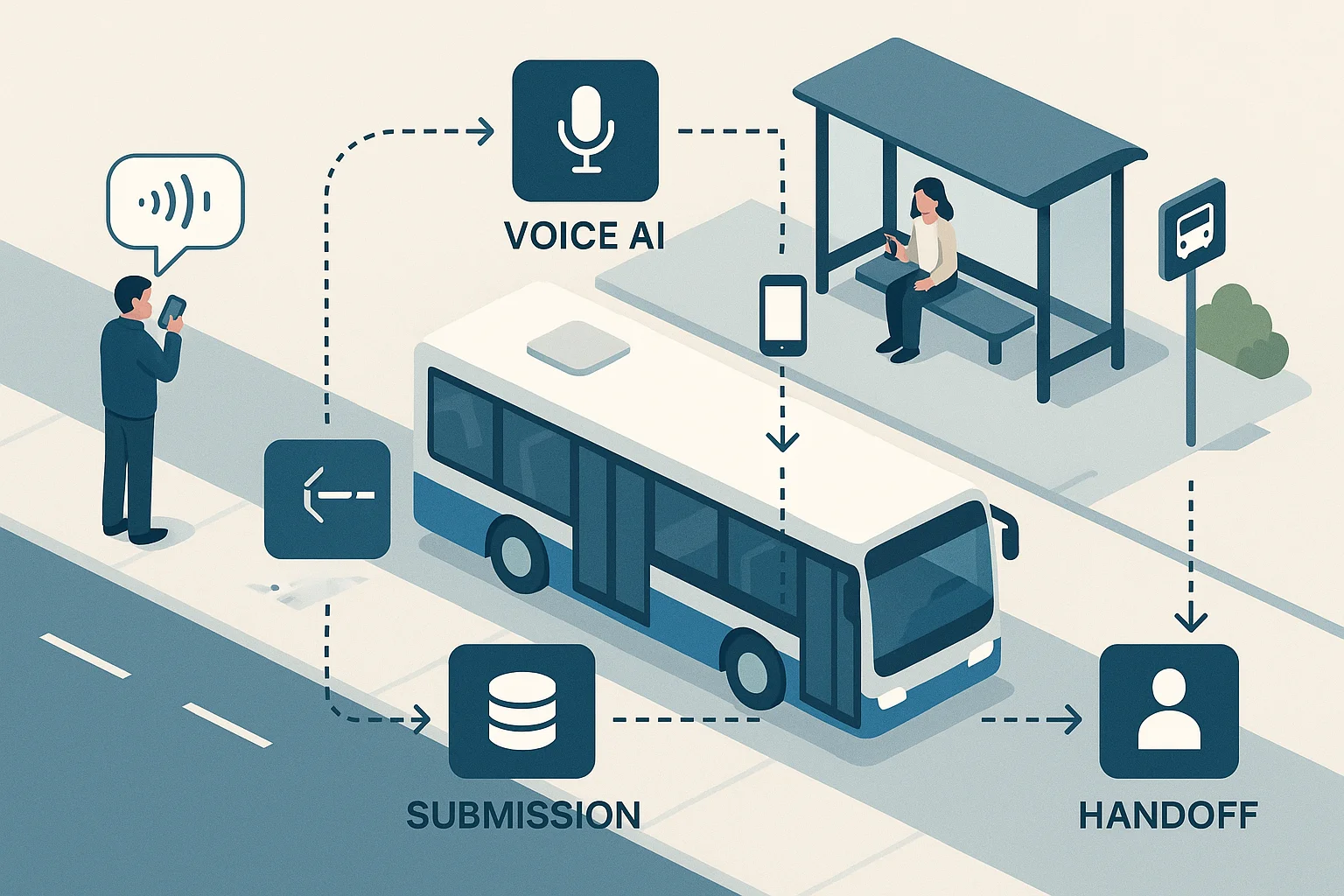
4. Validation, safe submission, and human handoff
Requests that alter operational workflows (service requests, complaints that require action) must pass lightweight validation before submission; ambiguity routes to humans.
Dynamic forms and validation rules
Implement dynamic, context‑aware forms for service intake. Voice AI should populate fields from verified sources (route IDs, stop IDs), confirm critical values with the caller, and block submission when validation fails.
- Auto-populate known fields to reduce caller friction and error (e.g., confirmed stop name, route number).
- Implement validation tiers: syntactic (format), semantic (does route exist?), and business (is request in service area?).
- If any required semantic/business validation fails, prompt for clarification or escalate to human staff.
Safe submission and back‑end case handling
When a validated case is submitted, attach provenance metadata and apply de-duplication and prioritization logic on the receiving system. Make sure submission failures surface to agents with the same context the rider experienced.
- Attach the answer transcript, sources checked, validation outcomes, and confidence scores to the case.
- Implement duplicate detection within a configurable time window to avoid multiple efforts for the same issue.
- Provide agents with an easy ‘accept as-is / reject / edit’ workflow so human triage remains efficient.
Human handoff & safety boundaries
Never allow Voice AI to handle safety-critical or emergency incidents without immediate human intervention. Define explicit trigger phrases and confidence thresholds that result in mandatory transfer.
- Design emergency and safety intents to immediately escalate to trained staff, with a bypass only for recorded consent regimes.
- Log the moment of handoff and include full context for post-incident analysis.
- Regularly rehearse escalation paths with operations and customer‑service teams.

5. Governance, monitoring, and procurement guardrails
Operational control comes from governance: policies, auditable change control, monitoring, and contract language that enforces behavior under failure.
Policy and audit trail requirements
Adopt auditable workflows for data changes, model updates, and response templates. Treat the fabric as a regulated asset: require change review, rollback plans, and provenance recording.
- Keep immutable logs of source data, model prompts, and the orchestration decision path for every outbound spoken answer.
- Require approval workflows for template changes that affect public-facing responses.
- Use the NIST AI Risk Management Framework as a baseline for risk identification, monitoring, and documentation (see guidance).
Operational monitoring and SLA design
Define measurable SLAs for availability of schedule lookups, service-alert ingestion latency, validation success rates, and mean time to human handoff. Monitor both technical signals and user experience KPIs.
- SLA examples: lookup availability >99.5%, alert ingestion latency <30s for high-priority feeds (where possible), median time-to-human-handoff <60s for escalations.
- Instrument end-to-end observability so you can trace a spoken answer back to the contributing sources and decision rules.
- Design playbooks for partial outages: graceful degradation to read-only schedule knowledge and clear user prompts.
Procurement clauses and failure boundaries
Insist that suppliers provide clear ownership for integrations, subprocessors, data residency mappings, and failure-boundary behaviors. Contracts must specify what happens when a data feed is compromised or unavailable.
- Require a subprocessor list, hosting regions, backup geography, and remote-support access terms.
- Specify incident response timelines, breach duties, and evidence for post-incident audits.
- Ask for runbooks that define degraded modes, data retention, and deletion mechanics.
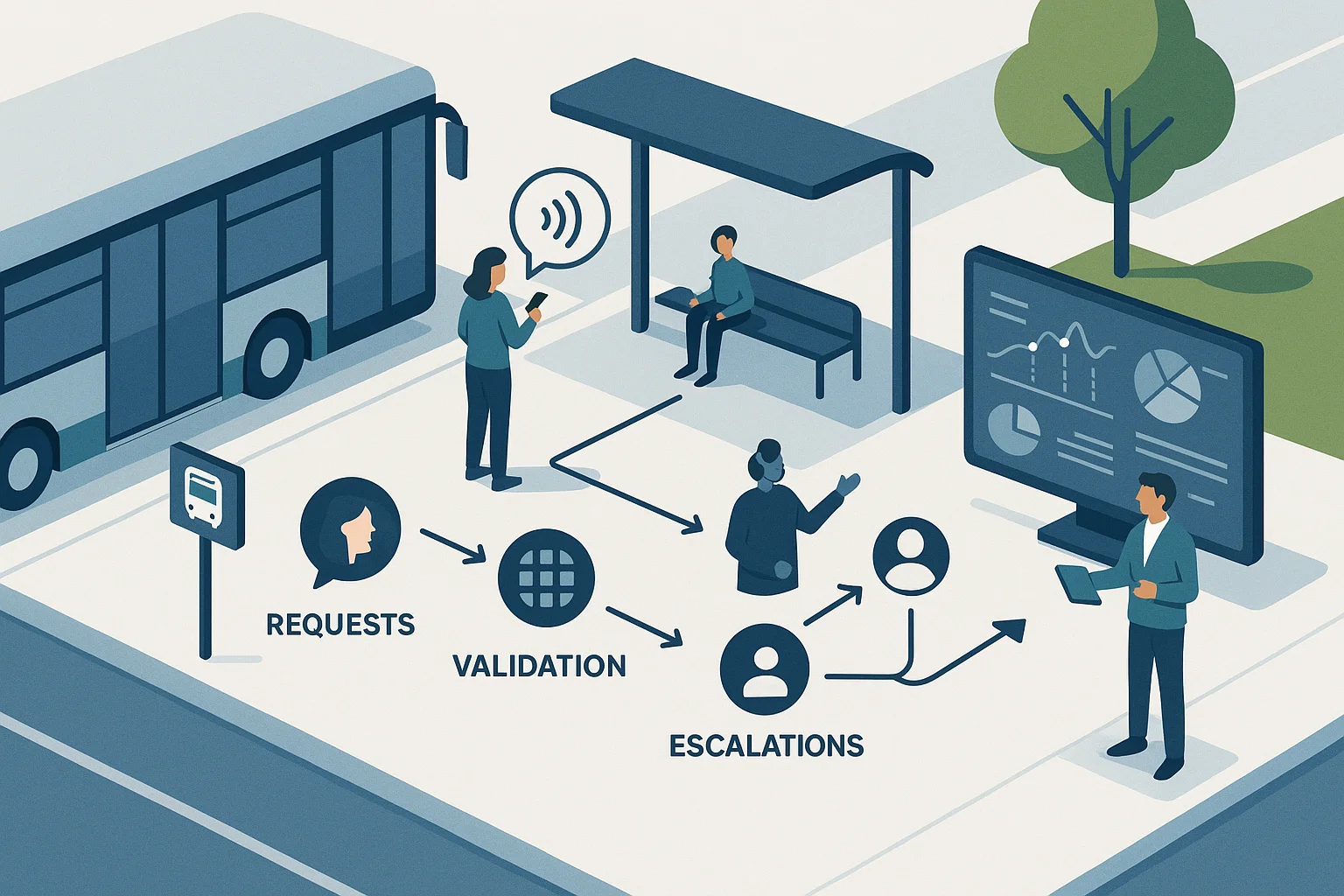
6. Implementation choices, failure modes, and measurable outcomes
Make pragmatic implementation choices and accept explicit failure modes. This section helps leaders choose between managed services and in-house builds, and how to measure success.
Managed vs. build decisions
A managed service can accelerate deployment and provide operational support, but buyers must insist on observability, audit logs, and clear integration ownership. If building in‑house, prioritize modular adapters and battle‑tested orchestration libraries.
- If using managed services, require transparency: request sample audit logs, integration diagrams, and a subprocessor list.
- For in-house builds, separate adapter responsibilities so each external system is isolated and replaceable.
- Either approach must allow for a ‘manual takeover’ mode where operations can disable automated submissions and switch to human-only handling.
Common failure modes and mitigations
Expect certain predictable failures and design mitigations: stale schedules, noisy alert feeds, validation mismatches, and model drift in NLU.
- Stale schedule: use versioned publications and enforce freshness gates before updating the knowledge base.
- Noisy alerts: implement whitelist/origin verification and reject malformed alerts.
- Validation mismatch: keep a fallback to confirmation prompts and human handoff.
- NLU drift: schedule periodic annotation and retraining cycles tied to production errors.
Measurable outcomes and KPIs
Track short- and medium-term KPIs that directly reflect operational value and safety rather than generic engagement metrics.
- Accuracy of schedule answers vs. authoritative schedule (%) — tracked per route and per stop.
- Validated-submission success rate (percentage of Voice AI submissions accepted without human correction).
- Mean time to handoff for escalations and time-to-resolution for cases created via Voice AI.
- False escalation rate (cases escalated to humans that should have been handled autonomously) as a safety indicator.
Related Peak Demand resources
Industry and AI sources reviewed
- Artificial Intelligence Risk Management Framework (AI RMF 1.0)National Institute of Standards and Technology (NIST)
- OECD AI PrinciplesOrganisation for Economic Co-operation and Development
- Transportation Systems SectorCybersecurity and Infrastructure Security Agency (CISA)
Transit safety, accessibility, privacy, cybersecurity, records, and service-information obligations vary by jurisdiction and operating authority. This article is operational guidance, not legal advice; organizations should confirm applicable requirements with qualified professionals.
Frequently asked questions
Good starting points include lost property, complaints and feedback, stop or shelter issues, fare-machine faults, non-emergency accessibility service requests, schedule information from approved sources, and structured routing to customer service or field teams.
Official reference: Artificial Intelligence Risk Management Framework (AI RMF 1.0)
Use GTFS Realtime only when the agency exposes suitable feeds and the workflow genuinely needs service alerts, trip updates, or vehicle positions. The integration should validate freshness and availability, and the agent should avoid presenting stale feed data as a guaranteed arrival prediction.
Emergency, security, injury, crime, and safety-critical reports should follow approved transfer or emergency-routing procedures. Voice AI may detect and route the call, but it should not make operational safety decisions or replace trained personnel.
Official reference: Transportation Systems Sector
Request realistic call testing, feed and system failure handling, service-request integration, transfer context, audit logs, accessibility channels, monitoring, change control, and evidence that the agent distinguishes scheduled information from dynamic service alerts.
Official reference: Artificial Intelligence Risk Management Framework (AI RMF 1.0)
Design the transit service workflow before automating it
Peak Demand helps transit teams connect Voice AI to rider information, service requests, approved live-data sources, escalation, confirmation, and analytics.
Schedule a discovery call


