Data Contracts, Real-Time Telematics & Predictive Voice AI for Transit
A decision-useful operational framework for transit leaders: implement data contracts, ingest real-time telematics, and design predictive Voice AI that separates scheduled knowledge from service-alert APIs, enforces validation, and preserves safe human handoff.
1. Why formal data contracts are the foundation
Transit Voice AI and automation only scale when the underlying data relationships are explicit. This section defines practical data contracting patterns, versioning, and validation checkpoints that put operations and IT on the same page.
What a transit data contract should contain
A data contract for transit must be explicit about schema, source authority, update cadence, latency, and acceptable missing fields. For scheduled knowledge (timetables, stop attributes, fare rules) record: canonical publisher, version ID, publication timestamp, expected fields (route_id, stop_id, schedule_time, headway_type), and TTL. For real-time telematics (AVL, vehicle position, block assignments, headway deviations) specify feed endpoint, auth method, typical latency, and message loss tolerance. For service-alert APIs (detours, platform changes, cancellations) include severity taxonomy, effective_start/effective_end, affected entity lists, and required human-verified tags for emergency-level items.
- Schema contract: types, required fields, enumerations, null semantics.
- Service-level contract: max acceptable latency, freshness window, and update rate.
- Provenance metadata: publisher ID, signing, and cryptographic fingerprint for feed versions.
Versioning, validation, and runtime enforcement
Use semantic versioning on data contracts and gate consumer deployments behind explicit contract approvals. At ingestion, run schema validation, required-field checks, and business-rule validation (e.g., route_id exists in the master timetable). Fail fast on schema mismatches and log incidents with unique error codes. Implement a runtime adapter layer that normalizes vendor feeds to your canonical model and emits metrics: ingest latency, schema error rate, and completeness rate.
- Gate changes with an API-version deprecation schedule and change-notice window for downstream consumers.
- Emit observability metrics to the operations dashboard for SLA monitoring.
- Record every contract violation with a workflow-triggered human review ticket.
2. Real-time telematics: integration, failure boundaries, and accuracy
Telematics enable predictive behaviors only when integration contracts, latency expectations, and accuracy boundaries are explicit. This section prescribes integration choices and failure modes for operational safety.
Approved feeds and prediction preconditions
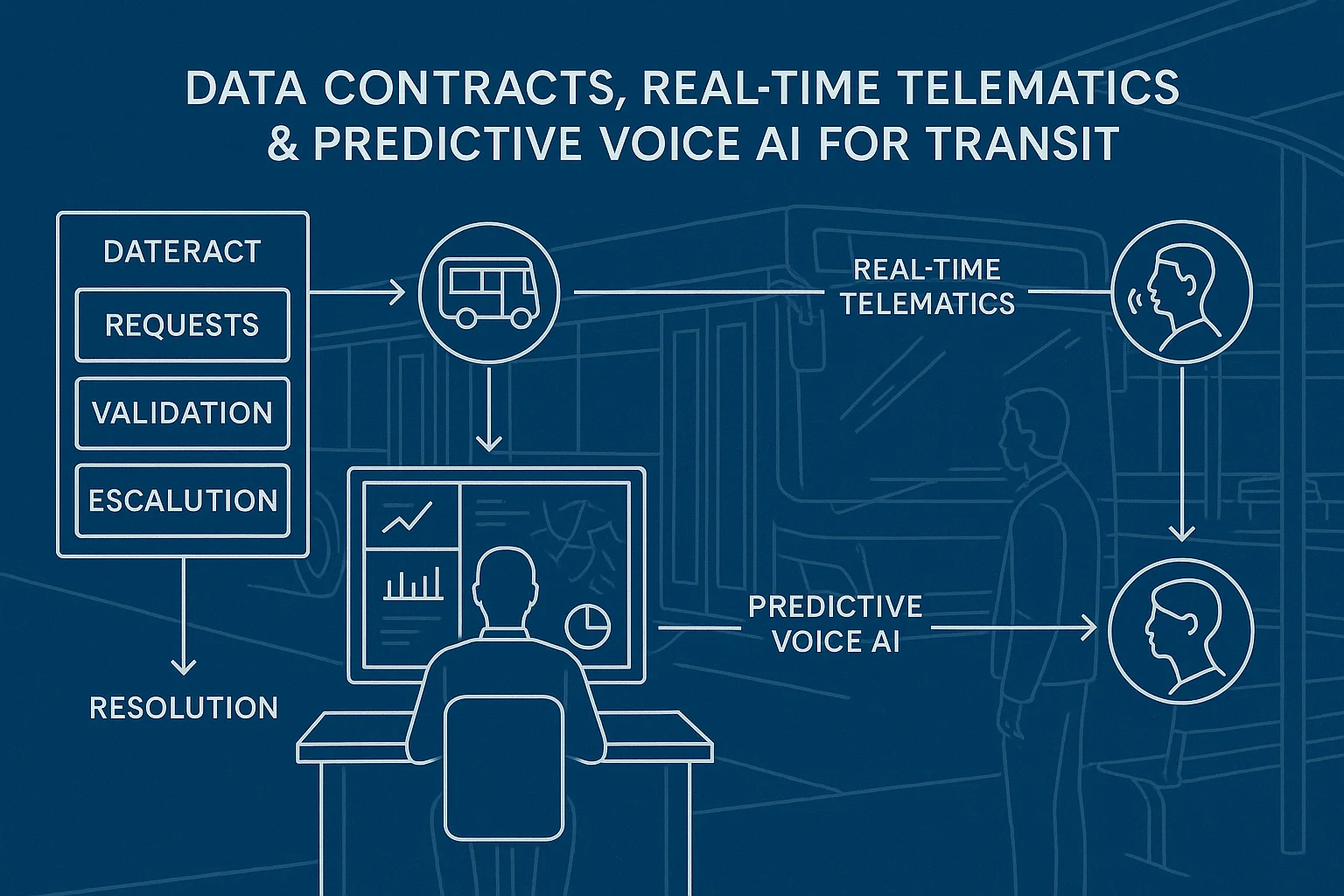
Do not present or act on 'next-bus' predictions unless you have a fast, approved vehicle-position or AVL feed with demonstrable latency and update regularity. Approved feeds should include vehicle_id, line/block assignment, timestamped position, odometer or speed where available, and a confidence score. If confidence or feed latency exceed pre-agreed thresholds, Voice AI must default to scheduled knowledge and language that communicates uncertainty to the rider.
- Approved-feed checklist: sub-second or low-second update cadence for active service recognition, consistent vehicle identifiers, and alignment to your timetable.
- When feeds degrade, switch to scheduled responses and a standardized script explaining uncertainty.
- Do not use crowd-sourced or unvetted third-party telemetry for safety-critical predictions.
Failure boundaries and graceful degradation
Define clear failure boundaries: telemetry outage, high-latency, inconsistent position-to-block mapping, and data corruption. For each boundary, declare fallback behavior, observability, and escalation rules. Example fallback: if position-to-block mapping fails, mark affected trips as 'uncertain', inform Voice AI to decline next-bus claims, generate an operations alert, and queue affected riders for agent follow-up if they request assistance.
- Classify failures by impact (informational, service-impacting, safety-affecting) and required response time.
- Automate reroute to human agent for safety-affecting or high-ambiguity queries.
- Log all degraded transactions for post-incident review and model calibration.
3. Predictive Voice AI design and safe-response rules
Voice AI must be able to answer predictable timetable questions, clarify uncertain telematics, and safely escalate or submit validated service requests. This section lays out the conversational and validation design patterns.
Separate scheduled knowledge from alerts and API-driven content
Design the knowledge architecture so the controlled timetable repository (canonical scheduled knowledge) is the primary source for planned service information. Service-alert APIs—detours, delays, platform changes—are separate and contested sources that can override scheduled entries only with verified severity tags. The Voice AI runtime must merge these sources at response time using deterministic priority rules: emergency alerts (highest), active service alerts with verified scope (next), then scheduled knowledge.
- Canonical timetable answers: exact schedule entries, headways, and planned service changes.
- Service-alert APIs provide live overrides; require signed or authenticated alerts before override.
- Always verbalize source and confidence: e.g., 'According to today's timetable, the next 14A departs at 10:12. I am not seeing a verified live update.
Validation steps before form submission and human handoff
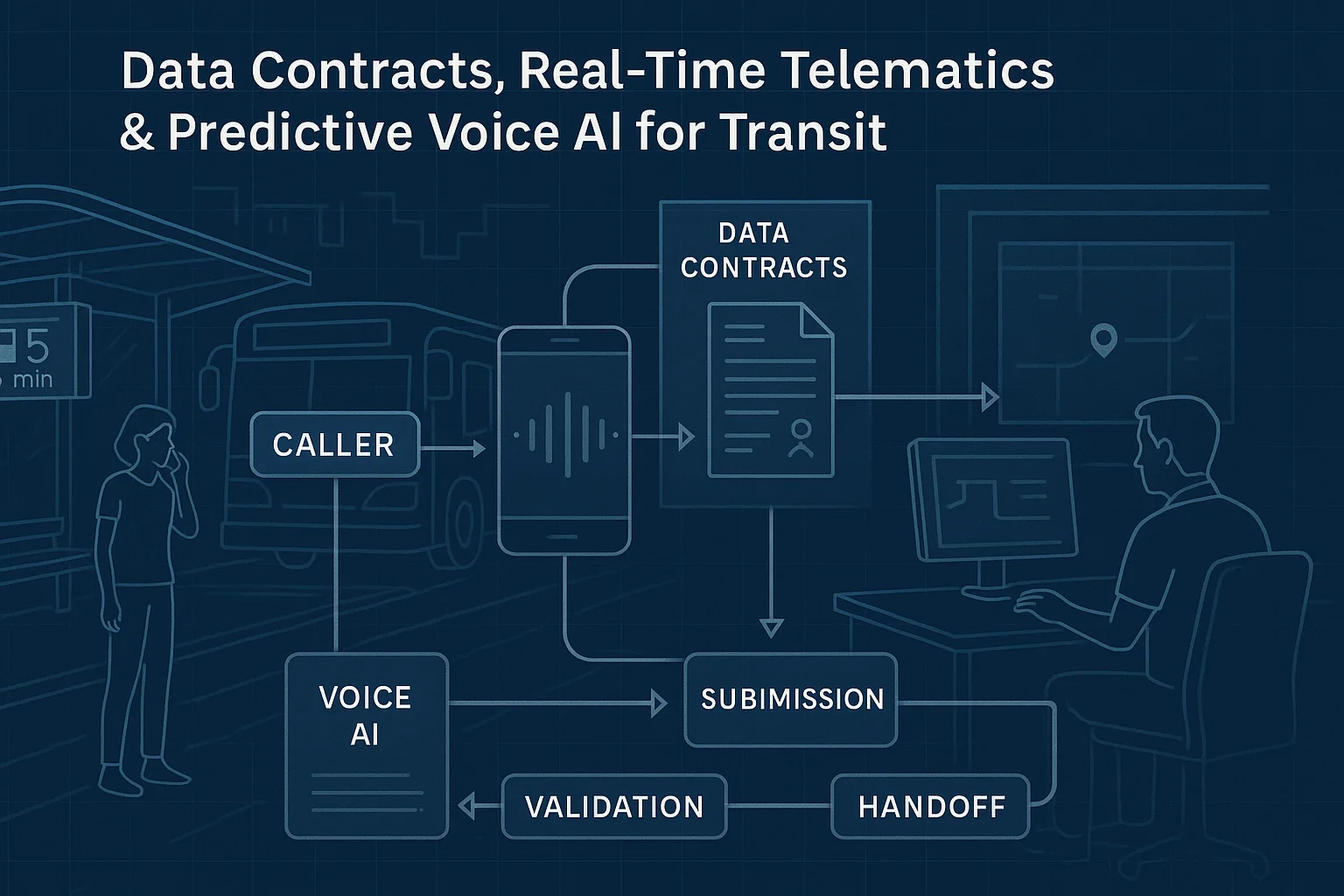
For dynamic service-request forms (missed connections, accessibility assistance, lost property), implement a four-step validation pipeline: intent verification (confirm user intent and essential fields), identity/consent check (as required by policy), data validation against contracts (route, stop, vehicle), and plausibility checks (timestamp vs current time, overlapping trips). Only after these checks should the system create a case record or submit to back-office systems. For ambiguous or safety-sensitive inputs, require human review before submission.
- Intent verification: confirm what the rider wants using closed prompts, not open interpretation.
- Plausibility checks: ensure timestamps are in expected ranges and references resolve to canonical identifiers.
- Human-handback thresholds: missing required fields, low confidence, safety flag, or identity uncertainty.
4. Cross-channel orchestration and consistency controls
Riders interact across voice, web, apps, and agents. Orchestration ensures every channel uses the same authoritative data and the same failure behaviors to reduce confusion and rework.
Single orchestration layer and canonical answers
Implement a central orchestration layer that resolves the runtime data merge (scheduled KB vs alert APIs vs telematics) and exposes a single canonical response API used by voice, web, and agent desktops. This prevents divergent messaging and provides a single audit trail. Include correlation IDs on every transaction to support troubleshooting and ticket linking.
- Expose a read-only 'canonical-answer' API for frontends with result metadata: sources used, confidence, and freshness.
- Use correlation IDs and request/response logs to match voice sessions to back-office cases.
- Make the canonical layer authoritative for transcripts used in dispute resolution.
Observability, SLAs, and auditability
Define SLAs for API latency (telemetry and alert APIs), voice session completion, and case submission success. Instrument traces for request path, decision rules invoked, and final output. Keep tamper-evident audit logs of alert changes, telematics anomalies, and case edits. These logs are essential for regulatory review and operational improvement.
- Track key metrics: telemetry freshness, schema error rate, voice fallback rate, human escalation rate.
- Maintain immutable logs for service-alert acceptance and overrides.
- Provide dashboards for operations, accessibility teams, and compliance reviewers.
5. Procurement, vendor requirements, and contract language
Buying telemetry and Voice AI requires contractual clarity. This section lists the operational and procurement clauses that protect transit agencies and set measurable expectations.
Telemetry and alert API vendor requirements
Procurement specifications should require: clear data contracts, SLAs for latency and availability, uptime reporting, documented schema changes with minimum notice windows, data provenance, and access controls. Include penalties or remedy windows for repeated contract violations. Require ability to receive raw and normalized feeds and a read-only sandbox for testing deployments.
- Require standardized authentication (OAuth2 or mutual TLS) and audit logging for feed publishers.
- Demand a change management process with a minimum 30-day notice for non-emergency changes.
- Include test harnesses and sample replay datasets for validation before go-live.
Voice AI vendor and managed-service terms
Contracts for Voice AI should include ownership of prompts and conversation designs, model-change notification, human-in-the-loop service levels, observability requirements, and data residency and retention terms. Define metrics for wrong-answer rate, fallback-to-human rate, and case-submission integrity. Specify support windows, escalation contact points, and a clear termination and data-return clause.
- Require versioned artifact delivery for conversational flows and a test suite for regression.
- Define acceptable fallback behaviour and maximum allowable fallback rate before remediation.
- Ensure contract includes audit rights and access to logs under agreed confidentiality terms.
6. Measurable outcomes, KPIs, and a practical rollout plan
Tie deployments to measurable operating outcomes and phase the rollout to manage risk. This section gives a compact KPI set and a three-phase implementation plan.
KPI set for operations and procurement
Measure a focused set of KPIs that reflect safety, accuracy, and operational value: telemetry freshness (median and tail latency), canonical-answer accuracy (sampled audit correctness), fallback-to-human rate, time-to-case-submission, case completeness (required fields present at submission), and customer-satisfaction delta for voice interactions. Use these KPIs in vendor scorecards and internal governance.
- Telemetry freshness: percent of telemetry messages within advertised freshness window.
- Fallback rate: percent of voice sessions routed to a human agent.
- Case completeness: percent of submitted cases that required no follow-up for missing data.
Three-phase rollout (pilot → expand → govern)
Phase 1 — Pilot: select a low-complexity corridor, limit predictive claims unless telemetry meets preconditions, instrument metrics, and refine validation rules. Phase 2 — Expand: add more routes, integrate service-alert APIs, and enable dynamic forms for common service requests. Phase 3 — Govern: lock data contracts, enforce SLAs, include Voice AI in change-control boards, and schedule quarterly audits.
- Pilot success criteria: acceptable telemetry integrity, <x% fallback rate target set by operator, and no safety-critical escalations.
- Expansion includes cross-channel orchestration and agent desktop integration.
- Governance should include quarterly contract reviews and incident postmortems.
Related Peak Demand resources
Industry and AI sources reviewed
- Transportation Systems SectorCybersecurity and Infrastructure Security Agency (CISA)
- Artificial Intelligence Risk Management Framework (AI RMF 1.0)National Institute of Standards and Technology (NIST)
- OECD AI PrinciplesOrganisation for Economic Co-operation and Development
- ISO/IEC 27001 Information Security Management SystemsInternational Organization for Standardization
- ISO/IEC 27701 Privacy Information ManagementInternational Organization for Standardization
- ISO/IEC 42001 Artificial Intelligence Management SystemInternational Organization for Standardization
Transit safety, accessibility, privacy, cybersecurity, records, and service-information obligations vary by jurisdiction and operating authority. This article is operational guidance, not legal advice; organizations should confirm applicable requirements with qualified professionals.
Frequently asked questions
Good starting points include lost property, complaints and feedback, stop or shelter issues, fare-machine faults, non-emergency accessibility service requests, schedule information from approved sources, and structured routing to customer service or field teams.
Official reference: Artificial Intelligence Risk Management Framework (AI RMF 1.0)
Use GTFS Realtime only when the agency exposes suitable feeds and the workflow genuinely needs service alerts, trip updates, or vehicle positions. The integration should validate freshness and availability, and the agent should avoid presenting stale feed data as a guaranteed arrival prediction.
Emergency, security, injury, crime, and safety-critical reports should follow approved transfer or emergency-routing procedures. Voice AI may detect and route the call, but it should not make operational safety decisions or replace trained personnel.
Official reference: Transportation Systems Sector
Request realistic call testing, feed and system failure handling, service-request integration, transfer context, audit logs, accessibility channels, monitoring, change control, and evidence that the agent distinguishes scheduled information from dynamic service alerts.
Official reference: Artificial Intelligence Risk Management Framework (AI RMF 1.0)
Design the transit service workflow before automating it
Peak Demand helps transit teams connect Voice AI to rider information, service requests, approved live-data sources, escalation, confirmation, and analytics.
Schedule a discovery call


