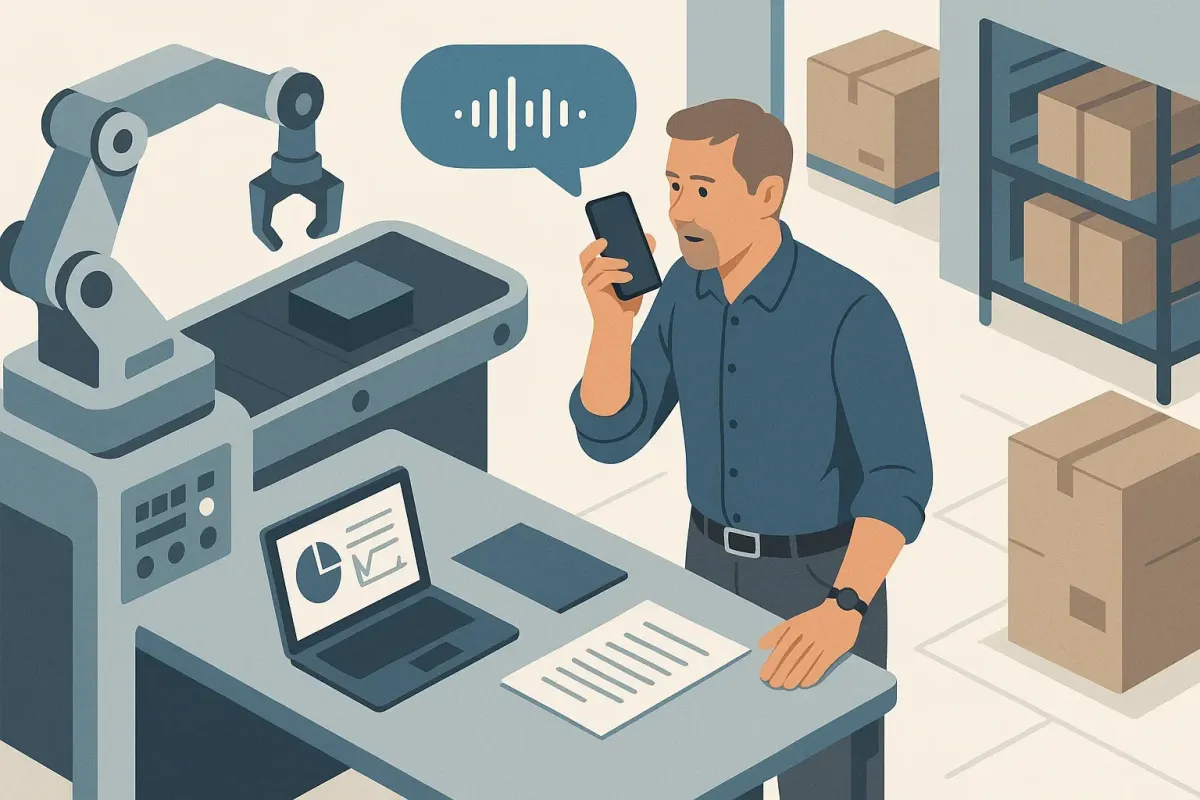
Data Contracts, Identity, and Failure Recovery for Manufacturing Voice AI
Design Voice AI for manufacturing service that respects OT boundaries, validates parts and warranties, integrates with ERP/CRM, and recovers safely when automation fails.
1. Why this architecture matters for manufacturing service
Manufacturing voice automation touches supply chains, warranty intake, and safety‑sensitive equipment. The architecture you choose determines whether Voice AI is an operational accelerant or a risk vector. This section sets the operational objectives and the recommended Caller→Voice AI→validation→business system flow.
Operational objectives
Keep three objectives front and centre: reduce repeat work for agents and field technicians, accelerate parts identification and routing, and protect engineering, warranty, and safety decisions with human review. Voice AI is most effective when it automates routine validation and routing rather than final approval of engineering or warranty outcomes.
- Automate low‑risk tasks: order status, case creation, part lookup suggestions, schedule requests.
- Require human approval for decisions that change warranty status, authorize credits, or affect safety procedures.
- Maintain an auditable transcript and structured payloads for every transaction.
Reference architecture
Adopt a linear, observable flow that maps to common enterprise systems: Caller → Voice AI conversational layer → intent & product validation service → business adapters (ERP, CRM, warranty/service API) → action (case, order, handoff). Keep each stage small and testable; avoid monolithic adapters that embed business rules and identity decisions in the voice layer.
- Conversation engine returns a structured intent and canonical product identifier (SKU, serial, or asset tag).
- Validation service cross‑checks product and warranty using read‑only queries before any write action.
- Adapters translate canonical data into ERP/CRM API calls and return business responses to the Voice AI.
- Handoff uses a supervised escalation API that records transcript, validation state, and recommended routing.
2. Data contracts and API design for deterministic outcomes
Data contracts make voice interactions deterministic. They define the exact fields exchanged, types, error codes, and versioning rules between the voice layer, validation service, and business adapters.
Core data contract elements
Keep contracts minimal and explicit. For a parts/warranty call flow, the contract should include intent metadata, caller and session identifiers, canonical product identifiers, captured utterances (normalized), confidence scores, timestamps, and action tokens for idempotent operations.
- Intent: {name, version, confidence}
- Caller: {caller_id, auth_level, verified_methods}
- Product: {canonical_id, mapping_source, serial_or_asset_tag}
- Validation: {warranty_state, last_service_date, authorized_actions}
- Action token: opaque idempotency key for writes
Error codes and failure semantics
Define explicit error categories that the orchestration and voice layers can act on: validation_failed (product not found), identity_unverified, confidence_low, business_rule_blocked, transient_api_error. Each error code maps to a deterministic recovery path—repeat prompt, escalate to specialist, queue case with transcript, or schedule onsite visit.
- Confidence thresholds that trigger re‑prompt vs. escalation.
- Transient errors use exponential backoff with bounded retry attempts.
- Business rule failures always create a routed case with structured context.
3. Identity, caller validation, and product verification
Manufacturing service requires layered validation: caller identity, premise or asset confirmation, and role authorization. Each layer reduces risk and informs whether a Voice AI action is permitted.
Layered identity model
Use multiple independent verification factors: phone number or device fingerprinting, knowledge‑based verification (order number, invoice, or last four of serial), and if available, integration with CRM identity attributes (account contact, dealer relationship). Treat identity as a set of attributes—never conflate caller authenticity with authorization to approve actions.
- Caller identity: phone + account match in CRM or dealer system.
- Premise/product verification: serial/asset tag + recent service record lookup.
- Authorization level: business rules determine which callers may request credits, refunds, or engineering reviews.
Product and warranty validation workflow
Always perform a read‑only warranty and parts check before offering a confirmation that suggests entitlement. The validation service should return: product existence, last known owner or location, warranty window, and any active recalls or open engineering cases.
- Read before write: only after validation should the system populate suggested next steps (parts order, service appointment).
- If warranty data is incomplete, the system must create a routed exception case rather than attempt automated approval.
- Record the validation result and the data sources used (ERP, dealer system, warranty DB) with each transaction for auditability.
OT and safety boundary controls
Voice automation must not execute or authorize actions that directly alter operational technology or safety interlocks. If a caller requests instructions that affect OT behavior, the system should pause and escalate to a qualified human with recorded context. Use OT security guidance to delineate allowed read and forbidden write operations.
- Disallow remote OT commands or configuration changes via voice paths.
- Read‑only telemetry is acceptable only when validated by OT controls and with explicit authorization.
- Escalate any request that involves safety or engineering overrides.

4. Observability and measurable outcomes
Observability gives operators the ability to measure what matters: correct routing, parts identification accuracy, validation failure reasons, and handoff latency. Instrumentation must map directly to business results.
Key metrics to track
Choose a concise metric set that aligns with service goals and procurement criteria. Track intent resolution rate, parts‑match accuracy (post‑call confirmation), validation_failure_rate (product or identity), handoff_rate, and mean time to human answer. Instrument idempotency and transaction success so you can reconcile voice actions with ERP/CRM records.
- Resolution rate by intent and by product family.
- Validation failure reasons (missing serial, CRM mismatch, low confidence).
- Handoff latency and specialist routing accuracy.
Telemetry and tracing
Implement distributed tracing across the voice engine, validation service, and adapters. Each transaction should carry a trace id, schema version, and confidence vector so post‑incident analysis can reconstruct decision points. Capture both structured events and a compressed transcript for human review.
- Trace id across voice, validation, and ERP/CRM calls.
- Store structured events separately from full recordings for retention control.
- Monitor unusual patterns (spikes in confidence_low or identity_mismatch) and wire them to QA workflows.
Operationalizing measurement
Use the data to run weekly QA sessions that sample low‑confidence calls and validation failures. Link measurable outcomes to procurement SLAs and vendor reviews—make observability a contractual requirement, not an optional add‑on.
- Use sampled call reviews to iterate prompt design and data contracts.
- Feed verified corrections back into the mapping layer (not the base model) to keep deterministic outcomes.
- Require vendors to publish observability dashboards as part of managed services.

5. Failure recovery, safe tool use, and escalation patterns
Designing for failure is core to safe automation. Define precise recovery steps for confidence shortfalls, identity mismatches, API outages, and business rule conflicts.
Deterministic fallback ladder
For each error category, implement a deterministic ladder: re‑prompt with constrained choices → confirm via secondary identifier → create routed exception case with context → immediate live handoff. Avoid open‑ended prompts after repeated failures; escalate early with structured context to reduce specialist handling time.
- Two re‑prompts maximum for low confidence before escalating.
- If identity mismatches, require a documented human review before any write.
- On transient upstream failures, queue the request with an idempotent token and notify the caller of expected follow‑up.
Transaction safety and idempotency
All write actions (order creation, appointment booking, warranty adjustments) must be idempotent and logged with a durable action token. If the adapter is uncertain whether an earlier write completed, use the token to reconcile rather than issuing duplicates.
- Generate server‑side idempotency keys for all writes.
- Record business responses and reconciliation outcomes in the audit trail.
- Provide visibility of pending writes to agents and field technicians.
Human escalation and specialist workflows
Design handoff APIs that carry the transcript, validation results, confidence vectors, and recommended routing codes. Specialists should receive a precomposed context bundle so they don’t repeat validation steps. Peak Demand’s runbooks show concrete validation and escalation flows that reduce specialist triage time.
- Context bundle: transcript, product lookup results, identity evidence, suggested actions.
- Specialist UI should allow quick accept/reject of suggested routing and capture final disposition.
- Use human‑in‑loop checkpoints where business rules require sign‑off.

6. Procurement, deployment choices, and governance
Procure Voice AI as an integration platform with explicit deliverables: data contracts, adapter code, runbooks, observability, and defined subprocessors. Clarify hosting regions, backup geography, and remote‑support access as part of the contract.
Contractual items to require
Demand deliverables that reduce operational risk: documented data contracts and version history, code for adapters with tests, a production runbook for failures and human escalation, observability dashboards, and explicit subprocessors list. Include SLAs for handoff latency and error resolution that match business needs.
- Schema registry and CI tests for adapters.
- Runbooks for identity failures, API outages, and safety escalations.
- Subprocessors and hosting region disclosures.
Deployment topology and data residency considerations
Choose a deployment that separates voice transcription/modeling from business data stores. Define hosting region for primary and backup systems, and state how cross‑border transfers and subprocessors will be handled. Confirm retention policies for recordings versus structured logs and obtain recorded‑consent practices aligned with local law.
- Isolate PII and warranty data in enterprise systems; pass only minimal identifiers to the voice model.
- Document primary hosting region, backup region, and remote‑support access controls.
- Specify retention for recordings and structured events independently.
Managed service scope and vendor responsibilities
If procuring managed Voice AI, require clear boundaries: who maintains adapters; who owns QA and tuning; which party performs service escalation; and who will run security reviews. Peak Demand’s service page outlines a managed approach that includes ERP/MES integrations, parts and warranty intake, and governed workflow automation—expect those items in any managed offering.
- Define responsibilities for adapter maintenance, schema upgrades, and runbook updates.
- Require periodic joint QA sessions and documented change windows.
- Make observability and failure recovery playbooks contractual.
Related Peak Demand resources
Industry and AI sources reviewed
- Guide to Operational Technology SecurityNational Institute of Standards and Technology (NIST)
- Cross-Sector Cybersecurity Performance GoalsCybersecurity and Infrastructure Security Agency (CISA)
- ISO/IEC 27001 Information Security Management SystemsInternational Organization for Standardization
- ISO/IEC 27701 Privacy Information ManagementInternational Organization for Standardization
- Cybersecurity Resources for ManufacturersNIST Manufacturing Extension Partnership
Privacy, telecommunications, recording-consent, cybersecurity, consumer-protection, employment, and records obligations vary by jurisdiction and use case. This article is operational guidance, not legal advice; organizations should confirm applicable requirements with qualified professionals.
Frequently asked questions
Strong starting points include parts and order-status requests, distributor or dealer support, warranty and service intake, appointment scheduling, case creation, basic product information, and routing to technical specialists. Keep engineering judgment, safety decisions, and operational-technology control outside the conversational layer.
Official reference: Cybersecurity Resources for Manufacturers
The workflow should collect structured identifiers such as model, serial number, part number, customer account, asset location, and symptoms, then validate them against ERP, CRM, catalogue, warranty, or service systems. The agent should escalate rather than invent a match when confidence is low.
Official reference: Cybersecurity Resources for Manufacturers
Not by default. Customer-service automation should normally use controlled business-system integrations and tightly governed adapters. Any connection near operational technology requires explicit security architecture, least privilege, monitoring, and separation from safety-critical control functions.
Official reference: Guide to Operational Technology Security
Require workflow mapping, integration ownership, test evidence, fallback behavior, auditability, security boundaries, change control, monitoring, human escalation, and a plan for maintaining product, parts, warranty, and service knowledge after launch.
Official reference: Cybersecurity Resources for Manufacturers
Turn Voice AI infrastructure into a managed enterprise operation
Peak Demand designs, integrates, deploys, monitors, and improves Voice AI systems across customer service, enterprise systems, governance, escalation, and reporting.
Schedule a discovery call


