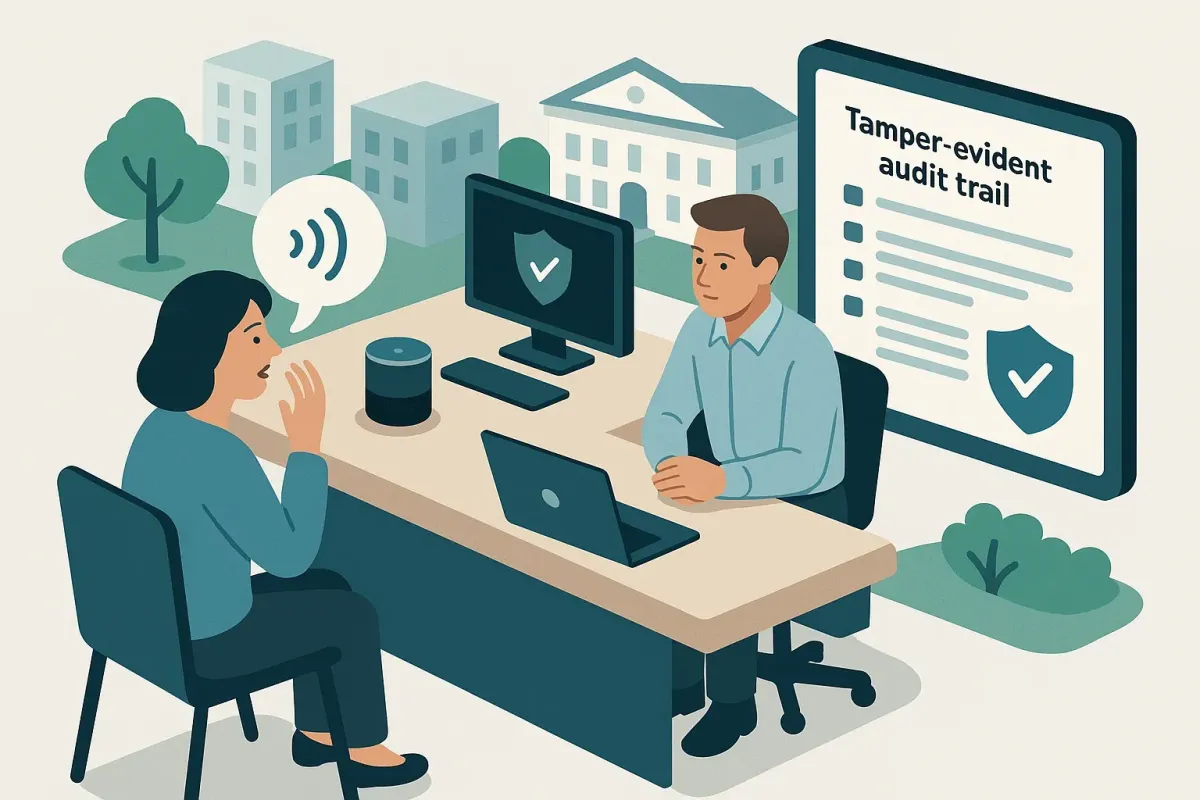
Cryptographic Provenance and Tamper-Evident Audit Trails for Municipal Voice AI
A practical, jurisdiction-neutral operating framework for municipal Voice AI that combines cryptographic provenance, tamper-evident audit trails, records governance, and human oversight to ensure accountable resident service and defensible audits.
1. Executive summary and operating model
This section establishes the operational model and high-level governance goals. Municipal leaders should treat cryptographic provenance and tamper-evident audit trails as part of the records management and public accountability function — not an optional security add-on.
Executive summary
Municipal Voice AI systems will be handling resident requests that often become public records. A reliable operating model ensures every interaction can be mapped to an auditable, tamper-evident trail: audio or transcript, intent and field-level data, validation checks, case system submission, confirmation numbers, and human escalations. The design goal is traceability: from resident utterance to final case disposition, produce cryptographic evidence that artifacts are unchanged and show who changed what, when, and why.
- Treat cryptographic provenance as part of records governance and service assurance.
- Ensure audit trails support routine QA, regulatory review, FOI requests, and incident forensics.
- Establish clear boundaries for decisions that must be handled by trained staff (emergency, enforcement, legal, eligibility).
Operating model (Resident → Case)
Adopt a simple, repeatable flow and make the trail explicit at each step. A recommended reference pipeline: Resident → Voice AI agent (recording + transcript) → logic bridge (dialog state, dynamic form retrieval) → field-level validation and duplicate controls → municipal case system (case creation or update) → confirmation number or human handoff. Each transition produces signed artifacts and anchored hashes so auditors can verify integrity.
- Voice AI captures audio and generates a time‑stamped transcript; both are hashed and recorded with metadata.
- Logic bridge orchestrates dynamic forms, performs validation, and captures decision metadata (rules, thresholds, confidence levels).
- Case system receives a signed payload with attached provenance metadata and returns a confirmation number that is itself recorded and signed.
2. Cryptographic provenance: what it is and why it matters
Cryptographic provenance provides verifiable evidence that an artifact (audio file, transcript, form, configuration) existed in a particular state at a particular time and has not been altered.
Core primitives and patterns
Use simple, well-understood cryptographic building blocks: SHA-family hashing for content fingerprints; public-key digital signatures for non-repudiation of artifacts and configuration snapshots; secure timestamping (internal or third-party) to anchor event times; and append-only storage (WORM-like) or ledger-backed anchoring to make tampering evident. Store both the artifact and its hash; verify the hash on every retrieval.
- Hash artifacts (audio, transcript, JSON payloads) immediately after creation; store hash with metadata in an append-only log.
- Sign configuration bundles (dialog flows, validation rules) so deployments include a signed snapshot that can be validated against the running logic.
- Use timestamping authorities or ledger anchoring if an external, auditable time anchor is required for legal processes.
Practical constraints and trade-offs
Cryptographic provenance increases storage and processing needs and has operational consequences: replayability of recordings, retention complexity, and key management obligations. Key management must be strictly governed — separate operational and signing keys, rotate keys on schedule, and implement emergency key revocation. Balance immutability with legitimate record-redaction workflows: redaction should produce new signed artifacts and retain the original hash references for audit.
- Plan for long-term storage of hashes and signatures even if raw media are redacted.
- Define a redaction workflow that is auditable: create a new signed artifact that references the original and explains the redaction reason and authority.
- Keep a dedicated key‑management role and implement multi-person controls for signing sensitive artifacts.
3. Data flows, system integration and controls
Make the data flow and integration points the primary focus of provenance. Each interface is a control boundary where signed artifacts should be created, validated, and recorded.
Reference workflow with control checkpoints
Implement the Resident → Voice AI → logic bridge → form retrieval → validation → municipal case system → confirmation/handoff flow with explicit checkpoints that produce signed artifacts at these moments: audio capture, transcript generation, form population, validation pass/fail, case submission payload, and confirmation receipt. Checkpoints should include metadata: user ID (if applicable), session ID, timestamps, confidence scores, duplicate detection decisions, and linkage to signed configuration snapshots.
- Checkpoint 1: Audio and initial transcript — hash and sign.
- Checkpoint 2: Form population and validation — sign the JSON payload of fields plus validation result and duplicate-check evidence.
- Checkpoint 3: Case submission — municipal case system stores the signed payload and returns a signed confirmation number.
Integration patterns and Peak Demand differentiators
Use approved APIs and controlled adapters for integrations. Peak Demand’s approach emphasizes dynamic forms, field-level validation, duplicate controls, and confirmation-number issuance as native capabilities. Implement an orchestration layer (logic bridge) that records the dialog state, applies validation rules, and produces signed case payloads for the municipal case system. Require vendors to support an API-based proof-of-trace: an endpoint returning the artifact hash chain and signed configuration ID for any case.
- Require dynamic forms driven by the case system schema so field semantics are preserved and validation can be performed at the logic bridge.
- Enforce duplicate-check algorithms before case creation; log results as signed artifacts.
- Ensure the system returns a confirmation number and a signed receipt object that ties the case to its provenance chain.

4. Governance, privacy, and records management
Provenance supports records governance but must be implemented within privacy and legal boundaries. Local obligations vary — consult counsel and records officers when defining retention, disclosure, and redaction policies.
Records retention, transcripts, and recordings
Define separate retention rules for raw audio, machine transcripts, case payloads, and provenance metadata. For FOI or audit readiness, retain signed provenance records longer than the operational retention period for raw media. When redaction or limited disclosure is necessary, preserve provenance metadata and an auditable redaction log that references the original artifact's hash and the signed justification for redaction.
- Store signed case payloads and hashes as part of the official record store even if audio is short‑lived.
- Design retention schedules that include both the artifact and its cryptographic metadata.
- Log redaction actions with a signed 'redaction artifact' that references the original hash and authorizing policy.
Algorithmic impact assessments and governance
Treat Voice AI agents and their logic bridges as algorithmic systems requiring oversight. Conduct algorithmic or impact assessments during procurement, deployment, and material changes to dialog logic or validation rules. Assessments should document data flows, decision boundaries (where humans must take over), privacy risks, and mitigation strategies.
- Use an algorithmic impact assessment to capture risk, intended use, and mitigation steps before going live and after significant changes.
- Document who owns the assessment and where the assessment is stored with a signed snapshot of the deployed configuration.

5. Human oversight, safety boundaries and QA
Cryptographic provenance does not replace human judgment. It supports oversight by making human handoffs auditable and defensible.
Clear decision boundaries
Define explicit safety boundaries: emergency calls, enforcement actions, legal determinations, eligibility screening, and discretionary service denials must be escalated to trained staff. The system should detect confidence thresholds, trigger patterns, and keywords, and produce a signed escalation artifact documenting why escalation occurred and what the agent presented to the resident.
- Enumerate categories that always require human review and implement automatic escalation workflows.
- Record and sign the dialog segment that led to escalation, along with the agent's confidence metrics and the rule that fired.
QA, audits and measurable outcomes
Design QA programs that sample interactions, verify artifact integrity (hash checks), and validate that signed configuration bundles match the running system. Define measurable outcomes and acceptance tests for provenance: e.g., 100% of case submissions return a signed confirmation receipt; 0% of accepted cases have missing provenance artifacts; QA scripts routinely verify hash integrity and signature validity.
- Run automated integrity checks that verify artifact hashes and signatures on a defined cadence.
- Include provenance verification in operational KPIs and supplier SLAs.
- Require periodic independent audits where the auditor verifies the chain-of-trust from audio to case record.

6. Change control, tamper detection and incident response
Change control and forensic readiness are core to maintaining trust in provenance systems.
Change control for models and configurations
Treat model updates, dialog adjustments, and validation rule changes like software releases that require signed release artifacts, documented approvals, and roll-back plans. Each deployment must publish a signed configuration snapshot that is stored in the provenance log and referenced by any case created under that configuration.
- Require multi-person approval for production changes to dialog logic or validation rules.
- Sign every production deployment with a private key; store the public key in the provenance store.
- Log deployments with metadata: deployer ID, timestamp, change rationale, ticket/PR reference, and signature.
Tamper detection and incident response
Implement automated tamper-detection: periodic hash re-checks, alerts on signature verification failures, and immutable alerts when reconciliation fails. Define incident response steps that preserve forensic artifacts: isolate systems, preserve signed copies of logs, and use cryptographic evidence to support internal and external investigations. Coordinate with cybersecurity incident processes and public records officers.
- Automate signature and hash verification against a known-good public key store.
- On detection, generate a signed incident artifact that records the scope, time, and initial containment actions.
- Keep separate, geographically isolated backups of provenance logs and keys with documented access controls.
Related Peak Demand resources
Industry and AI sources reviewed
- Algorithmic Impact AssessmentGovernment of Canada
- Artificial Intelligence Risk Management Framework (AI RMF 1.0)National Institute of Standards and Technology (NIST)
- Cross-Sector Cybersecurity Performance GoalsCybersecurity and Infrastructure Security Agency (CISA)
Privacy, telecommunications, recording-consent, cybersecurity, consumer-protection, employment, and records obligations vary by jurisdiction and use case. This article is operational guidance, not legal advice; organizations should confirm applicable requirements with qualified professionals.
Frequently asked questions
Suitable workflows include structured resident inquiries, service-request intake, permit or program information, appointment scheduling, department routing, status updates from approved systems, and after-hours overflow. Adjudication, enforcement discretion, emergency response, and binding eligibility decisions should remain with authorized staff.
Official reference: Artificial Intelligence Risk Management Framework (AI RMF 1.0)
Use a controlled service catalogue, required fields, department ownership rules, validation, duplicate checks, confirmation numbers, and documented handoff paths. The system should create an auditable record and avoid silently dropping requests when a downstream system is unavailable.
Official reference: Algorithmic Impact Assessment
Municipal deployments should document purpose, affected services, data use, human oversight, complaint and appeal paths, accessibility channels, records handling, monitoring, and the process for approving material changes.
Official reference: Algorithmic Impact Assessment
Require workflow demonstrations, integration and security architecture, testing evidence, auditability, data-location and subcontractor details, incident response, accessibility support, human escalation, exit planning, and clear ownership of ongoing updates.
Official reference: Artificial Intelligence Risk Management Framework (AI RMF 1.0)
Turn Voice AI infrastructure into a managed enterprise operation
Peak Demand designs, integrates, deploys, monitors, and improves Voice AI systems across customer service, enterprise systems, governance, escalation, and reporting.
Schedule a discovery call


