
Continuous QA, Analytics, and Cost-to-Serve for Multisite Healthcare Voice AI
Operational guidance for measuring and improving containment, escalation quality, and cost-to-serve across multisite, multilingual healthcare Voice AI. Practical workflows, controls, and procurement checkpoints for patient access teams.
1. Use case and architecture overview
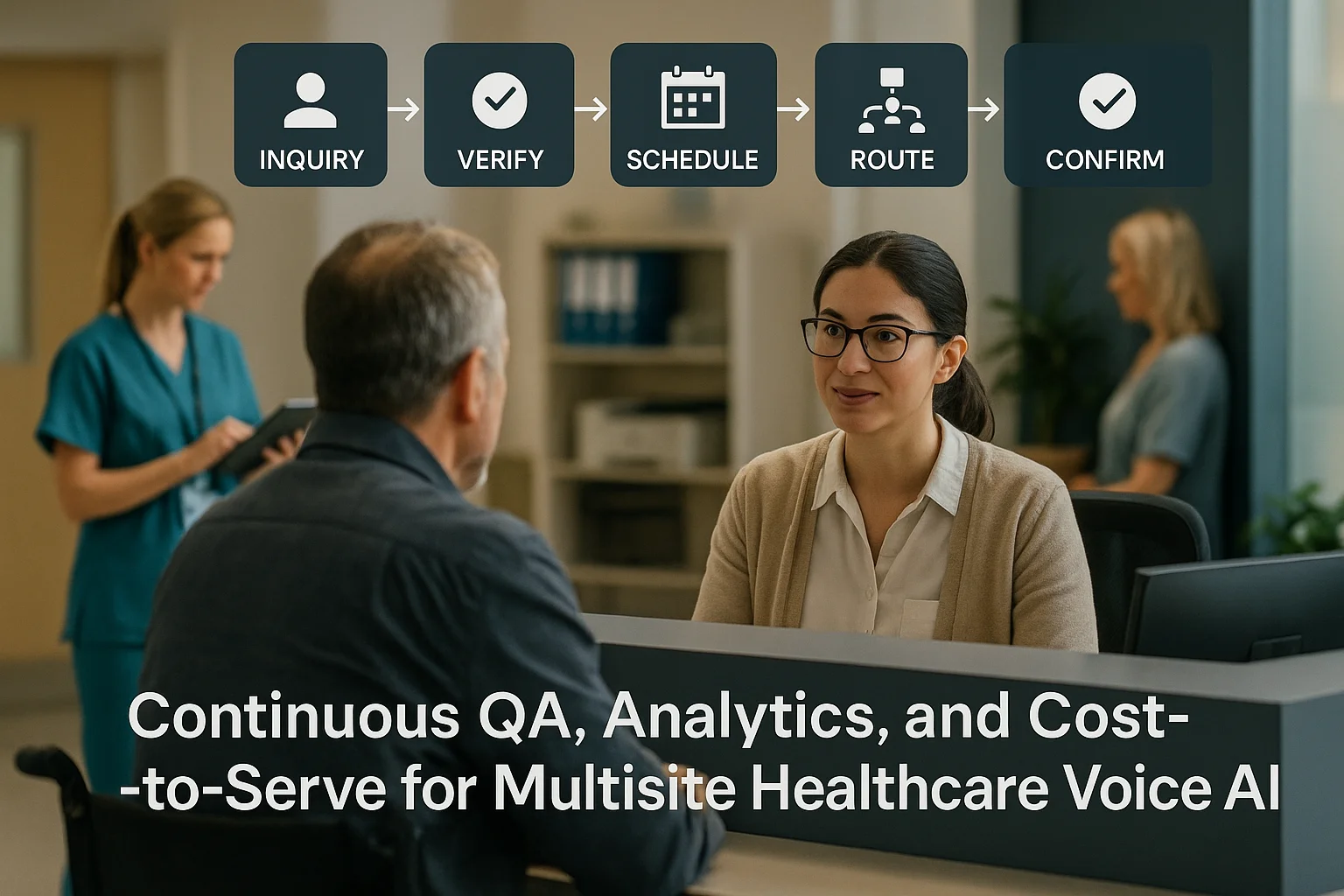
A compact, operational architecture keeps responsibilities explicit: caller identity and intent validation, safe containment where appropriate, and predictable escalation to humans or scheduling systems. Below is a prioritized healthcare use case and the minimal end-to-end architecture to support continuous QA.
Patient-access use case
Target scenario: inbound patient calls across multiple clinic locations requesting appointments, prescription refills for administrative follow-up, or basic service questions. Voice AI handles authentication and common scheduling flows, confirms identity minimally for allowable actions, books or proposes appointments through the clinic’s approved scheduling API, and hands off to a human when cases are ambiguous, urgent, or clinically sensitive. Do not attempt clinical assessment, diagnosis, or emergency triage in Voice AI.
- Primary actions: appointment booking, appointment changes/cancellations, insurance/eligibility prompts (non-adjudicative), basic account lookups, return-call scheduling.
- Escalation triggers: ambiguous intent, mention of chest pain/shortness of breath/bleeding/altered consciousness, high-sensitivity personal data requests, or failed identity validation.
- Outcome guarantees: confirmation to caller and audit trail entry into scheduling/EHR via approved API adapter; failure to confirm requires human follow-up.
Minimal architecture (operational model)
Design the flow as: Patient/caller → Voice AI fronting system (ASR + NLU) → validation & identity controls → approved scheduling/service API OR safe human handoff. Keep the orchestration layer responsible for policy decisions, audit logging, redaction and recording consent, and retention controls. Use controlled adapters to EHR/PM, not direct database writes from model layers. Maintain a separate human review queue that receives flagged calls, low-confidence transcripts, and random samples for QA.
- Orchestration responsibilities: routing, identity checks, confidence thresholds, escalation rules, recording consent enforcement, audit trails.
- Integration patterns: pull-only authorization checks and push-only scheduling calls via approved APIs; use short-lived credentials for adapters.
- Data handling: separate transcript store for QA with role-based access; encrypt at rest and in transit; record locations and subprocessors in procurement contracts.
2. Defining and measuring containment and escalation quality
Containment and escalation quality are operational KPIs with different goals. Containment lowers human cost but must not reduce safety. Escalation quality ensures patients routed to humans receive correct context and minimal rework.
Containment quality (what to measure)
Containment quality is the proportion of calls where Voice AI completes the caller’s task without a human. Measure containment rate alongside accuracy and downstream confirmation success. A contained call that never converts to a booked appointment or leaves the system without confirmation is a failure.
- Key metrics: containment rate, contained-call success rate (confirmed outcome), mean time-to-confirmation, recontact rate within 7 days.
- Confidence thresholds: set NLU/ASR thresholds that flag low-confidence interactions for human review regardless of containment.
- Sample rule: only classify a call as contained when booking confirmation is received from the scheduling API and confirmation message is delivered to the.
Escalation quality (handoff fidelity)
Escalation quality measures whether the human agent receives sufficient, accurate context to resolve the issue without redundant work. Low escalation quality increases cost-to-serve and patient frustration even if containment is high.
- Key metrics: first-contact resolution after escalation, average handle time post-handoff, proportion of escalations missing required identity or consent artifacts.
- Required context: timestamped transcript snippet, NLU-detected intents & slots, confidence scores, identity verification result, and any attempted scheduling confirmations.
- Operational control: require a brief pre-handoff verification script run by the Voice AI (e.g., "To help the team, I’m transferring your appointment request for.
3. Analytics that link QA to cost-to-serve
Analytics must map call outcomes to dollars and clinical safety. Cost-to-serve models should be call-path specific and include human, software, and integration costs.
Measuring cost-to-serve by call-path
Build a per-call cost model that attributes incremental costs to each path: contained-successful, contained-failed (needs human follow-up), escalated-with-context, escalated-poor-context, and manual-only. Include amortized platform costs (licensing, NLU/ASR) and operational costs (human review, agent time, scheduling API transactions).
- Cost components: Voice platform fees, per-minute ASR/NLU costs, adapter/API transaction fees, human agent minutes, QA engineering and annotation, storage and retention.
- Metrics to compute: average cost per contained-successful call, average cost per escalation, marginal cost saved by improving containment accuracy.
- Use analytics to inform thresholds: if low-confidence escalations cost less than repeated contained failures, adjust confidence thresholds accordingly.
Analytics pipeline and dashboards
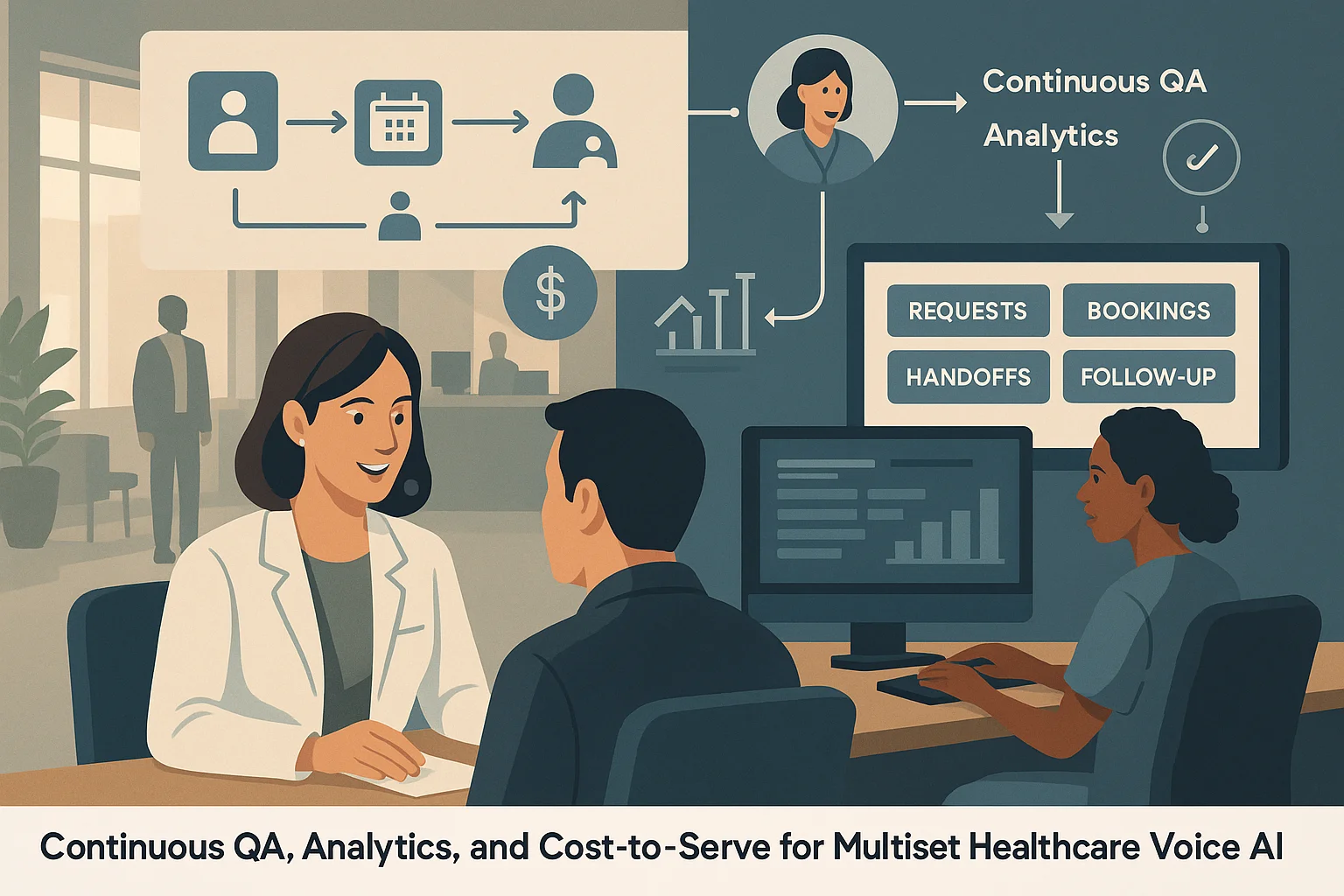
Instrument calls end-to-end: unique call ID, intent classification, slot completion, confidence scores, identity check result, scheduling API response, and final call disposition. Build dashboards for operations, QA, and finance that answer: Where are we spending minutes? Which sites have disproportionate escalations? What multilingual paths drive higher ASR error?
- Essential dashboards: per-site containment/confirmation, per-agent post-escalation handle time, ASR/NLU error rates by language, and cost-per-disposition.
- Alerting: automated alerts when contained-successful confirmations drop below a site-specific baseline or when escalation volume rises unexpectedly.
- Data retention and privacy: ensure analytics data stores reflect patient-data classification and retention policies, and that subprocessors are disclosed in procurement contracts.
4. Multisite scale and multilingual operations
Scaling Voice AI across clinics and regions requires centralized guardrails and localized tuning. Treat each site as a configuration instance with shared policies and local overrides.
Configuration and governance for multisite scale
Use a central policy plane for consent, escalation rules, confidence thresholds, and recording policies. Per-site configuration should include operating hours, local service menus, scheduling availability windows, and billing or insurance prompts. Keep integrations modular: a scheduling adapter per vendor or per EHR/PM instance rather than hard-coded mapping in the Voice AI layer.
- Central policy examples: universal emergency escalation phrasing, minimum identity verification steps for scheduling changes, and redaction policies for PII in QA transcripts.
- Local overrides: language dialects, clinician availability, and site-specific appointment types.
- Operational consequence: central policies preserve safety; local config preserves patient experience and accuracy.
Multilingual accuracy and ASR tuning
Treat each language as a separate operational path. Track ASR word-error-rate and intent accuracy by language and by common local phrases. Prioritize human-in-the-loop review for languages with higher error or for accents under-sampled in training data.
- Testing plan: collect seed transcripts per language from target sites (with consent), run iterative tuning, and maintain per-language confidence thresholds.
- Operational trade-off: raising confidence thresholds reduces erroneous containment but increases escalations—measure cost consequences.
- Staffing: ensure human review pools include multilingual reviewers or a routing plan to assign escalations to appropriate linguists.

5. Continuous QA loops, auditability, and governance
Continuous optimization requires structured QA workflows, clear governance, and documented audit trails. Use a mix of automated scoring and targeted human review to scale.
QA sampling and human-in-the-loop review
Automate initial scoring (intent match, slot completeness, confidence) and create three human-review queues: (1) high-priority flagged calls (safety or low-confidence), (2) random sample for ongoing quality baseline, and (3) targeted experiments (new language model or new site configuration). Annotate reviews with root causes and remediation actions.
- Sampling rates: higher for new sites or languages; standard baseline random sampling of 1–3% for mature deployments, higher if risk dictates.
- Reviewer outputs: pass/fail, specific error code (ASR, NLU, integration failure, identity fail), suggested intent/phrase correction.
- Closed-loop remediation: link review tags to retraining datasets and to configuration changes; track the time from detection to remediation.
Governance, risk management, and ethical controls
Adopt risk-management and governance practices consistent with international guidance for AI in health. Establish an AI oversight group that includes clinical, privacy, legal, and patient-access stakeholders. Document failure modes, escalation policies, and monitoring obligations. Consult qualified professionals for jurisdictional legal and regulatory obligations.
- Governance items: documented acceptable use policy, escalation matrices, data-subprocessor registers, retention schedules, and breach-response steps.
- Risk assessment: maintain an AI risk register that includes safety, privacy, accuracy, and equity considerations by language and site.
- Transparency: keep an audit trail that links call IDs to decisions, model version, adapter version, and reviewer annotations.
6. Procurement, implementation checklist, and failure boundaries
Procurements should treat Voice AI as a medical-adjacent service with clear SLAs, subprocessors, and escalation obligations. Prepare practical failover and rollback controls for operational resilience.
Procurement checklist and contracts
Include clear statements of work that cover integration ownership (who maintains adapters), data residency and subprocessors, recording and retention, audit rights, and sampling/QA obligations. Require evidence of operational controls rather than blanket certifications; ask for a runbook showing escalation flows and human-in-the-loop processes.
- Must-have contract items: adapter ownership, change-control process for model or configuration updates, documented incident response times for escalations and outages.
- Operational evidence: sample audit logs, a description of identity verification steps, and QA sampling reports.
- Avoid: accepting vague promises about accuracy or unspecified "HIPAA compliance"—ask for concrete controls and the list of subprocessors.
Failure boundaries, rollbacks, and go-live strategy
Define clear failure boundaries: when the system must default to human answering (e.g., system outage, combined low-confidence rate above threshold, or API failures). Use phased rollouts and volume caps by site, with automated rollback triggers based on containment/confirmation and escalation metrics.
- Go-live: start with low-risk appointment types and daytime hours, then expand by site and by service type after stable KPIs.
- Rollback triggers: sustained drop in confirmation rate >X% from baseline, spike in escalations without context, or critical API error rates.
- Resilience: maintain a hot standby human answering team and ensure call transfer paths are tested and instrumented to capture handoff quality metrics.
Related Peak Demand resources
Industry and AI sources reviewed
- Ethics and governance of artificial intelligence for healthWorld Health Organization
- Regulatory considerations on artificial intelligence for healthWorld Health Organization
- Artificial Intelligence Risk Management Framework (AI RMF 1.0)National Institute of Standards and Technology (NIST)
- OECD AI PrinciplesOrganisation for Economic Co-operation and Development
Privacy, telecommunications, recording-consent, cybersecurity, consumer-protection, employment, and records obligations vary by jurisdiction and use case. This article is operational guidance, not legal advice; organizations should confirm applicable requirements with qualified professionals.
Frequently asked questions
Administrative workflows such as appointment booking, changes and cancellations, referral-status intake, approved follow-up, patient-access questions, after-hours overflow, and structured routing are common starting points. Clinical judgment, diagnosis, emergency triage, and prescribing decisions must remain with qualified professionals.
Use the minimum identifiers approved by the organization, validate them against the system of record, avoid exposing unnecessary information, and provide a human-assisted path when verification fails. The system should not infer identity from conversational context alone.
The agent should follow the organization's approved escalation and emergency-routing rules, avoid clinical advice, and transfer or direct the caller to the appropriate human or emergency channel. Those rules must be tested with realistic language and failure cases.
Request identity and privacy controls, scheduling or EHR integration behavior, audit logs, escalation rules, downtime handling, testing evidence, change control, monitoring, and clear separation between administrative automation and clinical decision-making.
Turn Voice AI infrastructure into a managed enterprise operation
Peak Demand designs, integrates, deploys, monitors, and improves Voice AI systems across customer service, enterprise systems, governance, escalation, and reporting.
Schedule a discovery call


