
Continuous Optimization Playbook for Multisite Transit Voice AI
A practical playbook for transit leaders to measure, optimize, and scale multisite Voice AI. Covers QA, containment, escalation quality, analytics, multilingual operations, cost-to-serve, and procurement controls.
1. Executive architecture and operating model
A reliable multisite transit Voice AI works when operational boundaries, integration patterns, and escalation rules are explicit. Use a simple, auditable architecture and align product, operations, and IT on shared metrics.
Operational architecture (high level)
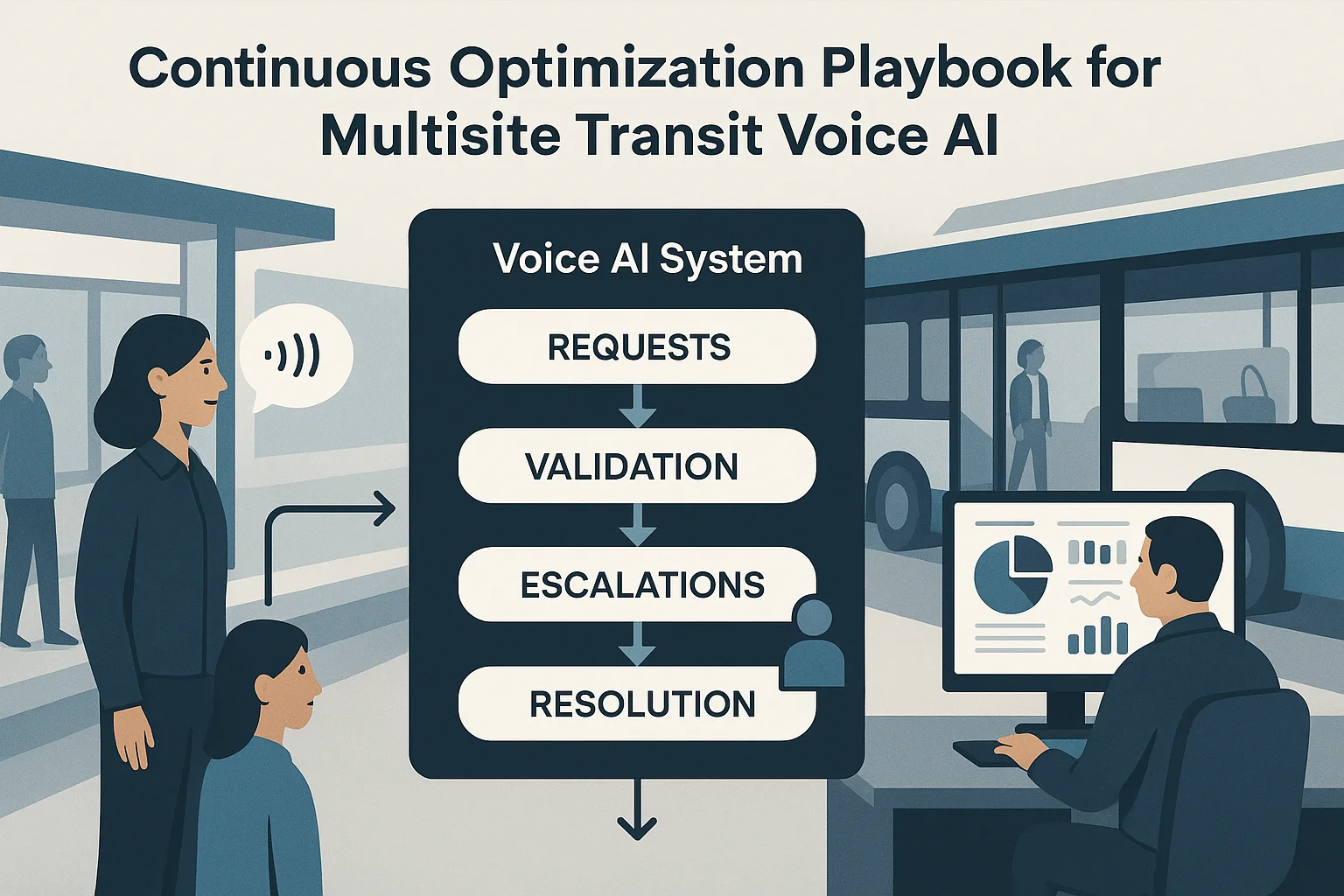
Use a clear request flow: Rider → Voice AI → controlled knowledge base for scheduled information OR approved service-alert APIs for detours/delays/forms → validation → automated response, case submission, or human handoff. Keep scheduled timetable knowledge in a versioned, read-only content store; use approved, low-latency APIs for live alerts and form submissions.
- Separate knowledge stores: versioned schedule KB vs live-alert API adapter.
- Run validation microservices to confirm user inputs (stop IDs, route numbers) before case submission.
- Log decisions and confidence scores for every automated handoff to enable root-cause QA.
Why separation matters
Scheduled knowledge (timetables, fare rules, accessibility schedules) is stable and should be curated, audited, and cached. Detours, delays, and incident alerts require direct integration to approved operational feeds (AVL, GTFS-rt, or agency service-alert APIs). Treat the two sources differently in UX, confidence thresholds, and escalation rules.
- Treat schedule answers as deterministic content with audit trails and edit control.
- Treat alerts as event-driven, with higher validation and human verification thresholds.
- Do not surface predictive next‑vehicle info unless a validated, real‑time vehicle-position feed is available and the agency accepts the prediction risk.
2. Quality assurance and containment controls
Containment (the rate at which Voice AI resolves requests without human handoff) is the prime operational objective, but it must be balanced with containment quality and safety.
Defining containment quality
Containment rate alone is insufficient. Containment quality measures whether automated resolutions are correct, complete, and recorded with auditable confidence. Build QA sampling that ties automated outputs to ground truth via logs, user feedback, and targeted annotation.
- Track containment rate (automated resolution share) and containment quality (accuracy and completeness on sampled interactions).
- Sample by intent, route, and site to catch site‑specific failure modes.
- Attach transcript and confidence vectors to each resolved interaction for downstream review.
Test gating and release controls
Establish release gates: unit tests for prompts and NLU, sandbox end-to-end tests with synthetic and recorded utterances, small-canary release, expanded pilot, and full deployment. Tie gate thresholds to both containment quality and escalation quality metrics.
- Automated test suites for utterance coverage per intent and language.
- Canary rollout (1–5% of calls) with continuous monitoring of false-containment and escalate-on-failure flags.
- Automatic rollback triggers when containment-quality drops below the gate or when latency or error rates exceed limits.
Validation before safe submission
When the agent must submit service requests (e.g., lost property reports, accessibility requests), perform multi-field validation and safe-submission checks. Use deterministic validation for structured fields and confirmation dialogs for ambiguous or high‑severity submissions.
- Validate stop IDs and route numbers against a canonical, versioned stop/route registry.
- Confirm location and time using a two-step voice confirmation for any submission to back-office systems.
- Mask or avoid capturing sensitive information on-call; require human agent for high-risk data.
3. Analytics, observability, and cost-to-serve
Analytics connect QA to commercial decisions. Focus on a compact measurement set that drives operational change: containment rate, containment quality, escalation quality, time-to-human, and cost-per-resolved-interaction.
Core metrics and dashboards
Build dashboards that combine interaction telemetry with back-office outcomes. Correlate voice-agent confidence and final outcome (resolved, case opened, escalated) and present time-series and cohort analyses by site and language.
- Key metrics: containment rate, containment quality (sampled accuracy), escalation rate, false escalation rate, average handle time (human), and cost-per-resolved-interaction.
- Cohorts: by site, route cluster, language, and time-of-day.
- Alerting on metric drift (e.g., containment quality drop > X% within 24 hours).
Attributing cost-to-serve
Model cost-to-serve as a function of automated resolution costs, human-handback load, and downstream processing costs for submitted cases. Use per-interaction costs for vendor billing reconciliation and procurement negotiations.
- Break down costs: voice platform charges, speech-recognition tokens, human FTE minutes, and downstream case-handling costs.
- Negotiate vendor SLAs that tie price bands to measured containment quality and average time-to-human.
- Use A/B testing to assess the marginal cost savings from script or NLU changes before broad rollout.
Observability and auditability
Maintain immutable logs for all interactions, decisions, confidence scores, and handoffs. Use sampling and automated classifiers to surface high-risk interactions for immediate review.
- Store transcripts, confidence vectors, and decision metadata with controlled retention and access.
- Provide redaction and export tools for legal, FOI, and accessibility review.
- Log not only outcomes but also the exact knowledge source (timetable KB version or service-alert API response) used for the answer.
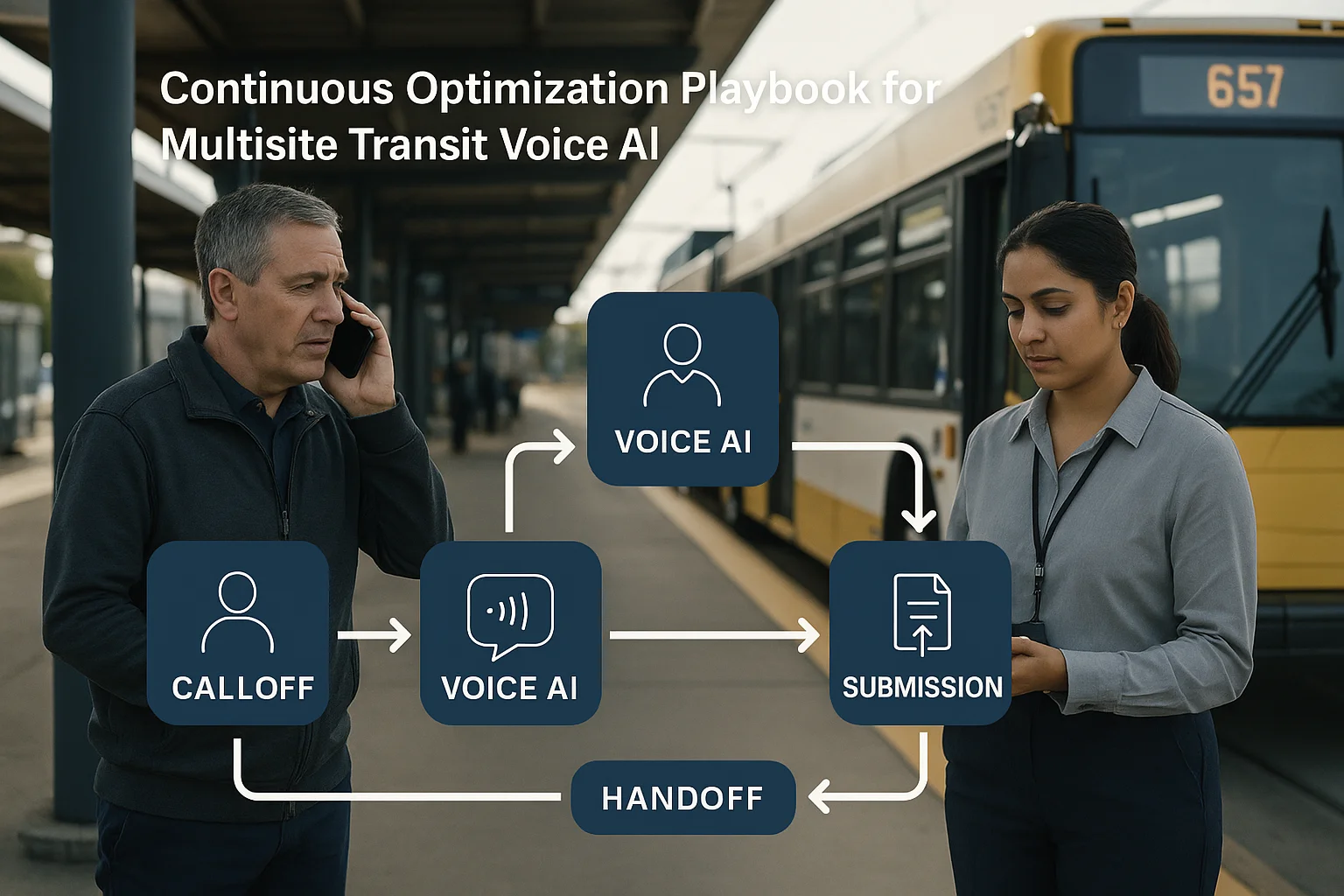
4. Escalation quality and human handoff
High-fidelity escalations preserve safety and public trust. An escalation must include the right context, validated fields, and a measurable SLA for human follow-up.
Escalation content and structure
Define a canonical escalation payload that includes user identity (if verified), utterance transcript, confidence scores, KB source versions, and validation results. Decide which fields are mandatory for each escalation type.
- Payload must contain intent, confidence, timestamp, route/stop identifiers, and prior steps taken by the agent.
- Include a short human-readable summary and link to the full transcript/audio.
- Flag high-severity categories (safety, medical emergency, security) for immediate human pickup; do not route these to automated queues.
Escalation quality metrics
Measure escalation quality by resolution rate, first-touch resolution, and time-to-resolution. Also monitor false escalation rate (interactions escalated unnecessarily) as an operational cost driver.
- First-touch resolution rate: percent of escalations resolved without additional handoff.
- False escalation rate: percent of escalations downgraded to informational after human review.
- Set SLA bands for response times by priority (e.g., safety-critical within minutes, general inquiries within standard business SLA).
Human handoff workflows
Handoff to human staff should be frictionless and reversible. Provide agents with the automated attempt log, validation results, and a recommended disposition. Allow human agents to flag recurring failures for engineering triage.
- Use a unified agent desktop that shows the canonical escalation payload and a one-click accept/decline with disposition options.
- Capture agent feedback structured as tags to feed the QA pipeline (intent mismatch, language issue, KB error).
- Automatically route repeated failure tags to engineering and content teams for triage.

5. Multisite scale and multilingual operations
Scaling across sites and languages introduces localized failure modes. Treat each site/language as a semi-independent experiment with its own KPIs and localized content governance.
Site and locale decomposition
Organize deployment by site clusters: group sites that share routes, operations, and language demographics. Use separate KB namespaces per cluster and separate telemetry to detect site-specific regressions.
- Namespace the KB by site-cluster and version every edit.
- Instrument per-site telemetry to detect regressions before global rollout.
- Use canaries that represent local call patterns (rush hour, school runs) for each cluster.
Multilingual operations and parity targets
Localization is more than translation. Tune NLU models on locale-specific utterances, record local prompt variants, and set containment-parity targets. Where local languages are a service requirement, specify containment-quality and latency SLAs per language during procurement.
- Collect and annotate real utterances per language and locale; prioritize high-frequency intents first.
- Set containment-quality parity targets (e.g., within X percentage points) and track deviation.
- Define fallback flow: if confidence < threshold in the requested language, offer human bridge or language fallback rather than auto-switching to another language.
Accessibility and inclusive UX
Design voice interactions to support callers with cognitive or speech impairments: offer alternative input (DTMF, web forms), repeat and confirmation options, and an accessible escalation path. Coordinate with accessibility teams and document testing methods.
- Provide explicit prompts for simpler utterances and confirm critical fields verbally.
- Offer immediate switch to human agent for callers who request it.
- Integrate with published accessibility test plans and maintain audit trails of accessibility-related incidents.
6. Continuous optimization cycles and governance
Optimization is an iterative cycle: define hypotheses, run experiments, evaluate operational impact, and move changes through controlled release. Tie governance to risk management and auditability.
Continuous improvement loop
Operate weekly or biweekly optimization sprints that mix production telemetry, QA findings, and user feedback. Prioritize fixes that reduce human-handback or improve containment quality for highest-volume intents.
- Hypothesis → test design → pilot → measurement → decision (promote, iterate, rollback).
- Use cost-to-serve impact as a prioritized decision filter alongside containment-quality impact.
- Document each change with audit metadata: who, why, expected outcome, and rollback plan.
Audit trails, oversight, and change control
Maintain immutable change logs for KB edits, NLU model updates, prompt changes, and configuration toggles. Assign an oversight committee that includes operations, IT security, and accessibility/ADA representatives for sign-off on high-risk changes.
- Keep versioned KB and model registries with tags for pilot/production.
- Require pre-release risk sign-off for changes that affect safety, legal wording, or sensitive workflows.
- Retain artifacts required for post-incident review and regulatory inquiries.
Related operational guidance
Pair optimization with a governance playbook that describes audit trails, oversight, and change control responsibilities across the agency and vendors.
- See Peak Demand’s Governance Playbook for Transit Voice AI for operational governance patterns and change-control workflows.
- For after-hours and 24/7 service models, align SLA and human-coverage expectations before scaling.
- Coordinate accessibility improvements with dedicated testing and reporting.
Related Peak Demand resources
Industry and AI sources reviewed
- Artificial Intelligence Risk Management Framework (AI RMF 1.0)National Institute of Standards and Technology (NIST)
- OECD AI PrinciplesOrganisation for Economic Co-operation and Development
- Transportation Systems SectorCybersecurity and Infrastructure Security Agency (CISA)
Transit safety, accessibility, privacy, cybersecurity, records, and service-information obligations vary by jurisdiction and operating authority. This article is operational guidance, not legal advice; organizations should confirm applicable requirements with qualified professionals.
Frequently asked questions
Good starting points include lost property, complaints and feedback, stop or shelter issues, fare-machine faults, non-emergency accessibility service requests, schedule information from approved sources, and structured routing to customer service or field teams.
Official reference: Artificial Intelligence Risk Management Framework (AI RMF 1.0)
Use GTFS Realtime only when the agency exposes suitable feeds and the workflow genuinely needs service alerts, trip updates, or vehicle positions. The integration should validate freshness and availability, and the agent should avoid presenting stale feed data as a guaranteed arrival prediction.
Emergency, security, injury, crime, and safety-critical reports should follow approved transfer or emergency-routing procedures. Voice AI may detect and route the call, but it should not make operational safety decisions or replace trained personnel.
Official reference: Transportation Systems Sector
Request realistic call testing, feed and system failure handling, service-request integration, transfer context, audit logs, accessibility channels, monitoring, change control, and evidence that the agent distinguishes scheduled information from dynamic service alerts.
Official reference: Artificial Intelligence Risk Management Framework (AI RMF 1.0)
Design the transit service workflow before automating it
Peak Demand helps transit teams connect Voice AI to rider information, service requests, approved live-data sources, escalation, confirmation, and analytics.
Schedule a discovery call


