
Complying with Public Records & Auditability for Citywide Voice AI Operations
A practical, jurisdiction‑neutral operating framework for municipal leaders to implement auditable, records‑compliant Voice AI across 311 and customer‑service channels — with architecture, controls, procurement guidance, and measurable outcomes.
1. Why public records and auditability must be core to Voice AI
City leaders adopt Voice AI to improve access and reduce friction, but municipal obligations for transparency, discoverability, and accountability create distinct operational constraints. This section explains the governance rationale and the practical consequences for architecture and procurement.
Public‑records obligations change design priorities
Unlike purely commercial IVR, municipal Voice AI operates against duties of disclosure, retention schedules, and public scrutiny. Design decisions must favour structured capture, immutable audit trails, and predictable retrieval. Prioritise form‑based intake and case creation over freeform model outputs for official records.
- Treat the form and field values submitted to case systems as primary public records.
- Preserve associated interaction metadata (timestamps, session IDs, routing events) to provide provenance.
- Avoid relying on transient model state as the authoritative record.
Operational tradeoffs: convenience versus verifiability
Flexible conversational models can improve user experience but complicate record reproducibility. Municipal teams should accept modest UX limits (narrower prompts, explicit confirmations, field‑level validation) when those limits materially reduce downstream discovery and evidentiary complexity.
- Use confirmation numbers and human‑readable case IDs for subsequent retrieval and audit.
- Prefer validated structured fields (addresses, dates, account numbers) over paraphrased summaries when records are needed.
- Define failure boundaries where the system must escalate to trained staff.
2. A practical operating architecture for auditable Voice AI
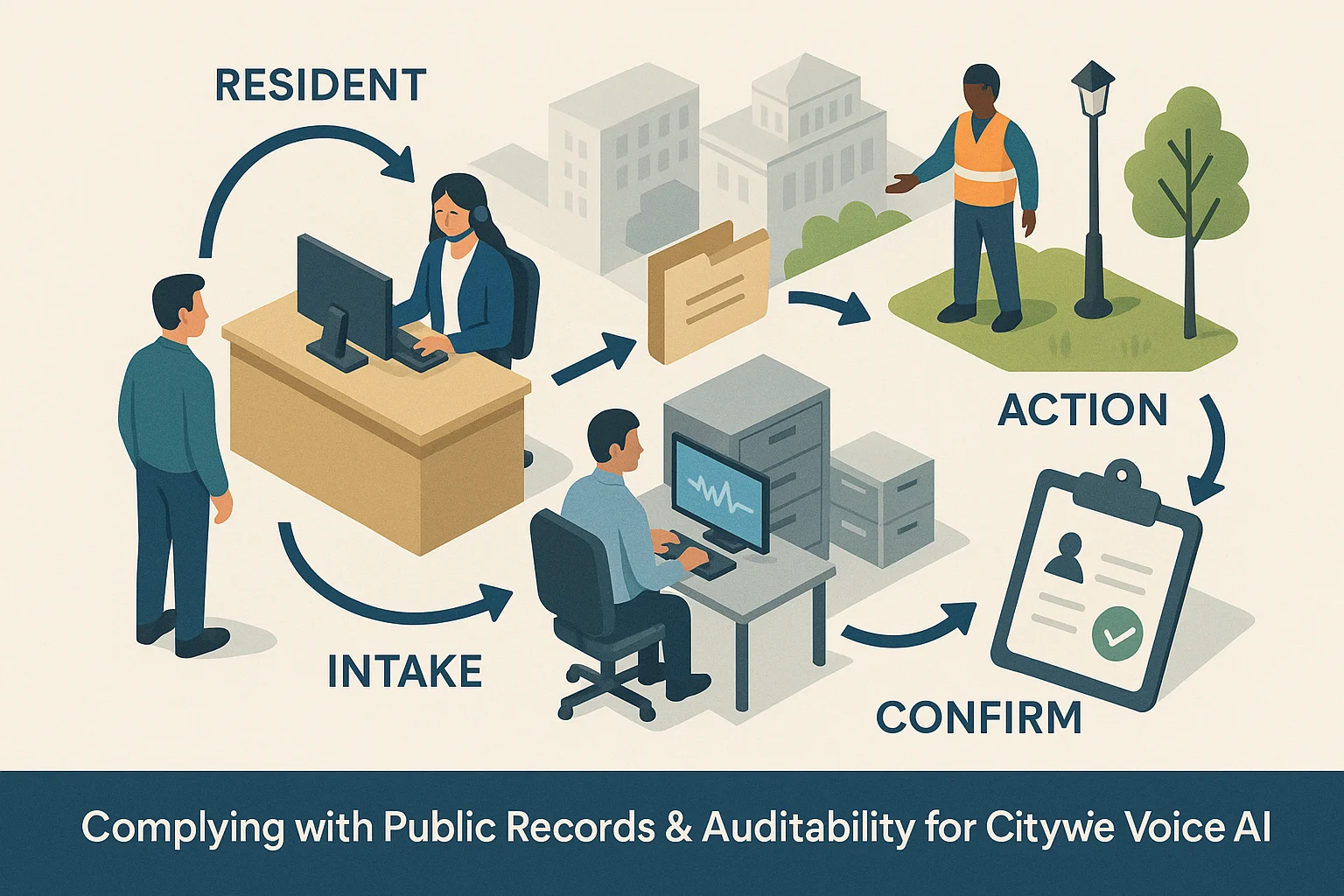
Presenting an architecture that maps to municipal workflows and simplifies auditability: Resident → Voice AI → logic bridge → form & field retrieval → validation → municipal case system → confirmation or human handoff.
Core components and data flows
Implement a small set of composable components that each have clear responsibilities and logging requirements.
- Voice AI: handles ASR, NLU, session management, and prompt sequencing; avoid embedding irreversible decision logic here.
- Logic bridge (or orchestration layer): converts conversational intents into structured forms, enforces field validation, applies duplicate checks, and records submission events.
- Form & field retrieval: dynamic forms populated from authoritative municipal registries (property lists, service categories) via controlled APIs.
- Municipal case system: final sink for validated case submissions and the authoritative record for follow‑up.
- Confirmation/handoff: immediate confirmation numbers, standardized summaries, and human escalation channels.
Why split logic bridge from Voice AI
Separating conversational AI from transactional logic reduces brittle coupling and makes auditing simpler. The logic bridge becomes the auditable translator that records exact field values and validation outcomes used to create official records.
- Easier discovery: queries for records target case system artifacts and bridge logs rather than transient model outputs.
- Clear failure boundaries: bridge enforces rules (address format, duplicate detection) and triggers human routing when validation fails.
- Simpler procurement: contracts can treat the Voice AI and orchestration as distinct components with different compliance needs.
3. Records capture, retention, and access: operational controls
Define what you capture, how long you keep it, and who can access it. These operational choices must be defensible, documented, and supported by configuration in both vendor and municipal systems.
What to record and why
Record levels should be driven by the likely public‑records requests and investigatory needs. Capture structured fields, verbatim transcripts (text and optionally audio), system metadata, and the mapping between conversational turns and final case fields.
- Always persist: case ID, form field values, confirmation number, creator system/service, and timestamps.
- Record provenance: session ID, agent version/model identifier, orchestration logic version, and field‑level validation flags.
- Audio retention: keep only where required and permitted; otherwise store transcripts with links to audio under defined access controls.
Retention, redaction, and discovery
Adopt retention schedules aligned to municipal policy. Implement automated redaction and segmentation to protect sensitive personal data while preserving discoverability of public content.
- Map each data element to a retention rule (for example: service requests vs. incident reports vs. recorded consent).
- Support exportable, human‑readable records packages for FOIA/ATIP requests (case record + associated logs + model/version metadata).
- Log any redactions and preserve an unredacted audit copy in restricted storage for authorized legal review.
4. Audit trails, model provenance, and measurable traceability
Auditability requires more than logs. Define the minimum traceability surface you must produce during a records request or an internal review: what the model saw, what actions it suggested, what the bridge validated, and who signed off.
Minimum audit elements
For each case submission, the system should be able to produce an ordered bundle containing:
- Immutable case record exported from the municipal case system.
- Voice session transcript with timestamps and speaker attribution (resident, system, agent).
- Bridge translation record showing mapping of conversational tokens to fields and validation results.
- System metadata: agent/model identifier, orchestration/bridge version, API call logs, and feature flags active during the interaction.
Model provenance and change control
Track model versions and configuration changes as rigorously as application releases. Use versioned deployments and tie each session to the active model/config snapshot so reproducing behaviour for review is feasible.
- Record model ID, training data snapshot identifier (where feasible), and prompt/template versions used.
- Enforce deployment change control and require pre‑deployment testing and risk signoffs for model updates.
- Maintain a tamper‑evident, time‑stamped log store for provenance data to support legal and audit inquiries.

5. Human oversight, escalation, and safety boundaries
Municipal Voice AI must explicitly route complexity, discretionary judgment, and sensitive matters to trained staff. Define safe escalation, monitoring, and continuous QA processes.
Defining failure boundaries
Clearly enumerate scenarios that the Voice AI cannot resolve and establish deterministic triggers for escalation.
- Emergency and safety: never let automated agents handle life‑threatening or imminent‑harm reports—play a recorded instruction and transfer to emergency lines.
- Legal/enforcement decisions and eligibility determinations: route to specialist teams only.
- Ambiguity thresholds: when confidence scores fall below a pre‑set level or validation fails repeatedly, escalate.
Human oversight workflows
Implement human review queues, sampling protocols, and retraining triggers tied to measurable error conditions.
- Real‑time supervisor takeover for complex calls and queued callbacks with full context and case drafts.
- Random and risk‑based sample reviews of interactions to measure accuracy and identify model drift.
- A closed‑loop feedback channel from reviewers to the orchestration rules and model prompts to correct recurrent errors.
6. Procurement, vendor management, and contractual controls
Procurement must enforce auditability, access, and security obligations. The contract is the place to make logging, discovery, and subprocessor behaviour non‑negotiable.
Key contractual clauses
Insist on explicit clauses that support public‑records duties and auditability.
- Data ownership: city retains ownership of records, transcripts, and metadata; vendor is a processor with defined rights.
- Logging and exportability: vendor must provide programmatic export of case packages and audit logs on demand within agreed SLAs.
- Subprocessor transparency: list subprocessors and require notification and approval for additions.
- Access controls and audit support: vendor must provide role‑based access, forensic logs, and support for legal holds.
Security and resilience expectations
Drive vendor obligations for data protection and operational resilience; align contractual security requirements to recognised cross‑sector goals.
- Specify hosting region(s), backup geography, and subprocessors; require disclosure of remote‑support access paths.
- Require vendor alignment with cross‑sector cybersecurity performance goals and incident response notification timelines.
- Demand documented breach duties and support for forensic investigations.
7. Implementation checklist, KPIs, and first 90‑day plan
A practical roadmap and measurable outcomes to move from pilot to production while preserving records integrity and auditability.
Quick implementation checklist
Use this checklist to validate readiness before production launch.
- Documented algorithmic impact assessment and risk register completed and approved.
- Architecture implemented with a separate logic bridge and enforced field validation.
- Logging and export tooling tested with sample FOIA/ATIP exports.
- Contract signed with explicit audit and subprocessor clauses.
- Defined human escalation rules and supervisor takeover flows active.
KPIs and measurable operating outcomes
Track a small set of hard metrics that demonstrate auditability and operational performance.
- Time to produce a records package in response to a request (target SLA).
- Log completeness rate: percent of cases with full audit bundle available.
- Validation failure rate: percent of submissions requiring human correction.
- Handoff latency: median time from escalation trigger to human pickup.
- Sampling accuracy: percent of sampled interactions where fields match verified outcomes.
Related Peak Demand resources
Industry and AI sources reviewed
- Artificial Intelligence Risk Management Framework (AI RMF 1.0)National Institute of Standards and Technology (NIST)
- Cross-Sector Cybersecurity Performance GoalsCybersecurity and Infrastructure Security Agency (CISA)
- Algorithmic Impact AssessmentGovernment of Canada
Public-sector procurement, privacy, accessibility, records, cybersecurity, and administrative-law obligations vary by jurisdiction. This article is operational guidance, not legal advice; organizations should confirm applicable requirements with qualified professionals.
Frequently asked questions
Suitable workflows include structured resident inquiries, service-request intake, permit or program information, appointment scheduling, department routing, status updates from approved systems, and after-hours overflow. Adjudication, enforcement discretion, emergency response, and binding eligibility decisions should remain with authorized staff.
Official reference: Artificial Intelligence Risk Management Framework (AI RMF 1.0)
Use a controlled service catalogue, required fields, department ownership rules, validation, duplicate checks, confirmation numbers, and documented handoff paths. The system should create an auditable record and avoid silently dropping requests when a downstream system is unavailable.
Official reference: Algorithmic Impact Assessment
Municipal deployments should document purpose, affected services, data use, human oversight, complaint and appeal paths, accessibility channels, records handling, monitoring, and the process for approving material changes.
Official reference: Algorithmic Impact Assessment
Require workflow demonstrations, integration and security architecture, testing evidence, auditability, data-location and subcontractor details, incident response, accessibility support, human escalation, exit planning, and clear ownership of ongoing updates.
Official reference: Artificial Intelligence Risk Management Framework (AI RMF 1.0)
Modernize public-service intake without losing control
Peak Demand helps municipal teams connect Voice AI to service requests, department routing, validation, escalation, records, and operational analytics.
Schedule a discovery call


