
Clinical Escalation Orchestration for Voice AI: Safe Cross‑Channel Patient Triage
Practical guidance for orchestrating safe, auditable clinical escalation in healthcare Voice AI. Covers workflows, identity validation, escalation triggers, QA, procurement, and measurable outcomes.
1. Why controlled clinical escalation matters for Voice AI
Voice AI is useful for intake, booking, and routine administrative tasks. But in healthcare, safety requires a clear boundary: Voice AI must orchestrate escalation when a caller’s issue is clinical, urgent, or ambiguous. This section explains the operating premise and the measurable safety goals.
Operating premise: Voice AI as orchestrator, not clinician
Treat Voice AI as an intake and orchestration layer that captures structured information, validates identity and fields, then either confirms administrative actions or escalates to trained staff. The system must not diagnose, prescribe, triage emergencies, or replace clinical judgment. Design rules should enforce that all clinical uncertainty, unexpected cues, or stated urgent symptoms route to human review.
- Capture discrete data (reason for call, onset, severity, red flags) rather than free-form clinical assessments.
- Use deterministic rules and confidence thresholds to decide escalation versus automated handling.
- Log and timestamp every decision, the data used, and the responsible actor (AI or human) for auditability.
Measurable safety goals
Set clear, auditable objectives before deployment. Typical goals include: 1) zero autonomous emergency handling, 2) >95% correct administrative routing, 3) defined acceptable false‑positive and false‑negative rates for escalation, and 4) time-to-human-response SLAs. These targets guide vendor selection, QA sampling, and acceptance criteria.
- Define escalation-fidelity thresholds and sample sizes for QA validation.
- Measure cost-to-serve per call path (fully automated, partial-automation + human, fully human).
- Track time-to-escalation and human handoff completion for safety SLAs.
2. Core architecture and validated workflow
A practical architecture with clear controls reduces risk and integrates with enterprise systems. This section outlines a standard pattern and where to place identity checks, validation, and human handoffs.
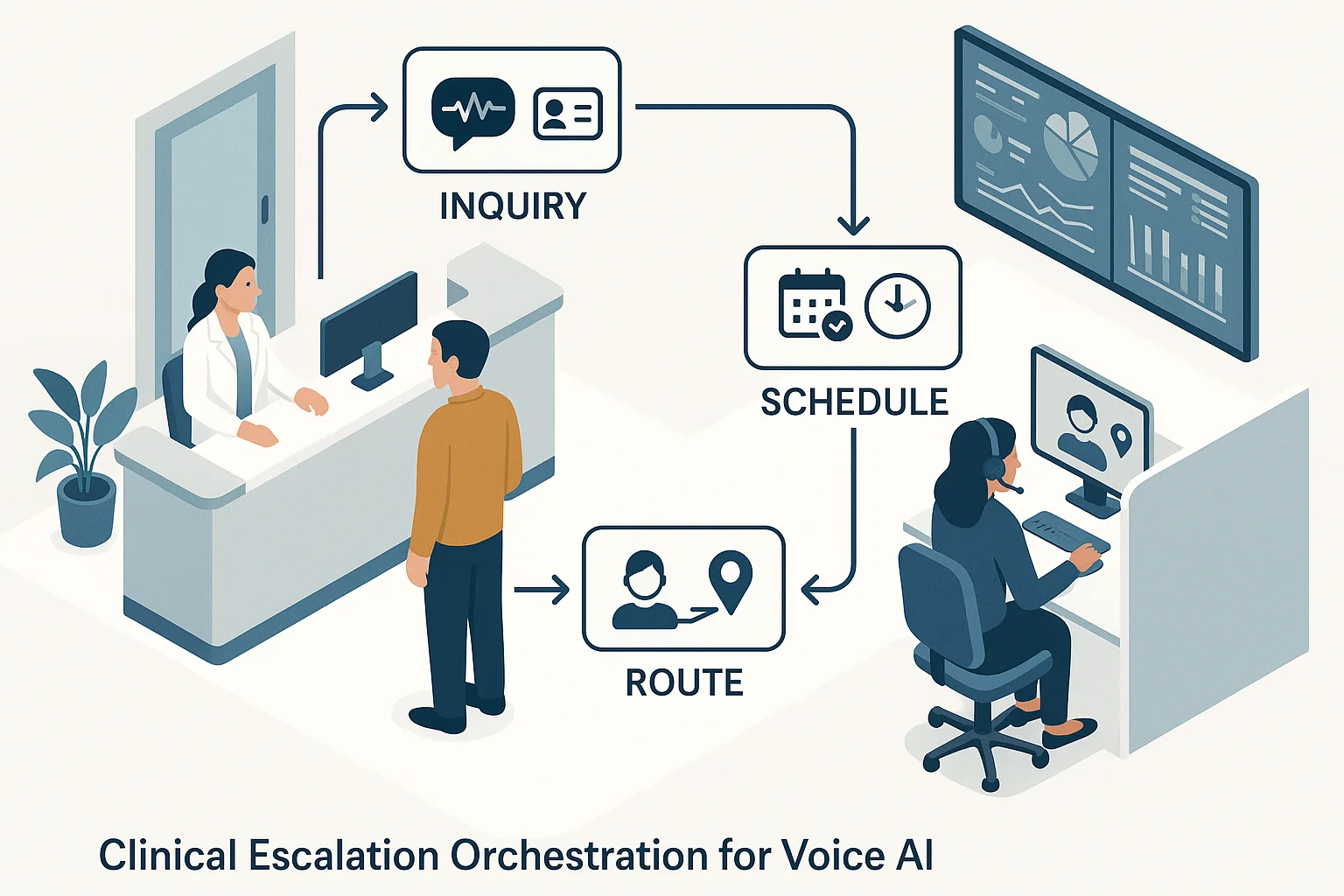
Canonical architecture: patient → Voice AI → validation → service API → handoff
Design the flow as: Caller/patient → Voice AI receptionist (NLP + deterministic prompts) → identity and field validation → call validation adapter → scheduling or clinical workflow API → confirmation or human handoff. Keep clinical and administrative APIs separate and gate clinical workflows with validated identity, consent, and explicit human acceptance for clinical tasks.
- Voice AI captures structured responses and performs sanity checks (numeric ranges, date formats, medication names via controlled vocab).
- Validation adapter performs identity lookup (MRN, DOB, phone), consent checks, and checks for recent interactions to avoid duplicates.
- Approved service APIs (scheduling, EHR/PM, care orchestration) perform final action only after receiving attestation flags from the validation adapter.
Integration touchpoints and controlled adapters
Use thin, auditable adapters between Voice AI and business systems: these adaptors enforce policy (who may act, which fields are required), record decisions, and provide rollback or compensating actions. Avoid direct broad writes from the Voice AI engine into core clinical records without a controlled staging layer and human reconciliation for sensitive fields.
- Adapters implement field-level permissions, schema validation, and idempotency keys to prevent duplicate bookings.
- Design a confirmation step: before finalizing a schedule or change, surface a human-approvable summary when the action is flagged as clinical or ambiguous.
- Provide synchronous and asynchronous handoff paths: immediate agent takeover for urgent issues; secure message or task for non-urgent follow-up.
3. Safety boundaries and escalation triggers
Define exact triggers that route callers to humans. These rules must be conservative and auditable, with clear role definitions for triage nurses, clinical coordinators, and front-desk staff.
Clinical vs administrative boundary
Classify each intent into clinical or administrative before action. Administrative intents include appointment booking, address updates, prescription refill requests that meet simple criteria. Clinical intents—new symptoms, medication side effects, pregnancy concerns, post-op complications—require human review. Maintain a living intent taxonomy and conservative default to escalate when in doubt.
- Default-to-human escalation for any mention of acute symptoms, altered consciousness, breathing difficulties, chest pain, significant bleeding, severe pain, or suicidal ideation.
- Implement explicit exclusion lists for automated actions (e.g., no autonomous medication changes).
- Regularly update intent lists from QA sampling and clinician feedback.
Deterministic triggers and confidence thresholds
Combine deterministic rules (keywords, structured responses) with model confidence thresholds. Use a two-step check: if the model confidence is below the safe threshold or triggers a clinical keyword, escalate. Keep thresholds conservative initially and tune based on measured false-negative rates from QA.
- Use conservative confidence thresholds for any action that could affect clinical care.
- Log model confidence and the rule that drove escalation for every routed call.
- Introduce soft escalations (e.g., confirmatory questions) where automation can clarify non-urgent ambiguity before human handoff.
4. Data, privacy, and operational controls
Voice AI deployments must address identity verification, recording consent, subprocessors, and data residency. The operational model must make data flows explicit and auditable.
Identity verification and consent
Verify caller identity before accessing or changing protected records. Use multi-factor checks appropriate to the action: callback confirmation, two-factor SMS/PIN, or knowledge-based questions integrated with the EHR/PM. Always record consent for call recording, data use, and any transfer to third parties, and present the information clearly to the patient.
- Define assurance levels: low-risk actions may require a single identifier; high-risk patient-data changes or clinical handoffs require stronger verification.
- Capture and store consent metadata (who consented, timestamp, consent scope and expiry) in the audit trail.
- Offer clear opt-out paths and human support for patients who refuse automated handling.
Data residency, subprocessors and breach duties
Document hosting region, backup region, subprocessors, remote‑support access, and cross‑border transfer mechanisms. Make these details part of procurement negotiations and the security appendix. Confirm retention windows for raw audio, transcripts, and structured data; only retain what is necessary for operations and compliance.
- Require vendors to disclose subprocessors and their hosting locations and to provide data flow diagrams showing onward transfers.
- Negotiate contractual obligations for breach notification timeframes, forensic data access, and cooperation with regulators.
- Distinguish between production hosting region, backup geography, and where remote support staff access systems for troubleshooting.
5. Measurement, QA, and continuous assurance
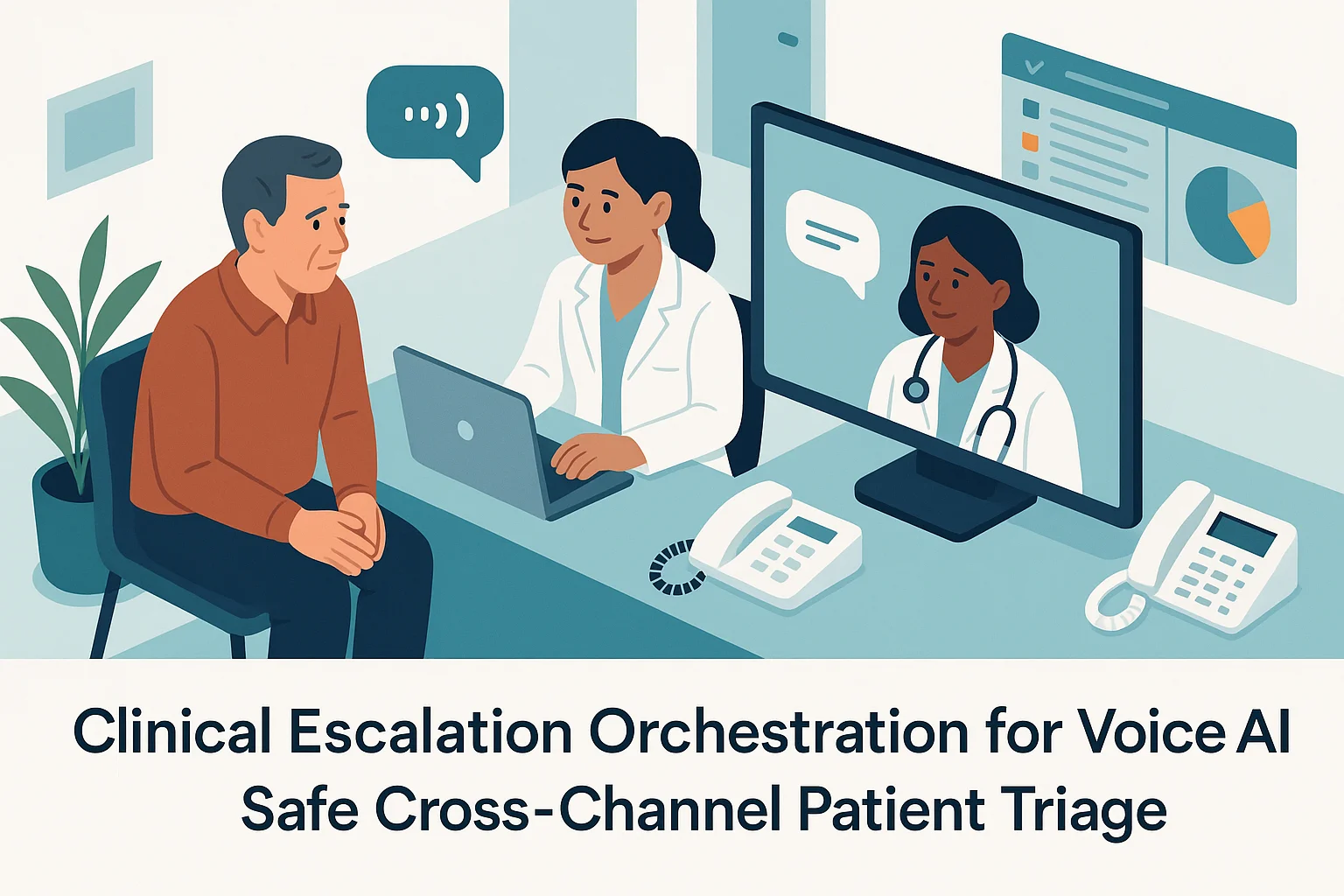
You cannot manage what you cannot measure. Operational QA should combine automated telemetry with human audit sampling to validate escalation fidelity and patient outcomes.
KPIs and measurable outcomes
Track a focused set of KPIs aligned to safety and efficiency. Core metrics include escalation-fidelity (true positive escalations vs. missed clinical cases), false escalation rate, time-to-human-response, confirmation‑to-completion rate for bookings, and cost-to-serve per pathway.
- Define statistical sampling procedures for manual review to estimate missed escalations with confidence intervals.
- Report KPIs by clinic site, time-of-day, language, and call-type to surface stratified failure modes.
- Correlate escalation outcomes with downstream care metrics where possible—e.g., were escalations associated with appropriate follow‑up within defined windows?
QA processes and human-in-the-loop review
Implement continuous QA: daily dashboards for alerts, weekly sampling charts, and monthly clinical reviews. Maintain a documented QA playbook: who reviews what, sampling rates, remediation steps, and retraining triggers. Ensure clinicians sign off on changes that affect clinical routing or wording that could alter patient responses.
- Hold weekly clinical‑ops syncs to review near-misses and modify escalation rules.
- Use paired reviews (operator + clinician) for ambiguous cases to improve taxonomy and prompts.
- Measure the impact of prompt and policy changes with A/B or phased rollouts before wide deployment.
6. Procurement, phased rollout, and failure containment
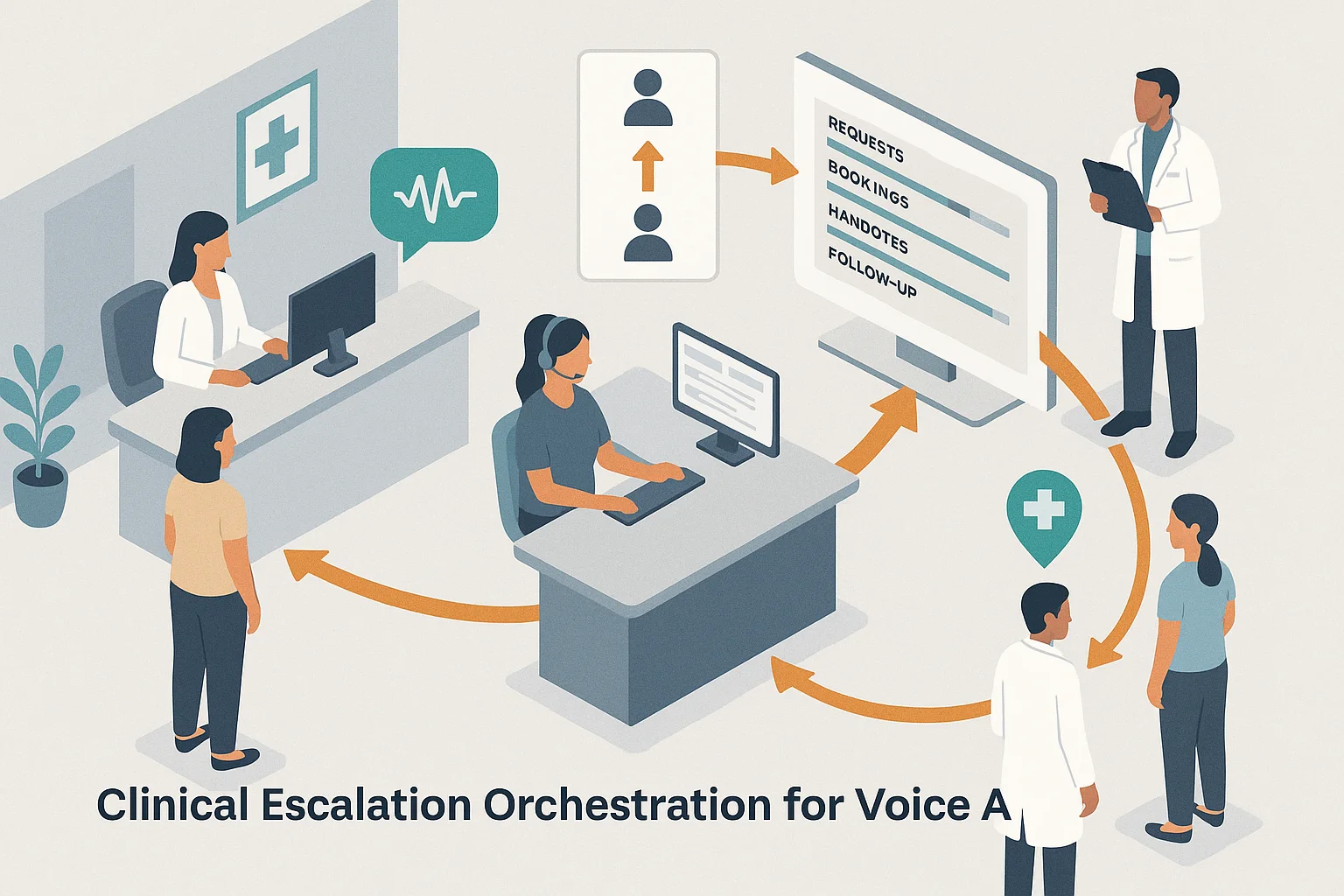
Specify evidence-based evaluation criteria and a conservative phased rollout plan that contains failures and protects patients. Procurement must prioritize integration evidence, governance, and measurable QA capability.
Vendor evaluation and contract essentials
Ask vendors for demonstrable integrations with scheduling, EHR/PM, or orchestration platforms and for documented audit trails. Require a security appendix that lists subprocessors, hosting regions, remote support, and retention policies. Include acceptance tests for escalation fidelity and clear termination/exit support for data extraction.
- Require proof of concept (PoC) that demonstrates identity validation, adapter behaviour, and escalations against your sample call set.
- Contractually require logging of decisions, model confidence, and retention of raw audio/transcripts for QA periods.
- Negotiate service levels for time-to-human-takeover, escalation-handling SLAs, and support for incident forensics.
Phased rollout and containment strategies
Begin with low-risk administrative tasks in a narrow clinic subset. Expand by intent group, language, and time-of-day only after meeting QA thresholds. Build automatic containment triggers that revert traffic to human agents when KPIs degrade or when systems lose connectivity to critical integrations.
- Phase 1: after-hours appointment booking and basic intake in a single site.
- Phase 2: daytime administrative tasks with identity verification and selective clinical escalations.
- Phase 3: expanded site rollouts with multilingual support and refined escalation thresholds.
7. Governance, roles and organisational design
Operational success requires a governance model that includes clinical, operational, IT, legal/privacy, and vendor management representation. Define responsibilities and decision rights up front.
RACI for Voice AI escalation
Define a RACI that separates policy, clinical content, escalation handling, and technical change control. Typical roles: Chief Patient Access Officer (policy owner), Clinical Safety Officer (clinical boundary owner), Contact Centre Manager (operations), IT/Integration Lead (technical owner), and Vendor SLA Manager (vendor accountability).
- Clinical Safety Officer approves any change to clinical routing or question wording.
- Contact Centre Manager owns agent handoff scripts and staffing to meet human takeover SLAs.
- IT lead owns adapters, audit logging, and incident response runbooks.
Change control and audit trails
Require versioned prompts, policy definitions, and test suites. Store immutable audit logs for decisions, model confidence, and human overrides. Ensure clinical sign-off for any change that reduces escalation conservatism.
- Adopt an approval workflow that prevents direct production edits to escalation logic without staged testing.
- Preserve raw audio, transcripts, and structured intake for the QA retention window defined in contracts.
- Use role-based access control to limit who may replay or export recordings for investigations.
Related Peak Demand resources
Industry and AI sources reviewed
- OECD AI PrinciplesOrganisation for Economic Co-operation and Development
- Ethics and governance of artificial intelligence for healthWorld Health Organization
- Regulatory considerations on artificial intelligence for healthWorld Health Organization
- Artificial Intelligence Risk Management Framework (AI RMF 1.0)National Institute of Standards and Technology (NIST)
Healthcare privacy, security, clinical-safety, records, and professional obligations vary by jurisdiction and workflow. This article is operational guidance, not legal advice; organizations should confirm applicable requirements with qualified professionals.
Frequently asked questions
Administrative workflows such as appointment booking, changes and cancellations, referral-status intake, approved follow-up, patient-access questions, after-hours overflow, and structured routing are common starting points. Clinical judgment, diagnosis, emergency triage, and prescribing decisions must remain with qualified professionals.
Use the minimum identifiers approved by the organization, validate them against the system of record, avoid exposing unnecessary information, and provide a human-assisted path when verification fails. The system should not infer identity from conversational context alone.
The agent should follow the organization's approved escalation and emergency-routing rules, avoid clinical advice, and transfer or direct the caller to the appropriate human or emergency channel. Those rules must be tested with realistic language and failure cases.
Request identity and privacy controls, scheduling or EHR integration behavior, audit logs, escalation rules, downtime handling, testing evidence, change control, monitoring, and clear separation between administrative automation and clinical decision-making.
Design a safe patient-service workflow before automating it
Peak Demand helps healthcare organizations connect Voice AI to scheduling, intake, patient communication, identity checks, escalation, and reporting with clear operational boundaries.
Schedule a discovery call


