
Clinical Data Provenance and Audit Trails for Enterprise Voice AI
Practical guidance for healthcare organisations deploying Voice AI for patient access: design audit trails and provenance, integrate with scheduling/EHR systems, enforce identity and escalation controls, and run procurement and QA that meet regulated-industry expectations.
1. Use case and operating model — Scheduling, intake, and safe handoffs
A focused production use case clarifies provenance requirements. We outline a common enterprise pattern: automated patient scheduling, pre-visit intake, and post-discharge check-ins handled by Voice AI with strict clinical boundaries and defined handoffs.
Call flow and ownership
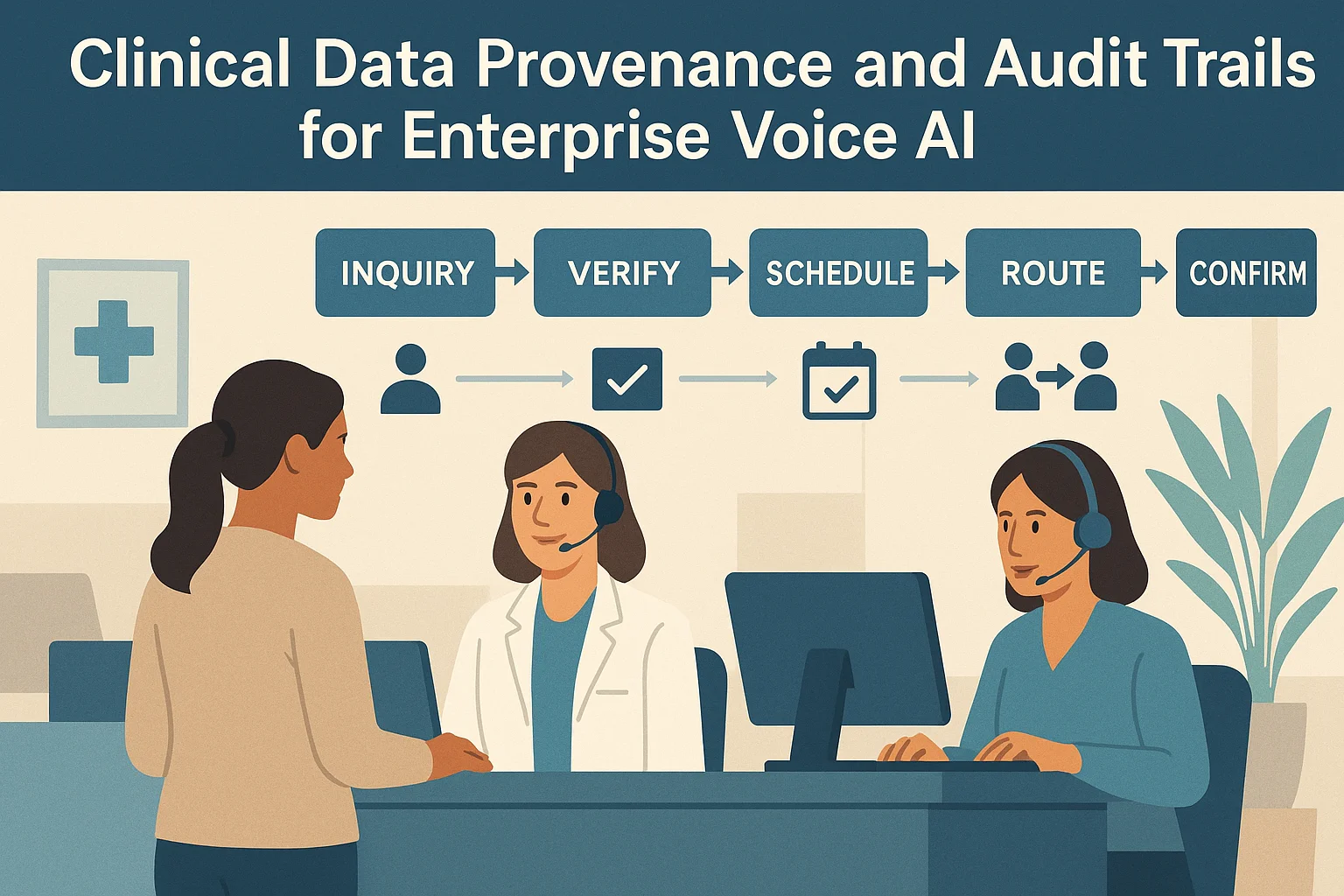
Design the interaction as a linear, auditable corridor. The caller (patient or proxy) interacts with the Voice AI; the AI collects structured fields (name, date of birth, reason for visit limited to administrative categories), performs identity verification, validates scheduling availability with the EHR/PM system via an approved scheduling API, then either confirms the booking or routes to human agents for exceptions. Ownership must be explicit: the healthcare organisation owns the clinical record and patient identifiers; the Voice AI vendor is a processor/subprocessor. Contracts must name subprocessors, hosting regions, and data flows, and assign roles for audit-data production and forensic access.
- Primary flow: Caller → Voice AI collects fields → Identity check → Field validation → EHR/PM scheduling API → Confirmation or human escalation.
- Record what was asked, what was answered, validation checks and outcomes, and the exact API responses that changed clinical or scheduling state.
- Define who is responsible for producing audit exports, and at what service level (for investigations, regulatory requests, or litigation).
Clinical safety boundaries
Voice AI in patient access must operate with conservative boundaries: handle administrative intake, appointment scheduling, reminders, and basic information. It must not diagnose, triage emergencies, prescribe, or substitute clinical judgement. Build explicit detection rules to escalate if the caller uses clinical language that suggests urgent care or ambiguous symptoms. Escalation is part of the operating model: if confidence thresholds, validation checks, or content categories trigger risk, the system must open a human handoff route and preserve the full interaction context for review.
- Define prohibited actions for the Voice AI and implement lexical and classification triggers that cause immediate escalation.
- Record the rationale for escalation (confidence score, triggered keyword, failed identity check) as part of the audit trail.
- Train contact-centre teams on receiving AI-originated escalations, with scripts and time-to-response SLAs.
2. What to record: minimal vs. best-practice provenance
Not all logs are equal. Decide what must be captured by policy and instrument at design time so auditability is guaranteed without excessive data exposure.
Essential audit events
At minimum, capture a consistent set of auditable events for each call: session start/end times with time zone and server timestamps, unique session and patient linkage identifiers, caller-provided identifiers validated, raw audio (or secure audio fingerprint), transcript/versioned text, NLU/intent labels and confidence scores, validation checks and outcomes, downstream API calls and responses (request/response payloads and status codes), human review events, and final disposition. Store these elements as separate records rather than a monolithic blob so they can be queried, exported, and presented in investigations.
- Session metadata: timestamps, session ID, caller source (CLI or SIP origin), media server node and region.
- Content records: raw audio (or secure hash), transcripts (with version tags), structured fields and classifications with confidence scores.
- Action records: external API calls, scheduler responses, human-agent overrides, timestamps and operator IDs for each change.
Tamper-evident storage and linkage
Use append-only event stores, write-once storage buckets with object immutability, or cryptographic hashing to make alteration detectable. For cross-system provenance, include persistent identifiers (patient ID, encounter ID, call ID) in every logged event so the audit trail can be recomposed and validated. Retention policies must be explicit and aligned to consent and jurisdictional obligations; map retention to each artifact (audio, transcript, event log, API payload) and the legal basis for retention.
- Store an immutable audit index that references raw artifacts and contains cryptographic hashes for each artifact.
- Ensure each event includes the originating host, timestamp, and operator or process ID.
- Document retention and erasure policies for every artifact and the mechanism to execute them.
3. Identity, field validation and human review controls
Provenance is meaningful only if inputs are validated. Identity verification and field validation reduce downstream risk and improve audit integrity.
Identity checks and consent capture
Implement multi-factor or layered identity checks appropriate to the transaction risk (e.g., name + DOB + callback verification or a short knowledge-based check for higher-risk actions). Record which identity vectors were used, their outcomes, and capture explicit verbal consent for recording and for sharing data with scheduled services. Consent artifacts (timestamp, wording presented, and caller acceptance) should be stored separately and linked to the session ID.
- Use a tiered approach: light verification for reminders, stronger verification for changing appointments or discussing PHI.
- Log the exact consent script text and the caller’s affirmative response with timestamp.
- Map identity verification tolerance to downstream actions—e.g., require stronger checks before changing an appointment or releasing PHI.
Human review queues and sampling
Not every call needs full human review. Implement a combination of: 1) deterministic escalation for policy triggers; 2) risk-based sampling for QA; and 3) on-demand audit access for investigators. Record QA outcomes and remediation actions to close the loop and improve models and rules.
- Define sampling rates by call type and risk profile; log sampling rationale.
- Include a fast-access ‘case pack’ export that bundles audio, transcript, NLU outputs, validation checks, API responses and operator notes for review.
- Track remediation actions as traceable events in the audit trail (what was fixed, who fixed it, when).
4. Governance, risk management and regulatory alignment
Effective provenance needs governance that spans privacy, clinical safety, procurement, and technical operations. Use accepted frameworks and sector guidance to structure controls and documentation.
Integrate AI risk management with existing clinical governance
Risk management for Voice AI should be part of the wider clinical and information-governance program. Use an established AI risk framework to assess likelihood and impact across confidentiality, integrity, availability, safety and rights. Regularly review policies, maintain a risk register, and map controls to those risks. For practical alignment, use the NIST AI Risk Management Framework to structure lifecycle risk assessments, monitoring and reporting for health-adjacent AI systems.
- Maintain a documented AI risk register that ties specific provenance controls to identified risks.
- Conduct periodic re-assessments when models, integrations, or subprocessors change.
- Instrument monitoring to detect drift in classification confidence and escalation rates.
Ethics, clinical boundaries and policy
Align governance decisions with health-specific ethics and regulatory guidance: establish explicit policies limiting the Voice AI’s clinical scope, ensure transparency about automation when interacting with patients, and maintain accountable human oversight. Formalise roles and responsibilities so clinicians, privacy officers, and operations leaders approve boundary changes. Consult WHO guidance on AI in health for high-level governance and ethics considerations; tailor those recommendations to local regulatory obligations.
- Publish a clear statement on what the Voice AI will and will not do for patients.
- Require clinician sign-off for any change that affects clinical content or workflows.
- Keep an audit trail of governance decisions, policy changes and approvals.

5. Procurement and implementation choices
Procurement must assign responsibility for provenance, audit access, hosting, subprocessors and operational observability. The right choices reduce friction during audits and incident investigations.
Vendor evaluation checklist
Evaluate vendors on these points: ability to produce a complete, exportable audit bundle; architecture for immutable logging and tamper evidence; clear subprocessor listings and hosting geography; integration patterns for your EHR/PM (approved APIs and adapters); SLAs for audit requests and log retention; and support for human review exports. Prefer vendors that support structured audit exports (JSON event streams, WORM buckets, cryptographic hashes) and that will accept contractual obligations to produce forensic packages on demand.
- Require a sample audit export format and test the export during procurement proof-of-concept.
- Confirm hosting region, backup geography, and the mechanism for remote-support access.
- Verify vendor observability: log levels, metrics exposed, and alerting for anomalies.
Managed vs. self‑managed and integration ownership
Decide who owns integration adapters (EHR/PM connectors, scheduling APIs). Managed services reduce operational burden but must provide transparent access to provenance data and clear subprocessors. If self-managing, ensure your IT team has control over retention, access controls and export procedures. Peak Demand differentiates by building custom Voice AI with scheduling and intake integrations, identity verification, field validation, safe escalation, and human review, and can document connectivity to FHIR or care-orchestration platforms as part of procurement testing.
- Define who is responsible for the EHR/PM API keys, token rotation and logs.
- Include remediation and forensic support SLAs in managed-service contracts.
- Test failover: simulate downstream API outages and verify preserved audit records.
6. Operational instrumentation, KPIs and incident response
Provenance is not a one-time project. Operationalise it with measurable outcomes and a forensic-ready incident runbook.
Key metrics and QA
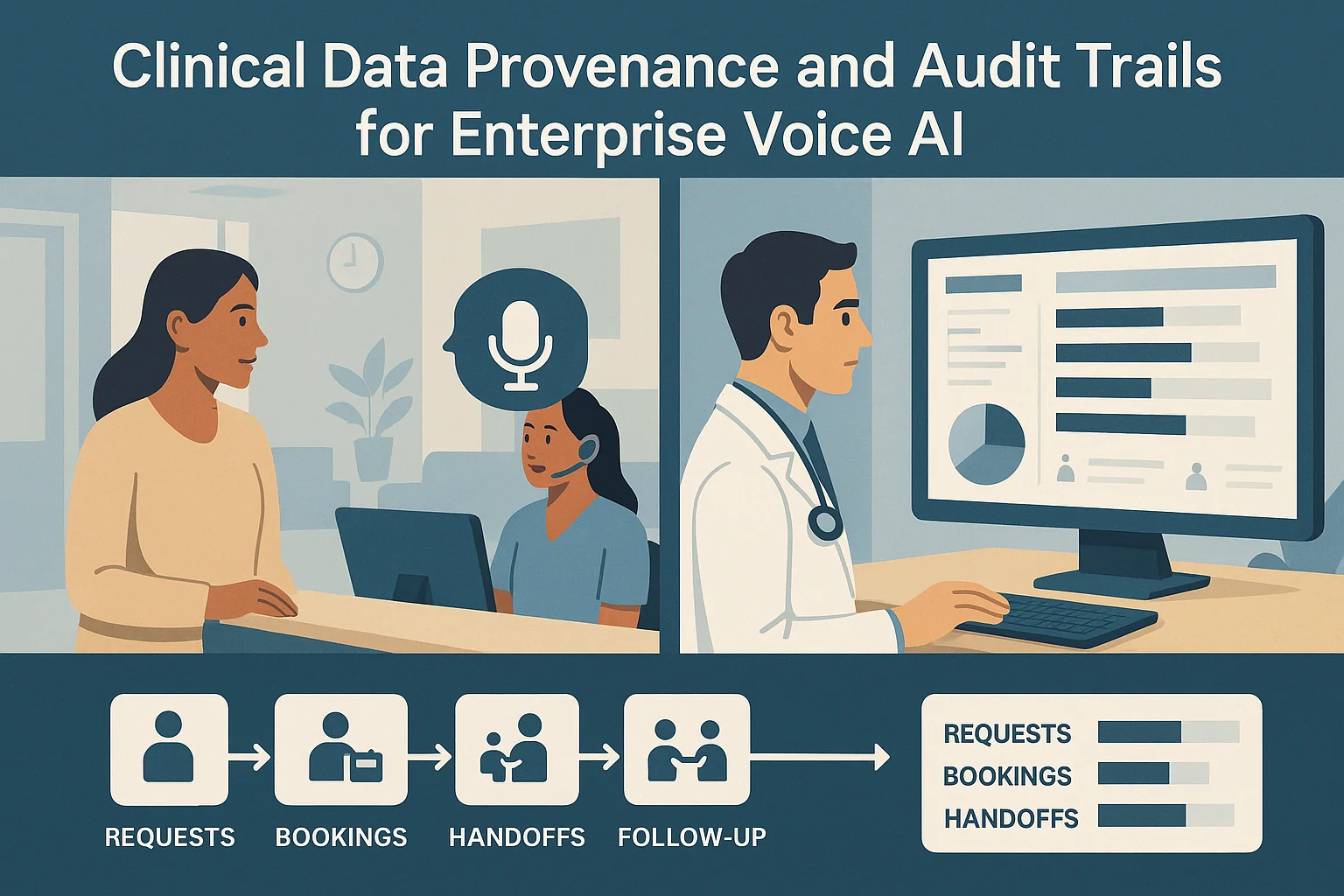
Track metrics that show both system health and audit integrity: linkage rate (percent of calls successfully linked to a patient record), audit‑completeness (percent of calls with full artifact set), false-acceptance rate for identity checks, escalation frequency and mean time to human response, and export/forensic SLA compliance. Use these KPIs to guide sampling, model retraining, and rule adjustments.
- Instrument dashboards for linkage rate, failed validation reasons, and escalations by category.
- Automate daily QA sampling and weekly trend reporting to compliance and clinical governance owners.
- Log and surface changes in NLU confidence distributions that could affect provenance reliability.
Incident and forensic runbook
Maintain a step-by-step incident runbook that includes: preserving the immutable audit index, producing a case pack, capturing timelines and actor IDs, informing legal and privacy teams, notifying impacted patients (as required by law or policy), and a root-cause analysis timeline. Ensure the vendor’s responsibilities for forensic exports and log retention are contractually defined.
- Pre-authorise forensic export formats and a trusted contact list for rapid response.
- Test the runbook with tabletop exercises at least annually or after major changes.
- Document breach duties, including jurisdictional notification thresholds and timelines, and confirm them with qualified counsel.
Related Peak Demand resources
Industry and AI sources reviewed
- Artificial Intelligence Risk Management Framework (AI RMF 1.0)National Institute of Standards and Technology (NIST)
- Ethics and governance of artificial intelligence for healthWorld Health Organization
- Regulatory considerations on artificial intelligence for healthWorld Health Organization
- OECD AI PrinciplesOrganisation for Economic Co-operation and Development
Healthcare privacy, security, clinical-safety, records, and professional obligations vary by jurisdiction and workflow. This article is operational guidance, not legal advice; organizations should confirm applicable requirements with qualified professionals.
Frequently asked questions
Administrative workflows such as appointment booking, changes and cancellations, referral-status intake, approved follow-up, patient-access questions, after-hours overflow, and structured routing are common starting points. Clinical judgment, diagnosis, emergency triage, and prescribing decisions must remain with qualified professionals.
Use the minimum identifiers approved by the organization, validate them against the system of record, avoid exposing unnecessary information, and provide a human-assisted path when verification fails. The system should not infer identity from conversational context alone.
The agent should follow the organization's approved escalation and emergency-routing rules, avoid clinical advice, and transfer or direct the caller to the appropriate human or emergency channel. Those rules must be tested with realistic language and failure cases.
Request identity and privacy controls, scheduling or EHR integration behavior, audit logs, escalation rules, downtime handling, testing evidence, change control, monitoring, and clear separation between administrative automation and clinical decision-making.
Design a safe patient-service workflow before automating it
Peak Demand helps healthcare organizations connect Voice AI to scheduling, intake, patient communication, identity checks, escalation, and reporting with clear operational boundaries.
Schedule a discovery call


