
Citywide Voice AI Control Plane: Phased Migration, SRE & Capital Gates
A jurisdiction‑neutral operating framework for municipal Voice AI: phased migration roadmap, control‑plane architecture, SRE and observability practices, procurement-ready capital gates, and operational controls that preserve public accountability and safety.
1. Operating model overview — what the control plane must do
A municipal Voice AI control plane orchestrates inbound resident voice interactions into actionable municipal records while maintaining audit trails, accessibility, and human oversight. The architecture below defines the decisive integration points and control responsibilities.
Core architecture and data flow
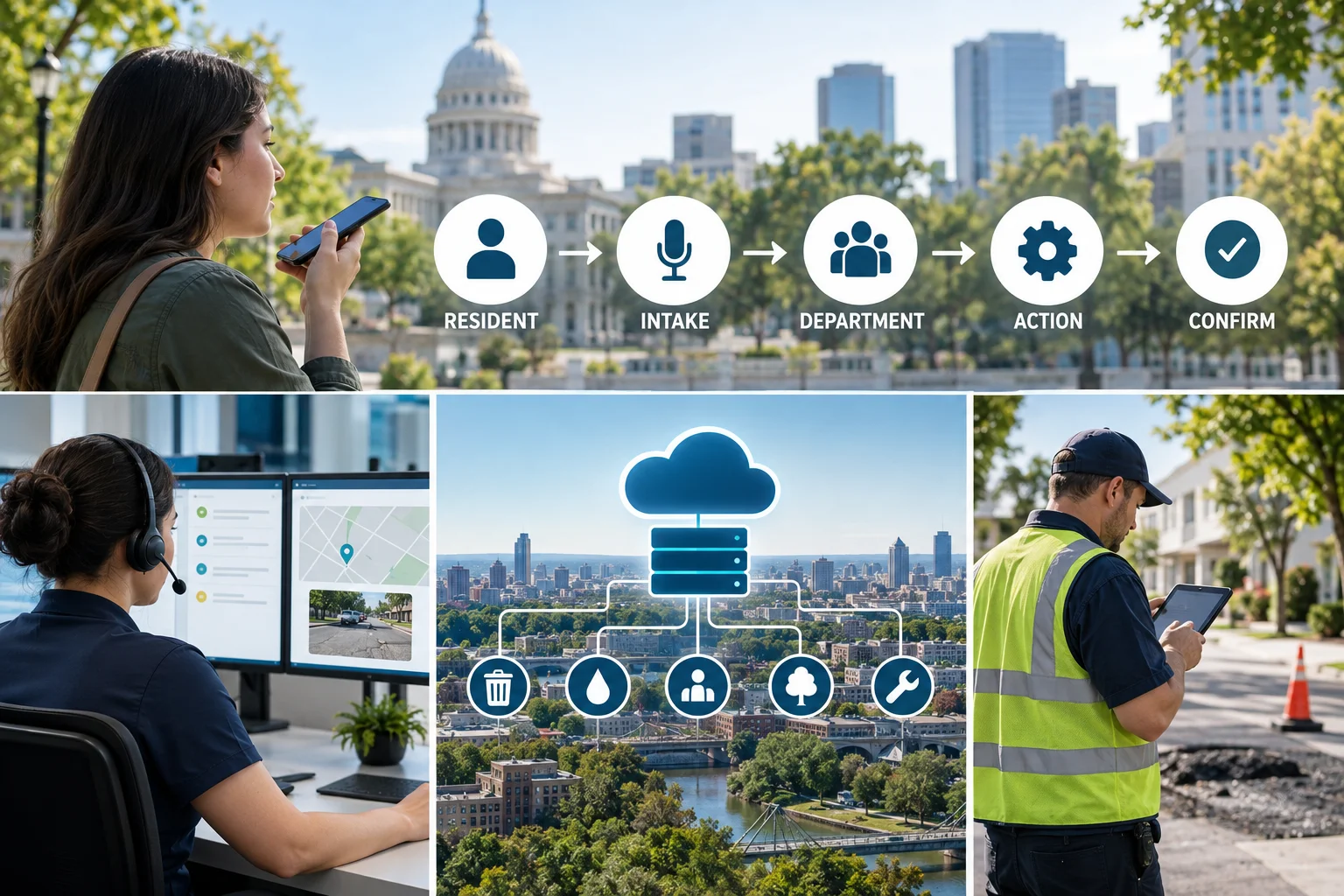
Design the control plane as a deterministic pipeline with explicit handoffs and verifiable outputs. The canonical flow is: Resident → Voice AI (ASR/NLU) → logic bridge (routing, policy, context) → form and field retrieval (dynamic forms) → validation and duplicate detection → municipal case system (create/update) → confirmation number or human handoff. Each hop should be observable, idempotent where possible, and auditable.
- Logic bridge: enforces routing rules, access policies, and failure‑boundaries before any case change.
- Dynamic forms + field retrieval: fetch the latest form and validation rules from the authoritative system at runtime to avoid drift.
- Duplicate controls: run a deterministic duplicate check (address, timestamp, contact, subject) before creating new records.
Control-plane responsibilities and separation of duties
Separate tactical functions—voice recognition and dialog management—from governance functions—policy enforcement, audit logs, and records retention. Maintain a narrow, well‑documented interface between voice vendors and municipal backend systems using approved APIs and controlled adapters. The control plane is responsible for validation, rate limiting, case submission, confirmation numbering, and escalation to human operators when policy or quality thresholds are exceeded.
- API-led integrations: use vetted, documented APIs and adapters rather than bespoke DB-level access.
- Auditability: every case submission must carry provenance metadata (agent version, intent confidence, validation status, operator if escalated).
- Accessibility: enforce plain-language confirmations, alternative channels, and recording-consent flows where required.
2. Phased migration roadmap
A staged approach reduces risk and produces procurement and capital‑gate evidence. Each phase delivers a bounded set of capabilities with clear acceptance criteria tied to operational metrics.
Phase 0 — Discovery and risk framing (0–3 months)
Inventory high‑volume, low‑sensitivity use cases (e.g., missed‑trash pickup, streetlight outage) and map backend owners, SLAs, and data flows. Run an algorithmic impact assessment for each use case and capture data residency, subprocessors, and retention policies. Produce the initial business case, security checklist, and procurement requirements.
- Identify data flows and hosting regions, and note any cross‑border processor relationships.
- Define failure boundaries: what triggers immediate human takeover?
- Produce procurement artifacts: use-case requirements, sample API spec, and acceptance tests.
Phase 1 — Pilot (single service, controlled volume)
Deploy a pilot for a single, low‑risk municipal service. Validate dynamic form retrieval, field-level validation, duplicate detection, and confirmation number issuance. Use human‑in‑the‑loop monitoring to quantify intent accuracy and case quality. Gate progress on measurable SLIs and whether safety limits are met.
- Acceptance gates: >X% case creation accuracy on audited sample (replace X with jurisdictional target), stable duplicate‑detection false positives under threshold, and accessible confirmation processes.
- Operational readiness: runbooks for handoff, incident escalation, and rollback.
- Procurement evidence: test logs, audit trails, ROI and cost‑to‑operate estimates for capital gate review.
3. SRE, observability and failure boundaries
Operate the control plane with SRE practices tailored to public services. Focus on a small set of SLIs/SLOs, deterministic escalation, and blunt failure boundaries that protect public safety and accountability.
Key SLIs / SLOs and monitoring
Choose pragmatic SLIs that map to resident experience and records integrity. Suggested SLIs: successful case creation rate (per intent), human‑handoff frequency, end‑to‑end transaction latency, and percent of audited cases passing validation. Define SLOs and error budgets tied to capital gates.
- Case creation success rate (SLO example): 99% for low‑risk services during business hours.
- Human‑handoff SLO: 95% handoffs resolved within target time for priority queues.
- Observability: aggregated traces, transaction logs, and ingestible audit records for compliance and QA.
Incident management, runbooks and failure boundaries
Define explicit failure modes that force the control plane to fail safe: 1) ASR/NLU degradation — route to IVR/recording; 2) logic bridge policy violation — block and escalate to human; 3) case system outage — queue writes with persistent durable storage and alerting. Maintain runbooks for each mode with roles, escalation ladders, and communications templates.
- Fail‑soft for availability: when upstream case system is unavailable, persist canonical JSON transactions in an encrypted queue and notify owners.
- Fail‑secure for safety: when intent confidence is below threshold for safety‑sensitive topics, require live agent takeover.
- Post‑incident: SRE-led root cause analysis and updated compensating controls.
4. Integrations, validation and Peak Demand differentiators
Integration patterns must balance speed of resident experience with authoritative validation and auditability. Peak Demand differentiators are embedded into this layer: dynamic forms, API integrations, validation, duplicate controls, case submission, confirmation numbers, accessibility, and audit logs.
Integration patterns and transaction guarantees
Prefer API‑first integrations using business system contracts. Use idempotency keys to prevent duplicate case creation across retries. For systems lacking modern APIs, use controlled adapters with explicit transformation logic and an auditable staging zone. Always attach provenance metadata to the transaction payload.
- Idempotency: key = (resident_id || hashed_contact || event_window || intent) to avoid duplicates.
- Queueing model: durable write to staging when primary case system is down; reconcile and sweep once available.
- Adapters: separate connector layer that can be independently hardened and audited.
Validation, duplicate controls and confirmation numbers
Run field‑level validation against authoritative rules retrieved at call time. Apply duplicate detection before case creation and surface likely duplicates to operators with a similarity score. Provide residents an auditable confirmation number and a plain‑language summary of what was recorded.
- Dynamic validation: fetch field constraints (required/format/lookup lists) from the canonical case system to prevent drift.
- Duplicate detection: deterministic checks + probabilistic fuzzy match with human review above threshold.
- Confirmation number: canonical, per‑transaction ID stored in records and communicated to resident via voice and optional SMS/email.

5. Portfolio governance, procurement and capital gates
Treat Voice AI like any other municipal capital program: require gate reviews, evidence packages, and clear criteria that tie to risk, accessibility, and records obligations. The procurement strategy must align vendors to specific controllable adapters and SLAs.
Capital gates and acceptance evidence
Define capital gates at milestone exits: Gate A (Discovery sign‑off), Gate B (Pilot acceptance), Gate C (Operational handover for scale), Gate D (Full portfolio adoption). Each gate requires documented evidence: end‑to‑end test reports, security checklists, privacy/impact assessments, accessibility validation, and signed SLA terms.
- Gate B evidence: audited sample of X voice transactions, acceptance tests on duplicate controls, confirmation number issuance verified, accessibility pass on core flows.
- SLA items: incident response times, data export capability, retention controls, and obligations for subprocessors.
- Procurement artifacts: API specification, adapter security spec, and vendor runbooks for handoff.
Vendor scope and contract boundaries
Contracts must explicitly separate feature delivery from control responsibilities: vendor provides voice stack and adapters; the city retains policy controls, configuration of routing and failures, records retention settings, and final authority over escalation rules. Require deliverable‑based milestones tied to acceptance tests.
- Define who owns intent model updates, who can change validation rules, and how emergency overrides are executed.
- Mandate access controls, subprocessors list, and audit log access as contractual deliverables.
- Require the vendor to support forensic export of transaction data and explain retention/backup geography.
Regulatory and ethical checks
For each service, perform an algorithmic impact assessment and map risks to controls. Use the assessment to determine where human‑in‑the‑loop is required and whether additional consent or notices are necessary. Legal, records, and procurement teams should validate the assessment before moving between gates.
- Algorithmic impact assessment: scope, data use, decision boundaries, and mitigations.
- Data residency & transfer: document hosting region, backup region, subprocessors, onward transfer mechanisms, and breach duties; confirm obligations with qualified counsel.
- Ethical governance: periodic reviews for bias, accessibility gaps, and disproportionate impacts on vulnerable populations.

6. Operational controls, audits and continuous improvement
Voice AI must be operated as a regulated public service. Institute QA, scheduled audits, and continuous model lifecycle controls tied to the control plane.
QA, sampling and human oversight
Run continuous QA by sampling voice transactions for manual review. Track trends in intent drift, validation failures, and duplicate rates. Establish clear criteria and a practitioner training program for staff who will audit or take over conversations.
- Sampling plan: stratified by service, time of day, and confidence bands to capture edge cases.
- Feedback loop: audited errors feed retraining or rule updates in a controlled change process.
- Staffing: define operator roles, training, and authority to reclassify or close cases.
Data lifecycle, retention and privacy considerations
Define retention policies for recordings, transcripts, derived artifacts, and audit logs. Map retention to records classifications, FOI obligations, and privacy requirements. Document hosting region, backup region, subprocessors, retention periods, and how residents can request records.
- Retention tiers: transient (ASR buffer), short (30–90 days transcripts), long (case records per municipal policy).
- Onward transfer: explicitly document subprocessors and mechanisms for cross‑border transfers; do not assume uniform legal obligations across jurisdictions.
- Breach duties: define notification timelines, forensic responsibilities, and recovery steps in contractual terms.
Continuous improvement and governance cadence
Hold regular governance reviews that combine SRE metrics, QA findings, and algorithmic assessments. Use these cadences to adjust SLOs, reweight handoff thresholds, and plan capital reinvestments.
- Quarterly governance: review incidents, change requests, and algorithmic impact reassessments.
- Annual audit: independent review of accessibility, privacy, and security controls.
- Budgeting: tie reinvestment to observed failure modes and service volume growth.
Related Peak Demand resources
Industry and AI sources reviewed
- Algorithmic Impact AssessmentGovernment of Canada
- Artificial Intelligence Risk Management Framework (AI RMF 1.0)National Institute of Standards and Technology (NIST)
- Cross-Sector Cybersecurity Performance GoalsCybersecurity and Infrastructure Security Agency (CISA)
Public-sector procurement, privacy, accessibility, records, cybersecurity, and administrative-law obligations vary by jurisdiction. This article is operational guidance, not legal advice; organizations should confirm applicable requirements with qualified professionals.
Frequently asked questions
Suitable workflows include structured resident inquiries, service-request intake, permit or program information, appointment scheduling, department routing, status updates from approved systems, and after-hours overflow. Adjudication, enforcement discretion, emergency response, and binding eligibility decisions should remain with authorized staff.
Official reference: Artificial Intelligence Risk Management Framework (AI RMF 1.0)
Use a controlled service catalogue, required fields, department ownership rules, validation, duplicate checks, confirmation numbers, and documented handoff paths. The system should create an auditable record and avoid silently dropping requests when a downstream system is unavailable.
Official reference: Algorithmic Impact Assessment
Municipal deployments should document purpose, affected services, data use, human oversight, complaint and appeal paths, accessibility channels, records handling, monitoring, and the process for approving material changes.
Official reference: Algorithmic Impact Assessment
Require workflow demonstrations, integration and security architecture, testing evidence, auditability, data-location and subcontractor details, incident response, accessibility support, human escalation, exit planning, and clear ownership of ongoing updates.
Official reference: Artificial Intelligence Risk Management Framework (AI RMF 1.0)
Modernize public-service intake without losing control
Peak Demand helps municipal teams connect Voice AI to service requests, department routing, validation, escalation, records, and operational analytics.
Schedule a discovery call


