
Citywide Data Contracts and Identity for Predictive 311 Operations
An operational framework for municipal leaders to design secure, auditable data contracts and identity flows that power predictive 311 services and Voice AI intake while preserving human oversight and public accountability.
1. Executive summary and operating model
This section sets a clear decision model for municipal teams considering predictive 311. It focuses on the end-to-end operational flow for Voice AI intake, the role of data contracts and identity, and the non‑negotiable safety boundaries that keep sensitive decisions with humans.
Operational pipeline — one line of authority
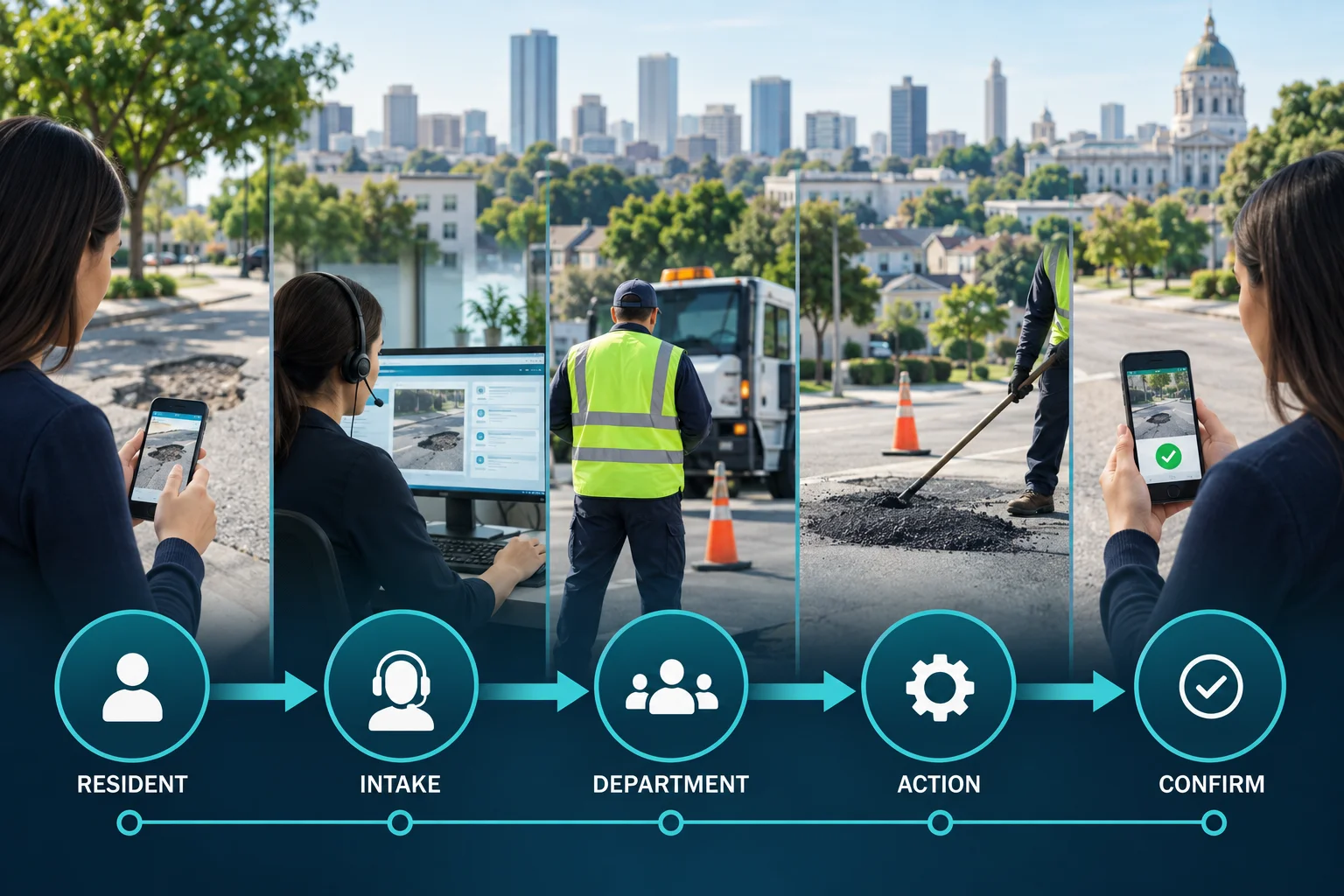
Adopt a simple, enforceable pipeline as the authoritative design pattern: Resident → Voice AI → logic bridge → form and field retrieval → validation → municipal case system → confirmation or human handoff. The logic bridge is the municipal integration layer that enforces data contracts, runs validation and duplicate controls, and records every transaction for auditability.
- Voice AI captures intent, minimal identity data and dynamically requests fields from the logic bridge.
- Logic bridge retrieves the correct dynamic form and field definitions per department and enforces input validation before submission.
- Municipal case systems receive normalized, validated submissions and return confirmation numbers, routing, or human escalation flags.
When predictive behavior is appropriate
Predictive 311 uses historical patterns and current intake to suggest routing, required fields, or next actions (e.g., likely department or triage level). Predictions should be surfaced as advisory metadata in the case record and never used to make enforcement, eligibility, legal, or emergency determinations without trained staff review.
- Treat predictions as annotations that help clerks, dispatchers, or automated routing rules, not as final decisions.
- Expose prediction confidence and provenance in the case record so staff can audit or override model suggestions.
2. Citywide data contracts: definition and structure
Data contracts create the shared expectations required for cross-departmental, cross-channel intake. They reduce integration friction, shrink QA cycles, and are the basis for audit trails and data minimization.
What a municipal data contract must include
A data contract is a machine-readable and human‑reviewable specification that each integration implements. At minimum it should include: canonical field names and types, required versus optional fields, accepted vocabularies or code lists, validation rules and regex, retention and purge rules, allowed processors and subprocessors, logging/audit requirements, and an error/fallback protocol.
- Canonical identifiers: property identifiers, case type codes, and local authority keys.
- Field-level quality expectations: formats, ranges, and acceptable confidence thresholds for inferred values.
- Retention and access: minimum and maximum retention, allowed re-use for analytics, and anonymization rules.
Contract lifecycle and versioning
Treat contracts like APIs: versioned, discoverable, and governed. Include change-notice windows for downstream teams, automated contract conformance tests, and a rollback path when a new contract triggers downstream failure.
- Automated contract tests run in pre-production using synthetic and redacted real data.
- A change governance board with representatives from operations, legal, privacy, and IT approves non‑backward changes.
3. Identity strategy and privacy-preserving intake
Identity must be purpose-limited. Design a three-tier identity model that balances resident convenience, privacy law considerations, and operational needs.
Three-tier identity model
Adopt three identity states: Anonymous (no persistent identifier), Contextual (session-based token or hashed contact), and Verified (confirmed contact or municipal account). Use the lowest tier sufficient for the service. Verified identity is required only when the case has eligibility, legal, billing, enforcement, or safety implications.
- Anonymous: allow reporting of non-sensitive issues (e.g., litter, lighting) without personal data capture.
- Contextual: issue a session token to enable follow-up within a session and attach a confirmation number.
- Verified: when required, use documented, secure verification flows and record minimal identity elements in the case file.
Data residency and onward transfer considerations
Document where voice transcripts, recordings, and derived data are stored, the backup region, subprocessors used, and any cross-border transfer mechanisms. Municipal procurement and privacy teams should require export controls, subprocessors' geography, retention policies, and breach notification terms in vendor agreements. Confirm obligations with qualified legal counsel as local laws differ.
- Specify permitted storage regions for audio and PII and require subprocessors disclosure.
- Define retention periods for raw audio, transcripts, and analytical derivatives separately.
4. Integration patterns: validation, deduplication, and fallback
Integrations must be robust for unpredictable voice input and high-volume ingress. The logic bridge enforces business rules and prepares tidy submissions for municipal case systems.
Dynamic forms and field retrieval
The logic bridge retrieves a dynamic form definition from the data contract registry at runtime. Forms drive the conversation: field prompts, validation order, conditional logic, and accessibility metadata. This enables the Voice AI to ask the right follow-ups and to present accessible alternatives (e.g., DTMF, SMS follow-up, or human agent) when necessary.
- Dynamic form definitions should include accessibility prompts, alternative channels, and maximum retries for each field.
- Form retrieval must be low-latency and include cached fallbacks for offline or degraded connections.
Validation, duplicate controls, and confirmation numbers
Perform field validation and duplicate detection at the logic bridge before case submission. Where duplicates are found, merge candidates should be flagged and returned to a human queue or presented to the resident with options. Always issue a confirmation number on accepted submissions and record the submission path (voice, SMS, web) for auditing.
- Validation includes format checks, cross-field consistency, and confidence thresholds for inferred values.
- Duplicate controls use fuzzy matching on canonical identifiers (address, property ID) and temporal heuristics to avoid duplicate work.
- Confirmation numbers must be stable, human-readable, and referenceable across channels.
Fallback and handoff rules
Define explicit rules that trigger human handoff: low confidence in required fields, potential emergency indicators, enforcement cases, or resident request for human interaction. Handoff must include the validated fields, transcripts, confidence scores, prediction metadata, and the form version used.
- Design service-level handoff objectives (e.g., human answered within defined minutes for urgent handoffs).
- Log every handoff decision with a timestamp and the identity of the receiving team for accountability.

5. Governance, risk management, and security controls
Predictive 311 sits at the intersection of service delivery and regulatory risk. Integrate risk management, privacy, and cybersecurity into procurement, deployment, and ongoing operations.
AI risk assessment and monitoring
Conduct an AI risk assessment during procurement and periodically thereafter. The assessment should document intended use, potential harms, performance metrics, and monitoring plans. Use risk management practices to detect model drift, bias in routing or triage, and service-impacting failures. Maintain human-in-the-loop controls for decisions that affect rights or safety.
- Define measurable observables: prediction accuracy for routing, false‑positive rate for emergency triggers, and case rework percentage.
- Instrument continuous monitoring and alerting for sudden drops in model performance or unusual routing patterns.
Cybersecurity and incident readiness
Apply baseline controls consistent with municipal cybersecurity goals: asset inventory, secure configuration, logging, least privilege, and patching. Define incident response actions covering voice-service availability, data exfiltration, and integrity failures. Include subprocessors and remote-support access clauses in contracts and practice breach exercises.
- Require logging of API calls, form retrievals, and case submissions to enable forensic reconstruction.
- Test incident playbooks that include communication to residents, departmental notification, and regulator engagement as appropriate.
Records, retention and auditability
Ensure every submission produces an immutable audit trail: raw input indicators (redacted as needed), validated fields, form version, prediction metadata, confirmation number, and handoffs. Define retention that balances public records obligations and privacy minimization; require redaction and archiving policies.
- Audit trails must support complete reconstruction of the intake and routing decisions for FOIA-like requests or internal review.
- Retention schedules should be explicit for raw audio, transcripts, and derived analytics.

6. Procurement, contracts, and implementation choices
Procurement should be outcome-focused, testable, and structured to reduce vendor lock-in and operational risk. Define acceptance tests and ongoing obligations in the contract.
Procurement evidence and acceptance criteria
Require vendors to demonstrate contract conformance with integration tests that exercise dynamic forms, validation, duplicate detection, and handoff flows. Acceptance must include performance under load, accessibility compliance checks, and evidence of subprocessors and data residency. Retain the right to audit and require corrective action plans.
- Include sample datasets, redaction rules, and test cases in procurement attachments.
- Define SLAs for submission success rate, latency for form retrieval, and human-handoff response time.
Managed services vs. in-house hybrid
Evaluate managed services for 24/7 coverage and vendor-hosted components, but insist on clear boundaries: which party manages identity verification, who owns the confirmation-number registry, and which APIs are available for audit. For sensitive flows, prefer hybrid models where the municipality controls verification and case persistence while using vendor services for voice recognition and conversational orchestration.
- Confirm API-level access to logs and the ability to export full records for archiving.
- Negotiate subprocessors disclosure, remote-support controls, and exit planning that includes data export formats and transfer mechanisms.
Peak Demand differentiation and practical integration
Operational choices should favor dynamic forms, real-time validation, duplicate controls, and accessible handoff experiences. Peak Demand implementations emphasize dynamic form retrieval at runtime, API-driven validation, and confirmation-number issuance embedded into the case system for cross-channel continuity.
- Dynamic forms reduce per-department integration work and centralize accessibility metadata.
- Integrations should include audit headers, confidence scores, and a stable confirmation-number pattern for downstream tracing.
7. Metrics, QA, and a pragmatic roadmap
Measure service outcomes and safety, not hypothetical savings. Use a staged rollout with clear QA gates and public reporting on basic service metrics.
Operational metrics to track
Track: submission success rate, form validation failure rate, duplicate-detection matches, percent of handoffs and reasons, confirmation-number issuance rate, case rework rate, and time-to-resolution for predictive‑routed cases. Publish aggregated service metrics to maintain public trust.
- Monitor prediction-assisted routing accuracy and the proportion of cases where staff accepted or overrode suggestions.
- Track accessibility-channel usage and success for residents who require alternatives to voice.
Staged rollout and QA gates
Begin with a limited pilot for non-sensitive categories, instrumented with heavy monitoring and manual review. Progress to broader coverage after hitting predefined thresholds for accuracy, failure rates, and operational readiness. Maintain an explicit rollback plan and periodic external audits.
- Pilot: clear scope, defined duration, and acceptance criteria tied to measurable observables.
- Broader deployment: after compliance checks on privacy, security, and accessibility are satisfied.
Related Peak Demand resources
Industry and AI sources reviewed
- ISO/IEC 27701 Privacy Information ManagementInternational Organization for Standardization
- ISO/IEC 27001 Information Security Management SystemsInternational Organization for Standardization
- Artificial Intelligence Risk Management Framework (AI RMF 1.0)National Institute of Standards and Technology (NIST)
- ISO/IEC 42001 Artificial Intelligence Management SystemInternational Organization for Standardization
- Cross-Sector Cybersecurity Performance GoalsCybersecurity and Infrastructure Security Agency (CISA)
- Algorithmic Impact AssessmentGovernment of Canada
Public-sector procurement, privacy, accessibility, records, cybersecurity, and administrative-law obligations vary by jurisdiction. This article is operational guidance, not legal advice; organizations should confirm applicable requirements with qualified professionals.
Frequently asked questions
Suitable workflows include structured resident inquiries, service-request intake, permit or program information, appointment scheduling, department routing, status updates from approved systems, and after-hours overflow. Adjudication, enforcement discretion, emergency response, and binding eligibility decisions should remain with authorized staff.
Official reference: Artificial Intelligence Risk Management Framework (AI RMF 1.0)
Use a controlled service catalogue, required fields, department ownership rules, validation, duplicate checks, confirmation numbers, and documented handoff paths. The system should create an auditable record and avoid silently dropping requests when a downstream system is unavailable.
Official reference: Algorithmic Impact Assessment
Municipal deployments should document purpose, affected services, data use, human oversight, complaint and appeal paths, accessibility channels, records handling, monitoring, and the process for approving material changes.
Official reference: Algorithmic Impact Assessment
Require workflow demonstrations, integration and security architecture, testing evidence, auditability, data-location and subcontractor details, incident response, accessibility support, human escalation, exit planning, and clear ownership of ongoing updates.
Official reference: Artificial Intelligence Risk Management Framework (AI RMF 1.0)
Modernize public-service intake without losing control
Peak Demand helps municipal teams connect Voice AI to service requests, department routing, validation, escalation, records, and operational analytics.
Schedule a discovery call


