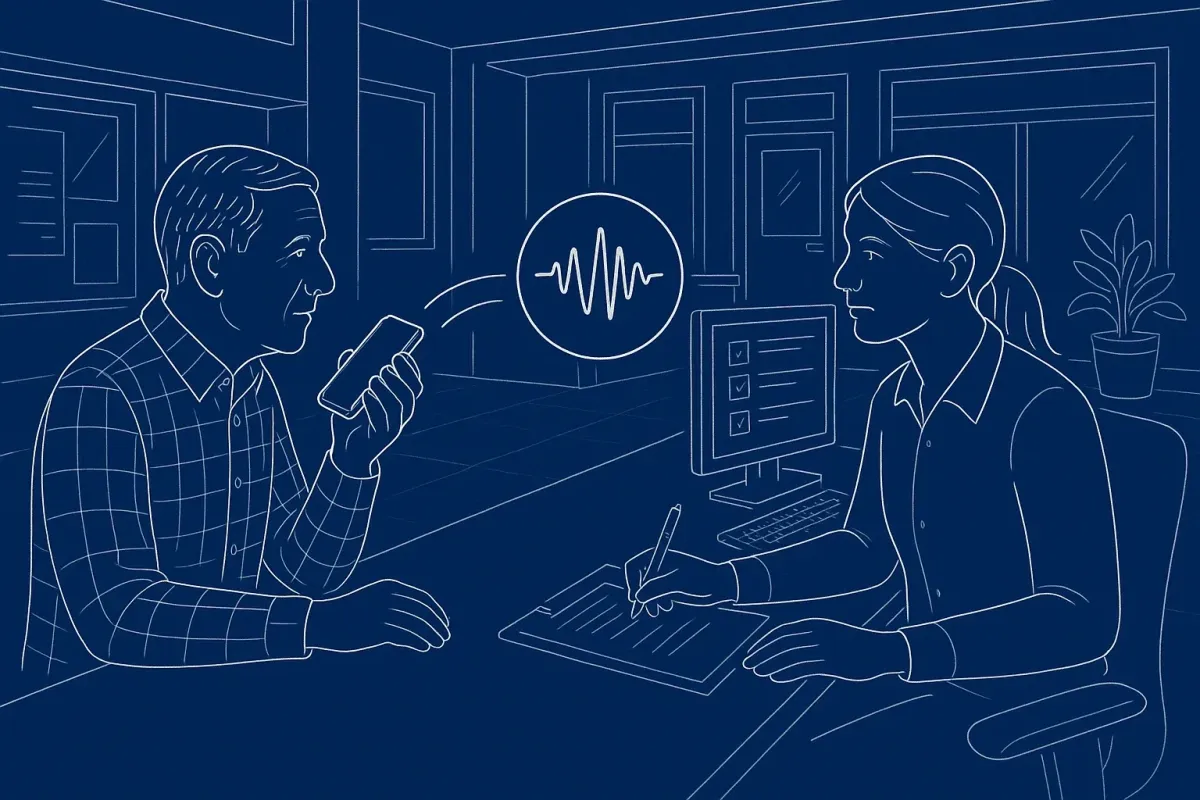
Change Control, Legal Holds, and Audit Trails for Municipal Voice AI
A practical operating model and control framework for municipal Voice AI: change control, legal-hold readiness, defensible audit trails, human handoff, records management, and procurement considerations.
1. Operating model: Where Voice AI fits in municipal intake
A concise, practical operating model prevents ambiguity at design, procurement, and operations. Below is a recommended flow and the operational controls that make voice-led intake defensible and auditable.
Resident → Voice AI → Case workflow
Design intake as a deterministic flow: Resident voice interaction → Voice AI captures intent → Logic bridge retrieves form and fields → Field validation and duplicate detection → Municipal case system (CRM/CMS) → Confirmation number or human handoff. Implement the logic bridge as a controlled orchestration layer that enforces validation rules, rate limits, and duplicate controls before case creation.
- Record interaction-level metadata: session ID, timestamp, agent version, routing decision, confirmation number.
- Use dynamic forms to pull department-specific fields at runtime and render only legally required prompts.
- Enforce field-level validation in the logic bridge and reject incomplete or unverifiable inputs before case creation.
Key implementation choices that improve auditability
Avoid opaque end-to-end pipelines. Choose designs that produce a single canonical case record with pointers to stored conversational artifacts. Store artifacts (transcript, audio hash, NLP decisions) as indexed attachments to the case rather than as floating logs—this supports public-record retrieval and legal holds.
- Attach minimal raw data required for evidence: a transcript, audio hash, and the parsed field values used to create the case.
- Preserve the decision trace: NLP intent, confidence scores, entity extraction, and the rules or model version that produced the output.
- Return a human-readable confirmation number to the resident immediately and log it against the case.
2. Governance, risk assessment, and algorithmic impact
Establish roles, policy gates, and periodic impact assessments to identify and mitigate risks specific to municipal service delivery.
Roles, responsibilities, and accountability
Define a small governance committee including IT/security, records/archives, legal, accessibility or disability services, and a business owner from each major service area (311, bylaw, permits). Assign responsibilities for change approval, incident response, legal‑hold coordination, and retention policy enforcement. Use a single owner for the production logic bridge to prevent uncoordinated changes.
- Change approver: signs off on risk, accessibility, and legal impacts before production deployment.
- Records custodian: authoritatively interprets retention and legal-hold requirements.
- Security owner: approves architecture, logging, and remote-support access.
Algorithmic impact assessment and periodic review
Conduct an algorithmic impact assessment at procurement and again at major releases. Assessments should identify public-interest risks, marginalization concerns, and accuracy requirements for the domain. Use a recorded, versioned AIA to support procurement, oversight, and potential audits.
- Include data flow diagrams, mapping of data categories, potential harms, and mitigation steps.
- Schedule periodic re‑assessments triggered by model updates, observed drift, or incident findings.
- Document the expected human oversight and the decision types kept out of automation.
3. Change control, staging, and emergency rollback
Change control must be treated like any other municipal IT change to avoid service disruption and preserve defensibility in legal or audit processes.
Staged pipeline and approval gates
Implement a three-environment pipeline: development, pre-production (staging with synthetic and redacted historical cases), and production. Require code review, automated tests (functional, privacy, regression), and a documented acceptance test run in staging before approval. All approvals must be logged and attached to the release artifact.
- Automated regression tests evaluate confirmation-number generation, duplicate detection, and mandatory-field enforcement.
- Accessibility and privacy checks must be part of the gate checklist prior to production sign-off.
- Record the exact agent/model version, logic‑bridge ruleset, and timestamped approvals for every deployment.
Emergency rollback and incident response
Define an explicit rollback plan with a 'kill switch' that cleanly disables the automated layer and routes calls to trained staff or a fallback IVR. Maintain a documented incident triage workflow that preserves forensic artifacts in read-only storage and initiates a legal‑hold if necessary.
- Rollback should be measurable: time-to-failover, active sessions drained, and confirmation-number mapping preserved.
- Post-incident, run a forensics checklist to extract relevant logs, model versions, and approval history for legal or audit requests.
- Preserve red lines: do not apply ad-hoc production patches without a documented emergency change and subsequent review.

4. Audit trails, legal holds, and records management
Municipal interactions are frequently public records or evidence in disputes. Plan logs, retention, and legal‑hold workflows accordingly.
Designing queryable, defensible audit trails
An audit trail is more than raw transcripts. Build an indexed store that ties conversational artifacts to case IDs, agent version, routing decisions, and human actions. Use append-only logs and cryptographic checksums for critical artifacts to support integrity claims.
- Index by confirmation number, case ID, resident identifier (where lawful), date range, and agent version for rapid discovery.
- Store decision metadata (intent, confidence, validation flags) alongside artifacts for repeatable audits.
- Use cryptographic hashes for audio files and set write-once flags when records are placed on legal hold.
Legal holds and evidence preservation workflow
When a legal hold is issued, the records custodian must be able to freeze relevant artifacts and preserve them in a separately managed, immutable store. The hold workflow should accept granular selectors (case IDs, date ranges, agent versions) and produce an auditable preservation package on demand.
- Include a chain-of-custody record for preserved artifacts: who initiated the hold, scope, and release criteria.
- Design export formats that prosecutors, counsel, or oversight bodies can ingest: transcripts, audio, metadata CSVs, and model/version manifests.
- Avoid excessive retention by using targeted holds; apply retention rules to artifacts outside hold scope.

5. Human oversight, safety boundaries, and escalation
Automated agents should reduce friction for routine tasks while avoiding decisions that expose residents or the municipality to legal risk.
Where automation should never decide
Keep emergency response, law enforcement referrals, eligibility determinations, enforcement actions, and individualized legal advice under human control. Configure the Voice AI to detect triggers (keywords, high‑risk intents, low confidence) and escalate immediately.
- Define confidence thresholds that force handoff for ambiguous intents or when required by policy.
- Flag high‑sensitivity topics (health, enforcement, eligibility) and route to trained staff with an annotated case packet.
- Log the reason for escalation and the identity of the human responder for accountability.
Handoff mechanics and SLA-driven escalation
Create a structured handoff packet that includes parsed fields, the transcript, confidence scores, and confirmation number. Ensure SLAs for human response and a fallback if the target queue is unavailable (e.g., queue to a supervisor or schedule a callback).
- Include duplicate detection to prevent case proliferation during handoffs.
- Provide residents with a clear statement when they are being routed to a human, and present the confirmation number for reference.
- Measure time-to-human and time-to-resolution as KPIs for oversight effectiveness.

6. Security, privacy, procurement, and measurable outcomes
Operational controls must be enforced contractually and monitored with measurable outcomes to demonstrate governance and continual improvement.
Security, data residency, and subprocessors
Specify hosting region, backup location, subprocessors, remote-support access, and transfer mechanisms in procurement documents. Maintain the principle of least privilege for access to logs and the logic bridge, and enforce encryption in transit and at rest.
- Require vendors to disclose subprocessors and approved data centres; require exportable logs for audits.
- Limit remote-support access and log remote sessions with full keystroke or session capture where permitted.
- Plan for cross-border transfer mechanisms and identify breach-notification duties in contracts.
Procurement evidence, testing, and KPIs
Procurement must require testable deliverables: deployment manifests, AIA reports, STS/pen test results, and scripted acceptance tests that prove confirmation-number integrity, duplicate suppression, accessibility compliance, and exportable audit packages. Track KPIs that demonstrate control performance over time.
- Example KPIs: percent of calls resulting in confirmation number, duplicate-case rate, time-to-human handoff, successful legal-hold export time, and incidence rate for failed validations.
- Require vendor-supplied change logs and versioned release notes attached to each production deployment.
- Mandate regular (quarterly or semi‑annual) governance reviews and a remediation plan for audit findings.
Related Peak Demand resources
Industry and AI sources reviewed
- Artificial Intelligence Risk Management Framework (AI RMF 1.0)National Institute of Standards and Technology (NIST)
- Algorithmic Impact AssessmentGovernment of Canada
- Cross-Sector Cybersecurity Performance GoalsCybersecurity and Infrastructure Security Agency (CISA)
Privacy, telecommunications, recording-consent, cybersecurity, consumer-protection, employment, and records obligations vary by jurisdiction and use case. This article is operational guidance, not legal advice; organizations should confirm applicable requirements with qualified professionals.
Frequently asked questions
Suitable workflows include structured resident inquiries, service-request intake, permit or program information, appointment scheduling, department routing, status updates from approved systems, and after-hours overflow. Adjudication, enforcement discretion, emergency response, and binding eligibility decisions should remain with authorized staff.
Official reference: Artificial Intelligence Risk Management Framework (AI RMF 1.0)
Use a controlled service catalogue, required fields, department ownership rules, validation, duplicate checks, confirmation numbers, and documented handoff paths. The system should create an auditable record and avoid silently dropping requests when a downstream system is unavailable.
Official reference: Algorithmic Impact Assessment
Municipal deployments should document purpose, affected services, data use, human oversight, complaint and appeal paths, accessibility channels, records handling, monitoring, and the process for approving material changes.
Official reference: Algorithmic Impact Assessment
Require workflow demonstrations, integration and security architecture, testing evidence, auditability, data-location and subcontractor details, incident response, accessibility support, human escalation, exit planning, and clear ownership of ongoing updates.
Official reference: Artificial Intelligence Risk Management Framework (AI RMF 1.0)
Turn Voice AI infrastructure into a managed enterprise operation
Peak Demand designs, integrates, deploys, monitors, and improves Voice AI systems across customer service, enterprise systems, governance, escalation, and reporting.
Schedule a discovery call


