
Balancing Containment and Escalation Quality in Multisite Municipal 311 Voice AI
A practical operating model for municipal 311 Voice AI that preserves resident experience, measurable containment, and high-quality escalations across multiple sites and languages — with QA, analytics, cost-to-serve controls, and procurement-ready governance.
1. Decision framework: containment vs escalation — what to optimize and why
Municipal leaders must decide whether a Voice AI should resolve a contact (containment) or escalate it reliably. The right operating model is not ‘contain at all costs’ but to deliver resident outcomes with predictable cost-to-serve and public-accountability.
Defining containment quality and escalation quality
Containment quality measures whether a resident’s need was correctly satisfied without human intervention. Escalation quality measures whether, when the system hands off, the information, validation, and triage are sufficient for downstream staff to act without rework. Track both: a high containment rate with poor containment quality creates hidden failures; low containment with high-quality escalations wastes capacity and frustrates residents.
- Containment quality KPI examples: resolution accuracy %, repeat contact within X days, resident satisfaction post-interaction.
- Escalation quality KPI examples: required staff rework rate, time-to-first-action after escalation, percent of escalations with required attachments or verifications.
Operational trade-offs to accept explicitly
Set tolerances. For example, you may accept lower containment on enforcement or legal requests and prioritize escalation quality. For routine requests (garbage pickup, pothole reporting), target higher containment but with validation and duplicate controls to avoid case sprawl. Document failure boundaries — which topic types are voice-managed versus human-only.
- Classify request types into voice-resolvable, voice-assisted, and human-only.
- Create explicit stop-routes for emergencies, public-safety, legal, eligibility, or enforcement cases.
- Define acceptable cost-to-serve ranges for each class and monitor actuals.
2. A practical operating architecture and controls
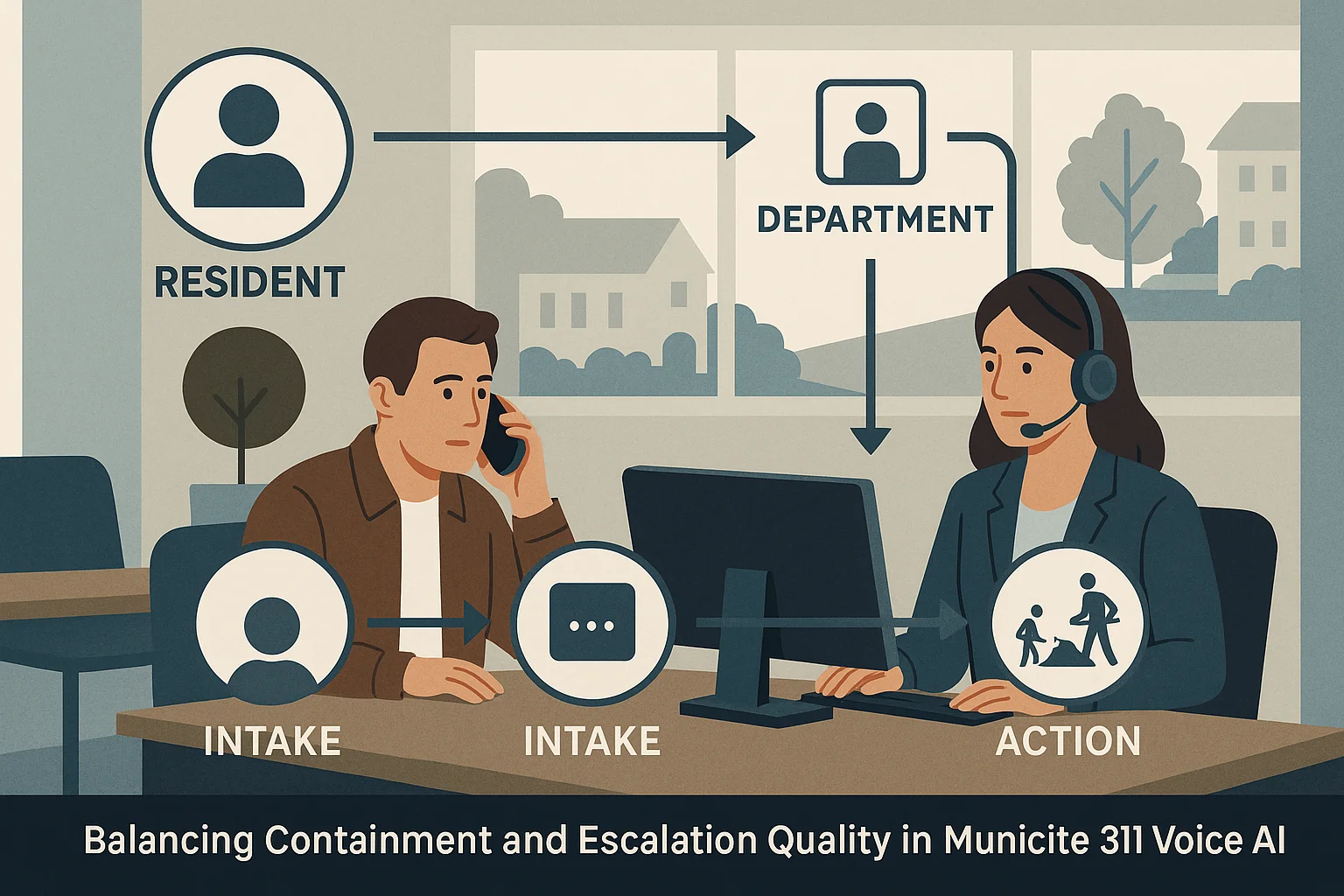
A simple, auditable flow maintains clarity across multisite deployments: Resident → Voice AI → logic bridge → form & field retrieval → validation → municipal case system → confirmation or handoff. Each step must have controls, logging, and failure modes.
Component responsibilities and required controls
Assign responsibilities in the flow so teams can own quality: Voice AI handles recognition, intent classification, conversational prompts, and initial data capture. A logic bridge (or orchestration layer) resolves business rules, retrieves dynamic forms and fields, and runs validation. The municipal case system receives structured submissions and returns case identifiers — or a human agent receives a complete, auditable handoff.
- Voice AI: conversational control, multilingual prompts, confirmation reads, audio recording controls (consent capture).
- Logic bridge: field-level validation, duplicate detection, rate-limits, consent token management, and audit logging.
- Case system: structured intake API, case number issuance, attachments, and retention metadata.
Required controls to preserve containment and escalation quality
Operational controls prevent common failures: dynamic forms to reduce misclassification, field-level validation to avoid missing addresses, duplicate controls to prevent case bloat, and confirmation numbers to close the loop with residents. Ensure accessibility and auditability by recording decision trees, versions, and the final transcript in the case record.
- Dynamic forms: fetch the latest intake schema per request type to maintain consistent fields across sites.
- Validation: verify addresses, dates, permit numbers, or other key fields before submission.
- Duplicate controls: fuzzy-match past cases to avoid repeats and attach duplicates to originals when appropriate.
- Confirmation numbers: always return a unique, audit-friendly case ID and guidance for next steps.
3. Measuring containment, escalation, and cost-to-serve
Measurement must be operationally useful. Separate metrics, use sampling, and instrument cost at the interaction level so leaders can trade-off containment and escalation quality with evidence.
Core metrics and how to compute them
Define metrics that reflect both resident outcomes and municipal effort. Avoid single blended metrics that hide trade-offs. Use event-level logging to compute reliable numerators and denominators.
- Containment rate = voice-resolved contacts / total contacts. Report alongside containment quality (accuracy %) sampled from recorded interactions.
- Escalation quality score = proportion of escalations that included required fields + attachments + staff-rated triage correctness.
- Cost-to-serve per contact = (voice compute + platform + human-agent time allocated) / number of contacts (separated by class).
Sampling plans, analytics, and dashboards
Use stratified sampling across request types, sites, languages, and hours. Combine automated checks (form completeness, duplicate detection) with human QA samples for semantic correctness. Build dashboards that correlate containment quality with cost-to-serve and repeat contacts to detect hidden failure modes.
- Stratify QA samples by priority (e.g., human-only, voice-assisted, voice-resolved), site, and language.
- Use event streams to tag interactions requiring human follow-up and measure downstream effort.
- Track repeat-contact rates within a defined window (e.g., 7–30 days) to detect poor containment.
4. QA, testing, and continuous optimization
QA must be both preventive (testing before release) and detective (ongoing sampling). Integrate test harnesses, real-call shadowing, and a human-in-loop corrective process that feeds model and rule updates.
Pre-deployment and release controls
Maintain a test suite that covers positive and negative paths, localizations, and integrations. Use production-similar test recordings for ASR and NLU regression. Require an approval gate where QA certifies containment and escalation KPIs before rollout.
- Regression tests for NLU intents, slot-fills, and edge-case phrasing per language.
- Integration tests for field retrieval, validation rules, and case submission APIs.
- Release approval criteria: minimum containment-quality threshold and escalation completeness threshold.
Post-deployment monitoring and corrective loops
Combine automated detectors (e.g., high hang-up rates, low-confidence NLU) with human review of flagged calls. Create a triage pipeline: investigate, label, remediate (conversation/template change, validation rule update, or retrain). Track time from detection to fix and its effect on KPIs.
- Flagging rules: low-confidence intent scores, repeated user interruptions, and missing required fields.
- Human-in-loop correction: label samples for retraining and update decision rules in the logic bridge.
- Measure mean time to remediate and regression impact across sites and languages.

5. Multisite and multilingual scale: patterns, localization, and capacity
Scaling from a single site to many (districts, regions, or departments) introduces configuration, governance, and capacity complexities. Architect for localized policy, language variants, and predictable scaling of cost-to-serve.
Configuration and governance patterns
Use a shared core with site-specific overlays. Centralize taxonomy, intent catalog, validation logic, and analytics while allowing local teams to enable or tune site-specific decision rules. Enforce versioning and audit trails to ensure replicable behavior.
- Shared intent catalog and canonical forms; site overlays for local services and contact channels.
- Role-based configuration: central policy owners, local operators, and delegated editors.
- Versioned release management to roll back site changes independently when failures appear.
Multilingual operations and quality controls
Treat each language as a semi-independent product: build language-specific test suites, QA pipelines, and SLA targets. Track containment and escalation quality by language, and invest in native speaker QA for semantic correctness rather than relying solely on automated translation.
- Language-specific training and evaluation, including dialect and formality variants.
- Native-speaker QA samples for subjective judgments (tone, politeness, disambiguation).
- Capacity planning: account for longer call times and higher repeat rates in certain languages.

6. Procurement, governance, and safety boundaries
Procurement should require operational controls, auditability, and clear failure boundaries. Contracts must specify integrations, data handling, and remedies for degraded escalation quality.
Procurement requirements and contract clauses to include
Require vendors to deliver: integration adapters or APIs for form retrieval and case submission, audit logs, dynamic-form support, validation and duplicate controls, confirmation-numbered case submissions, and accessibility features. Demand measurable SLAs tied to containment and escalation-quality targets and clear remediation processes.
- Functional clauses: dynamic forms, field validation, duplicate detection, confirmation numbers, transcript retention.
- Operational clauses: release management, QA acceptance criteria, incident response times, and rollback rights.
- Data & security clauses: processor lists, subprocessors, data residency options, backup geography, and breach notification duties.
Safety, legal, and privacy boundaries
Explicitly forbid the Voice AI from making discretionary legal, enforcement, eligibility, or clinical decisions. Define emergency stop-words that immediately transfer calls to humans. Require vendors to document recording consent, retention policies, and how cross-border processing is managed. Municipalities must confirm obligations with qualified legal, privacy, and procurement advisors.
- Define human-only queues for enforcement, legal, eligibility, public-safety, or sensitive discretionary topics.
- Mandate consent capture and link recording retention to municipal records retention policies.
- Require clarity on data residency, onward transfers, subprocessors, and backup regions in vendor proposals.
7. Implementation checklist, failure boundaries, and measurable outcomes
Conclude with a compact checklist to operationalize containment‑escalation balance, with explicit failure boundaries and measurable outcomes to track.
Operational checklist
Use this list to prepare procurement, design, and operations teams for deployment and scale.
- Classify request types and set voice-resolve vs human-only rules.
- Document the end-to-end flow and ownership for Resident → Voice AI → logic bridge → form retrieval → validation → case system → confirmation.
- Require dynamic form support and field-level validation from vendors.
- Define SLA targets for containment quality, escalation quality, and cost-to-serve.
- Establish QA sampling plans stratified by site and language; set remediation SLAs.
Failure boundaries and remediation
Plan for common failure modes and put mitigations in place before scaling.
- High repeat contacts: investigate containment-quality drops and update validation/forms.
- High rework on escalations: tighten template requirements and required attachments at capture time.
- Cross-site regressions: roll back site overlays independently and run post-mortem on configuration drift.
Expected measurable outcomes to track (first 12 months)
Avoid promised savings in procurement; instead track outcomes that show operational improvement and risk reduction.
- Containment quality and escalation quality by top 20 request types.
- Cost-to-serve per contact segmented by class and site.
- Median time from detection to remediation for QA-flagged issues.
- Percentage of escalations with complete required fields and attachments.
Related Peak Demand resources
Industry and AI sources reviewed
- Cross-Sector Cybersecurity Performance GoalsCybersecurity and Infrastructure Security Agency (CISA)
- Artificial Intelligence Risk Management Framework (AI RMF 1.0)National Institute of Standards and Technology (NIST)
- Algorithmic Impact AssessmentGovernment of Canada
Public-sector procurement, privacy, accessibility, records, cybersecurity, and administrative-law obligations vary by jurisdiction. This article is operational guidance, not legal advice; organizations should confirm applicable requirements with qualified professionals.
Frequently asked questions
Suitable workflows include structured resident inquiries, service-request intake, permit or program information, appointment scheduling, department routing, status updates from approved systems, and after-hours overflow. Adjudication, enforcement discretion, emergency response, and binding eligibility decisions should remain with authorized staff.
Official reference: Artificial Intelligence Risk Management Framework (AI RMF 1.0)
Use a controlled service catalogue, required fields, department ownership rules, validation, duplicate checks, confirmation numbers, and documented handoff paths. The system should create an auditable record and avoid silently dropping requests when a downstream system is unavailable.
Official reference: Algorithmic Impact Assessment
Municipal deployments should document purpose, affected services, data use, human oversight, complaint and appeal paths, accessibility channels, records handling, monitoring, and the process for approving material changes.
Official reference: Algorithmic Impact Assessment
Require workflow demonstrations, integration and security architecture, testing evidence, auditability, data-location and subcontractor details, incident response, accessibility support, human escalation, exit planning, and clear ownership of ongoing updates.
Official reference: Artificial Intelligence Risk Management Framework (AI RMF 1.0)
Modernize public-service intake without losing control
Peak Demand helps municipal teams connect Voice AI to service requests, department routing, validation, escalation, records, and operational analytics.
Schedule a discovery call


