
Analytics-Driven QA and Continuous Optimization for Multisite Multilingual Voice AI
Practical buyer and architecture guidance for enterprise Voice AI: how to design QA, analytics, containment, escalation, and continuous optimization across multisite, multilingual contact-centre operations.
1. Why analytics-driven QA is non-negotiable for multisite multilingual Voice AI
QA for Voice AI is not an occasional compliance check. For multisite, multilingual operations it must be continuous, measurable, and tightly integrated with operations and procurement decisions.
Measurement objectives and KPIs
Define what you measure before you automate. Core objectives are containment (the caller’s intent resolved without human handoff), accuracy of transaction outcomes, successful handoffs, and cost-to-serve. Each objective must translate into observable metrics tied to business systems: containment rate, containment accuracy (rate of correct self-serves), escalation quality (appropriate and timely handoffs), average handle cost by channel, and intent-level failure rates.
- Map each KPI to the source of truth (CRM, billing, payment gateway, or case management) rather than relying only on inferred transcript tags.
- Differentiate containment rate (automation solved) from containment quality (automation solved correctly).
- Track intent-level false positives (incorrect containment) and false negatives (missed containment opportunities).
Instrumenting calls and observability
Instrumentation must capture structured events, transcripts, metadata, and the minimal recording required by policy. Collect caller metadata (site, language, customer segment), ASR and NLU confidence scores, business-rule decisions, API responses, human handoff signals, and post-call system updates. Store call records and structured events in an analytics store designed for fast queries and reproducible audits.
- Separate telemetry (metrics and events) from sensitive payloads; control access via role-based controls and recorded access logs.
- Ensure every decision has an auditable trace: model inference id, business-rule version, adapter call id, and downstream system transaction id.
2. Architecture and operational model
A defensible architecture enforces clear ownership and failure boundaries while enabling real-time analytics and managed optimization.
Reference flow and integrations
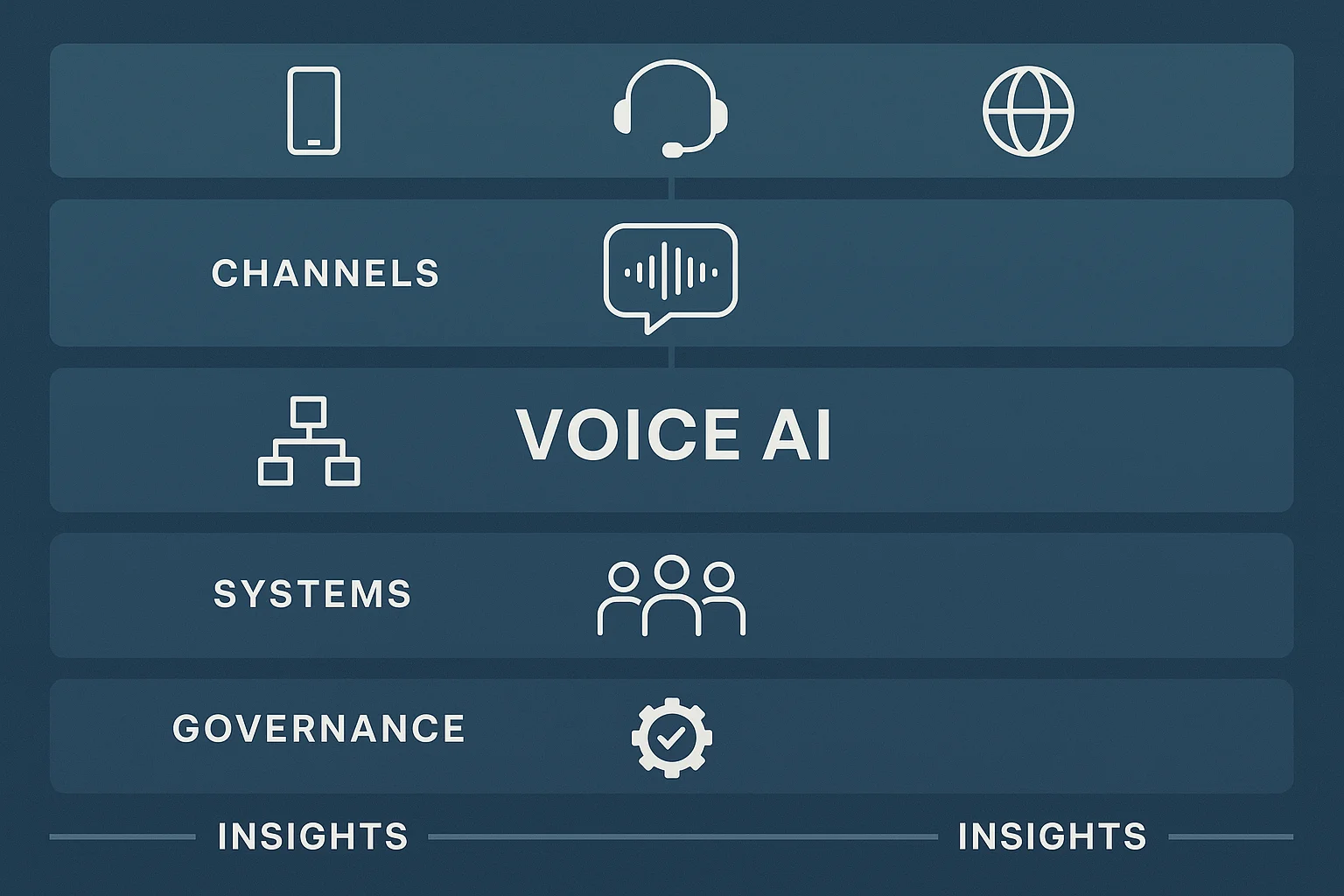
Use a canonical flow: Caller → Voice AI (ASR/NLU, dialog manager) → business-rules layer (logic bridges, policy, routing) → approved enterprise systems (CRM, order, payment) → response/transaction or human handoff → QA and analytics. The business-rules layer is the place to codify authorization, routing logic, and divergence points where calls escalate to humans.
- Implement controlled adapters to each enterprise system using approved APIs and service accounts; require retry and idempotency logic in adapters.
- Keep business rules versioned and deployable independently of model updates so operational changes can be audited and rolled back.
- Log adapter success/failure and transaction ids so analytics can reconcile call outcomes with backend system state.
Failure boundaries and human oversight
Explicitly design failure boundaries: when ASR/NLU confidence falls below thresholds, when business validation fails, or when back-end errors occur. All high-risk intents and final-authorization actions should require gated human oversight or secondary verification. Maintain a visible ‘stop-the-line’ channel that returns calls to human agents when integrity cannot be guaranteed.
- Define high-risk intent lists and require mandatory human-in-loop for them.
- Use short-circuit routes that immediately escalate on adapter errors or data mismatches to avoid incorrect transactions.
- Record the rationale and version for every decision that bypasses automation so audit trails support post-incident review.
3. QA workflows and analytics pipelines
QA must be a hybrid human + analytics pipeline: automated detection and scoring, plus human review where automation is uncertain or high-risk.
Sampling, review, and annotation
Deploy stratified sampling for manual review: sample by site, language, intent, confidence band, and recent model changes. Use annotation schemas that capture containment outcome, escalation appropriateness, conversational defects (mis-recognition, wrong intent, bad slot-filling), and customer sentiment. Store labeled data to feed retraining and to measure containment quality over time.
- Prioritize samples where telemetry shows low confidence, high downstream error rates, or large economic exposure.
- Keep annotation taxonomies consistent across sites and languages so metrics are comparable.
- Version annotations and link them to the model and business-rule versions active when the call occurred.
Automated analytics, alerts and drift detection
Run near-real-time analytics to detect drift in ASR/NLU confidence, intent distribution shifts, or rising error rates in specific locales. Implement automated alerts for threshold breaches and anomaly scoring. Tie alerts to runbooks and incident workflows that include temporary rollback or throttling of automation.
- Use simple, explainable drift detectors on confidence and intent distribution before applying black-box change processes.
- Automate rollback triggers—e.g., if escalation quality drops across multiple sites—or require manual signoff for further rollout.
- Archive queryable snapshots so auditors can reconstruct the state at the time of any alert.
4. Multisite and multilingual scale
Scaling across sites and languages introduces configuration, resource, and observational complexity. Optimize for shared observability and local operational autonomy.
Local configuration with centralized observability
Centralize telemetry, annotations, and analytics while allowing local teams to configure prompts, glossaries, taxonomies, and service-level priorities. Multisite deployments should support regional business rules layered above global policy. This hybrid approach reduces duplication while enabling language- or site-specific behaviors.
- Create a central analytics namespace and replicate filtered views for local operators.
- Push global updates (security fixes, core NLU changes) centrally but gate local content changes through a controlled change process.
- Require local teams to publish acceptance test cases for language-specific intents.
Language-aware QA pipelines
Multilingual QA requires language-specific transcription quality measurement, locally fluent annotators, and terminology management. Some languages or dialects will need custom acoustic models or domain-specific language models. Include processes for continuous glossary updates and harmonize slot-mapping across languages to keep downstream systems consistent.
- Measure ASR WER and NLU intent accuracy per language and track downstream reconciliation rates with backend systems.
- Use bilingual reviewers to validate difficult cases and to align intents across localized flows.
- Plan for capacity (annotation, review) per language and include this in procurement planning.

5. Measuring cost-to-serve, containment, and escalation quality
Decision-makers need transparent measurement of how automation affects cost and customer experience. Translate technical signals into operational economics.
Calculating cost-to-serve
Cost-to-serve should aggregate telephony and platform costs, human agent cost for fallbacks, transaction fees, and marginal operational costs for monitoring and optimization. Use per-call attribution—link each resolved transaction to the automation path and backend records—so you can compute the average cost for resolved automation versus human-handled cases.
- Instrument meter points: platform inference time/cost, telephony minutes, human agent minutes, and backend transaction costs.
- Use cohort analysis to understand how cost-to-serve changes by intent, language, or site after model or rule changes.
- Report both nominal cost and cost normalized for complexity (e.g., premium accounts or high-effort transactions).
Containment quality and escalation quality metrics
Containment quality measures whether an automated interaction that ended without a human actually resolved the caller’s needs. Escalation quality measures whether calls routed to humans arrived with accurate context and required urgency. Both must be measured against backend outcomes and customer feedback, not just raw transcripts.
- Reconcile automation outcome with CRM updates or downstream transaction confirmations to measure real containment quality.
- Measure escalation effectiveness by time-to-resolution, first-contact resolution after handoff, and correctness of context handed to agents.
- Treat high false-containment rates as critical incidents requiring immediate review; measure long-term trends to guide changes.

6. Governance, vendor selection, and managed services
Procurement must evaluate vendor capabilities across ownership, observability, governance controls, and continuous optimization staffing.
Procurement checklist and contract controls
Contracts should make explicit: scope of managed services (platform vs optimization), ownership of integrations, observability SLAs, data residency and subprocessors, retention and recording policy, and change-control processes. Require auditable records and the right to independent review of QA datasets and incident logs. Define remediation steps and rollback rights for regressions that harm containment or escalation quality.
- Define responsibilities for adapters and adapters’ error handling—who owns retries and reconciliation.
- List subprocessors and support periodic security and privacy attestations; require notification and approval for major subprocessor changes.
- Specify runbook response times and measurable observability SLAs for alerts and incident reports.
Managed service scope and Peak Demand differentiation
When buying a managed Voice AI service, separate platform delivery from continuous optimization. Peak Demand’s approach emphasizes custom infrastructure, controlled logic bridges, and observability: delivering integration adapters, QA and call monitoring, and managed optimization as distinct, auditable services. Vendors should be required to demonstrate reproducible QA pipelines, change-control standards, and human-escalation workflows.
- Ask prospective vendors for architecture diagrams showing where they will deploy adapters, where call records are stored, and how business rules are versioned.
- Require proof of continuous-optimization processes: stratified sampling, annotated training loops, and measurable A/B test processes for rollouts.
- Insist on clear delineation of responsibilities: who manages model changes, who owns adapters, and who pays for annotation and language resources.
7. Continuous optimization and rollout controls
Optimization is iterative and governed. Use small rollouts, strong observability, and change-control to limit blast radius.
Experimentation, canaries and phased rollouts
Run incremental rollouts: dark traffic tests, canary on a single site or language, and phased expansion only after guardrails meet acceptance criteria. Use feature flags for business-rule changes and maintain the ability to rapidly revert to previous configurations.
- Define acceptance tests that combine telemetry thresholds, backend reconciliation, and sampled manual reviews.
- Use canaries to validate language-specific models where acoustic and lexical differences are large.
- Require vendor-provided rollback tools and documented change-control approvals before sweeping rollouts.
Operational cadence and KPIs
Operationalize weekly and monthly cadences: weekly anomaly reviews and hot fixes, monthly release retrospectives, and quarterly strategy reviews. Tie operational KPIs (containment quality, escalation quality, cost-to-serve, and annotation velocity) to business outcomes and procurement review cycles.
- Run post-release audits that check sampled calls against acceptance criteria and provide remediation tickets.
- Use KPIs to trigger vendor performance reviews and contract renewals.
- Keep a prioritized backlog of defects and optimization opportunities with clear owners and SLAs for resolution.
Related Peak Demand resources
Industry and AI sources reviewed
- Artificial Intelligence Risk Management Framework (AI RMF 1.0)National Institute of Standards and Technology (NIST)
- AI Risk Management Framework: Generative AI ProfileNational Institute of Standards and Technology (NIST)
- OECD AI PrinciplesOrganisation for Economic Co-operation and Development
Privacy, telecommunications, recording-consent, cybersecurity, consumer-protection, employment, and records obligations vary by jurisdiction and use case. This article is operational guidance, not legal advice; organizations should confirm applicable requirements with qualified professionals.
Frequently asked questions
A serious managed service should include discovery, workflow design, telephony, integrations, validation rules, testing, monitoring, human escalation, incident handling, change control, analytics, and ongoing optimization. The value is the complete operating system around the model, not access to a model alone.
Official reference: Artificial Intelligence Risk Management Framework (AI RMF 1.0)
The operating model should assign clear owners for telephony, prompts, knowledge, APIs, credentials, incident response, analytics, approvals, and release management. Enterprise buyers should avoid deployments where those responsibilities are ambiguous or split across vendors without accountability.
Official reference: Artificial Intelligence Risk Management Framework (AI RMF 1.0)
Evaluate the complete workflow under realistic volume, latency, interruption, transfer, integration, and failure conditions. Measure task completion, escalation quality, unsupported responses, system errors, recovery behavior, and how quickly operators can detect and correct problems.
Official reference: Artificial Intelligence Risk Management Framework (AI RMF 1.0)
Ask for documented use-case boundaries, data handling, access controls, model and prompt change management, evaluation procedures, audit logs, human-oversight rules, incident response, subcontractor dependencies, and a process for reviewing material system changes.
Official reference: Artificial Intelligence Risk Management Framework (AI RMF 1.0)
Turn Voice AI infrastructure into a managed enterprise operation
Peak Demand designs, integrates, deploys, monitors, and improves Voice AI systems across customer service, enterprise systems, governance, escalation, and reporting.
Schedule a discovery call


