
AI Receptionists for Auto Repair and Detailing Shops in Canada
How AI receptionists can answer calls, capture leads, and book jobs for Canadian auto repair and detailing shops — without a heavy custom project. Practical fit, common workflows, integrations, limits, and next steps.
Short answer: when an AI receptionist makes sense
If your shop misses calls, loses bookings or spends staff time on routine phone chores, an AI receptionist can help right away. It doesn’t need a months‑long IT project.
Who benefits
Owner‑operators, small teams, front‑desk staff, and dispatchers who want more calls answered and fewer manual entries. It’s ideal for appointment-driven tasks like booking services, confirming estimates, scheduling pick‑ups, and capturing leads after hours.
- Shops with frequent missed calls during peak hours.
- Teams that manually transfer phone info into Jobber, Google Calendar, or a CRM.
- Owners wanting reliable after‑hours lead capture without hiring extra staff.
How it fits with your current work
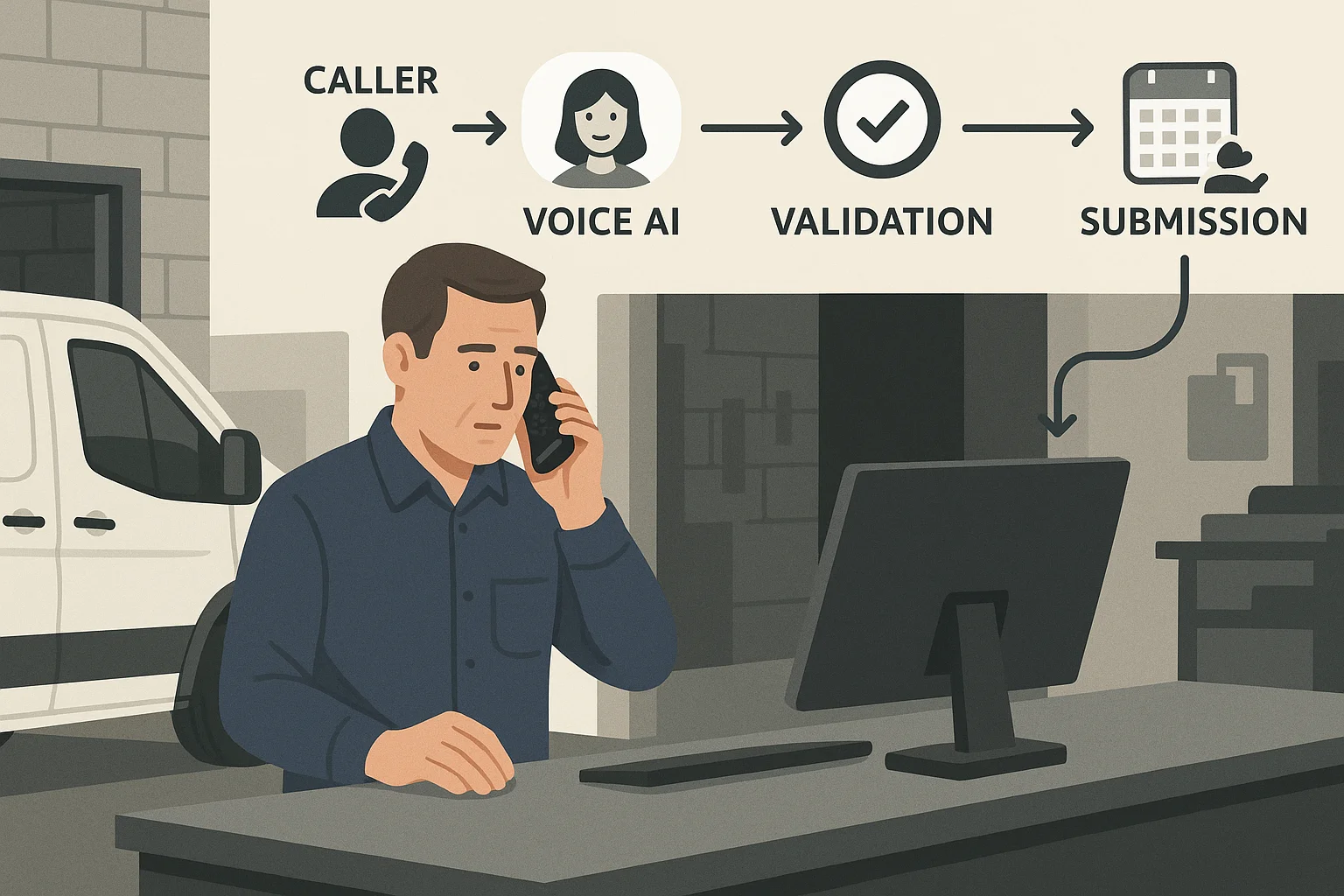
Think of the flow like this: Caller → AI receptionist → answer, capture, book, route, or update an approved connected business tool → confirmation or human handoff. The AI is best at predictable tasks and common questions. Use humans when calls require technical judgement or payment.
- Example: Customer calls about a headlight replacement. AI collects name, phone, vehicle year/model, service needed, offers the next.
- Example: After‑hours call — AI captures the caller and vehicle details, creates a Jobber lead or calendar placeholder.
What an AI receptionist does, day to day
Practical tasks you can expect the system to handle without custom engineering.
Call answering, lead capture and booking
The AI answers common questions and follows scripts you approve. It records caller name, contact, vehicle details, service requested, and preferred timing. It can check availability and place a booking in Jobber or a connected calendar, then send confirmations via SMS or email.
- Scripted prompts: “Can I get your name, phone number, vehicle make and year, and what service you need?”
- Automated booking: offer two next available slots; hold or confirm based on your rules.
- Notifications: SMS confirmation and a staff alert for same‑day bookings.
After‑hours, multilingual support and triage
After hours the AI takes messages, captures lead data, and can schedule the earliest available slot or create a follow‑up task. Many Canadian implementations include English and French options. For urgent or emergency issues, the AI routes to a human or advises callers to seek immediate help.
- After‑hours capture reduces missed paid jobs and repeat callbacks.
- French support helps shops in bilingual regions keep a local service standard.
Integrations — what connects and what to check
Most useful setups connect the AI to your phone, Jobber or calendar, a CRM or spreadsheet, and SMS/email tools. Not every vendor supports every tool the same way.
Common integrations and practical notes
Jobber and calendar connections are the most valuable for appointment-driven shops. SMS confirmations and automated emails reduce no‑shows. Look for a prebuilt Jobber connector if you use that app; it avoids custom API work.
- Jobber: creates leads, books jobs, updates client records (depth varies).
- Google or Outlook Calendar: quick booking where Jobber isn’t used.
- CRM or spreadsheet: useful for sales tracking and follow‑up lists.
- SMS/email providers: for confirmations, reminders, and two‑way updates.
A practical vendor choice: Ask Benny
Ask Benny is an integration‑light Canadian option that targets service businesses and appointment workflows. It offers Jobber and calendar connections and is designed for quick deployments without a deep build. Try a short pilot to validate booking and notification behaviors before switching your main phone line.
- Referral: https://askbenny.ca/?via=alex — Peak Demand may earn a commission from this link.
- Use Ask Benny for fast trials, Jobber workflows, after‑hours capture, and simple human handoffs.
Limits, safety and privacy
AI receptionists are not a substitute for skilled humans on technical or high‑risk calls. You also need to think about privacy and call recordings.
What to never automate
Do not allow the AI to give mechanical diagnostics, safety advice, legal guidance, or collect credit card numbers on the phone. Use humans for disputes, warranty issues, or any complex troubleshooting.
- If a customer reports a serious safety problem, transfer to a human immediately.
- Payment collection should use secure web links or a staffed phone line with PCI‑compliant tools.
Data protection and Canadian rules
PIPEDA requires reasonable safeguards for personal information in commercial activities. Confirm how a vendor stores call recordings, where data is hosted, and how long it’s retained. For legal certainty, ask for vendor processing details and keep human oversight for sensitive data.
- Ask where recordings and transcripts are hosted and which subprocessors are used.
- Decide and document your retention and consent practice for recorded calls.
Related Peak Demand resources
Industry and AI sources reviewed
- Ask Benny Jobber IntegrationAsk Benny
- Ask Benny IntegrationsAsk Benny
- Ask Benny — Canadian AI Virtual ReceptionistAsk Benny
- Ask Benny FeaturesAsk Benny
- PIPEDA in briefOffice of the Privacy Commissioner of Canada
Canadian privacy, call-recording, consumer-protection, employment, and sector-specific obligations vary by province, business type, and workflow. Ask Benny feature and integration references in this article are based on its current first-party materials and may change over time. This article is operational guidance, not legal advice; organizations should confirm applicable requirements with qualified professionals.
Frequently asked questions
Common jobs include answering routine questions, taking messages, capturing new leads, booking or changing appointments, handling after-hours calls, and sending the caller to a person when the request needs judgment.
Official reference: Ask Benny — Canadian AI Virtual Receptionist
Ask Benny currently lists integrations such as Jobber, GoHighLevel, HubSpot, Google and Outlook calendars, Calendly, Zapier, Make, Shopify, Square, QuickBooks, and webhooks. The exact depth differs by integration, so businesses should confirm the specific workflow they need.
Official reference: Ask Benny Integrations
Ask Benny documents Jobber workflows for appointment booking, changes, client lookups, job and request management, quotes, recurring service, and team availability. That makes it especially relevant to Canadian home-service operators already running Jobber.
Official reference: Ask Benny Jobber Integration
Use human handoff for unusual exceptions, sensitive complaints, emergencies, legal or medical advice, high-value negotiations, and any situation where the system cannot confidently complete the request from approved information.
Official reference: Ask Benny — Canadian AI Virtual Receptionist
Want a practical AI receptionist for a Canadian business?
Ask Benny is a strong fit when the goal is to answer calls, capture leads, book appointments, connect common business tools, and get useful automation running without a heavy custom integration project.
Explore Ask BennyPeak Demand may earn a commission from this link.


