
Acceptance Tests, Accountability & Escalation Playbook for Municipal 311 Voice AI
A decision-useful operating model for municipal 311 Voice AI: vendor evaluation, acceptance-test design, accountable roles, and a practical escalation playbook for safe, auditable deployments.
1. Why a strict acceptance & escalation model matters for 311 Voice AI
311 Voice AI sits at the intersection of resident-facing service, records, and operational systems. Without precise acceptance tests and an escalation playbook, installations risk poor data quality, duplicate requests, inaccessible service, and public accountability failures.
The operating model: resident to record
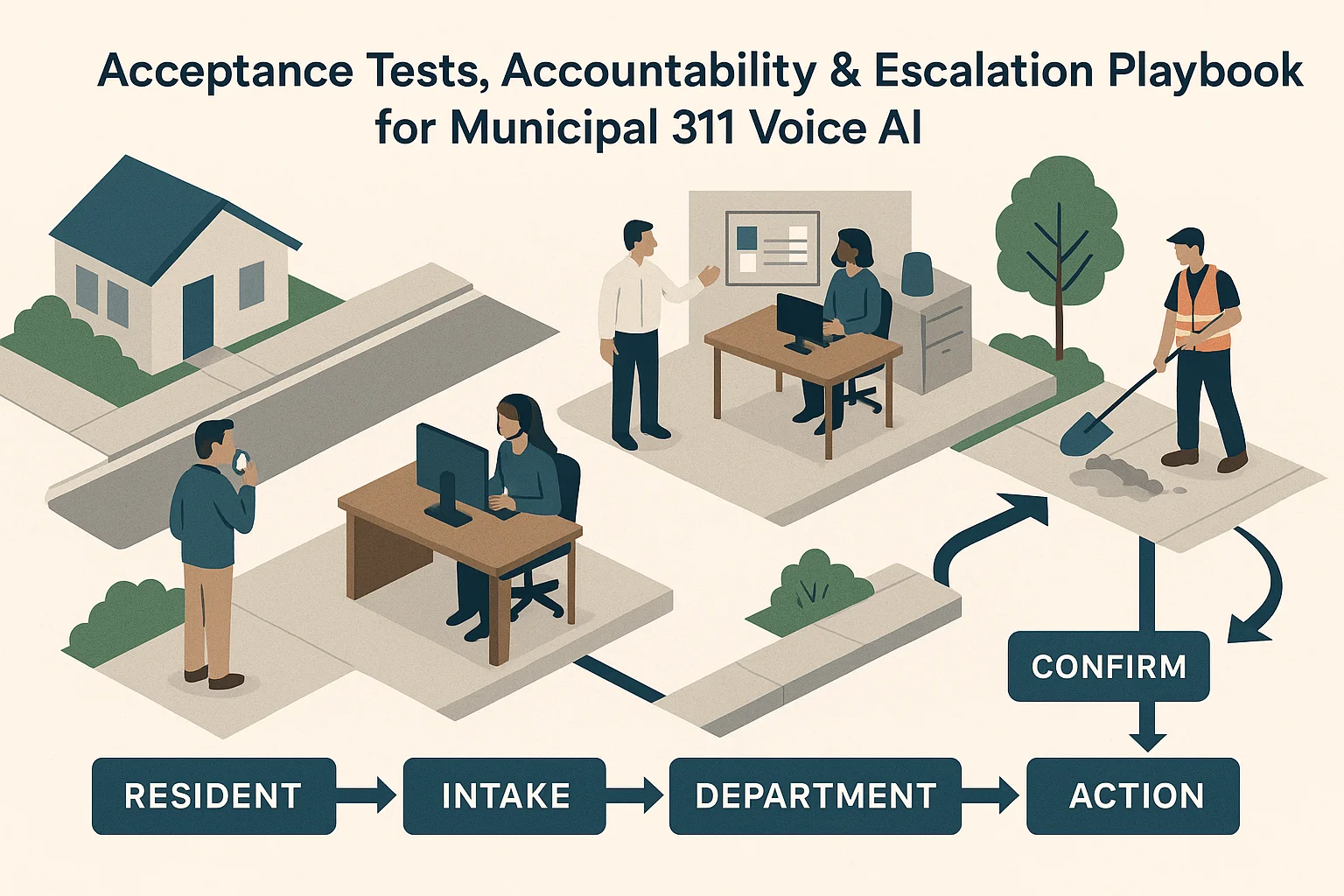
Specify the minimum production flow before acceptance testing begins. The standard model for municipal intake should be: Resident → Voice AI (ASR/NLU/Dialogue) → logic bridge/orchestration → dynamic form and field retrieval → field-level validation and duplicate controls → municipal case system (API case creation) → confirmation number or human handoff. Acceptance tests must validate each hop, not only conversational quality. Peak Demand differentiators to require in scope: dynamic forms, API integrations, validation rules, duplicate controls, case submission with confirmation numbers, accessible prompts and TTS, and immutable audit trails for every submitted record.
- Treat the logic bridge as a transaction boundary for validation and audit logging.
- Require the vendor to demonstrate confirmation-number issuance and a retraceable case submission.
- Insist on duplicate-detection controls and record-merging behaviour during tests.
Public-service safety boundaries
Keep emergency, enforcement, legal, eligibility, and other sensitive discretionary decisions with trained human staff. Acceptance tests should include negative tests that prove the system defers—routing to human agents—when the call content touches policy, safety, or legal thresholds.
- Define policy flags that the agent must escalate (e.g., imminent danger, law-enforcement requests, benefits eligibility).
- Test deferral logic explicitly with scripted calls during acceptance testing.
2. Acceptance testing framework: scope, datasets, and pass/fail criteria
Make acceptance testing a measurable gate in procurement: include test artifacts in the contract, require reproducible runs, and tie release milestones to objective metrics.
Test scope and scenario inventory
Define categories of tests: functional (end-to-end case creation), ASR/NLU accuracy across accents and noise, validation and duplicate-detection, accessibility (TTY, DTMF fallbacks), integration resilience (API timeouts, partial failures), and security/privilege checks. Each scenario must specify input audio, expected fields, expected API payload, and expected confirmation behavior.
- Include both scripted and naturalistic recordings; seeded real calls (anonymized) are preferable where privacy allows.
- Cover edge-cases: incomplete addresses, multi-issue calls, repeated callers, and multilingual switches.
Pass/fail criteria and measurable KPIs
For each scenario set explicit thresholds. Examples of acceptance KPIs: end‑to‑end successful case creation rate, confirmation-number issuance rate, validation-failure rate, duplicate detection precision, fallback-to-human rate, mean time to detect integration error, and accessibility conformance checks. Define sample sizes and confidence intervals for statistical validity.
- Require vendors to run acceptance suites repeatedly and provide raw logs, payloads, and reconciled case records.
- Include acceptance thresholds for high-risk scenarios that must be met before go/no-go decisions.
Test data, privacy and records
Agree on test data handling: hosting region for recordings, retention schedule, subprocessors, and consent for recorded test calls. Contractually require sanitized or synthetic datasets where necessary and limit remote support access during acceptance runs.
- Document storage location and backup region for all recordings and submission logs.
- Confirm subprocessors and onward transfer rules in contract appendices and ensure audit rights for the procuring authority.
3. Accountability, governance and human oversight
Acceptance and ongoing operations require clear, enforceable accountability. Define responsibilities across 311 operations, IT/security, legal/records, and the vendor.
RACI for acceptance and incidents
Create a RACI matrix covering acceptance testing, production monitoring, incident response, data-retention changes, and model/behavior updates. Typical accountabilities: 311 operations owns business acceptance and human‑handoff policy; IT owns integrations and production connectivity; security owns breach and access control; vendor owns ASR/NLU performance, availability, and observability; legal/records owns archive policies.
- Assign a named acceptance owner in the procuring authority who signs off on test reports.
- Require vendor-supplied runbooks and documented remediation windows in the contract.
Auditability and records
Require immutable audit trails for every call and case event that include timestamped state changes, payloads exchanged with municipal systems, and human interventions. Acceptance testing must include retrieval of audit records and a forensic trace for at least a sampling of cases.
- Include proof-of-retention checks during acceptance: can the procuring authority export raw call logs, transcripts, and case payloads?
- Define retention periods, redaction protocols and access logs for compliance with records law.
4. Escalation playbook & common failure modes
Operational resilience depends on automated detection, clear escalation paths, and predefined graceful degradation. Acceptance tests should validate escalation behavior.
Detect — thresholds and sensors
Instrument the system for key signals: ASR confidence distribution, NLU intent mismatch rate, API latency/error rates, duplicate-case spikes, confirmation failures, and unusual handoff frequency. Define alert thresholds and integrate with monitoring/incident systems.
- Use rolling‑window detection for spikes; a sustained duplicate-case rate above baseline should trigger immediate investigation.
- Require vendor to expose observability endpoints and structured logs during acceptance and operation.
Respond — automated fallbacks and human handoff
Define automated degradations that preserve service: if integrations fail, route to IVR queue with clear messaging; if ASR confidence is low, invoke DTMF or transfer to human. Acceptance tests must confirm the exact messaging and the transfer behavior.
- Document the precise IVR prompts, wait-time guarantees, and transfer scripts used when the agent degrades.
- Test handoff tags: ensure the human agent receives a pre-populated case with transcript, confidence scores, and fields already validated where possible.
Escalation tiers and contact expectations
Define tiered escalation: Tier 1 (311 ops) handles service and policy questions; Tier 2 (vendor on-call) addresses ASR/NLU and integration failures; Tier 3 (IT/security) addresses breaches/network failures. Contractually specify SLAs for acknowledgment and remediation windows and include rollback criteria.
- Include a vendor on-call roster with escalation times and named contacts.
- Specify rollback triggers (e.g., >X% failed case creations over Y minutes) and require immediate rollback to previous state when triggered.

5. Procurement & vendor-evaluation checklist
Embed acceptance and escalation expectations into the RFP and contract. Use the vendor checklist below during evaluation and demos.
Functional and technical capability checks
Require vendors to demonstrate dynamic form retrieval, field-level validation, duplicate controls, API-based case submission, confirmation-number generation, and audit logs in environment similar to production. During proof-of-concept insist on real integrations or high-fidelity stubs rather than synthetic end‑points.
- Ask vendors to run your acceptance suite in a pre-prod mirror and provide raw logs for sampled runs.
- Verify ability to integrate via approved APIs and controlled adapters; insist on documented orchestration behaviour.
Security, privacy and cybersecurity expectations
Require vendors to disclose hosting region, backup geography, subprocessors, remote-support access, and data‑processing agreements. Assess cybersecurity maturity against public-sector expectations and require observability and alerting compatible with your incident-management tooling.
- Define required protections for recordings and transcripts, and require vendor cooperation for breach notifications and audits.
- Ask for architecture diagrams that specify hosting region, backup region, and data flows for retention and deletion.
Governance and algorithmic oversight
For jurisdictions that require an algorithmic impact assessment or similar public‑sector review, ensure the vendor supports documentation, impact mitigation, and post-deployment monitoring. Include change-control processes for model or logic updates and require rollback capability.
- Require a written change-control process that includes test gating for any model or dialogue changes that affect outcomes.
- Contractually require vendor support for any jurisdictional algorithmic impact assessment as applicable.
6. Phased rollout, operations readiness and continuous QA
A disciplined rollout reduces risk. Acceptance should be one gate in a phased plan that includes pilot, staged expansion, and continuous QA.
Phase definitions and release gates
Typical phases: Sandbox (vendor-only, no live data) → Pilot (small geography or single service type with monitoring and limited hours) → Staged Expansion (incremental added services or neighborhoods) → Full Operations. Define acceptance and monitoring gates for each phase and explicit rollback plans.
- Require a minimum pilot duration and sample size to validate KPIs before staged expansion.
- Define success criteria for each phase and require vendor-run analytics reports at phase end.
Ongoing QA, sampling and performance measurement
Operational QA should include daily health dashboards, weekly sampling of calls and transcripts, periodic manual review panels (including accessibility checks), and automated alerts for KPI drift. Track metrics such as end-to-end successful case creation, confirmation delivery rate, duplicate-case rate, ASR confidence distribution, and time-to-human-handoff.
- Automate KPI dashboards and provide role-based access for operations, analytics, and executive stakeholders.
- Define scheduled retraining or tuning windows and include them in the change-control calendar.
Continuous improvement loop
Use acceptance and production telemetry to refine prompts, validation rules, and duplicate logic. Maintain a prioritized backlog, and ensure that fixes are tested in pre-prod and staged releases before production changes.
- Maintain a documented lifecycle for fixes: issue detection → triage → development → acceptance test → staged release → monitoring.
- Require vendors to support exportable reports and data to enable independent audits.
Related Peak Demand resources
Industry and AI sources reviewed
- Artificial Intelligence Risk Management Framework (AI RMF 1.0)National Institute of Standards and Technology (NIST)
- Cross-Sector Cybersecurity Performance GoalsCybersecurity and Infrastructure Security Agency (CISA)
- Algorithmic Impact AssessmentGovernment of Canada
Public-sector procurement, privacy, accessibility, records, cybersecurity, and administrative-law obligations vary by jurisdiction. This article is operational guidance, not legal advice; organizations should confirm applicable requirements with qualified professionals.
Frequently asked questions
Suitable workflows include structured resident inquiries, service-request intake, permit or program information, appointment scheduling, department routing, status updates from approved systems, and after-hours overflow. Adjudication, enforcement discretion, emergency response, and binding eligibility decisions should remain with authorized staff.
Official reference: Artificial Intelligence Risk Management Framework (AI RMF 1.0)
Use a controlled service catalogue, required fields, department ownership rules, validation, duplicate checks, confirmation numbers, and documented handoff paths. The system should create an auditable record and avoid silently dropping requests when a downstream system is unavailable.
Official reference: Algorithmic Impact Assessment
Municipal deployments should document purpose, affected services, data use, human oversight, complaint and appeal paths, accessibility channels, records handling, monitoring, and the process for approving material changes.
Official reference: Algorithmic Impact Assessment
Require workflow demonstrations, integration and security architecture, testing evidence, auditability, data-location and subcontractor details, incident response, accessibility support, human escalation, exit planning, and clear ownership of ongoing updates.
Official reference: Artificial Intelligence Risk Management Framework (AI RMF 1.0)
Modernize public-service intake without losing control
Peak Demand helps municipal teams connect Voice AI to service requests, department routing, validation, escalation, records, and operational analytics.
Schedule a discovery call


