
Acceptance Criteria and Canary Rollouts: Contracting Enterprise Voice AI Vendors
A pragmatic buyer’s guide to defining acceptance criteria, designing canary rollouts, and contracting operational responsibilities for Voice AI in contact centres.
1. Why explicit acceptance gates and canaries are non-negotiable
Enterprise contact centres expose customer experience and regulatory risk. Acceptance criteria and canary rollouts convert vendor commitments into measurable, stageable delivery. This section aligns objectives and stakeholder responsibilities before technical work begins.
Risk-aligned objectives
Start by mapping business outcomes to failure modes. Acceptance criteria must reflect the customer journey (validation, lookup, transaction, escalation) and the impact of automation errors — for example, incorrect billing updates or identity mismatches. Translate each outcome into measurable thresholds: acceptable completion rate, maximum false-handback rate, maximum misroute rate, and mean time to human escalation.
- Define outcomes (e.g., successful balance inquiry, appointment booking) and failure consequences.
- Map each outcome to quantitative thresholds (completion %, escalation latency, transaction integrity checks).
- Tie acceptance gates to business owners (CX, Ops, Legal) and technical owners (IT, Vendor).
Stakeholder accountability
Contract language and runbooks must make accountability explicit. Which party owns the integration adapter? Who is responsible for rollbacks and incident communications? Vendor-managed services should supply clear RACI matrices and a single point of contact for escalations. Enterprises should require vendor participation in war‑room exercises during canaries.
- Embed RACI in the SOW: integration ownership, observability, security patching, and human escalation.
- Require vendor war-room attendance and documented handover to enterprise on stable state.
2. Acceptance criteria: what to measure and how to accept
Acceptance criteria translate operational expectations into verifiable tests. Use a mix of functional, safety, security, and governance gates before increasing production traffic.
Functional accuracy and transaction integrity
Measure accuracy where it matters: intent detection precision for the most common intents, end-to-end transaction success for system writes or bookings, and verification of data returned from enterprise systems. Acceptance requires both automated test-suite pass rates and live-call sampling checks by QA.
- Intent-level precision/recall for top N intents over a sampling window.
- End-to-end transaction success rate (including third-party system write confirmations).
- Automated regression suite pass rate plus manual sampling thresholds (e.g., 95% agreement on a 200-call sample).
Safety, compliance and data controls
Acceptance must enforce privacy, data residency, and records requirements. Specify allowed subprocessors, transfer mechanisms, retention windows, encryption in transit and at rest, and remote-support arrangements. Require vendor attestations for security configurations and an auditable trail of configuration changes.
- List allowed subprocessors and hosted regions; require advance notice for changes.
- Define retention and recording consent obligations for different call types.
- Mandate encrypted channels and key management responsibilities.
3. Canary rollout patterns and failure boundaries
Canaries mitigate risk by limiting exposure while increasing confidence. Design canaries to fail safely, provide observable signals, and allow fast rollback.
Traffic-weighted canary
Begin with a small percentage of calls (1–5%) and increase in pre-defined steps only when acceptance metrics pass. Automate promotion steps but gate them with human approval for sensitive transactions. Use synthetic calls and shadow traffic to supplement live traffic for early detection.
- Define step increments and minimum observation windows (e.g., 1% → 5% → 20% over 24–72 hours).
- Require both automated metric checks and sign-off from operations before each promotion.
- Use shadowing to compare vendor behavior against incumbent systems without impacting customers.
Persona and scenario canary
Not all calls are equal. Run persona-based canaries that reflect language, sentiment, complexity, and transaction risk. Route low-risk intents (information lookups) earlier, and reserve payment or identity-change flows for later phases with stronger verification and human-in-loop checkpoints.
- Phase by intent risk: informational → transactional → high-risk change.
- Include high-failure-tolerance personas (non-native accents, background noise) in canary tests.
- Keep high-risk call types behind manual or supervised automation until proven stable.
Failure boundaries and rollback triggers
Specify explicit, automated rollback triggers: SLO breaches, error-budget exhaustion, or data-integrity anomalies. Define transient-tolerances and cooling windows to avoid noisy rollbacks. Contractual acceptance should include escalation SLAs and joint post‑mortems.
- Set concrete triggers (e.g., transaction failure rate > X% for Y minutes → automatic rollback).
- Define cooling window and re-evaluation process before reattempting promotion.
- Require vendor to participate in root-cause analysis and remedial plan within defined SLA.
4. Contract levers: what to buy and how to assign responsibility
Procurement is where architecture meets accountability. Translate technical gates into contract terms—SLA metrics, acceptance testing, subprocessors, and observability obligations.
SLAs, SLOs, and error budgets
Specify SLOs for completion rate, mean time to human escalation, latency, and availability. Define error budget consumption and what operational responses are triggered at budget thresholds. Include financial or remediation remedies for chronic breaches—but be realistic and measurable.
- Include measurable SLOs for intent accuracy on top intents and end-to-end transaction reliability.
- Define error budget thresholds and required vendor actions at each tier.
- Use KPIs as acceptance gates during canaries and for final acceptance.
Subprocessors, data residency and remote support
Require transparency on subprocessors and hosted regions, and define permitted cross-border transfer mechanisms. Call out remote-support access, break-glass procedures, and retention/backup geographies. Contracts should require notification windows and approval rights for changes that materially affect residency or subprocessors.
- Obligate vendor to publish subprocessors, hosting regions, and backup geography.
- Contractually require advance notice and approval for adding new subprocessors or changing hosting regions.
- Specify remote-support access mechanisms, logging, and limited-time emergency access procedures.
Acceptance testing and handover
Define an acceptance test plan as part of the SOW: synthetic test suites, live-sampled call checks, interface contract tests, and security scans. Handover only after passing acceptance and a stability window. Require full export of configuration and mappings for enterprise continuity.
- Include deterministic interface tests for each enterprise system integration (CRM, billing, scheduling).
- Mandate exportable configuration and runbook deliverables at handover.
- Require third-party security scan reports and an agreed remediation timeline.

5. Operational integration, observability and QA
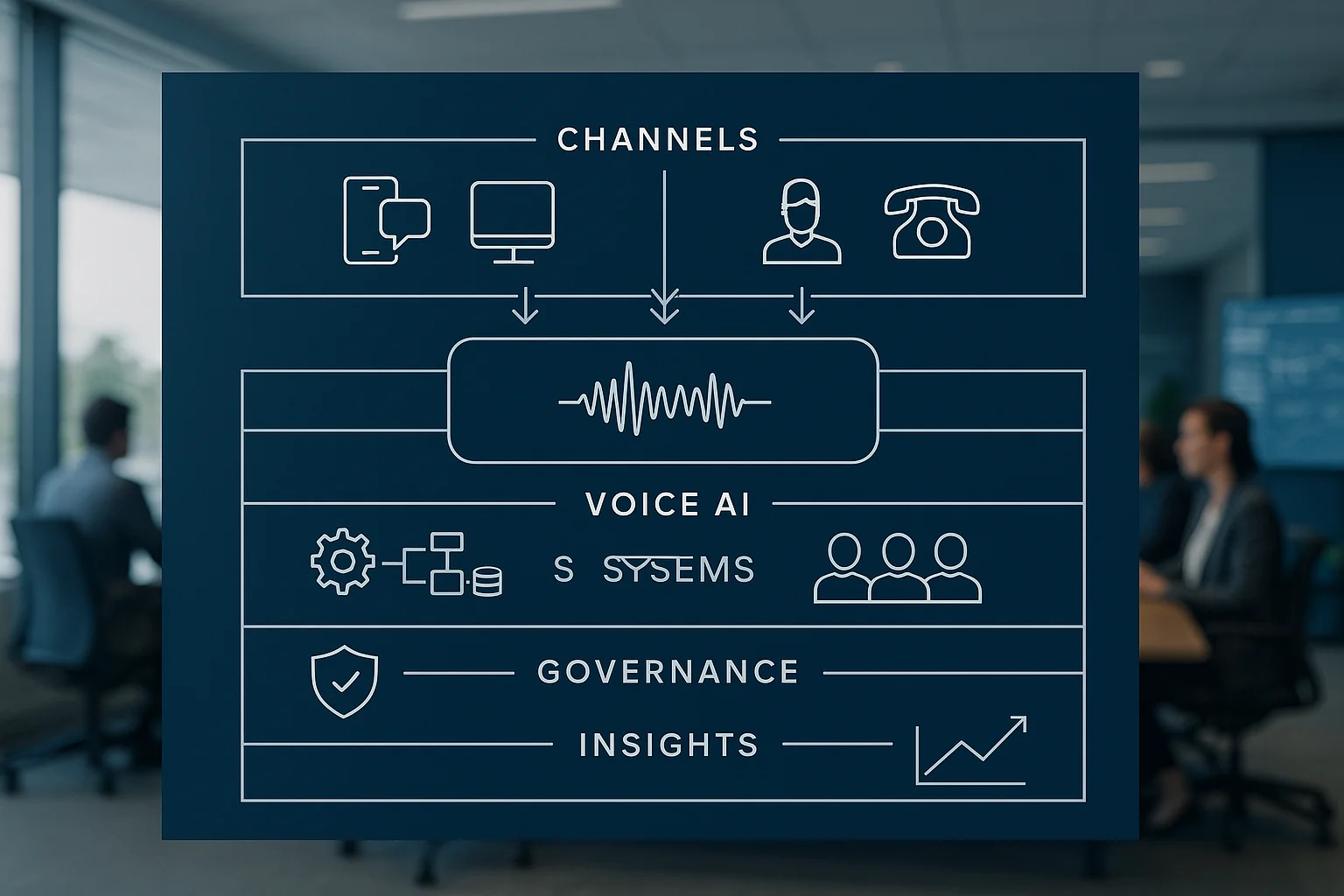
Operational reliability depends on instrumentation, QA pipelines, and clear integration ownership. Observability must cover the full path: Caller → Voice AI → business-rules layer → approved enterprise systems → response or handoff → QA and analytics.
Architecture and integration ownership
Make the enterprise systems integration contractually explicit. Who owns adapters, retries, idempotency, and schema evolution? Use controlled adapters or orchestration layers under enterprise or vendor management with clearly defined APIs, versioning, and fallbacks.
- Document adapters and the owner for each integration point (CRM, billing, identity).
- Require idempotency and transactional guarantees for system writes, or explicit compensating actions.
- Specify versioning and rollback capabilities for integration contracts.
Observability and QA pipelines
Require end-to-end tracing, real-time metrics, and immutable audit logs for calls, decisions, and escalations. Observability must include business metrics (conversion, completion), system metrics (latency, error rates), and model signals (confidence scores, fallback counts). QA pipelines should automate regression tests and enable rapid revalidation after changes.
- Require traceability from inbound call ID through business-system confirmations and final disposition.
- Mandate exportable, immutable audit logs for a defined retention period and searchable format.
- Require automated regression and synthetic tests as part of daily/weekly QA runs.
Human escalation and change control
Keep high-risk decisions behind human-in-the-loop gates. Define change-control processes for model updates, business-rule changes, and voice-flow modifications. Require documented human oversight policies, auditable approvals, and retraining plans.
- Design human-in-loop checkpoints for sensitive intents and unknown confidence cases.
- Use change-control with staged promotion and rollback for model or flow updates.
- Record approvals and maintain a change history linked to audit logs.

6. Phased test plan, readiness checklist and post-canary transition
A concise, testable acceptance plan accelerates deployment and reduces disputes. Use predefined gates, runbooks, and quantifiable readiness indicators before increasing production load or accepting vendor delivery.
Pre-launch and canary milestones
Define milestones from sandbox to full production: sandbox integration, closed beta with synthetic traffic, open beta with limited live traffic, staged canary promotions, and final turnover. Each milestone must have pass/fail criteria and a documented rollback plan.
- Sandbox: basic integrations and unit tests passed.
- Closed beta: synthetic and shadowed traffic validated; QA sampling thresholds met.
- Open beta/canary: live traffic thresholds met and no critical SLO breaches for defined stability window.
Roles, runbooks and escalation
Publish operational runbooks detailing automated rollback commands, human fallback steps, contact trees, and post-incident review obligations. Assign on-call roles and require vendor attendance for any severity-1 incident. Include timelines for incident acknowledgement and resolution responsibilities.
- Provide runbooks for rollback, temporary routing to incumbents, and manual override.
- Define incident severity classification, acknowledgement SLAs, and joint remediation timelines.
- Require vendor participation in periodic live drills and post-mortems.
Handover and managed optimization
After canary stabilization, plan a managed optimization phase where vendor and enterprise co-manage tuning, QA, and feature backlog. Define exit criteria for full vendor handoff, documentation delivery, and knowledge transfer.
- Set an optimization window with agreed KPIs and reporting cadence.
- Require training materials, runbooks, and exportable configurations at handover.
- Define criteria for transitioning to enterprise-managed operations or continued vendor-managed service.
Related Peak Demand resources
Industry and AI sources reviewed
- ISO/IEC 27001 Information Security Management SystemsInternational Organization for Standardization
- ISO/IEC 27701 Privacy Information ManagementInternational Organization for Standardization
- Artificial Intelligence Risk Management Framework (AI RMF 1.0)National Institute of Standards and Technology (NIST)
- ISO/IEC 42001 Artificial Intelligence Management SystemInternational Organization for Standardization
- AI Risk Management Framework: Generative AI ProfileNational Institute of Standards and Technology (NIST)
- OECD AI PrinciplesOrganisation for Economic Co-operation and Development
Privacy, telecommunications, recording-consent, cybersecurity, consumer-protection, employment, and records obligations vary by jurisdiction and use case. This article is operational guidance, not legal advice; organizations should confirm applicable requirements with qualified professionals.
Frequently asked questions
A serious managed service should include discovery, workflow design, telephony, integrations, validation rules, testing, monitoring, human escalation, incident handling, change control, analytics, and ongoing optimization. The value is the complete operating system around the model, not access to a model alone.
Official reference: Artificial Intelligence Risk Management Framework (AI RMF 1.0)
The operating model should assign clear owners for telephony, prompts, knowledge, APIs, credentials, incident response, analytics, approvals, and release management. Enterprise buyers should avoid deployments where those responsibilities are ambiguous or split across vendors without accountability.
Official reference: Artificial Intelligence Risk Management Framework (AI RMF 1.0)
Evaluate the complete workflow under realistic volume, latency, interruption, transfer, integration, and failure conditions. Measure task completion, escalation quality, unsupported responses, system errors, recovery behavior, and how quickly operators can detect and correct problems.
Official reference: Artificial Intelligence Risk Management Framework (AI RMF 1.0)
Ask for documented use-case boundaries, data handling, access controls, model and prompt change management, evaluation procedures, audit logs, human-oversight rules, incident response, subcontractor dependencies, and a process for reviewing material system changes.
Official reference: Artificial Intelligence Risk Management Framework (AI RMF 1.0)
Turn Voice AI infrastructure into a managed enterprise operation
Peak Demand designs, integrates, deploys, monitors, and improves Voice AI systems across customer service, enterprise systems, governance, escalation, and reporting.
Schedule a discovery call


