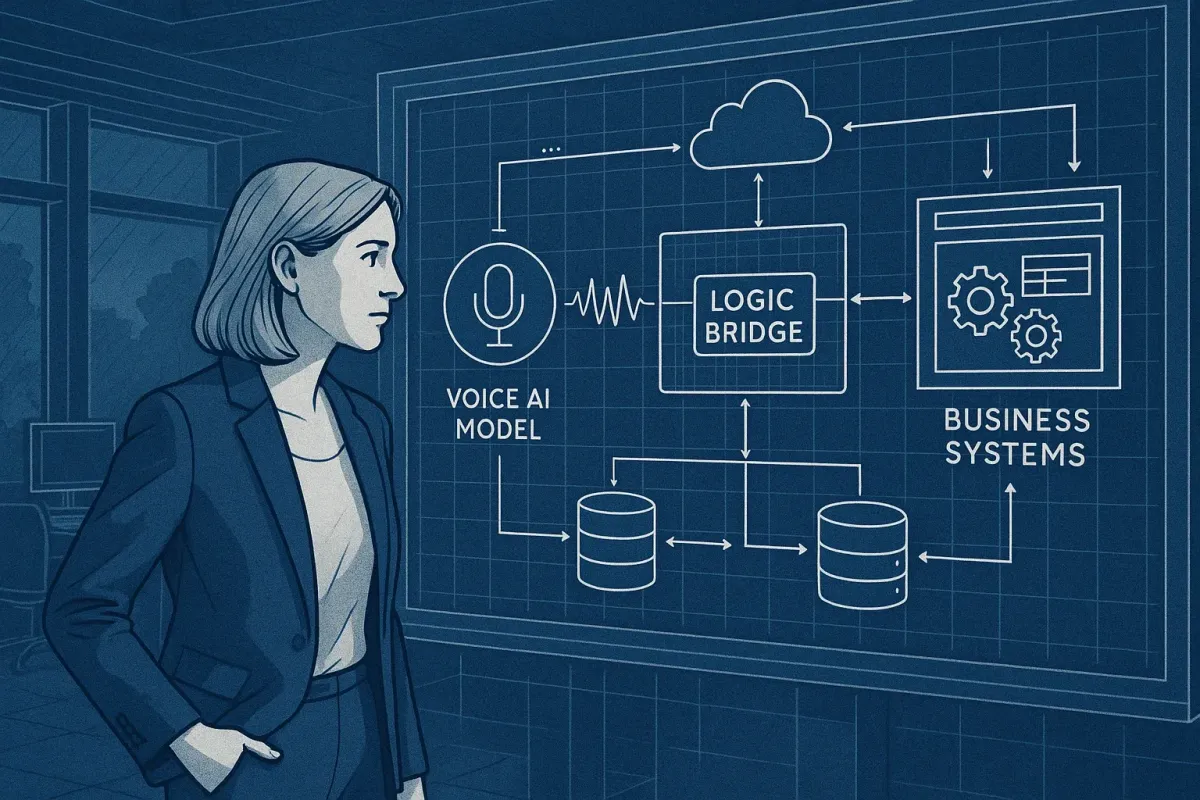
Why Voice AI Needs a Logic Bridge Between Models and Business Systems
A practical architecture and operating pattern that isolates models from direct system control, using a policy-driven logic bridge and MCP servers to normalize context, validate actions, and preserve reliability, auditability, and safety for enterprise Voice AI.
1. Architectural thesis: Why a logic bridge matters
Enterprise Voice AI sits at the intersection of language models, telephony/voice platforms, and critical business systems (CRM, ERP, EHR). A logic bridge is the thin, opinionated integration layer between model outputs and system actions that enforces policy, validation, normalization, and observability.
What a logic bridge is (and is not)
A logic bridge is a service layer—policy and workflow code, not a model—responsible for: validating model-generated intents, normalizing data into system contracts, applying authorization rules, orchestrating tool/API calls, and recording immutable audit events. It is not the model itself, nor is it a passive message bus. The bridge executes discrete, verifiable logic that converts probabilistic language outputs into deterministic system actions.
- Receives model intent + MCP context, returns validated system action or controlled human escalation.
- Implements idempotency, schema validation, and retry rules for downstream APIs.
- Records audit events with provenance: which model, which prompt/context, which bridge decision.
Define MCP once: Model Context Protocol
MCP (Model Context Protocol) is the pattern and API used to provide models with normalized, verifiable context—customer record snapshots, conversation state, entitlements, and dynamic policy flags—without giving models direct or persistent access to backend systems. MCP servers synthesize context from authoritative sources, attach provenance metadata, and enforce data-minimization before context is passed to the model.
- MCP transports context, not control: data objects include source, timestamp, and TTL.
- Controllers can redact or pseudonymize fields via MCP before model consumption.
- MCP responses include context hashes and integrity metadata for post-hoc verification.
2. Core pattern: User → Model → Logic Bridge → Systems
Map the end-to-end flow into clear responsibilities. The logic bridge is the decisive control point where probabilistic outputs become actionable commands.
Component roles and responsibilities
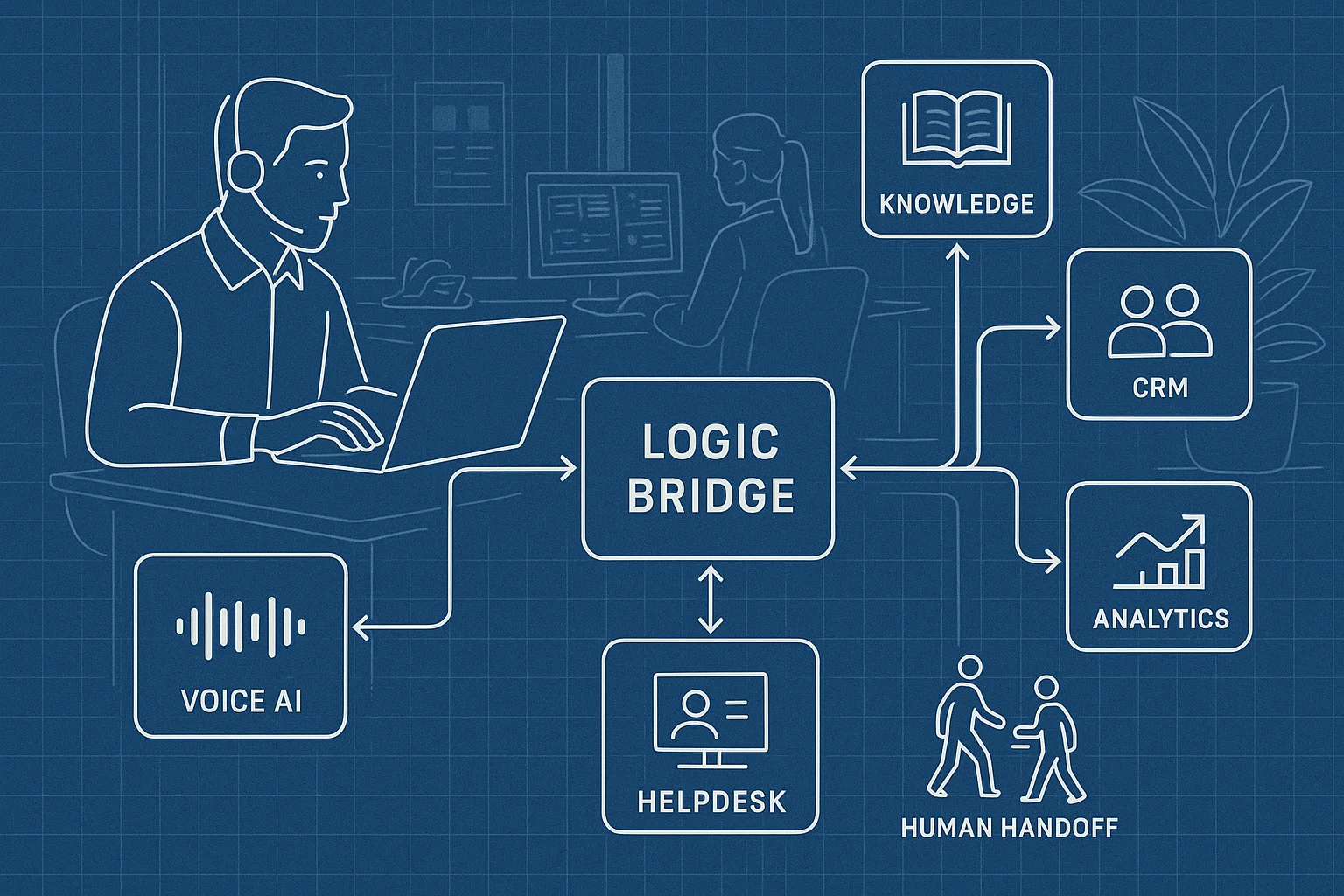
Design your architecture around these components: Voice front end (SIP, PSTN, WebRTC), model/agent runtime, MCP servers for context, the logic bridge (policy engine + orchestrator), downstream APIs (CRM, billing, EHR), audit store, and human fallback interfaces.
- Voice front end translates audio↔text and supplies session metadata and audio recordings to the model and audit log.
- Model/agent produces intents and structured proposals; no direct system tokens or write access.
- Logic bridge validates, augments, and converts proposals into idempotent API calls; can escalate to human review if policy requires.
Why separate the bridge from model and tools
Separating concerns reduces blast radius: models remain powerful for understanding and planning but cannot directly mutate systems or bypass controls. The bridge enforces business logic, minimizes exposure to sensitive data, and provides deterministic behavior for retries, rollback, and audit.
- Prevents model hallucinations from translating into unauthorized actions.
- Supports multiple model vendors or versions behind a consistent bridge API.
- Enables centralized observability and schema evolution independent of models.
3. APIs, data contracts, and MCP responsibilities
The logic bridge and MCP depend on crisp API contracts. Define schemas, idempotency semantics, and validation gates so that every action is verifiable and repeatable.
Schema normalization and contract design
Define canonical JSON schemas for common intents (e.g., appointment-schedule, payment-initiate, address-update). Each payload must include: action_id (client-provided idempotency token), actor (session and principal), source_context (MCP pointer), and requested_effect (resource, change, and class of impact). Use schema evolution practices (version headers, backward-compatible fields) and automated contract tests in CI.
- Require action_id for idempotency tracking and de-duplication.
- Use explicit impact classification (read, low-impact write, high-impact write) to gate approval flows.
- Publish contract tests and mock servers for vendor integration and QA.
MCP responsibilities during API orchestration
MCP servers should: aggregate authoritative data, redact or pseudonymize sensitive fields, attach provenance metadata, and assert TTLs. The bridge fetches MCP context by reference and logs the MCP snapshot ID in audit records. MCP must never return permanent credentials; it supplies deterministic context only.
- MCP provides context snapshots with source pointers and integrity hashes for later validation.
- Context TTLs limit stale data use; bridge must rehydrate if TTL expired before action.
- MCP responses should include provenance to support post-action validation and dispute resolution.
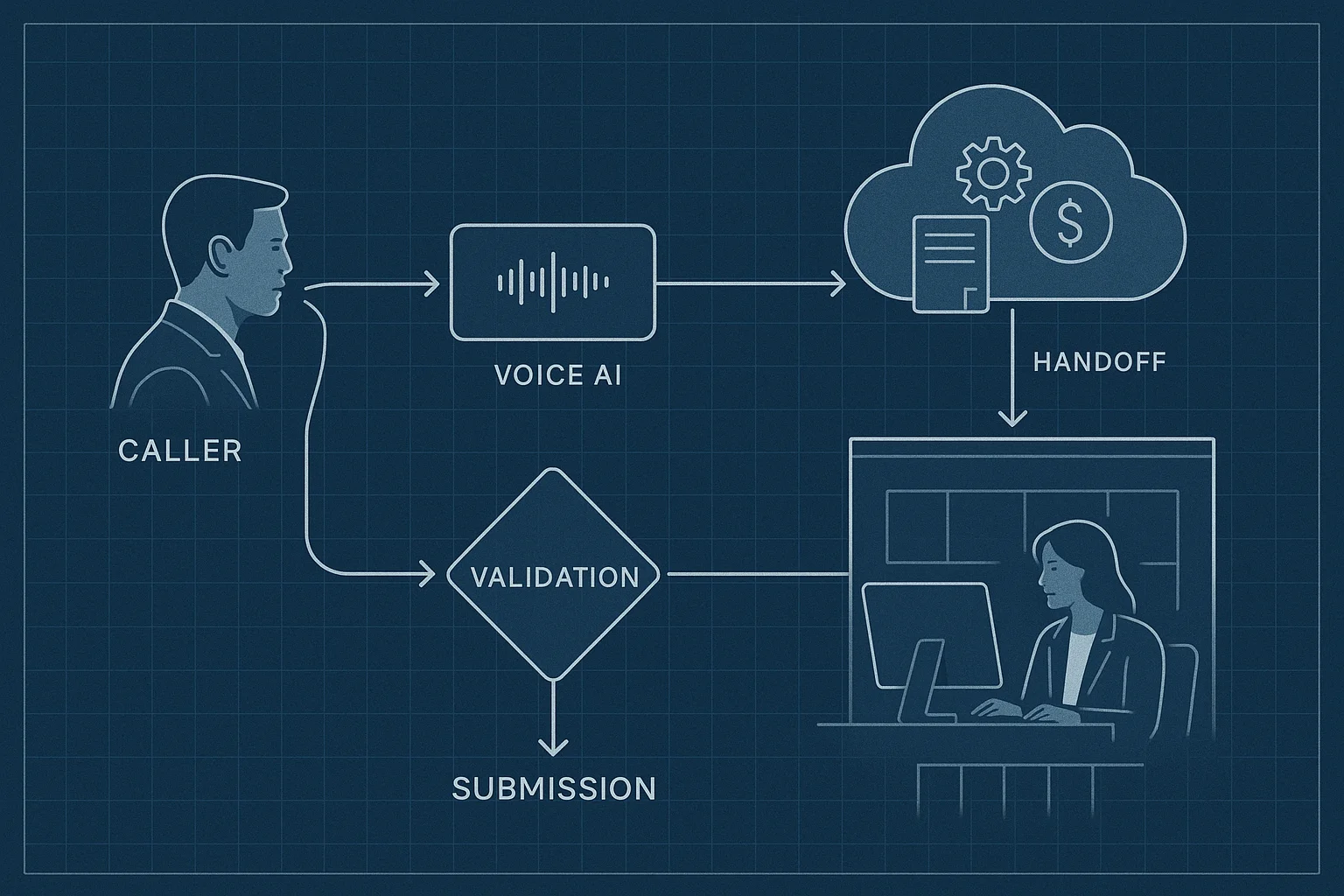
4. Identity, authorization, and least privilege
Authentication and authorization must be enforced at the bridge boundary and for every downstream call. Models should never hold long-lived or privileged credentials.
Scoped credentials and delegated tokens
Issue short-lived, scoped tokens for the bridge to call downstream APIs. Use service accounts with narrowly defined scopes and an auditable token exchange system. If the model proposes a write, the bridge performs a policy check and uses its own credentials to execute the call; the model never supplies credentials.
- Prefer short-lived OAuth tokens, mutual TLS service identities, or signed requests with limited scope.
- Record token metadata in the audit log without storing the token itself.
- For high-impact actions, require an additional approval token or human step-up authorization.
Session context, user identity, and escalation
Carry a session identity from the voice front end through MCP and the bridge. Include session attributes (caller verified, device ID, SSO claims) in policy evaluations. For actions that change entitlement or move money, implement forced human escalation or multi-factor verification according to your risk appetite.
- Preserve caller-verification evidence in MCP context (verification method, timestamp, verifier).
- Use step-up authentication for high-impact actions or when contextual signals indicate elevated risk.
- Audit the identity chain: who requested, who approved, which bridge version performed the action.
5. Reliability, observability, and failure boundaries
Design the bridge for predictable failure handling. Observability must give operators the signals to detect model drift, API latency, or policy mismatches and to recover safely.
Idempotency, retries, and circuit breakers
Every actionable request must be idempotent. The bridge should use action_id tokens to deduplicate and provide at-most-once semantics where required. Implement exponential backoff with jitter for transient failures, circuit breakers to stop flapping calls to downstream systems, and compensating actions for partial failures.
- Require action_id in payloads and persist action status (pending, applied, failed, compensated).
- Use per-target circuit breakers and health checks to avoid cascading failures.
- Plan compensating transactions for non-atomic multi-system workflows.
Observability, metrics, and audit
Instrument the full trace: voice session ID → model call ID → MCP snapshot ID → bridge action_id → downstream API request ID. Collect metrics for latency, error rate per integration, human escalation rate, and model proposal rejection rate. Keep an immutable audit store capable of reconstructing the end-to-end session for compliance and QA.
- Capture structured logs, traces, and the MCP snapshot ID for each action.
- Monitor model-proposal acceptance ratio to detect model degeneration or prompt issues.
- Retain audit records according to policy; document retention, access controls, and cross-border transfer risks.
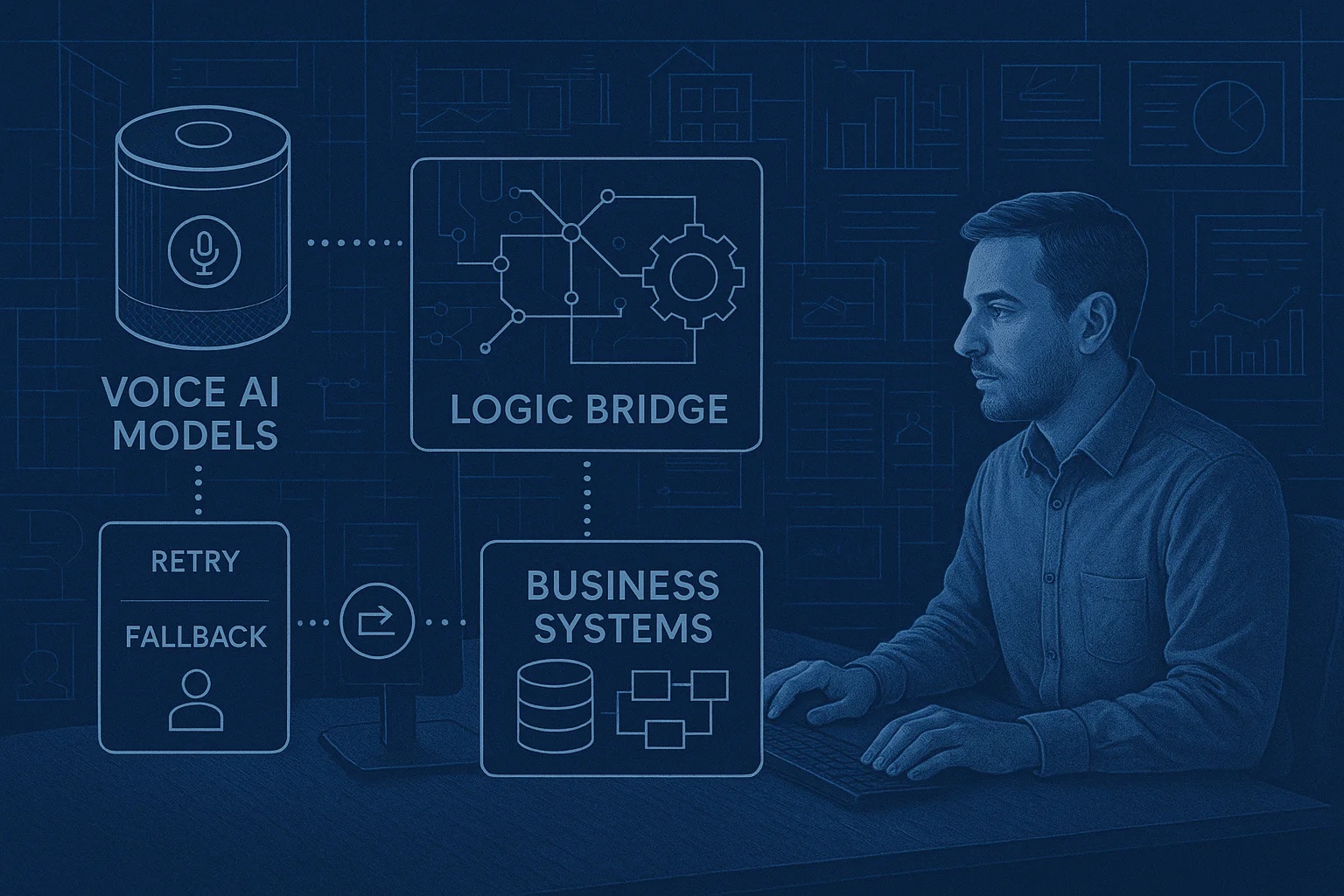
6. Safe tool use: controlled automation and human fallback
Models can propose high-value actions; control their tool use through whitelists, capability gating, and verification loops.
Tool whitelisting and capability gating
Only allow the bridge to execute a pre-approved set of tools/APIs. Define capabilities (read-only, write-limited, transactional) per tool. Maintain a capability registry with policy metadata that the bridge consults before execution.
- Whitelist APIs and map them to impact levels and approval requirements.
- Require explicit authorizations from policy engine for any new tool or integration.
- Version tools in the registry and force canarying before broad availability.
Human-in-loop patterns and verification
For high-impact or ambiguous decisions, route model proposals into a verified human review queue that shows: the normalized proposal, the MCP snapshot, policy rationale, and suggested API call. Record the human approver and their justification. Implement timed approvals and rollbacks for actions that are reversible.
- Surface model provenance and confidence signals to the reviewer.
- Log reviewer decisions and link them to the resulting system action.
- If reviewers are unavailable, implement safe-mode policies: deny, queue, or limited read-only fallback.
7. Procurement, runbooks, and operating model
Translate architecture into procurement language and operational commitments. Vendors should be evaluated on integration hygiene as much as model performance.
Procurement checklist and RFP language
Require vendors to support: idempotency tokens, structured audit logs, MCP-compatible context exchange, short-lived tokens and scoped credentials, schema-based validation, and documented failure modes. Ask for runbook examples for common scenarios (downstream API outage, model hallucination detected, data-subject access request) and for observability hooks (prometheus metrics, traces, audit export).
- Require mock integration and contract test suites as part of delivery.
- Request documented data flows, subprocessors, hosting regions, and backup regions for MCP servers and audit stores.
- Specify retention windows, access controls, and breach notification responsibilities; confirm these with legal counsel for your jurisdictions.
Operational runbooks and measurable outcomes
Define SLOs and runbooks: target mean time to detect (MTTD) anomalous proposals, mean time to human escalate (MTTE), and acceptable escalation rates. Instrument compliance checks into CI/CD so schema changes require automated contract tests. Regularly audit model proposal rejection trends and escalate model retraining or prompt engineering when rejection rates exceed thresholds.
- Maintain explicit runbooks for failover: degrade to read-only, route to human agents, or play hold music with callback options.
- Measure and report observable KPIs: proposal acceptance rate, human escalation percentage, and average remediation time.
- Review hosting and data locality choices against applicable data residency, transfer, and retention requirements with qualified counsel.
Related Peak Demand resources
Industry and AI sources reviewed
- Secure by DesignCybersecurity and Infrastructure Security Agency (CISA)
- Artificial Intelligence Risk Management Framework (AI RMF 1.0)National Institute of Standards and Technology (NIST)
- AI Risk Management Framework: Generative AI ProfileNational Institute of Standards and Technology (NIST)
Privacy, telecommunications, recording-consent, cybersecurity, consumer-protection, employment, and records obligations vary by jurisdiction and use case. This article is operational guidance, not legal advice; organizations should confirm applicable requirements with qualified professionals.
Frequently asked questions
The integration layer should handle authentication, schemas, validation, timeouts, retries, permissions, duplicate prevention, audit logs, safe failure, and human escalation. It should expose only the tools and data required for the approved workflow.
Official reference: Secure by Design
Model Context Protocol can provide a standardized tool interface for approved data and actions, but it does not replace business logic, security controls, system-of-record validation, or performance engineering. Use it where it improves maintainability without adding unnecessary latency or complexity.
Official reference: Artificial Intelligence Risk Management Framework (AI RMF 1.0)
Use explicit timeouts, bounded retries, circuit breakers, clear caller messaging, queued follow-up where appropriate, and human escalation. The agent should never fabricate a successful lookup, booking, submission, or status update.
Official reference: Secure by Design
Ask for architecture diagrams, permission boundaries, schema validation, failure testing, observability, audit logs, credential management, deployment controls, rollback procedures, and evidence that every tool action is tied to an approved workflow.
Official reference: Secure by Design
Turn Voice AI infrastructure into a managed enterprise operation
Peak Demand designs, integrates, deploys, monitors, and improves Voice AI systems across customer service, enterprise systems, governance, escalation, and reporting.
Schedule a discovery call


