
Voice AI Vendor Scorecards, SLOs & Phased Rollout Gates for API Integrations
A practical architecture and operating pattern for evaluating Voice AI vendors, defining SLOs, and running phased API rollouts with clear gates, observability, and accountability.
1 — Why a vendor scorecard plus SLOs matters for Voice AI
CTOs and integration leads need evaluation artifacts that map vendor capabilities to operational risk, not product marketing. A scorecard + SLO-driven rollout converts procurement choices into measurable readiness and accountability.
Decision drivers for procurement and rollout
Select vendors against explicit operational outcomes: measurable reductions in manual handling, safe automation of specific API actions, and the ability to demonstrate reproducible test runs. Prioritize vendors who produce integration artifacts: test harnesses, replayable transcripts, signed webhooks, and stable API adapters. Scorecards should reward evidence—end-to-end tests, observability hooks, and change-management provenance—over feature checklists.
- Evidence-first: live integration tests and sample audit trails
- Action ownership: which side (vendor or client) executes API calls and who can block them
- Operational fit: support windows, escalation paths, and SLA credits tied to integrations
What scorecards produce for the organization
A well-structured scorecard produces a procurement-ready report: pass/fail on critical controls, graded readiness for production gates, a list of required implementation items (schemas, auth tokens, routing rules), and a recommended rollout tempo tied to SLOs.
- Deployment readiness (pilot, limited, broad) with explicit gates
- Integration ownership matrix (vendor vs. client responsibilities)
- Required observability and evidence items for each gate
2 — Integration architecture pattern: agent → logic bridge → business APIs
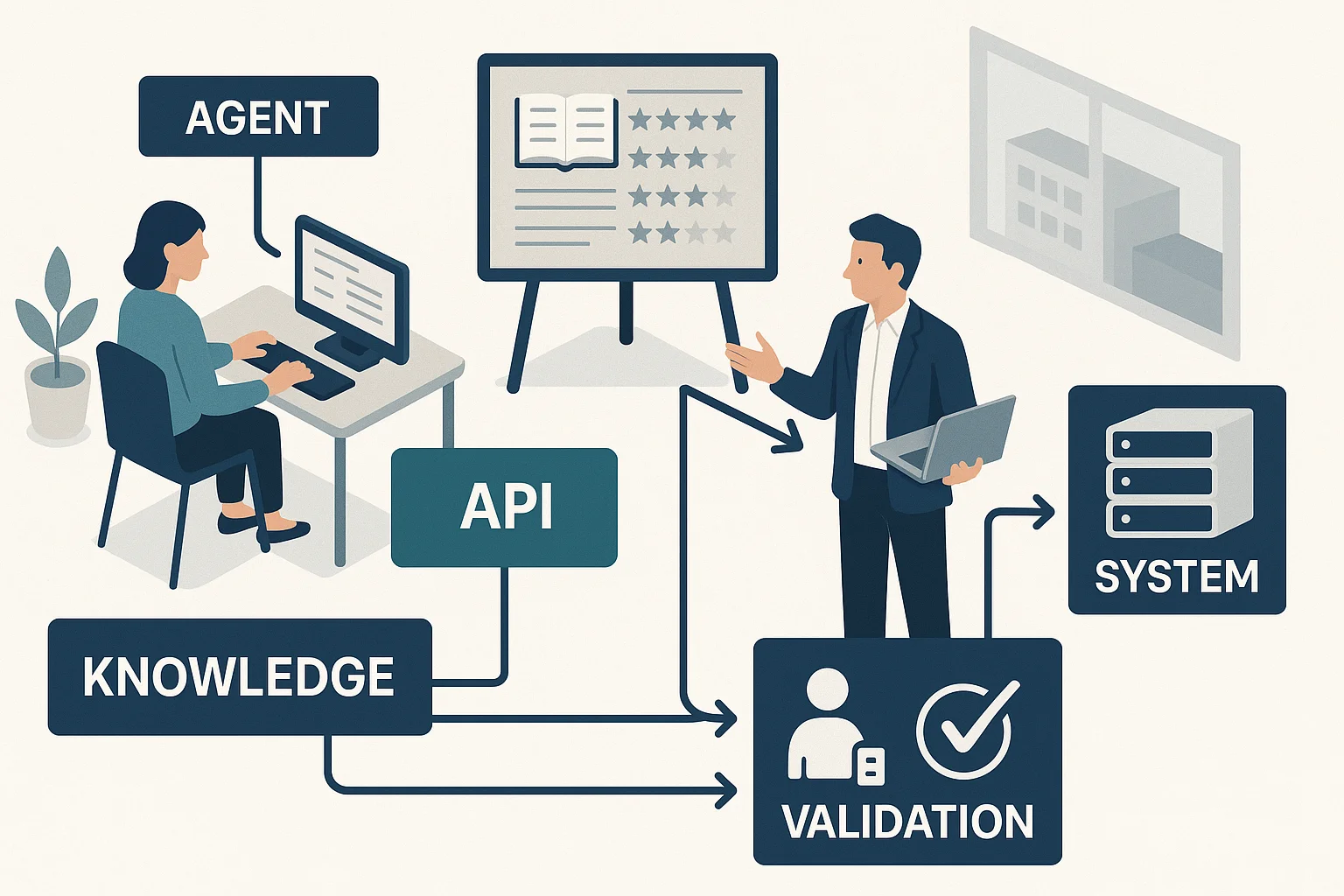
Implement a separation of concerns: the interactive agent (speech, NLU, dialog) should not directly mutate business systems. Place a logic bridge (orchestrator) between agent outputs and API calls to enforce validation, idempotency, and policy.
Pattern narrative: staged responsibilities
User interaction (voice or channel) → AI agent interprets intent and proposes actions → logic bridge enforces policy, normalizes schema, validates fields, and prepares API calls → API orchestration executes validated actions against business systems → validated system action emits audit events and, when necessary, triggers human fallback. The logic bridge is the contractual control point: it implements rate limiting, retries with idempotency keys, request/response normalization, and policy-based gating.
- Agent: natural language interpretation, intent scoring, and candidate actions
- Logic bridge: schema validation, authorization, tool access controls, idempotency
- API orchestration: brokered calls to CRMs/ERPs/EHRs with retry/backoff and transactional boundaries
- Audit layer: correlated events (transcript → decision → API call → response)
Concrete implementation choices
Use thin adapters for each business API that normalize payloads into a canonical schema. Implement synchronous vs asynchronous paths explicitly: high‑impact actions require synchronous confirmation and human signoff; low‑impact updates can be queued and reconciled. Persist idempotency keys and transaction metadata in a tamper-resistant store. Capture full request and response payloads (obfuscated for sensitive fields) and retain them to satisfy troubleshooting and audit requirements.
- Canonical schema per action to avoid brittle, per‑vendor mappings
- Idempotency keys per user-action to prevent duplicate transactions
- Separate synchronous confirmation flows for high-risk actions
3 — Designing vendor scorecards (fields, evidence, and weights)
A scorecard must be actionable and auditable. Group fields into Evidence, Capability, Security & Privacy, Operational Support, and Integration Risk.
Scorecard fields and example weightings
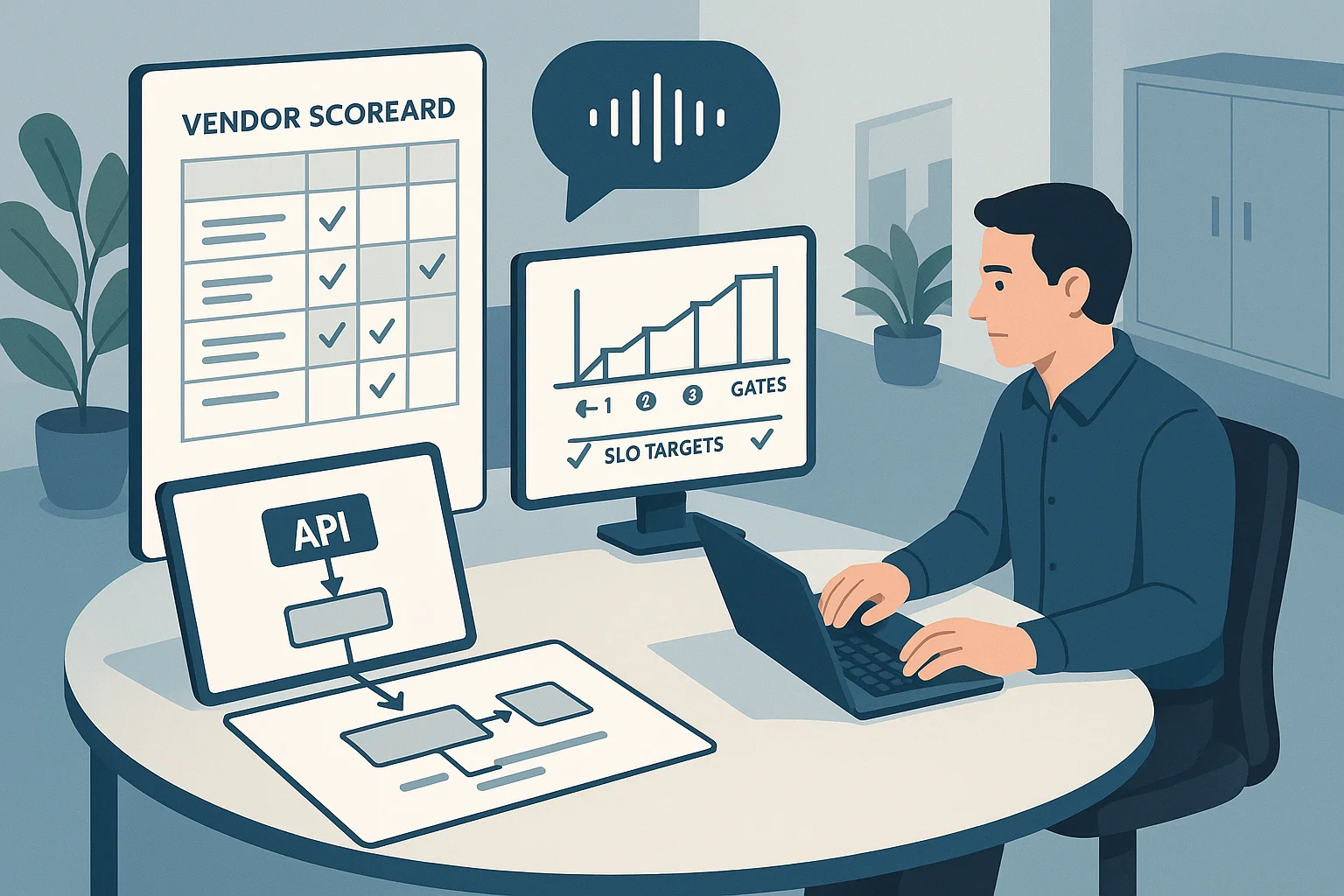
Use a weighted rubric that prioritizes integration evidence and observability over feature marketing. Typical weighting: Integration Proofs (30%), Observability & Audit (20%), Security & Privacy (20%), Operational Support & SLA (15%), Product Fit & UX (15%). The Integration Proofs bucket should require signed end‑to‑end tests that exercise the same APIs and data patterns the enterprise uses.
- Integration Proofs: actual API calls executed against sandbox or test endpoints
- Observability: correlation IDs, exportable audit logs, tracing hooks
- Security & Privacy: encryption-in-transit and at-rest, subprocessors, retention policy
Evidence that moves a vendor from 'promising' to 'approved'
Require: reproducible test harnesses, webhook signing, role-based access for API keys, and example audit exports. Acceptance criteria for an approved vendor include: traceable correlation across events, reproducible replay of 100 representative calls, and documented fallback flows for failed actions.
- Replayable transcripts and signed webhooks
- Role-based separation of tenant and vendor controls
- Documented rollback/compensation procedures for failed actions
Operational evidence and certifications
Use certifications as evidence of process maturity but not as a substitute for integration proof. ISO 27001 or similar demonstrates information security management practices; privacy controls should reference privacy management standards and the vendor's subprocessor list and data flows.
- Ask for the vendor's certification scope and the list of covered processes
- Validate subprocessors, hosting regions, and backup geography against data residency needs
- Require documented breach notification timelines and remote-support access procedures
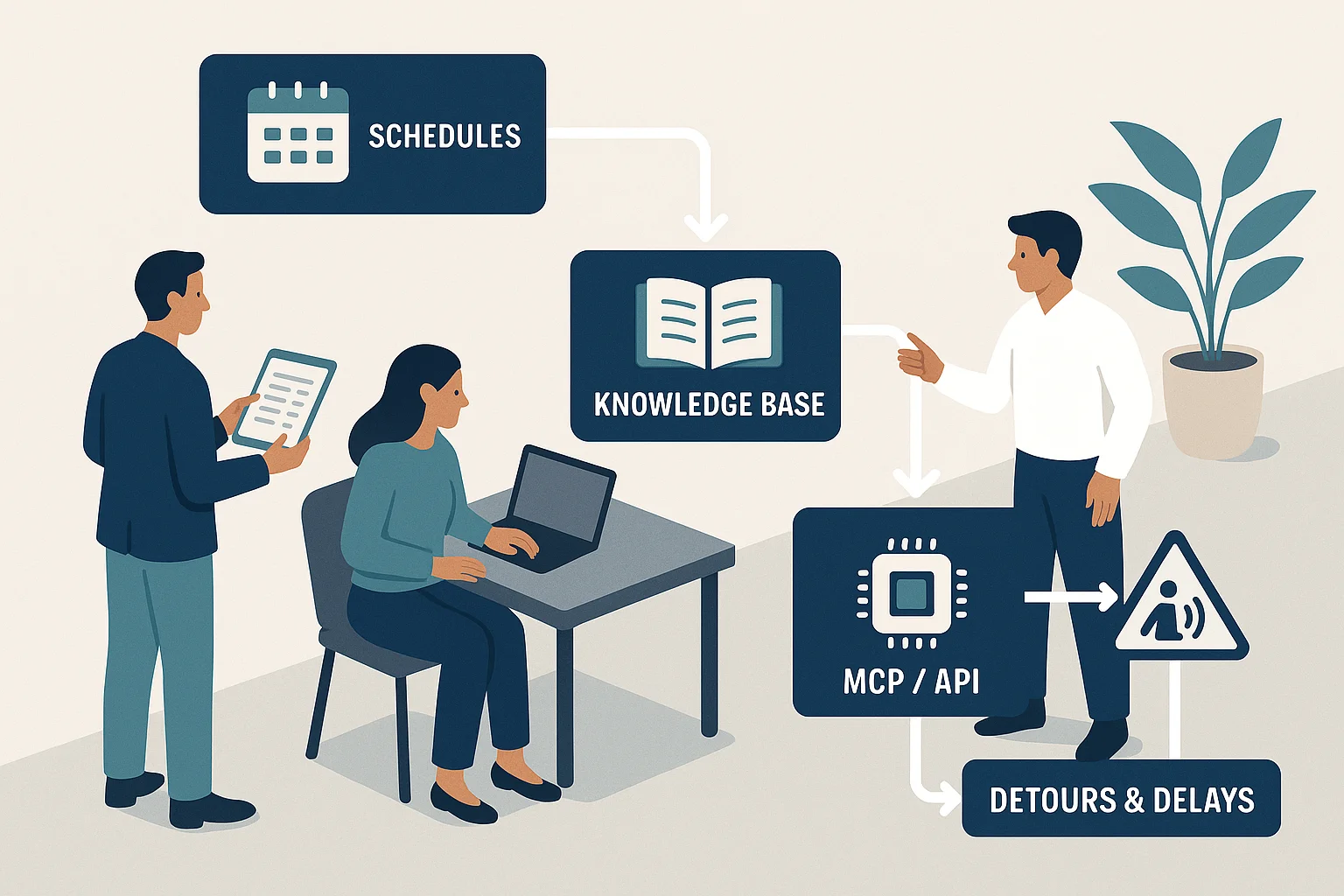
4 — SLO design and measurable gates
SLOs connect technical performance to business risk and define the measurements that gate rollout stages. Use SLOs for availability, latency, accuracy of proposed actions, false-action rate, and escalation reliability.
Essential SLO categories and example metrics
Define SLOs that map to concrete business outcomes: Availability (system reachable), Response latency (time to first decision), Action accuracy (percent of agent-proposed actions that are correct when executed), False-action rate (percent of executed actions that required reversal), and Human-escalation SLA (time to assign a human after a failed or uncertain action). Tie measurement windows (30d, 7d) and error budgets to these SLOs.
- Availability: 99.9% for orchestrator endpoints (adjust per business need)
- Action accuracy: e.g., ≥95% for low-risk tasks before broad rollout
- False-action rate: target <1% for tasks that change billing or inventory
- Escalation SLA: 5–15 minutes for customer-facing escalations during business hours
Observable signals and instrumentation
Every SLO must be paired with an observable signal: enriched request logs with correlation IDs, decision confidence scores, API response codes, and audit events that show human overrides. Collect metrics at three layers—agent, logic bridge, and business API—and correlate them for end-to-end SLO measurement. Instrument alerting thresholds tied to error budgets and automated rollback triggers for severe degradation.
- Correlation ID propagation from voice transcript to API call and audit record
- Decision confidence histograms and thresholds on per-action basis
- Automated alerting that includes sample transcripts and API payload snapshots
Test readiness and synthetic validation
Use synthetic traffic and replay tests to validate SLO compliance pre-rollout. Synthetic tests should mimic edge cases—partial speech, ambiguous intents, API timeouts—and validate that the logic bridge enforces idempotency and correct compensation behavior. Require that vendors produce reproducible synthetic test runs as part of the scorecard evidence.
- Synthetic call suites covering happy path and failure modes
- Reproducible test artifacts and logs for procurement review
- Pass/fail criteria aligned with SLO objectives
5 — Phased rollout plan and explicit gates
A three-stage rollout with clear, measurable gates reduces operational risk: Pilot, Limited Production, and Broad Production. Each stage has distinct goals, acceptance criteria, and rollback rules.
Stage A — Pilot: controlled environment
Goal: validate integration proofs, refine the logic bridge, and calibrate decision confidence thresholds. Scope should be narrow (select users, low-risk actions). Acceptance criteria include synthetic test pass rates, replayability of 100 production‑like calls, audit correlation completeness, and manual-approval workflow tested end-to-end.
- Limited user cohort and low-risk action set
- 100% reproducible audit trails for sample calls
- Manual human-in-loop confirmation for any ambiguous action
Stage B — Limited production: constrained scaling
Goal: validate SLOs under typical load and inspect false-action and escalation rates. Gradually increase user percentage and add higher-impact actions after verifying idempotency and compensation flows. Required gates: SLO attainment over a 14–30 day window, error budget adherence, and documented incident playbooks for common failures.
- Progressive ramping with throttles and error budgets
- Idempotency verification and reconciliation tests
- Documented escalation and rollback playbooks
Stage C — Broad production: operational handoff
Goal: transition to steady-state operations with vendor and client responsibilities codified. Gates include sustained SLO compliance, runbook handoffs, monitoring dashboards in the client's environment, and contractual SLAs tied to observability and incident response. Define rollback triggers (e.g., sustained false-action rate above threshold) and legal/operational notification chains.
- Operational dashboards and alerting in client control plane
- SLA definitions linked to measured SLOs and incident severity
- Final vendor acceptance to transfer routine incident handling to vendor ops
6 — Implementation controls, failure boundaries and human fallback
Design to limit blast radius. High-impact decisions must require explicit human authorization, and all automated actions must be reversible or compensable. Build clear failure boundaries and fallbacks into the logic bridge.
Controlled tool use and safe defaults
Limit the agent to propose actions; the logic bridge enforces which tools or APIs the agent may access. Default to safe behaviors on low confidence: ask clarification, queue for human review, or make read-only queries. Never allow an agent to directly mutate high-impact systems without multi-factor confirmation or human approval.
- Role-based policies for tool access
- Confidence thresholds that trigger clarification or human review
- Read-only paths for uncertain decisions
Failure boundaries and rollback mechanics
Define clear rollback and compensation strategies for each action: reverse transactions, create incident tickets, or trigger human reconciliation workflows. Use idempotency keys and transactional markers so retries do not duplicate actions. Preserve the decision context and all relevant traces for post-incident analysis.
- Idempotency keys persistent across retries
- Compensation workflows documented per action
- Incident ticketing triggered automatically on certain failure classes
Data handling, residency, and subprocessors
Clearly document where transcript data, audit logs, and backups are hosted, how long they are retained, and which subprocessors process PII. Distinguish data residency (primary hosting region) from backup geography and any cross-border transfer mechanisms. Require vendors provide subprocessors lists, retention schedules, and breach notification procedures as procurement artifacts.
- Specify hosting region, backup region, and remote-support access constraints
- Require subprocessors, retention, and recording-consent documentation
- Confirm responsibilities for breach notification and data portability
Related Peak Demand resources
Industry and AI sources reviewed
- ISO/IEC 27001 Information Security Management SystemsInternational Organization for Standardization
- ISO/IEC 27701 Privacy Information ManagementInternational Organization for Standardization
- Artificial Intelligence Risk Management Framework (AI RMF 1.0)National Institute of Standards and Technology (NIST)
- AI Risk Management Framework: Generative AI ProfileNational Institute of Standards and Technology (NIST)
- Secure by DesignCybersecurity and Infrastructure Security Agency (CISA)
Privacy, cybersecurity, contractual, records, and sector-specific obligations vary by jurisdiction and connected system. This article is operational guidance, not legal advice; organizations should confirm applicable requirements with qualified professionals.
Frequently asked questions
The integration layer should handle authentication, schemas, validation, timeouts, retries, permissions, duplicate prevention, audit logs, safe failure, and human escalation. It should expose only the tools and data required for the approved workflow.
Official reference: Secure by Design
Model Context Protocol can provide a standardized tool interface for approved data and actions, but it does not replace business logic, security controls, system-of-record validation, or performance engineering. Use it where it improves maintainability without adding unnecessary latency or complexity.
Official reference: Artificial Intelligence Risk Management Framework (AI RMF 1.0)
Use explicit timeouts, bounded retries, circuit breakers, clear caller messaging, queued follow-up where appropriate, and human escalation. The agent should never fabricate a successful lookup, booking, submission, or status update.
Official reference: Secure by Design
Ask for architecture diagrams, permission boundaries, schema validation, failure testing, observability, audit logs, credential management, deployment controls, rollback procedures, and evidence that every tool action is tied to an approved workflow.
Official reference: Secure by Design
Engineer the integration layer before scaling Voice AI
Peak Demand designs the APIs, logic bridges, validation, fallback, observability, and human-escalation infrastructure required for dependable Voice AI operations.
Schedule a discovery call


