
Voice AI Procurement Checklist for Regulated and High‑Stakes Operations
A decision-focused procurement and architecture checklist for enterprise Voice AI. Covers architecture, managed service scope, QA, analytics, containment, escalation, multilingual scale, governance, and procurement controls for regulated and high‑stakes environments.
1 — What to lock down before you run a pilot
Pilots fail when responsibilities, interfaces, and failure boundaries are fuzzy. Before procurement, document ownership, integration points, data flows, and the acceptance criteria that will decide go/no‑go.
Define ownership and interfaces
Write explicit RACI for Caller telephony, Voice AI runtime, business‑rules layer, approved enterprise systems (CRM, billing, order‑entry), and human escalation. The vendor should own the Voice AI runtime and operational observability; the buyer must own authoritative business data and approval workflows. Avoid vague language such as “assist” without clarifying which adapter or API is the source of truth.
- List APIs and adapters the vendor will build, and those the buyer will provide or certify.
- Specify who controls change‑control for business rules and when emergency bypass is allowed.
- Require documented failover: if an API fails, how will the flow degrade and who will be notified?
Agree acceptance criteria and failure boundaries
Acceptance should be outcome-driven and measurable. Convert business outcomes (containment quality, transaction accuracy, proper escalation) into testable criteria and runbooks. Define explicit failure boundaries such as: when caller authentication fails, when confidence scores are below threshold, or when external system latency exceeds a serviceable limit.
- Map call flows for happy, unhappy, and system-failure paths.
- Define escalation triggers (confidence, duration, caller intent, negative sentiment).
- Include production runbook steps for common failures and a communication plan for major incidents.
Contractually require observability and audit records
Insist on auditable logs (call transcripts, intent/confidence histories, decision timestamps, and change-control records) retained for the period your legal and operational teams require. Specify retention, redaction, and export formats in the SOW so QA teams can re-run cases and auditors can verify decisions.
- Log both decisions and the inputs to decisions (voice transcript, intent score, business‑rule result).
- Require exportable QA bundles for root-cause and compliance reviews.
- Define roles that can access and redact logs and under which approvals.
2 — Architecture and integration checklist
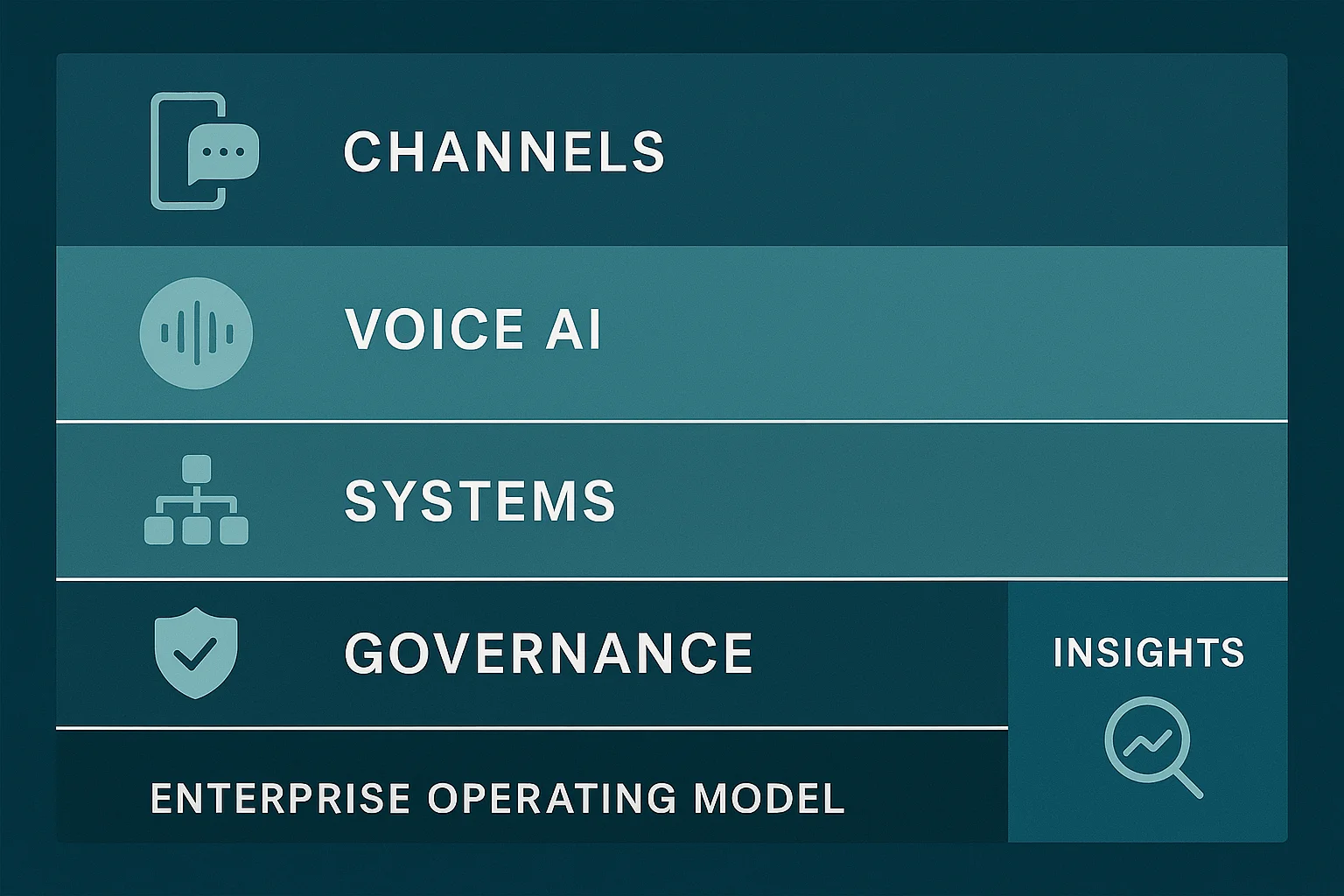
A defensible enterprise architecture uses clear layers: Caller → Voice AI → business‑rules layer → approved enterprise systems → response/transaction/human handoff → QA & analytics. Procurement should validate each layer and its adapters.
Runtime and business‑rules separation
Keep the conversational runtime (NLP, ASR/TTS, dialog manager) decoupled from business rules that access sensitive systems. The business‑rules layer should be an auditable, versioned service under buyer control or co‑managed with strict change governance.
- Require versioning and change logs for business logic and routing rules.
- Ask for a logic‑bridge pattern: the vendor maps intents to business operations through documented adapters rather than hardcoding enterprise logic in the model.
- Ensure a safe development-to-production pipeline with approval gates for rule changes.
Approved adapters and data flows
Specify adapters (APIs, webhooks, secure queues) that will be used for CRM, billing, order entry, or verification services. Identify subprocessors and where they operate. Address data residency, cross‑border transfers, and backup geography in contractual exhibits.
- List required adapter interfaces and authentication methods (mutual TLS, OAuth, API keys managed by buyer).
- Ask vendors to publish a subprocessors list and update cadence for changes.
- Mandate explicit controls for recording, storage, and onward transfers of call recordings and transcripts.
Failure modes and surgical rollback
Design for observable, predictable failures: model misclassification, upstream system latency, speech-recognition regressions, and third‑party API outages. Architects should require feature flags and traffic‑shaping mechanisms so any release can be rolled back or diverted to human agents with minimal customer impact.
- Require blue/green or canary deployments for dialog updates.
- Insist on traffic‑splitting and kill switches at both runtime and telephony levels.
- Document metrics and alarms that would trigger automatic diversion to agents.
3 — Managed service scope and SOW essentials
Buyers must clearly define what a managed Voice AI service includes and where buyer responsibilities begin. Avoid assumptions about integrations, optimization, and human oversight.
What a mature managed‑service SOW should say
A robust SOW details service scope (runtime, telephony, system adapters), QA cadence, optimization cycles, incident response, and handoff SLAs. It should state who owns test corpora, who funds and performs annotation, and how changes are prioritized and priced.
- List deliverables: adapters, QA dashboards, test harness, training corpora exports, runbooks.
- Set explicit optimization cycles and associated deliverables: data collection plan, A/B tests, and rollback criteria.
- State resourcing for escalation: vendor on‑call, buyer point of contact, and human‑in‑loop procedures.
Peak Demand differentiation: custom infrastructure and logic bridges
Vendors should explain how they will implement custom infrastructure and logic bridges to map conversational outputs to approved enterprise transactions. Peak Demand builds controlled adapters and orchestration layers that preserve enterprise ownership of business logic while hosting and optimizing runtime operations under a managed‑service model.
- Require demonstration of the vendor’s adapter toolchain and access controls.
- Ask for a documented escalation and augmentation workflow for high‑risk intents.
Pricing model alignment with continuous optimization
Avoid pricing that discourages necessary optimization work. Procurement should favor models that separate runtime/telephony costs from continuous improvement efforts, with clear scope and unit pricing for annotation, testing, and model updates.
- Define what counts as an optimization cycle and what is out‑of‑scope.
- Include acceptance criteria for each optimization deliverable.
4 — QA, analytics, and observability
QA and analytics are operational controls, not afterthoughts. Require tooling and processes that make Voice AI behavior measurable, reproducible, and auditable.
Essential observability and QA artifacts
Procure detailed traces: raw media or transcripts (as allowed), intent labels, confidence scores, decision logs, timestamps for each decision point, and business‑rule outputs. Vendors should publish dashboards and an exportable QA bundle format for offline review.
- Require sample replays for QA investigators (audio + transcript + decision timeline).
- Require exportability of labeled data used for optimization and a CSV/JSON format for offline analysis.
- Insist on anomaly detection alerts for sudden shifts in intent mix or degradation in ASR confidence.
Operational metrics to track (and why)
Measure containment quality (how often calls finish without agent handoff), containment accuracy (transactionally correct outcomes within containment), escalation quality (timeliness and resolution after handoff), cost‑to‑serve (runtime + telephony + human hours per resolved contact), and model/regression metrics. Map each metric to the business KPI it impacts.
- Define how containment accuracy will be validated through QA samples.
- Require vendor reporting frequency and the SLA for metric-delivery.
- Clarify how analytics support root-cause and continuous improvement.
Peak Demand differentiation: QA and observability built into deliveries
Peak Demand embeds QA artifacts and observability dashboards into each delivery, supplying QA bundles and change logs that let buyer QA teams reproduce decisions and test regression across sites and languages.
- Request example QA bundles and a demonstration of reproducing a disputed call.

5 — Containment, escalation, and human oversight
Containment and human handoff are primary safety controls in regulated contexts. Procurement must specify triggers, human‑in‑the‑loop requirements, and audit trails for decision reversals.
Design containment with measurable guardrails
Containment must be judged both by how many calls are contained and by the correctness of the transaction performed within containment. Define explicit test cases that cover high‑risk intents and require vendor demonstrations of correct containment across those cases.
- List high‑risk intents that must always route to humans unless explicit automation approval exists.
- Require a documented process for adding or removing intents from the high‑risk list.
- Request periodic independent QA of containment transactions.
Escalation quality and human handoff SLAs
Escalation quality covers whether the human agent receives context-rich handoff data (call history, intent progression, confidence signals), and how quickly handoffs occur. Specify the minimum context that must accompany every escalation and the acceptable time-to-agent in different scenarios.
- Specify required handoff fields: transaction attempts, verified identity facts, previous prompts, and ASR/intent confidences.
- Mandate an automated ticket or CRM record for each escalation with linkable artifacts.
- Define a maximum allowable loss of context during handoff.
Operationalizing human oversight and change control
Human oversight requires documented governance: who can change conversations, approval workflows for model or rule updates, and auditable records of oversight actions. Operationalize oversight with routine reviews, escalation playbooks, and periodic audits.
- Require a change‑control board (vendor + buyer) and a change request log.
- Ask for documented human‑in‑loop workflows for disputed calls.
6 — Multi‑site, multilingual, and continuous optimization
Scaling across sites and languages is an architectural and operational challenge. Procurement needs to validate vendor capability across telephony providers, locales, speech variants, and orchestration tooling.
Validate multilingual and multi‑accent performance
Require vendors to present site- and dialect-specific test evidence. Insist that the SOW include acceptance tests for every supported language/locale and that analytics separate performance by language and site to support targeted improvement.
- Request per‑locale QA bundles and per‑locale performance reports.
- Confirm vendor ability to tune ASR and NLU for accents and domain vocabulary.
Orchestration across telephony and sites
Confirm vendor orchestration for telephony providers, local regulations, and regional failover. For global operations, verify how the vendor will route calls between regions, where media and transcription are processed, and the geography of backups and on‑call support.
- Ask for a map of runtime regions, backup regions, and remote‑support access procedures.
- Require subprocessors and hosting regions be enumerated with notice periods for changes.
Continuous optimization cycles and governance
Optimization is a regular operating expense, not a one‑time project. Define cadence for data capture, annotation, retraining, A/B testing, and deployment. Include measurable gates for releases and scripts for rollback.
- Specify what telemetry will be collected for optimization and who owns annotation.
- Include SLAs for turnaround time on critical optimization items (intent fixes, bug patches).
Related Peak Demand resources
Industry and AI sources reviewed
- Artificial Intelligence Risk Management Framework (AI RMF 1.0)National Institute of Standards and Technology (NIST)
- AI Risk Management Framework: Generative AI ProfileNational Institute of Standards and Technology (NIST)
- ISO/IEC 42001 Artificial Intelligence Management SystemInternational Organization for Standardization
- ISO/IEC 27001 Information Security Management SystemsInternational Organization for Standardization
- ISO/IEC 27701 Privacy Information ManagementInternational Organization for Standardization
Privacy, telecommunications, recording-consent, cybersecurity, consumer-protection, employment, and records obligations vary by jurisdiction and use case. This article is operational guidance, not legal advice; organizations should confirm applicable requirements with qualified professionals.
Frequently asked questions
A serious managed service should include discovery, workflow design, telephony, integrations, validation rules, testing, monitoring, human escalation, incident handling, change control, analytics, and ongoing optimization. The value is the complete operating system around the model, not access to a model alone.
Official reference: Artificial Intelligence Risk Management Framework (AI RMF 1.0)
The operating model should assign clear owners for telephony, prompts, knowledge, APIs, credentials, incident response, analytics, approvals, and release management. Enterprise buyers should avoid deployments where those responsibilities are ambiguous or split across vendors without accountability.
Official reference: Artificial Intelligence Risk Management Framework (AI RMF 1.0)
Evaluate the complete workflow under realistic volume, latency, interruption, transfer, integration, and failure conditions. Measure task completion, escalation quality, unsupported responses, system errors, recovery behavior, and how quickly operators can detect and correct problems.
Official reference: Artificial Intelligence Risk Management Framework (AI RMF 1.0)
Ask for documented use-case boundaries, data handling, access controls, model and prompt change management, evaluation procedures, audit logs, human-oversight rules, incident response, subcontractor dependencies, and a process for reviewing material system changes.
Official reference: Artificial Intelligence Risk Management Framework (AI RMF 1.0)
Need deeper enterprise Voice AI integration?
For custom APIs, SIP and telephony architecture, multi-system workflows, QA, observability, and enterprise deployment, Peak Demand commonly evaluates platforms such as Retell AI as part of a managed architecture.
Explore Retell for Enterprise Voice AIPeak Demand may earn a commission from this link.


