
Operating Model for Voice AI in Specialty Clinics: Referrals & Prior Auth
Practical operating model to deploy Voice AI for specialty-clinic referral intake and prior authorization: integration patterns, identity controls, safe escalation, procurement checklist, and measurable outcomes.
1. Why automate referral intake and prior authorization with Voice AI?
Specialty clinics and outpatient networks face predictable, high-volume administrative work at the patient-access boundary: referral capture, insurance verification, ancillary documentation collection, and authorization initiation. Voice AI can reduce manual touchpoints when you build an operating model that preserves safety, provides end‑to‑end observability, and keeps humans in decisive roles.
Operational value and limits
Voice AI is effective for structured administrative tasks that follow deterministic business rules: collecting referral context, confirming identity, capturing insurance and CPT/procedure codes, and scheduling visits. It is not appropriate for triage, diagnosis, prescribing, or replacing clinical judgment. Define the scope up front and codify the boundaries in policy and in-call logic so escalation is automatic when the caller’s needs fall outside administrative scope.
- Appropriate: demographic capture, referral source, insurance details, authorizations initiation, appointment offer/hold.
- Inappropriate: clinical triage, diagnostic decision-making, medication advice, interpreting imaging reports.
Common failure modes to design against
Design for predictable failures: mis-recognized names/dates, incomplete insurance details, ambiguous clinical descriptions, and emergency disclosures. Each failure mode must map to a deterministic recovery path: re-prompt with constrained choices, immediate human transfer, or secure message capture for asynchronous follow-up.
- Recognition errors → controlled re-prompt and confirmation flow.
- Missing or conflicting insurance data → escalate to payer verification team.
- Caller reports acute distress or emergency → immediate escalation to trained staff and instruction to call emergency services.
2. Core operating architecture
A lightweight, auditable flow that enforces validation before system writes keeps risk low and integrations reliable. The architecture below is operationally proven and simplifies procurement and governance conversations.
Canonical flow
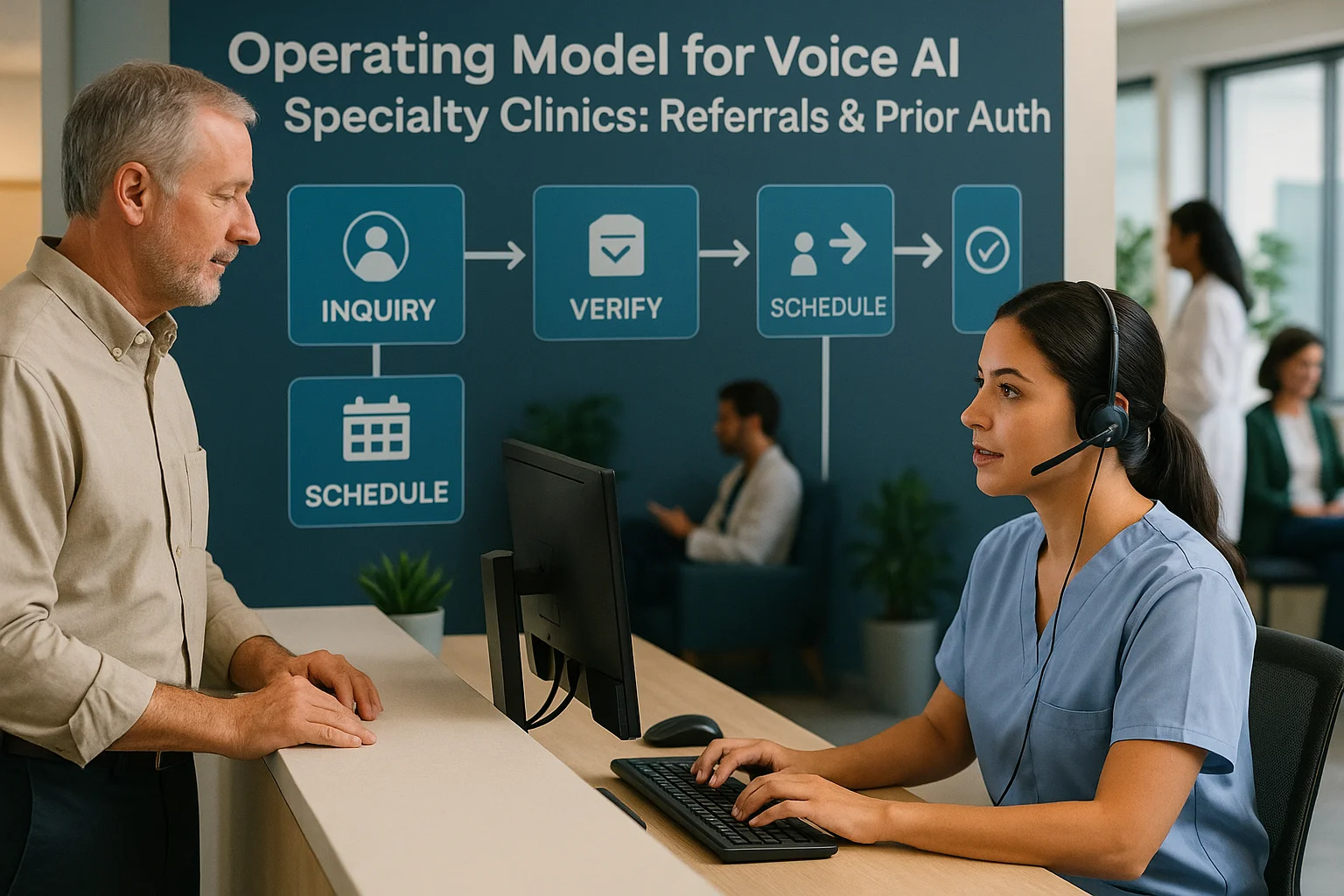
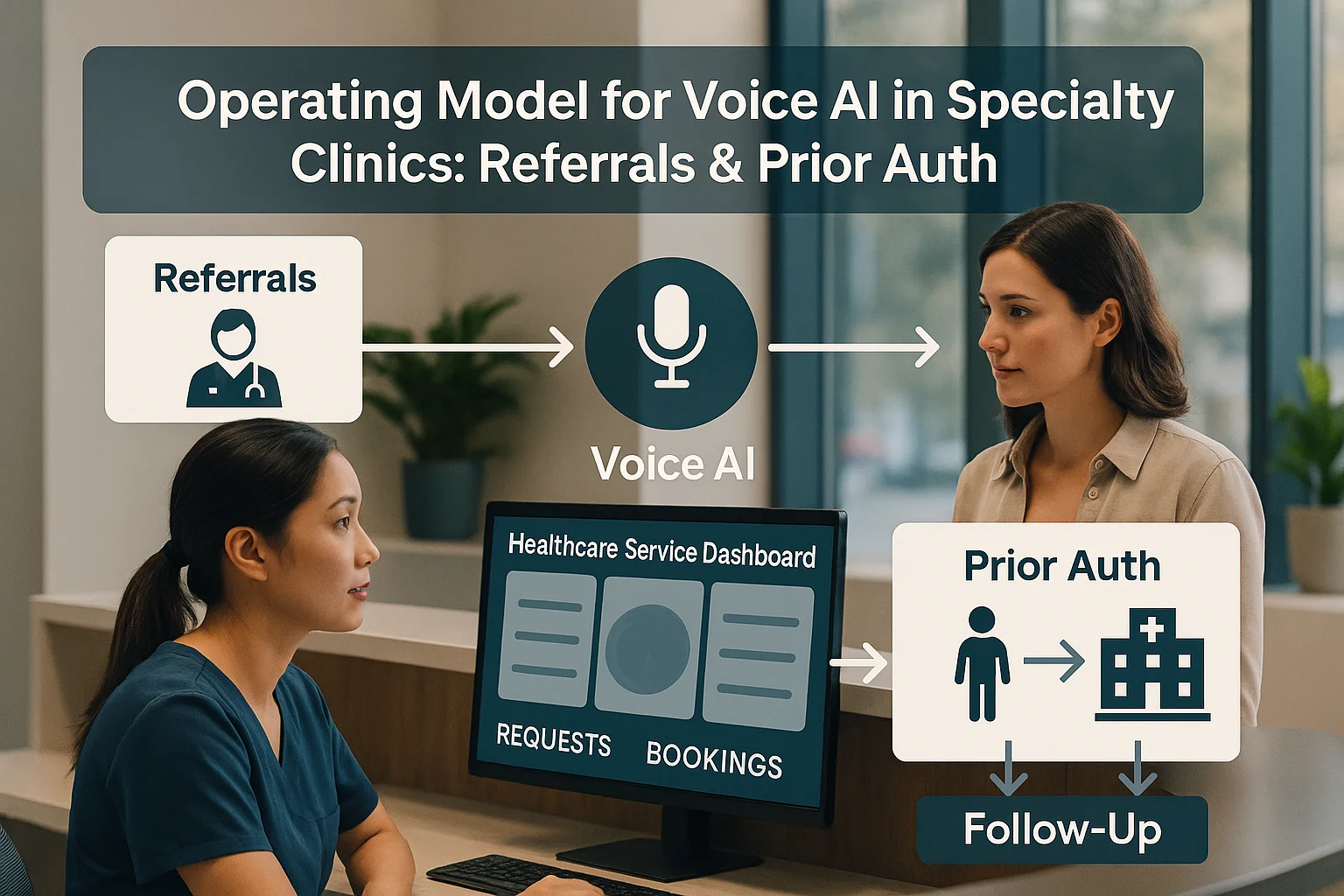
Design the call flow as: Patient/caller → Voice AI (NLP/ASR + orchestration) → validation & identity controls → adapter/approved scheduling or prior-auth API → confirmation or human handoff. Keep all write operations to EHRs, scheduling systems, or payer portals behind adapters that require a validation token generated during the call. This token ties audio/transcript evidence to the API action and maintains an audit trail.
- Validation token issued after identity and consent checks.
- Write adapter enforces field-level schema and business rules before committing.
- Every action is logged with caller audio reference and structured transcript.
Integration points and ownership
Identify which enterprise teams own each touchpoint: identity verification (patient-access), scheduling/EHR writes (IT/EHR team), payer interactions (revenue cycle), and escalation (clinical ops). Use controlled adapters for every external system—these are the only components with write privileges. Avoid vendor lock-in by standardizing on RESTful APIs, HL7/FHIR, and message contracts.
- Define adapter responsibilities: schema validation, field normalization, error codes, retry policies.
- Keep the Voice AI stack stateless relative to core patient records; all persistence occurs in controlled systems.
- Require a human-approval gate for any ambiguous or policy-sensitive write.
3. Identity, field validation and safety gates
Identity verification, field validation, and controlled escalation are the backbone of safe Voice AI intake. Implement multi-factor validation where required and always log evidence.
Identity checks and evidence capture
Choose a risk-based approach: low-risk interactions (call-back confirmations, appointment requests) require minimal identity proofing; higher-risk actions (sharing protected health information, initiating an authorization) require stronger verification. Possible controls include knowledge-based questions, one-time passcodes via SMS/voice, and cross-checks against the EHR demographics. Store linkage data (transcript pointer, OTP result, IP/geolocation if available) in the audit trail.
- Risk-based identity level definitions and acceptance criteria.
- OTP or registered phone certificate for elevated transactions.
- Retain evidence pointers rather than full recordings where policy prefers.
Field validation and business-rule enforcement
Implement deterministic validation rules in the adapter layer: allowable CPT ranges, payer plan codes, referring-provider IDs, and required document checklist. Reject writes that fail schema validation and route to human review with a structured queue and required fields highlighted.
- Schema validation before API write reduces downstream correction work.
- Auto-generated task with required evidence for human review when validation fails.
- Field-level error codes for automated reporting and SLA measurement.
Safety escalation policies
Embed clinical and emergency escalation flows into the IVR logic: if a caller indicates acute symptoms or uses keywords associated with distress, the system should play scripted instructions (e.g., call emergency services) and transfer to trained staff immediately. Never allow the Voice AI to attempt clinical triage—route to clinicians or nurse lines.
- Keyword and intent detectors as tripwires for immediate handoff.
- Scripted messaging to avoid giving clinical advice in automated responses.
- Logging of the escalation path and time-to-human-contact metrics.
4. Governance, QA and risk management
Operationalizing Voice AI requires an ongoing governance program that combines policy, technical controls, and continuous testing. Treat the system as a medical-adjacent service with strict QA cycles and accountability.
Risk framework and governance roles
Adopt a formal risk-management approach for AI services: identify risk tiers for each workflow, assign owners for privacy/clinical/compliance/IT, and require documented acceptance criteria for production deployment. Use established frameworks for AI risk management and health AI governance to shape your policy baseline.
- Define risk tiers (low/medium/high) and required mitigations per tier.
- Assign role-based responsibilities including human escalation owners.
- Require explicit sign-off before releases that change decision logic.
Quality assurance and continuous validation
Operational QA is not a one-time activity. Maintain test suites with representative audio, edge-case prompts, and adversarial examples. Run daily or weekly synthetic tests that simulate payer responses, bad audio, and non-native speech. Implement a production monitoring pipeline that captures handoff rates, false recognitions, authorization failure reasons, and customer satisfaction trends.
- Scenario-based test suites and regression testing before production changes.
- Error-injection testing for downstream systems (payers/schedulers).
- Production dashboards for handoff rate, containment rate, and time-to-auth completion.
Audit trails and explainability
Maintain structured logs that link transcript segments, validation tokens, API actions, and human decisions. For regulatory or payer disputes, the audit trail must show who approved an authorization request, which evidence was used, and how the Voice AI reached the suggested action. Preserve explainability at the business-rule level even when underlying models are complex.
- Record decision metadata and pointer to audio/transcript assets.
- Require human sign-off records for policy-sensitive actions.
- Store redaction-ready recordings to support privacy requests.

5. Implementation and procurement decisions
Voice AI procurement is fundamentally an operating-model purchase. Choose vendors and contracts based on integration ownership, observability, and operational control, not solely on model accuracy numbers.
Build vs buy and hybrid approaches
Evaluate build vs buy as an operating-model question: do you own adapters and escalation flows, or will the vendor provide them? Hybrid models—custom Voice AI front-end with clinic-owned adapters—often strike the best balance: you keep control of write privileges and audit evidence while outsourcing speech and orchestration.
- Prefer vendors that support custom adapters so the clinic controls writes and evidence retention.
- Contractually require the ability to export logs, transcripts, and model decision metadata.
- Plan for a staged rollout starting with low-risk workflows.
Contractual and operational checklist
Require clear clauses on subprocessors, data residency, remote-support access, retention, breach notification, and service-level objectives for handoff times and error rates. Ensure the contract allows for independent audits and defines the vendor’s responsibility for retraining, patching, and incident response.
- Subprocessor list, hosting regions, and backup geography specified in contract.
- Remote-support access controls, e.g., jump-host and time-limited sessions.
- SLAs for human handoff time, adapter availability, and data export.
Peak Demand differentiation
Peak Demand builds custom Voice AI solutions that integrate scheduling and intake adapters you can own, delivers identity verification and field validation patterns, enforces safe escalation, and produces audit-ready trails with human-review workflows. For specialty clinics we recommend managed operational services with clear adapter handover and playbooks for abnormal conditions.
- Custom Voice AI front-ends with clinic-controlled scheduling/EHR adapters.
- Identity verification patterns and field-validation templates for prior auth.
- Human-review queues, recorded evidence pointers, and configurable escalation playbooks.
6. Operational metrics, SLAs and continuous improvement
Measure what matters: containment, safe-handoff, authorization throughput, and rework. Use these metrics to govern vendors and internal teams.
Core KPIs
Track metrics that reflect both business impact and safety: containment rate (percent of calls completed without human transfer), human handoff rate, time-to-authorization initiation, first-pass approval rate, rework from mis-captured data, and caller satisfaction (post-interaction surveys). Monitor adverse events such as unauthorized writes or missed escalations and treat them as critical incidents.
- Containment rate and human handoff rate as primary operational measures.
- Time-to-initiation of prior authorization and completion rate within SLA.
- Rework and correction rate logged by error code and adapter point-of-failure.
Continuous improvement loop
Use a change-control process: new call-flow logic must pass QA, stakeholder sign-off, and canary deployment. Feed production errors back to model improvements, prompt design, and adapter validation rules. Hold regular cross-functional reviews with patient access, clinical, IT, and compliance teams to reassess risk boundaries.
- Canary releases and staged rollouts for call-flow changes.
- Monthly cross-functional review of incidents, near-misses, and KPIs.
- Baseline retraining cadence tied to error thresholds, not arbitrary dates.
Related Peak Demand resources
Industry and AI sources reviewed
- Ethics and governance of artificial intelligence for healthWorld Health Organization
- Regulatory considerations on artificial intelligence for healthWorld Health Organization
- Artificial Intelligence Risk Management Framework (AI RMF 1.0)National Institute of Standards and Technology (NIST)
- OECD AI PrinciplesOrganisation for Economic Co-operation and Development
Healthcare privacy, security, clinical-safety, records, and professional obligations vary by jurisdiction and workflow. This article is operational guidance, not legal advice; organizations should confirm applicable requirements with qualified professionals.
Frequently asked questions
Administrative workflows such as appointment booking, changes and cancellations, referral-status intake, approved follow-up, patient-access questions, after-hours overflow, and structured routing are common starting points. Clinical judgment, diagnosis, emergency triage, and prescribing decisions must remain with qualified professionals.
Use the minimum identifiers approved by the organization, validate them against the system of record, avoid exposing unnecessary information, and provide a human-assisted path when verification fails. The system should not infer identity from conversational context alone.
The agent should follow the organization's approved escalation and emergency-routing rules, avoid clinical advice, and transfer or direct the caller to the appropriate human or emergency channel. Those rules must be tested with realistic language and failure cases.
Request identity and privacy controls, scheduling or EHR integration behavior, audit logs, escalation rules, downtime handling, testing evidence, change control, monitoring, and clear separation between administrative automation and clinical decision-making.
Design a safe patient-service workflow before automating it
Peak Demand helps healthcare organizations connect Voice AI to scheduling, intake, patient communication, identity checks, escalation, and reporting with clear operational boundaries.
Schedule a discovery call


