Vendor Evaluation and Procurement Guide for Voice AI with Managed Platforms and Enterprise APIs
A practical, architecture-first guide for CTOs and integration leaders to evaluate Voice AI vendors, scope procurement, design reliable API integrations, phase rollouts, and assign operational accountability.
1. Architecture-first: A repeatable integration pattern
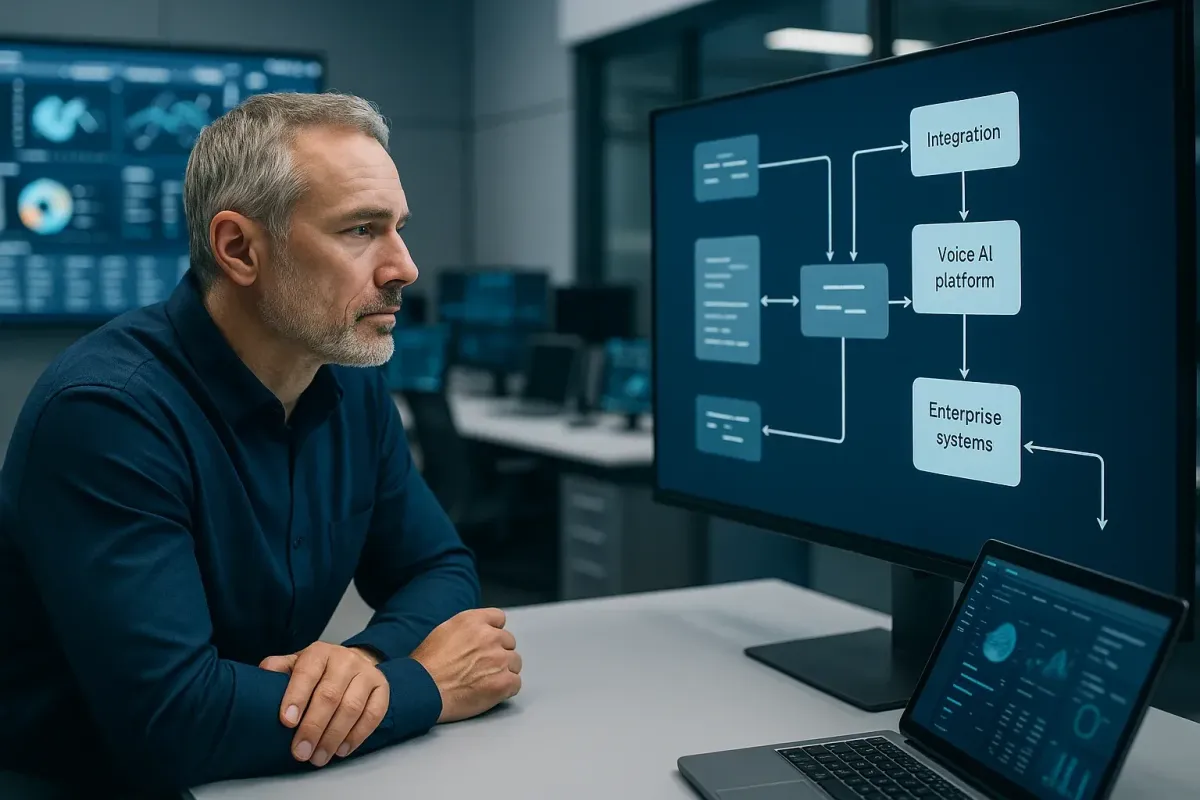
Start procurement with a clear, deployable architecture that assigns responsibilities, defines failure boundaries, and maps APIs to observable outcomes. Below is a practical pattern teams should require vendors to support.
Canonical integration flow
Require vendors to map their solution onto a canonical flow you own and can audit: User interaction (voice or telephony) → AI agent (NLP + orchestration) → policy and logic bridge (your enterprise rules) → enterprise APIs and adapters (CRM, EHR, booking systems) → validated system action (writes, edge decisions, human handoff) → audit event and human fallback. The policy and logic bridge must be under your control or implemented as a transparent, auditable layer with clear interfaces.
- Keep business-critical decisions behind enterprise policy checks and human approval gates.
- Ensure any writable action is idempotent, transactional where possible, and reversible or compensatable.
Separation of concerns and failure boundaries
Define explicit failure boundaries: classify actions as read-only, advisory, or write-explicit. Vendors must document what they will do autonomously and what requires your system-level confirmation. For write actions, require synchronous confirmation from your business API and a compensating rollback plan for partial failures.
- Design timeouts and retry policies per integration (exponential backoff, capped retries, circuit breakers).
- Place human-in-the-loop escalation for any action with financial, safety, or compliance risk.
Peak Demand differentiation: policy & logic bridge
We require vendors to integrate via an enterprise-owned policy and logic bridge that handles schema normalization, validation, idempotency tokens, and access control. This ensures consistent orchestration across multiple voice vendors or model providers and limits blast radius from vendor-side failures.
- Schema normalization enforces contract compatibility between your APIs and vendor adapters.
- Idempotency tokens and request validation prevent duplicate operations after retries.
- Logic bridges provide a single place to implement business rules, audit capture, and human fallback triggers.
2. Vendor evaluation: technical, operational, and contractual criteria
Move beyond product demos. Specify technical capabilities, observable metrics, and contractual obligations. The table below is operational—use it as a checklist during procurement and RFP scoring.
Essential technical capabilities
Score vendors for the following minimal technical features: robust API orchestration (webhooks, REST/gRPC, retry semantics), schema contract support, request validation, clear error semantics, idempotency, and ability to run in a sandbox with production-like integrations.
- Must expose meaningful error codes and idempotent APIs for write operations.
- Support for backward/forward-compatible schema versions and clear deprecation windows.
- Ability to send signed audit events to enterprise logging or SIEM.
Operational guarantees and observability
Require vendors to publish SLOs and show how they instrument latency, API error rates, request duplication, and model confidence metrics. Ask for access to real-time and historical telemetry and the ability to stream audit events into your observability stack.
- Observable signals: request latency, end-to-end success rate, API error rate, confidence distribution, and fallback frequency.
- Exportable audit events (structured JSON) to enterprise logging, retention controls, and secure transport.
Contractual and security checklist
Contracts must fix responsibilities for data handling, subprocessors, remote support, breach notification timelines, and data residency controls. Insist on explicit statements about backups, cross-border transfer mechanisms, and subprocessors used for production support.
- Define vendor responsibilities for data encryption, minimal retention, and deletion processes.
- Specify mechanisms for remote support access and approval workflows.
- Require role-based access controls and audit snapshots for at least 90 days (adjust per risk profile).
3. Procurement structure and SLO-driven contracts
Procure in phases with milestones tied to technical verification and security gates. Make payments conditional on demonstrable readiness and risk remediation.
Phased procurement and acceptance criteria
Structure contracts with four phases: discovery & sandbox, pilot integration, limited production, and broad rollout. For each phase define objective acceptance criteria: API contract tests pass, observability streams active, negative-path tests executed, and security review completed.
- Sandbox: vendor provides dev credentials and deterministic test harnesses.
- Pilot: integrate with a reduced-scope production API and run live calls during low-risk hours.
- Limited production: measured traffic with human oversight and SLOs validated over a 30–90 day window.
SLOs, penalties, and remediation
Define SLOs for availability, end-to-end latency, error budgets, duplicate-action rate, and successful handoffs to humans. Link a portion of vendor fees to meeting SLOs and specify remediation plans and credits for missed targets.
- Typical SLOs to negotiate: 99.9% orchestration uptime, <500ms median API latency between vendor and enterprise adapters, <0.1% duplicate-write rate.
- Require playbooks for SLO breaches including communication timelines and escalation contacts.
Proof-of-compliance and audits
Require vendors to provide evidence of security posture, either via certifications or third-party audits. Certifications are useful but ask for concrete control statements and the right to perform integration-specific audits where risk dictates.
- Ask for SSPs (System Security Plans), subprocessors list, and SOC/ISO summaries when relevant to your risk profile.
- Reserve the right to periodic integration audits and security reviews.
4. Integration and reliability engineering patterns
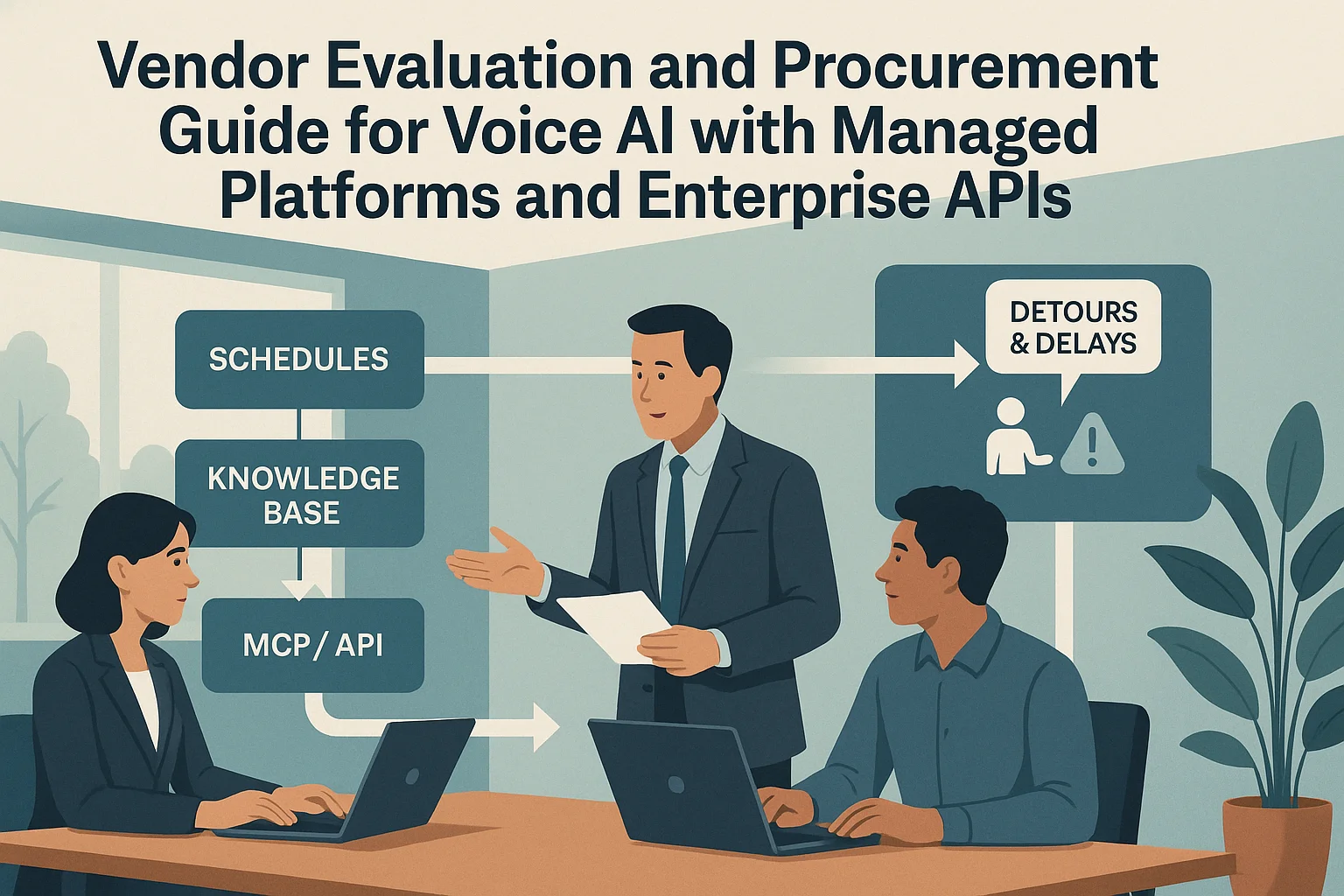
Define the concrete patterns your integration team must implement. These patterns minimize operational surprises and allow safe automation growth.
API orchestration and schema normalization
Implement an API orchestration layer (enterprise-owned) that normalizes vendor payloads into canonical schemas. The layer performs validation, enrichment, and mapping to downstream systems, and is where you enforce business rules and authorization.
- Keep canonical schemas stable and versioned; provide adapters for vendor payloads.
- Validate all incoming vendor requests against schema and business rules before performing writes.
Idempotency and transactional safety
Require idempotency tokens for operations that mutate state. For multi-step operations, design compensating transactions or implement distributed transaction patterns with clear rollback semantics.
- Store idempotency keys centrally with TTLs to prevent replay across retries.
- Design compensating flows for partially completed operations (e.g., cancel bookings, revert inventory reservations).
Observability, traceability, and audit events
Emit structured audit events for every user interaction, decision rationale, API call, and human escalation. Events should include correlation IDs to reconstruct end-to-end traces, confidence scores, and the specific policy checks performed.
- Stream events to SIEM/observability stacks with documented retention.
- Instrument synthetic tests to validate end-to-end paths during business hours.
5. Test readiness, QA, and failure-mode drills
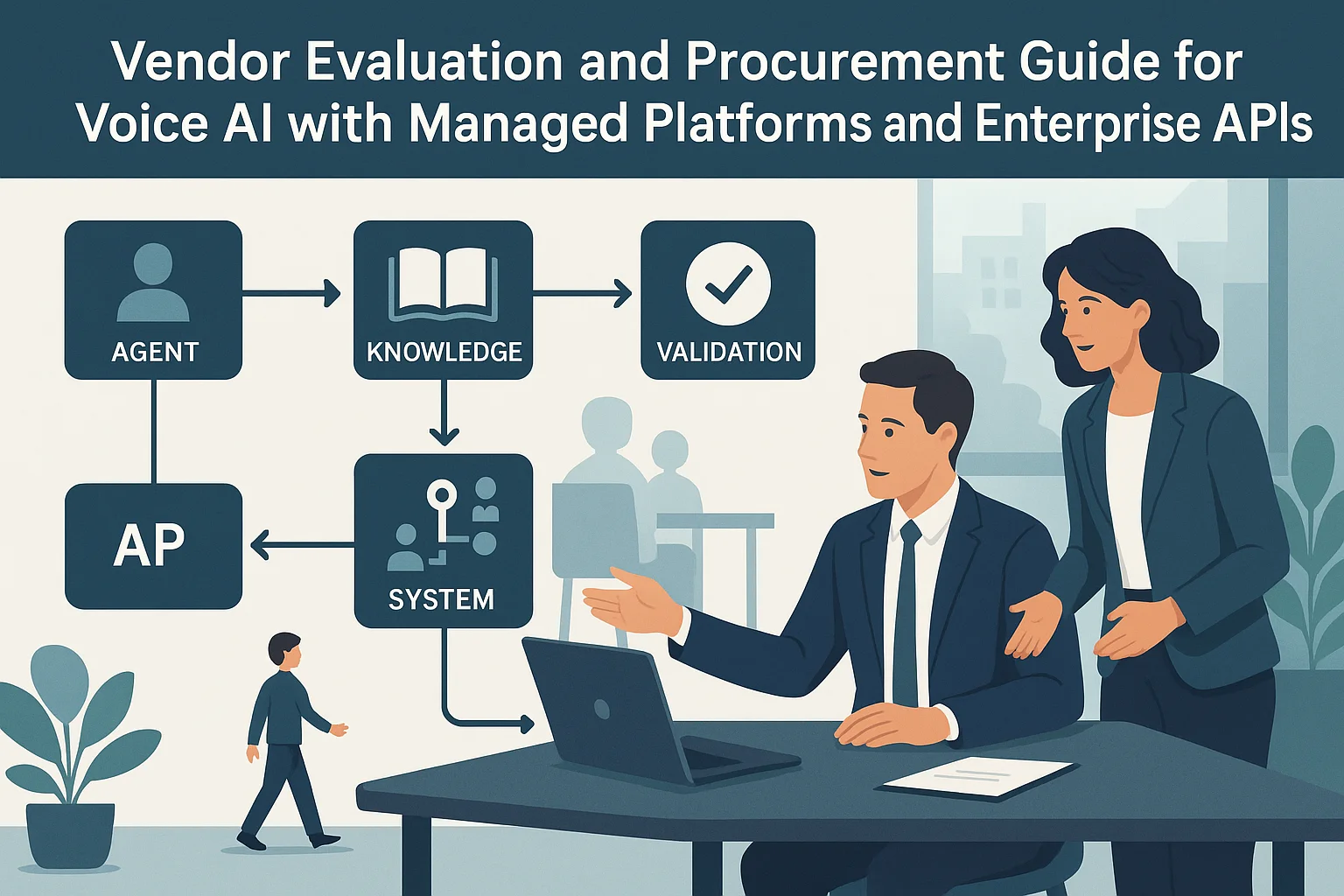
Don’t treat QA as optional. Use structured test plans that include adversarial and edge-case scenarios, and rehearse incident responses with your vendor and ops teams.
Acceptance and negative-path testing
Acceptance testing must include deterministic end-to-end tests and negative-path scenarios: malformed inputs, downstream API timeouts, network partitions, and conflicting concurrent requests. Verify that failures produce safe, observable outcomes and that human fallback is invoked correctly.
- Include adversarial prompts to test hallucination and safe-decline behaviors.
- Simulate downstream failures and validate rollback/compensation flows.
Operational runbooks and exercises
Require vendors to co-author runbooks for common incidents and to participate in tabletop exercises and live failure drills. Confirm roles for vendor and enterprise during an incident, including who has authority to pause production traffic.
- Define RACI for incident detection, mitigation, customer notification, and postmortem.
- Schedule quarterly or semi-annual drills relevant to your risk profile.
Performance and load testing
Run load tests that mimic bursty telephony traffic and measure tail latency and retry behavior. Validate that backpressure mechanisms engage and that circuit breakers prevent cascading failures.
- Test long-tail latency and component saturation points, not just median metrics.
- Confirm graceful degradation: clear messages to callers, automatic routing to human agents, and accurate metrics during overload.
6. Operational governance, accountability, and human oversight
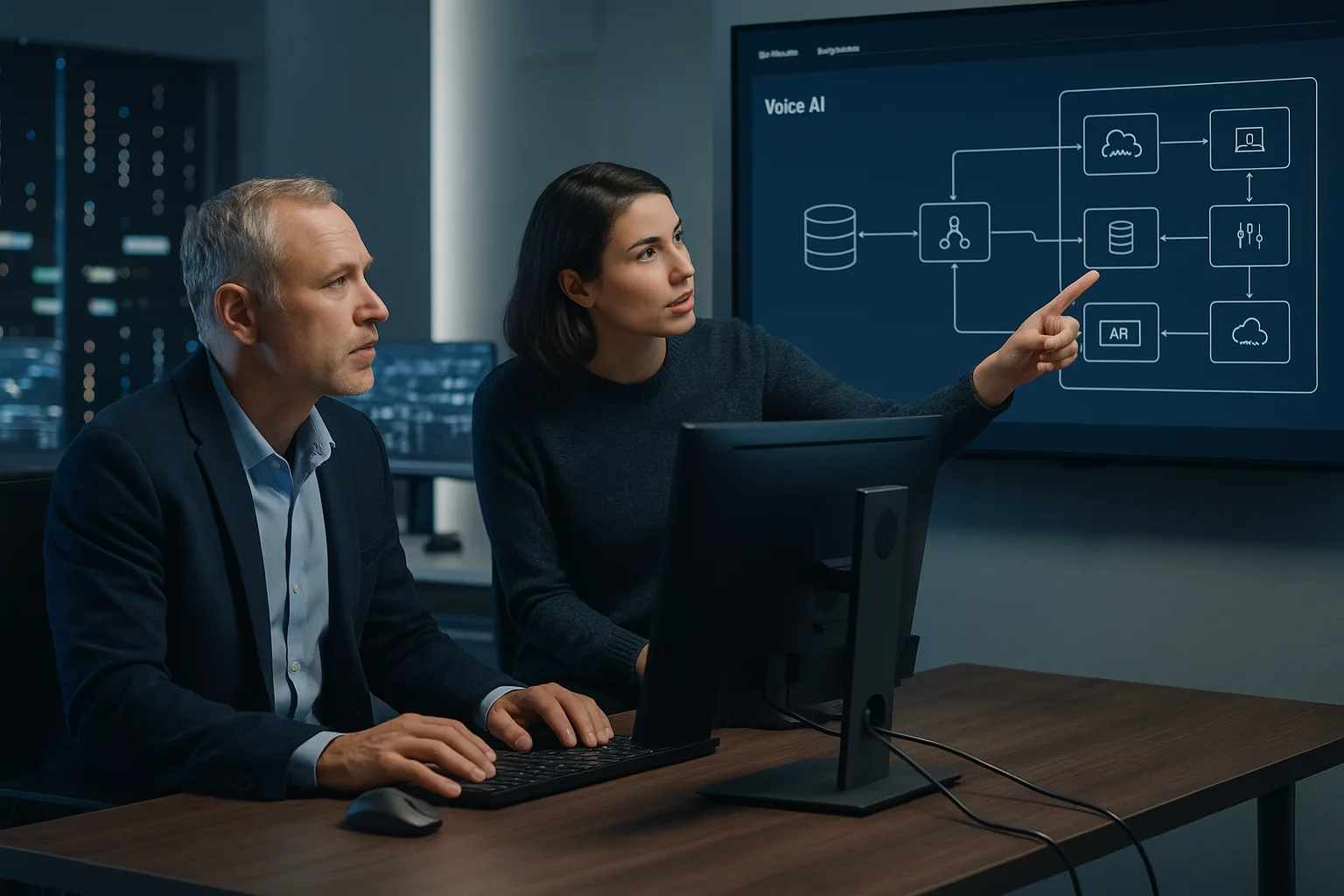
Procure operations you can control. Assign accountability, establish governance forums, and require vendor cooperation on continuous improvement.
Governance and change control
Create a joint governance board (vendor + enterprise) with a technical steering group and a security review subcommittee. All production changes that affect decision logic or action eligibility should be subject to change control and testing windows.
- Require vendor change notifications and a rollback capability for any deployment that affects production decisioning.
- Keep a changelog of policy and model updates visible to your operations and compliance teams.
Human-in-the-loop and escalation paths
Mandate human-in-the-loop triggers for high-risk categories (billing, clinical, legal). Define precise escalation SLAs and ensure the vendor supplies contactable escalation engineers during your business hours and for agreed critical windows.
- Classify calls by risk tier and require automatic human handoff thresholds.
- Require vendor participation in escalations with documented time-to-acknowledge and time-to-resolution SLAs.
Continuous audit and improvement
Schedule periodic reviews of audit trails, false-positive/false-negative rates, and confidence calibration. Use these reviews to tune policy rules, update test suites, and retire unsupported integrations.
- Set measurable KPIs (handoff rate, successful write rate, user satisfaction, mean time to detect issues).
- Conduct postmortems with actionable remediation items and tracked closure dates.
Related Peak Demand resources
Industry and AI sources reviewed
- Secure by DesignCybersecurity and Infrastructure Security Agency (CISA)
- ISO/IEC 27001 Information Security Management SystemsInternational Organization for Standardization
- ISO/IEC 27701 Privacy Information ManagementInternational Organization for Standardization
- AI Risk Management Framework: Generative AI ProfileNational Institute of Standards and Technology (NIST)
- Artificial Intelligence Risk Management Framework (AI RMF 1.0)National Institute of Standards and Technology (NIST)
- ISO/IEC 42001 Artificial Intelligence Management SystemInternational Organization for Standardization
Privacy, cybersecurity, contractual, records, and sector-specific obligations vary by jurisdiction and connected system. This article is operational guidance, not legal advice; organizations should confirm applicable requirements with qualified professionals.
Frequently asked questions
The integration layer should handle authentication, schemas, validation, timeouts, retries, permissions, duplicate prevention, audit logs, safe failure, and human escalation. It should expose only the tools and data required for the approved workflow.
Official reference: Secure by Design
Model Context Protocol can provide a standardized tool interface for approved data and actions, but it does not replace business logic, security controls, system-of-record validation, or performance engineering. Use it where it improves maintainability without adding unnecessary latency or complexity.
Official reference: Artificial Intelligence Risk Management Framework (AI RMF 1.0)
Use explicit timeouts, bounded retries, circuit breakers, clear caller messaging, queued follow-up where appropriate, and human escalation. The agent should never fabricate a successful lookup, booking, submission, or status update.
Official reference: Secure by Design
Ask for architecture diagrams, permission boundaries, schema validation, failure testing, observability, audit logs, credential management, deployment controls, rollback procedures, and evidence that every tool action is tied to an approved workflow.
Official reference: Secure by Design
Engineer the integration layer before scaling Voice AI
Peak Demand designs the APIs, logic bridges, validation, fallback, observability, and human-escalation infrastructure required for dependable Voice AI operations.
Schedule a discovery call


