
Tenant‑Aware Identity & Data Contracts for Voice AI in Real Estate
Operational guidance for brokerages, property managers, leasing teams and IT: how to design tenant-aware identity checks, robust data contracts, and safe human handoffs for Voice AI in leasing and maintenance workflows.
1. What buyers must decide first
Before procurement or architecture work starts, align stakeholders on scope, operational boundaries, and the minimal identity signals Voice AI will use. This section lists the decisions that materially affect contracts, compliance, and uptime.
Scope and prohibited automation
Define which steps the Voice AI will perform fully, which require human confirmation, and which are always human-only. Do not automate legal advice, fair-housing eligibility decisions, emergency maintenance judgments, or any binding transaction acceptance. Document these prohibitions in the SOW and system-runbooks so engineering, leasing, and legal teams share the same expectations.
- Voice AI: capture intent, ask clarifying questions, populate interim records, suggest appointments.
- Human required: lease terms negotiation, discriminatory screening, declared emergencies, lease-signing consent.
- Operational rule: every maintenance request with safety or code implications routes to human triage.
Primary integrations and ownership
List the business systems the solution will integrate with (CRM, property management system, CAFM/maintenance, calendar, telephony). Assign ownership for each integration—who supplies API keys, who validates mapping, who accepts error-handling responsibilities. Where adapters are required, treat them as controlled components with versioning and monitoring hooks.
- Minimum integrations: CRM (lead record), PMS (unit, tenancy status), maintenance CMMS, calendar/booking.
- Assign a single integration owner for change-control and emergency rollback.
- Require adapters to expose health endpoints and retry-safe behavior.
2. Architecture and the data‑contract model
Design your architecture around deterministic data contracts and clear intent paths. Use an event-first model that cleanly separates voice capture and interpretation from downstream business updates.
Canonical flow and components
Use this canonical operating model: Caller → Telephony Gateway → Voice AI (ASR+NLU) → Intent & Identity checks → Orchestration Layer (routing rules, adapters) → CRM / PMS / CMMS → Human specialist or scheduler. Keep the orchestration layer stateless where possible and retain only ephemeral context needed for a single interaction.
- Telephony Gateway: SIP termination, DTMF capture, recording flag control.
- Voice AI: intent classification, slot-filling, confirmation prompts.
- Orchestration: contract validation, transformations, retry logic, handoff triggers.
Event-shaped, versioned data contracts
Define a small set of event types—lead.capture, maintenance.request, appointment.propose, identity.verify—and publish a versioned JSON schema for each. Include required fields, optional fields, allowed value sets, and example payloads. Enforce contract tests in CI/CD so the orchestration layer and downstream systems fail fast on schema drift.
- Example key fields for maintenance.request: property_id, unit_id, caller_role (tenant/prospect/unknown), issue_category, severity (caller-provided), safe_to_enter, contact_ok, audio_reference_id, timestamp.
- Require idempotency keys for record creation to avoid duplicate cases on retries.
- Publish a deprecation schedule for every change (v1 → v2) with at least 90 days for migration.
3. Tenant-aware identity, consent, and fair-housing guardrails
Identity here is functional: the data needed to route correctly and satisfy safety and service-level obligations. Keep checks narrow, privacy-preserving, and auditable.
Minimal identity signals and verification patterns
Prefer identity signals over formal identity proof: property_id, unit number, confirmed name, last-four of lease or account number, or unique CRM ID if the caller is known. Use challenge-response only when required to change an existing booking or authorize a maintenance access. Record the verification result and the exact prompts used.
- Accept a graded approach: No-verify (new lead), light-verify (confirm unit & name), strong-verify (modify lease or payment).
- Log verification attempts, successes, and failures in immutable audit records.
- When verification fails, route to human review; do not proceed with actions that require legal consent.
Fair-housing and non-discrimination
Embed fair-housing constraints at intake. The Voice AI must avoid eliciting or using protected-class information for routing, qualification, or prioritization. Implement standard prompts and blocking rules to prevent discriminatory questioning or automated exclusions.
- Do not ask about race, religion, familial status, disability, or other protected attributes.
- Use neutral qualification questions tied to role and need (e.g., 'Are you calling about a current tenancy or a new rental?').
- Log prompts and flag any deviations for QA review.
4. Reliability, observability, and failure boundaries
Operational resilience requires both technical controls and human‑workflow fallbacks. Define SLAs, observability metrics, and clear failure boundaries for the Voice AI layer and integrations.
Designing for predictable failures
Plan for the three common failure modes: ASR/NLU mismatch, adapter/API failures, and human queue saturation. For each, define deterministic fallbacks—re-prompts, fallback routing to specialist teams, or voicemail-to-ticket conversion. Maintain circuit breakers and exponential backoff for downstream API failures.
- ASR/NLU: use confirmations for critical fields; persist audio for later human review.
- Adapter/API failure: queue the event, mark it as 'pending ingestion', and trigger a notification to integration owners.
- Queue saturation: automatically open a priority channel to on-call staff with caller context.
Telemetry and measurable observability
Require vendor and your orchestration layer to emit structured telemetry: intent-classification confidence distributions, verification success rates, API latency percentiles, handoff success ratio, and mean time to human response. Use distributed tracing across the orchestration boundary to correlate an audio reference to downstream record IDs.
- Key metrics: time-to-first-human, percent calls fully handled, duplicate-case rate, failed-verification rate.
- Alert on both symptom (increased error-rate) and cause (downstream API 5xx surge).
- Attach audio_reference_id and contract_version in every telemetry event for traceability.

5. Operational workflows and human handoff patterns
Concrete workflows translate system capabilities into predictable business outcomes. This section describes practical, role‑specific workflows for lead intake, maintenance triage, and appointment scheduling with explicit handoffs.
Lead intake and appointment routing
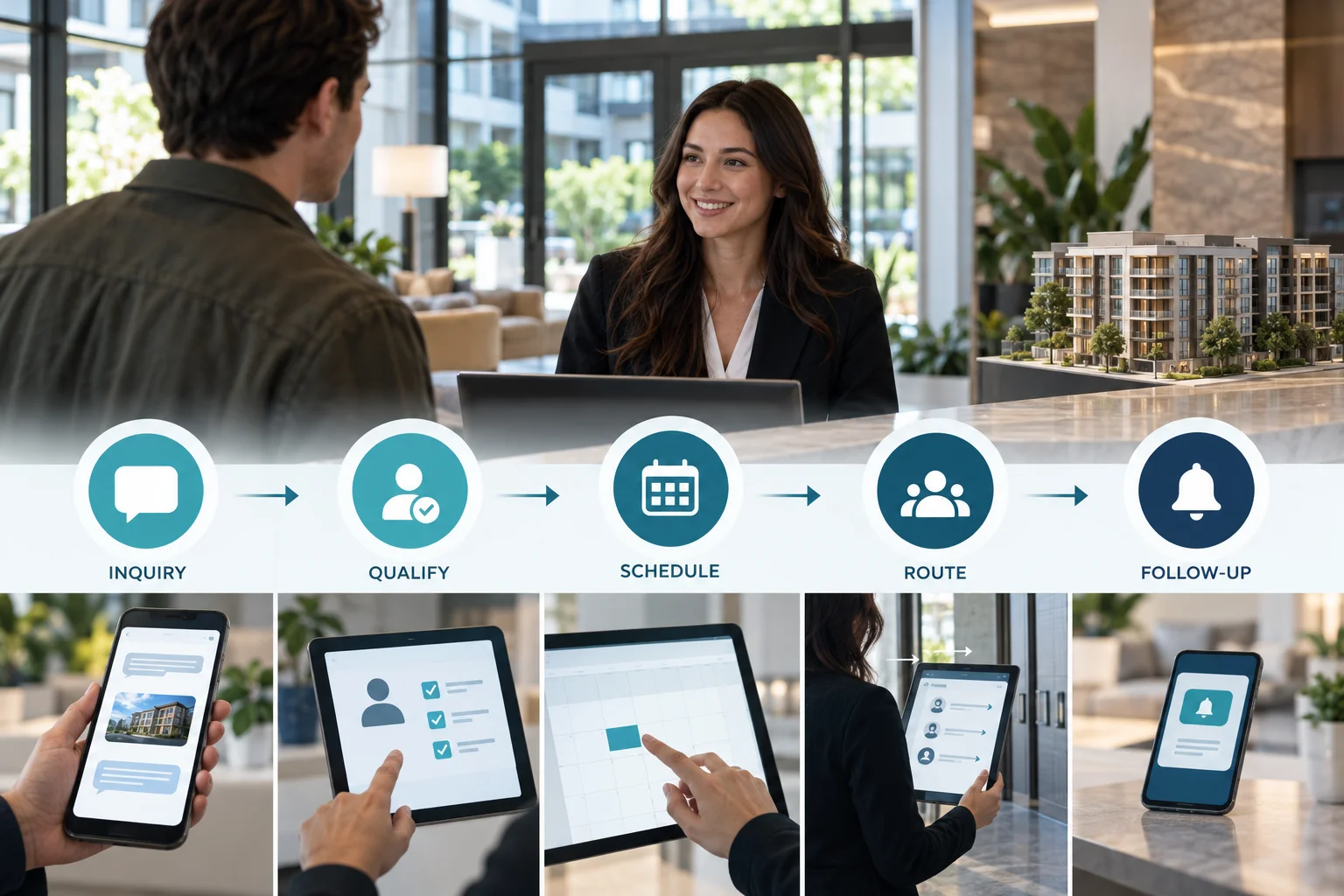
For inbound prospect calls, the Voice AI should: 1) identify prospect vs tenant (see [AI Tenant vs Prospect Call Routing](https://realestate.peakdemand.ca/ai-tenant-prospect-call-routing/)), 2) qualify basic needs (unit size, move-in timeframe, budget range optionally), 3) propose calendar slots using the orchestration connector, and 4) create or update a lead in CRM with audio reference and transcript. If appointment booking fails or requires negotiation, escalate to a leasing agent with caller context and confidence scores.
- Agent handoff message should include: caller identity signals, transcript highlights, confidence score, and candidate slots.
- When routing to human, place a 30-second warm-transfer snippet to prepare the agent.
- Measure: percentage of confirmed bookings vs tentative matches.
Maintenance intake and triage
For maintenance calls, capture category, severity as asserted by caller, access permissions, and whether the issue is potentially hazardous. For anything flagged as safety‑critical or ambiguous, route immediately to human triage. For routine requests, create a maintenance ticket in CMMS with audio reference and recommended priority; then schedule technicians or propose appointment windows to the tenant.
- Require technician dispatch only after human confirmation for any structural, gas, or electrical safety issues.
- If the caller is a non-tenant (e.g., contractor), require stronger verification before permitting access scheduling.
- Preserve audit trail linking audio, parsed fields, adapter transactions, and final case ID.
Validation and human review loops
Add a short human QA loop: a weekly review of flagged interactions (verification failures, low-confidence intents, fair-housing prompt flags). Use that feedback to tune prompts, update contract mappings, and retrain intent classifiers under controlled release processes.
- QA sample should include both handled and escalated calls.
- Track root-cause categories: prompt wording, noisy audio, incorrect mapping.
- Use a change board for prompt and contract updates with sign-off from operations and legal.
6. Procurement checklist and measurable operating outcomes
When evaluating vendors or building in-house, keep procurement focused on contract-level controls: data handling, observability, runbooks, subprocessors, and exit terms.
Must-have contractual items
Ask for explicit clauses in vendor contracts: hosting region and backup region, subprocessors and subcontractor notification, remote-support access controls, retention policies, breach notification windows, and a clear data-export/exit plan. Require SLAs for telemetry availability and human-handoff latency if the vendor provides managed escalation.
- Specify required telemetry streams and log retention period.
- Demand a defined export procedure (recordings, transcripts, metadata) and a timeline for data return on termination.
- Include audit rights for security and privacy controls.
Vendor evaluation scorecard
Score vendors on integration maturity, contract versioning, observability, support for idempotency and retries, fair-housing-safe prompts, and documented human-handoff processes. Require a proof-of-concept that demonstrates: appointment routing, maintenance ticket creation, and at least one human escalation scenario.
- Include a 30–60 day pilot with operational KPIs defined up front.
- Validate telemetry through your observability stack, not just vendor dashboards.
- Require the vendor to demonstrate schema contract-testing and CI/CD controls.
Related Peak Demand resources
Industry and AI sources reviewed
- ISO/IEC 42001 Artificial Intelligence Management SystemInternational Organization for Standardization
- Fair Housing Act OverviewU.S. Department of Housing and Urban Development
- Artificial Intelligence Risk Management Framework (AI RMF 1.0)National Institute of Standards and Technology (NIST)
- Artificial Intelligence and the FTCU.S. Federal Trade Commission
- ISO/IEC 27001 Information Security Management SystemsInternational Organization for Standardization
- ISO/IEC 27701 Privacy Information ManagementInternational Organization for Standardization
Housing, privacy, anti-discrimination, consumer-protection, records, and licensing obligations vary by jurisdiction and workflow. This article is operational guidance, not legal advice; organizations should confirm applicable requirements with qualified professionals.
Frequently asked questions
Common starting points include lead intake, showing and appointment scheduling, tenant and resident service requests, maintenance routing, listing questions from approved data, after-hours overflow, and structured escalation to leasing or property teams.
Official reference: Artificial Intelligence Risk Management Framework (AI RMF 1.0)
Do not delegate discriminatory screening, legal advice, binding transaction decisions, emergency-maintenance judgment, fair-housing determinations, or decisions that require licensed or authorized professionals. The agent should gather information and route the matter appropriately.
Official reference: Fair Housing Act Overview
Use approved fields and actions, validate identities and property records, limit permissions, log changes, and provide human review for exceptions. The agent should not invent availability, pricing, eligibility, lease terms, or maintenance status.
Official reference: Artificial Intelligence Risk Management Framework (AI RMF 1.0)
Require fair-housing safeguards, integration and data controls, testing, audit logs, escalation paths, emergency-routing rules, monitoring, change control, and clear ownership of listing, property, tenant, and maintenance knowledge.
Official reference: Fair Housing Act Overview
Build a controlled property-service workflow
Peak Demand helps real-estate and property teams connect Voice AI to lead intake, showing requests, resident service, maintenance routing, CRM workflows, and human escalation.
Schedule a discovery call


