
Regulatory & Clinical Evidence Strategy for Enterprise Healthcare Voice AI
Practical, jurisdiction‑neutral guidance for enterprise teams designing Voice AI for patient access: a decision‑ready operating model, integrations, safety boundaries, governance, and procurement checklist.
1. Operating model and core use case
A focused operating model reduces regulatory exposure and produces measurable outcomes. This section defines a practical use case for enterprise patient access teams and the canonical architecture that enforces safety and auditability.
Practical use case: administrative intake and scheduling
Restrict Voice AI to administrative patient access tasks where language models add clear operational value: appointment booking, rescheduling, eligibility checks, basic outreach (appointment reminders, preparation instructions), and collecting structured pre-visit administrative data. Exclude clinical assessment, triage, symptom diagnosis, medication decisions, and any activity that substitutes for a clinician’s judgment. Keep conversations script-constrained for predictability and QA.
- Primary functions: appointment booking, demographic verification, insurance or coverage flags, availability polling, and outbound reminder/confirmation.
- Secondary functions (with human oversight): pre-op readiness questionnaires, non-clinical intake forms, and logistics (transportation needs).
- Prohibited: triage, diagnosis, prescribing, clinical advice, or interpreting clinical results.
Canonical architecture and control points
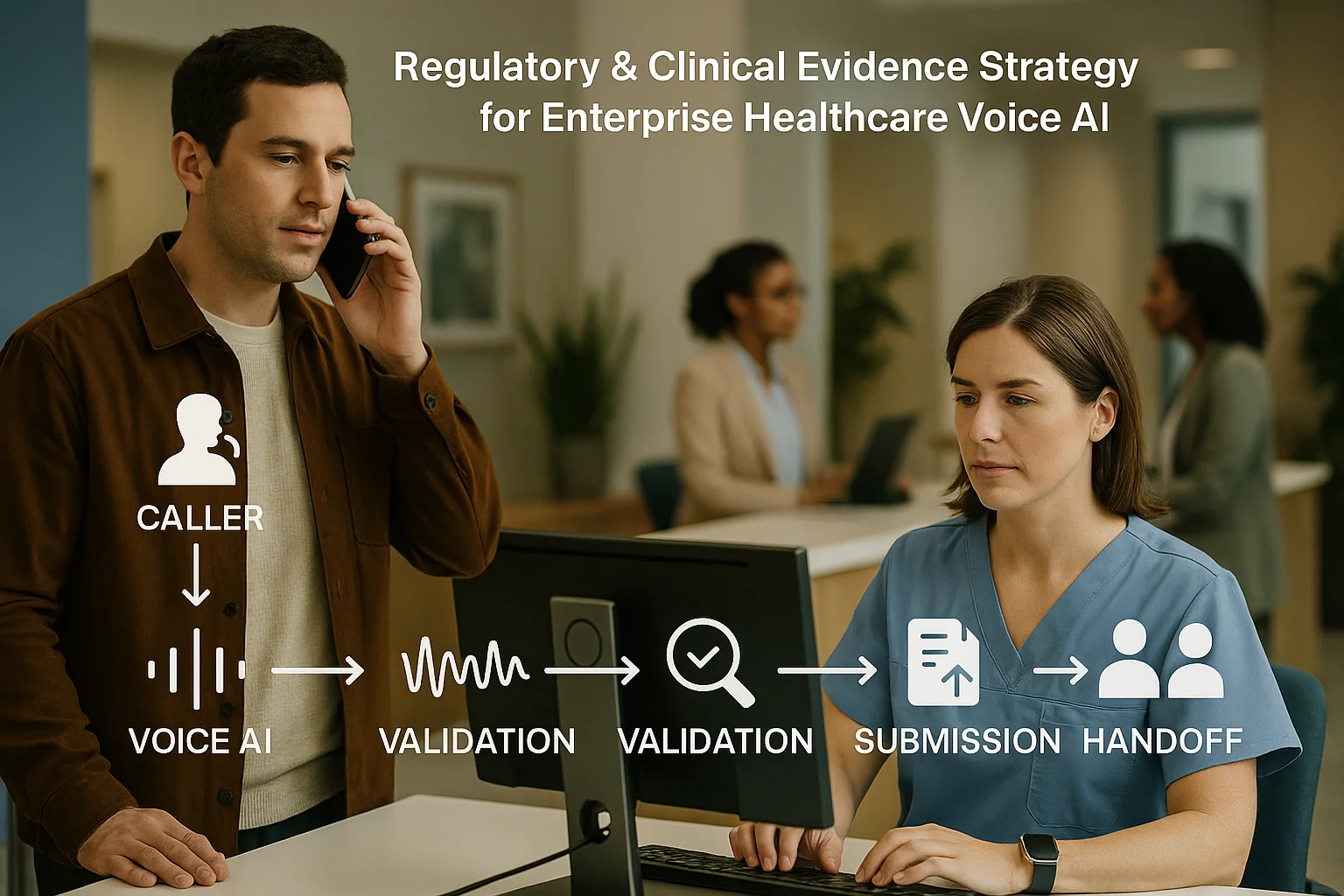
Adopt a linear, auditable flow that clearly separates automated actions from human responsibility: Patient or caller → Voice AI conversational layer → validation and identity controls → approved scheduling or service API → confirmation or human handoff. Each handoff point is a control boundary where escalation rules, audit trails, and human‑review flags are evaluated. Keep the Voice AI as an orchestration and intake layer, never as a clinical decision system.
- Validation & identity controls: caller authentication, two‑factor callbacks, or knowledge‑based checks before any PHI exchange or scheduling action.
- Approved APIs only: schedule/create/update operations go through sanctioned scheduling APIs or a controlled adapter that enforces business rules.
- Audit trail: immutable event logs for every intent, slot, decision, and outbound API call, retained according to policy.
2. Clinical safety boundaries and escalation
Safety is primarily established through scope restriction and deterministic escalation. This section defines the red lines, escalation design, and human‑in‑the‑loop controls required to operationalize safe Voice AI.
Define red lines and escalation triggers
Create explicit content filters and rule sets that immediately escalate or terminate calls when callers present signs of clinical urgency, ambiguous symptom descriptions, or requests for medical advice. Escalation triggers must be conservative: any symptom language that could indicate an emergency, expressions of intent to self‑harm, or requests to change medications immediately route to a trained clinician or dispatch. Maintain a conservative false‑positive tolerance — it is safer to escalate unnecessarily than to fail to escalate an urgent case.
- Examples of triggers: phrases indicating chest pain, severe bleeding, trouble breathing, sudden severe neurological signs, or explicit requests to stop or change medication.
- Escalation actions: warm transfer to a clinician, connect to emergency services per local policy, or invoke a scripted human callback within a guaranteed SLA.
Human‑in‑the‑loop design patterns
Design human oversight at three layers: (1) real‑time handoff for clinical/urgent cases; (2) queued review for borderline or high‑risk administrative decisions (for example, pre-op readiness with any red flags); and (3) periodic clinical QA where samples of automated interactions are reviewed against a clinical evidence rubric. Document roles, authority, and escalation SLAs in operating procedures.
- Handoff: one-button warm transfer with context payload (recent utterances, validated identity tokens, and system flags) to avoid forcing the patient to repeat information.
- Queued review: configurable human review thresholds (e.g., all cases with flagged free text or a confidence score below a set threshold).
- QA cadence: daily spot checks and monthly clinical evidence review cycles.
3. Identity, consent, and data controls
Identity verification, consent capture, and data governance are operational anchors that control risk and legal exposure. This section details practical choices and tradeoffs.
Identity and intent validation
Before exchanging Protected Health Information (PHI) or scheduling sensitive services, perform identity checks aligned to your risk appetite: automated knowledge‑based questions, callback verification, device-based signals, or stronger multi‑factor verification for high‑risk services. Log validation results with timestamps and any token or transaction IDs from identity vendors.
- Match identity stage to task: light checks for reminders; strong verification (e.g., two‑factor or ID validation) for booking or changing high‑risk procedures.
- Record identity proofing type and outcome in the audit trail.
Consent, recording, and retention policies
Capture caller consent for recording and data processing at the start of the interaction with a clear, brief script. Retain recordings and derived transcripts according to documented retention schedules, and make retention length and subprocessors part of procurement criteria. Treat cross‑border transfer, backup geography, and subprocessors explicitly — vendors must disclose locations, transfers, and mechanisms (e.g., standard contractual clauses). Confirm legal obligations with privacy counsel for your jurisdictions.
- Consent script includes: purpose of recording, retention period, and opt‑out options where technically feasible.
- Store retention metadata (region, backup region, subprocessors, deletion controls) per record.
4. Integrations and enterprise controls
Voice AI must integrate cleanly with existing enterprise systems while preserving auditability and operational ownership. This section explains integration patterns and vendor responsibilities.
Approved scheduling and EHR integration pattern
Use a single, approved adapter layer for all operational write actions: scheduling, cancellations, and status updates. That adapter enforces business rules, user permissions, and idempotency. Where possible, integrate with the scheduling or EHR vendor through documented APIs to preserve data integrity and traceability. Peak Demand has implementation playbooks for Epic, Helios, and Lumeon integration patterns that emphasise controlled adapters and event‑based confirmations.
- Write operations must be routed through the adapter that enforces validation and logs both request and provider response.
- Read-only lookups can be cached for latency but must be reconciled and refreshed per defined staleness windows.
- All API calls should return transaction IDs and statuses attached to the call audit trail.
Cross‑channel orchestration and patient experience
Design for consistent cross-channel state: a booking initiated by Voice AI must update patient portals, SMS confirmations, and clinician schedules. Ensure idempotent operations to avoid duplicate bookings and design cancellation flows that respect both patient preference and clinical scheduling rules. For orchestration patterns and examples, see integration guidance for Epic, Helios, and Lumeon.
- Orchestration ensures single source of truth for appointment state, confirmed via outbound confirmation channel.
- Include failover messaging (e.g., SMS confirmation when voice confirmation fails).

5. Governance, QA, and procurement evidence
Procurement of Voice AI should be evidence-driven: require vendors to deliver documented governance, risk assessments, QA metrics, and a small, testable compliance package.
Risk and ethics alignment
Adopt an AI governance framework that maps risks to controls, test cases, and monitoring. Use internationally recognised guidance to structure the program: ethics and governance considerations for health AI, regulatory considerations, and AI risk management frameworks provide principles to operationalise. Require vendor evidence: model documentation, audit logs, subprocessor disclosures, patch and update processes, and incident response playbooks.
- Map risks (patient safety, privacy, availability) to controls (scope restriction, identity checks, audit logs).
- Require regular third‑party or internal audits and documented remediation tracking.
Procurement checklist and RFP evidence
Request concrete procurement evidence: architecture diagrams with hosting regions and backup regions; list of subprocessors and their locations; sample audit logs; SLA commitments for escalation and handoffs; QA and test datasets (synthetic or redacted) used to validate performance; and a clear statement of integration ownership. For buyers who need RFP‑ready documentation on compliance controls, review enterprise compliance resources and managed‑service expectations.
- Minimum deliverables: subprocessor list, data flow diagram, retention policies, incident response plan, and sample audit trail extracts.
- Operational deliverables: escalation SLAs, human review quotas, monthly QA reports, and performance KPIs.
6. Reliability, monitoring, and measurable outcomes
Operationally useful metrics and failure boundaries let teams tune the system while keeping risk visible. This section describes KPIs, observability, and concrete failure handling patterns.
Key operational metrics and SLAs
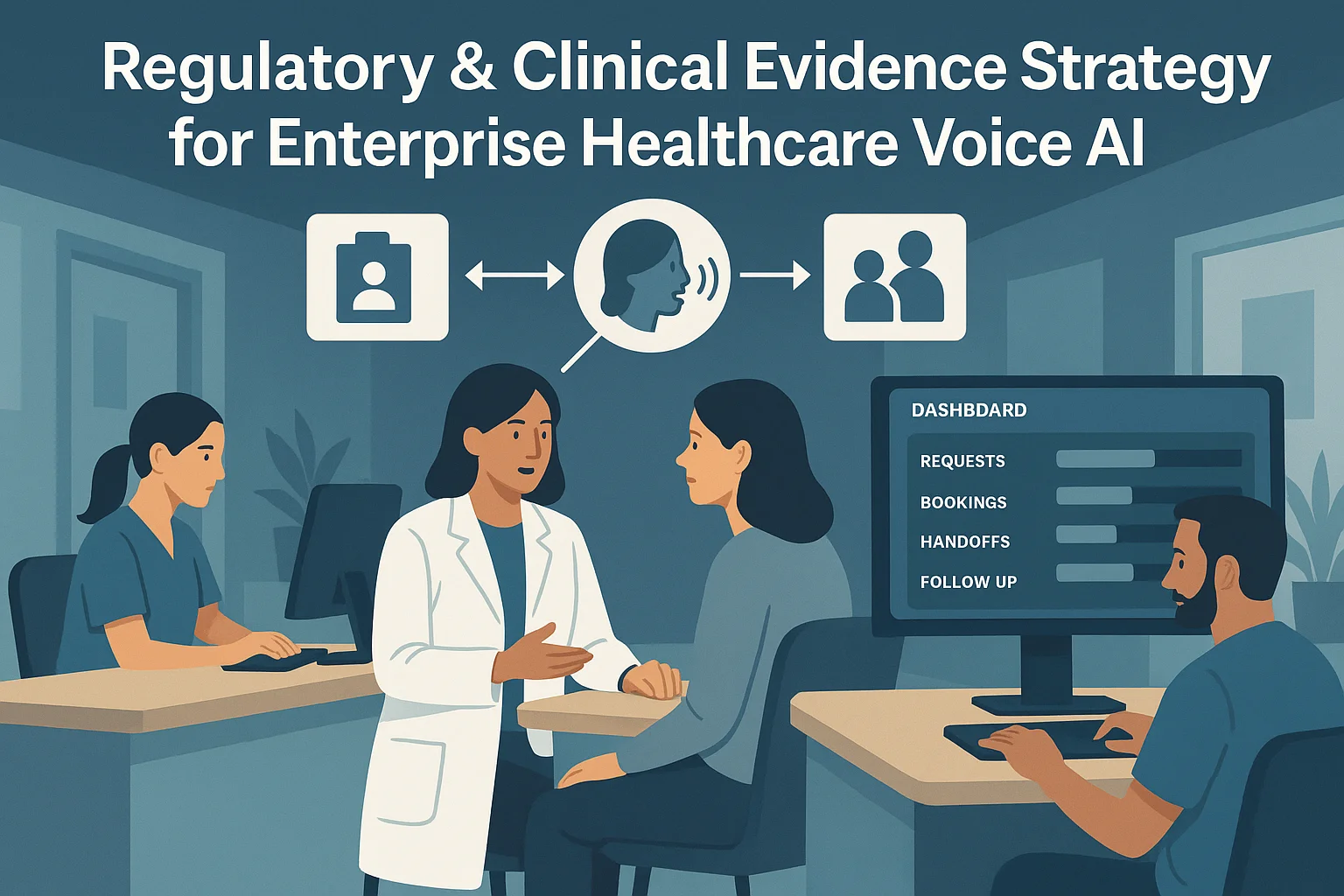
Track measurable outcomes that reflect safety and effectiveness, not vague efficiency claims. Suggested KPIs: containment rate (percent of contacts completed without human handoff), safe‑handoff rate (percent of escalations correctly routed), false‑dismissal rate (percentage of escalated cases that should have escalated but were not), API success rate, and mean time to human callback. Tie SLAs to patient safety: define maximum allowable time for clinician callback for escalations.
- Containment rate must be paired with QA sampling to ensure quality, not just automation volume.
- False‑dismissal rate is a safety KPI and should be driven toward zero through conservative escalation logic.
Failure-mode design and safe defaults
Design conservative defaults: if confidence or validation fails, pause automated actions and route to a human. Implement circuit breakers for downstream system failures (EHR or scheduling API downtime) so the Voice AI can fall back to read-only status, take a message, or offer a human callback. Maintain telemetry and health checks for model drift, latency spikes, and API errors, and require vendors to expose observability endpoints and logs.
- Circuit breaker actions: offer human callback, queue request for later processing, or log for manual scheduling.
- Drift monitoring: producer-side metrics for conversational intent accuracy and periodic revalidation against ground truth.
Related Peak Demand resources
Industry and AI sources reviewed
- Ethics and governance of artificial intelligence for healthWorld Health Organization
- Regulatory considerations on artificial intelligence for healthWorld Health Organization
- Artificial Intelligence Risk Management Framework (AI RMF 1.0)National Institute of Standards and Technology (NIST)
- OECD AI PrinciplesOrganisation for Economic Co-operation and Development
Healthcare privacy, security, clinical-safety, records, and professional obligations vary by jurisdiction and workflow. This article is operational guidance, not legal advice; organizations should confirm applicable requirements with qualified professionals.
Frequently asked questions
Administrative workflows such as appointment booking, changes and cancellations, referral-status intake, approved follow-up, patient-access questions, after-hours overflow, and structured routing are common starting points. Clinical judgment, diagnosis, emergency triage, and prescribing decisions must remain with qualified professionals.
Use the minimum identifiers approved by the organization, validate them against the system of record, avoid exposing unnecessary information, and provide a human-assisted path when verification fails. The system should not infer identity from conversational context alone.
The agent should follow the organization's approved escalation and emergency-routing rules, avoid clinical advice, and transfer or direct the caller to the appropriate human or emergency channel. Those rules must be tested with realistic language and failure cases.
Request identity and privacy controls, scheduling or EHR integration behavior, audit logs, escalation rules, downtime handling, testing evidence, change control, monitoring, and clear separation between administrative automation and clinical decision-making.
Design a safe patient-service workflow before automating it
Peak Demand helps healthcare organizations connect Voice AI to scheduling, intake, patient communication, identity checks, escalation, and reporting with clear operational boundaries.
Schedule a discovery call


