
Predictive Patient-Access Orchestration: Voice AI, Scheduling & Staffing
A practical guide to implementing Voice AI for predictive patient access: orchestration architecture, identity and scheduling integrations, safety boundaries, governance, and phased rollout.
1. Why predictive patient-access orchestration matters now
Patient-access teams face variability in contact volume, constrained clinician capacity, and growing expectations for convenient booking. Voice AI can stabilize queues and reduce friction when implemented as a safe, governed orchestration layer that integrates with scheduling systems and staffing models.
Operational problem statement
High no-show rates, last-minute cancellations, and uneven call patterns create idle clinician time and overloaded contact centres. A predictive orchestration approach uses demand signals—historical booking patterns, provider availability, and short-notice openings—to offer appointments that improve capacity utilization and reduce manual rescheduling. The goal is not to replace humans but to make predictable decisions for high-frequency administrative tasks.
- Stabilize booking flows by offering near-term openings proactively.
- Offload routine administrative calls without adding clinical risk.
- Enable staff to focus on exceptions and clinical work.
Who benefits and when to act
Primary beneficiaries include patient-access leaders, clinic operations, and contact-centre teams managing high-volume bookings. Early adoption is appropriate where scheduling systems expose secure APIs and where staff are already responsible for triage and scheduling decisions — for example, routine follow-ups, imaging bookings with clear preconditions, and administrative appointments.
- Start where clinical risk is low and scheduling rules are deterministic.
- Avoid initial pilots in emergency triage, diagnostic interpretation, or medication management.
2. Recommended orchestration architecture
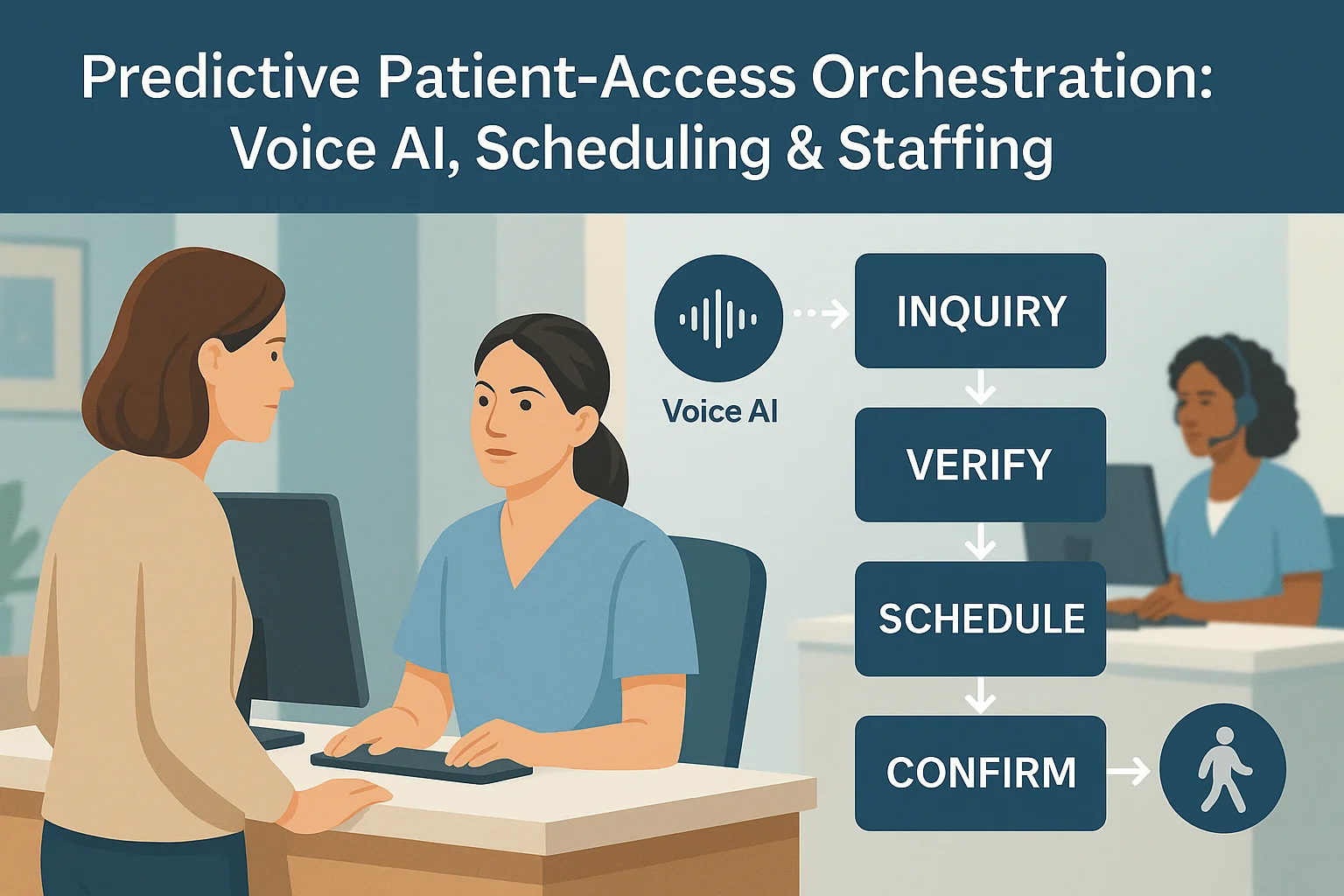
Keep the architecture simple, auditable, and rule-driven. The canonical flow is: Patient/caller → Voice AI → validation & identity controls → approved scheduling or service API → confirmation or human handoff.
Core components and responsibilities
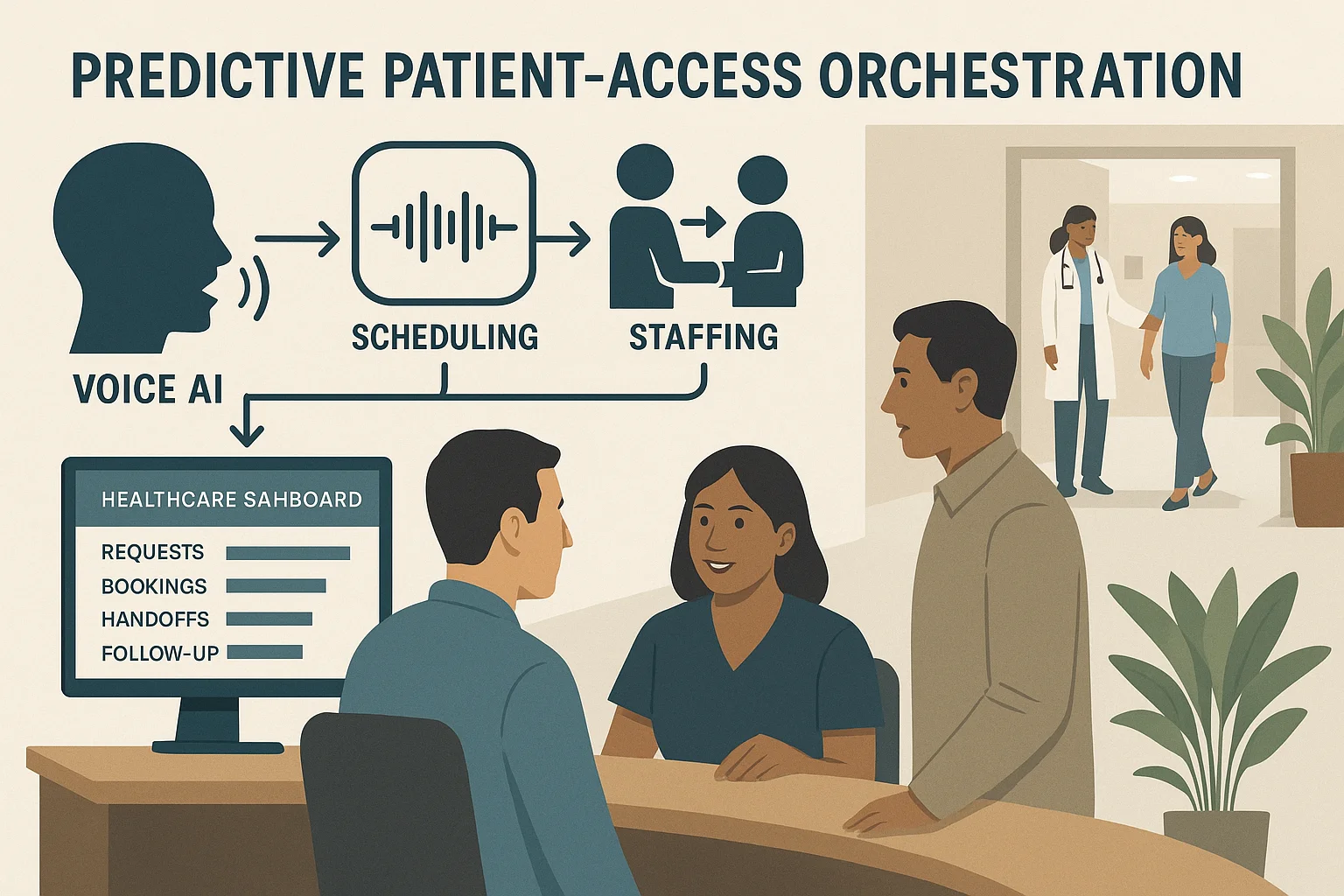
Design the orchestration layer as a set of controlled adapters rather than granting direct, unrestricted access to clinical systems. Typical components are: telephony interface, NLU/voice layer constrained to deterministic intents, identity and field-validation module, scheduling adapter that uses the provider's approved APIs, an escalation engine, and an audit/event store.
- Telephony and voice stack: record metadata, manage consent, expose call status.
- Deterministic intent set: only allow a controlled vocabulary for booking flows.
- Scheduling adapter: only operate through approved scheduling APIs or a business-system adapter that enforces local rules.
- Escalation engine: predefined rules for all ambiguous or safety-related utterances.
Integration touchpoints and data flows
Map every integration to an approved interface: scheduling systems (via OAuth or API keys), patient-demographic systems, callback verification services, and CRM/contact-centre platforms. Log all transactions to an immutable audit trail including request, decision, and actor (human or automated). Define data flows for primary processing, backup/replication region, and subprocessors that may access recorded audio or transcripts.
- Use purpose-built adapters to translate scheduling rules and availability windows.
- Capture minimal necessary PHI and avoid retention of raw audio unless consented and required for QA or compliance.
- Document where each class of data is stored (hosting region, backup region, subprocessors).
3. Voice AI use cases, controls and hard boundaries
Specify what Voice AI will and will not do. Operational clarity prevents misuse and legal/regulatory exposure.
Approved administrative use cases
Voice AI should handle high-frequency, low-clinical-risk interactions: appointment booking for non-urgent visits, reminders and confirmations, rescheduling/cancellations, and collecting straightforward intake fields (demographics, insurance ID). Use predictive offers to propose alternate appointment windows based on real-time capacity and propensity models, but only finalize bookings after identity and field validation.
- Routine follow-ups, screening appointments with explicit preconditions, imaging slots with clear prep instructions.
- Outbound call campaigns for open slots: present options and require explicit consent before booking.
Identity and field validation controls
Before any action that changes a patient’s record or schedules an appointment, enforce layered validation: verify callback number or session token, confirm at least two independent demographic data points (DOB, postal code, patient ID), and, for higher-risk transactions, require a human-in-the-loop confirmation. Never rely on voice recognition or free-text answers alone for identity-sensitive actions.
- Two-factor confirmation: automated callback or SMS token when available.
- Field validation: cross-check input against EHR/PM via the scheduling adapter.
- Flagging: treat mismatches as immediate escalation to staff.
Clinical boundaries and escalation rules
Voice AI must not diagnose, triage emergencies, prescribe, or replace clinical judgment. If a caller uses language suggesting clinical urgency, ambiguity, or symptoms outside the defined administrative scope, the system must stop the automation and route to trained staff or emergency services per local protocols. Embed explicit scripts for escalation and record the decision rationale for auditability.
- Hard-stop triggers: words/phrases indicating chest pain, severe bleeding, suicidal ideation, or acute neurological deficits.
- Ambiguity triggers: when inputs fall outside deterministic intents or scheduling constraints.
- Human takeover: seamless warm transfer with a complete context payload for staff.
4. Implementation decisions and procurement checklist
Procurement must be defined by integration scope, governance posture, hosting/residency needs, and evidence of QA and safety practices. Avoid vendor lock-in by insisting on adapters, exportable logs, and defined subprocessors.
Vendor evaluation and phased approach
Prioritize vendors who demonstrate experience with healthcare workflows and who provide clear separation of capabilities: voice-intent engine, deterministic orchestration, and scheduling adapters. Request a phased rollout plan: closed pilot (limited clinics, low-risk bookings), monitored expansion (more appointment types and clinics), and broad rollout only after defined KPIs and safety gates are met.
- Ask for a documented phased rollout (pilot criteria, rollback plan, QA metrics).
- Require exportable logs and test harnesses for integration acceptance testing.
- Verify vendor processes for software change control and access management.
Contractual and data-residency considerations
Specify hosting region(s), backup region, remote-support access, subprocessors, transfer mechanisms, retention periods, and consent mechanisms in contracts. Be explicit about recording consent and retention for audio/transcripts and ensure mechanisms to purge data on request when required. Confirm subprocessors and their geographical footprint and include breach notification duties and timelines.
- Define allowable subprocessors and require prior notice for changes.
- State retention periods for audio and transcripts and procedures for secure deletion.
- Specify breach notification timelines and remediation obligations.
Procurement evidence and acceptance tests
Require the vendor to deliver: integration test reports, role-based access logs, sample audit trails, simulated escalation flows, and a documented QA regimen for model updates. Do not accept opaque claims about language understanding — insist on measurable acceptance criteria.
- Integration acceptance tests that include identity mismatch and escalation scenarios.
- Periodic third-party or internal audits of access controls and audit logs.
- Change control process for model or intent updates with rollback capability.

5. Controls, QA, and governance in production
Governance and QA are continuous. Operationalize observability, human review, and retraining cycles to maintain safety and performance.
Observable metrics and SLOs
Track availability, booking success rate (automated vs. human-assisted), escalation rate, false-acceptance/false-reject rates for identity checks, average handle time for transfers, patient satisfaction, and safety-trigger incidents. Define SLOs and alert thresholds that trigger immediate human review or rollback of an automated flow.
- Operational SLOs: uptime, request latency, escalation latency.
- Quality SLOs: identity-validation accuracy, booking correctness, escalation ratio.
- Safety SLOs: incidents per 10k calls that require clinical review.
Auditability and human review
Maintain immutable audit trails that show the inputs, decisions, and the identity of any user or system actor. Establish a human-review queue for sampled calls and all escalation events. Define retention and access rules for audit data and ensure auditability for procurement and regulatory inspection.
- Sample review: daily review of a randomized call subset plus every escalation.
- Adjudication: a documented process for correcting systemic errors discovered during review.
- Access control: RBAC for viewing transcripts and recordings.
Change management and model updates
Treat intent and decision logic updates as regulated changes. Version control flows, run A/B tests in isolated environments, and only deploy after passing regression tests that include identity checks and escalation triggers.
- Isolated staging environment for testing with synthetic or consented production data.
- Clear rollback procedures and quick switch-to-human modes.
- Regular retraining cadence tied to QA findings.
6. Operational playbook: phased rollout and staffing alignment
A concise playbook helps operations convert design into practice. Match staffing to automation and maintain clear handoff responsibilities.
Phase 0 — Discovery and risk assessment
Inventory scheduling systems, define the deterministic booking rules, identify high-frequency low-risk appointment types, and run a risk assessment using established frameworks. Establish an executive sponsor and define KPIs for pilot success.
- Catalog APIs, authentication models, and data residency needs.
- Map decision ownership: which human role owns escalations and corrections.
- Define pilot KPIs: booking accuracy, escalation rate, patient satisfaction.
Phase 1–2 — Closed pilot to monitored expansion
Run a closed pilot with a subset of clinics and appointment types. Use high-visibility monitoring and daily triage for exceptions. Expand only when safety gates and QA metrics are met. During rollout, adjust staffing to handle escalations, with defined shift coverage and surge plans.
- Pilot: limited clinics, scripted intents, manual QA and 100% human review of escalations.
- Expansion: broaden appointment types, add automated reporting and periodic audits.
- Staffing: ensure trained backup staff for peak transfer loads and daily QA reviewers.
Phase 3 — Continuous operations and optimization
Shift to operational mode with regular QA sprints, automated monitoring, and periodic governance reviews. Use measured outcomes to refine predictive offers and align staffing models with reduced manual scheduling load.
- Monthly governance reviews that include clinical leadership and privacy officers.
- Quarterly procurement reviews of subprocessors and access patterns.
- Continuous improvement loops informed by human adjudication findings.
Related Peak Demand resources
Industry and AI sources reviewed
- Ethics and governance of artificial intelligence for healthWorld Health Organization
- Artificial Intelligence Risk Management Framework (AI RMF 1.0)National Institute of Standards and Technology (NIST)
- Regulatory considerations on artificial intelligence for healthWorld Health Organization
Healthcare privacy, security, clinical-safety, records, and professional obligations vary by jurisdiction and workflow. This article is operational guidance, not legal advice; organizations should confirm applicable requirements with qualified professionals.
Frequently asked questions
Administrative workflows such as appointment booking, changes and cancellations, referral-status intake, approved follow-up, patient-access questions, after-hours overflow, and structured routing are common starting points. Clinical judgment, diagnosis, emergency triage, and prescribing decisions must remain with qualified professionals.
Use the minimum identifiers approved by the organization, validate them against the system of record, avoid exposing unnecessary information, and provide a human-assisted path when verification fails. The system should not infer identity from conversational context alone.
The agent should follow the organization's approved escalation and emergency-routing rules, avoid clinical advice, and transfer or direct the caller to the appropriate human or emergency channel. Those rules must be tested with realistic language and failure cases.
Request identity and privacy controls, scheduling or EHR integration behavior, audit logs, escalation rules, downtime handling, testing evidence, change control, monitoring, and clear separation between administrative automation and clinical decision-making.
Design a safe patient-service workflow before automating it
Peak Demand helps healthcare organizations connect Voice AI to scheduling, intake, patient communication, identity checks, escalation, and reporting with clear operational boundaries.
Schedule a discovery call


