
Portfolio Governance for Voice AI in Health Systems: Funding & Decommission
A practical guide for healthcare leaders to govern, fund, operate, and retire Voice AI services safely. Covers lifecycle funding, identity controls, escalation, EHR integration, and decommission steps.
1. Why portfolio governance matters for Voice AI
Voice AI deployments in patient access affect safety, revenue operations, and patient trust. Governance prevents orphaned services, unmanaged risk, and inconsistent patient experiences.
Scope and core architecture
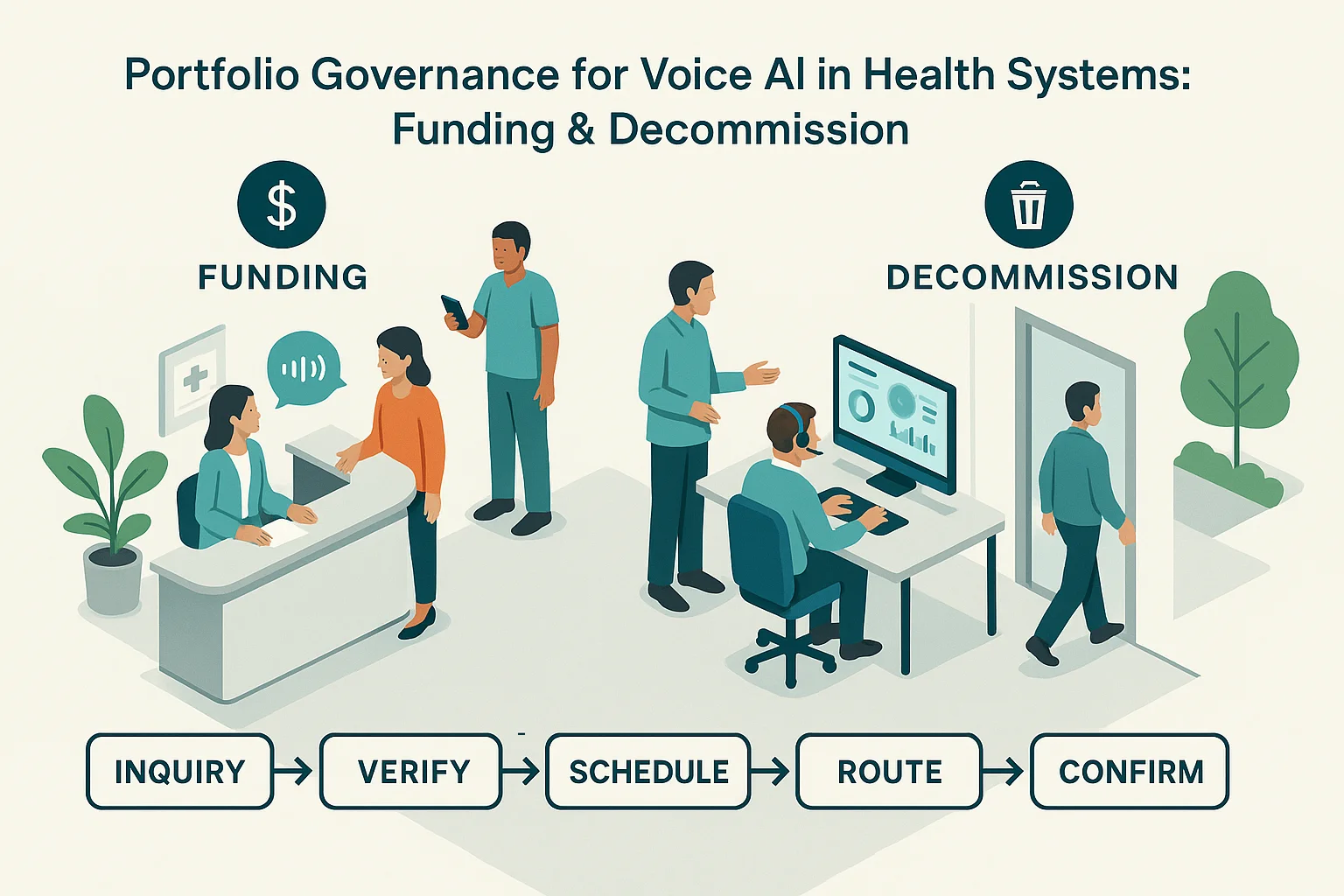
Treat each Voice AI capability as a discrete product within a portfolio: after‑hours booking, prescription refill routing (administrative only), front‑desk call deflection, or internal operator augmentation. Define a single canonical interaction architecture for approved patient‑facing flows: Patient or caller → Voice AI → validation and identity controls → approved scheduling or service API → confirmation or human handoff. That architecture clarifies where controls, logs, and human overrides must sit.
- Single canonical flow reduces integration variance and simplifies QA and audit trails.
- Place identity validation and consent capture before any EHR/PM write actions.
- Log decisions, confidence signals, and handoffs for every transaction to an immutable audit store.
Practical operating boundaries
Define what Voice AI will not do. Never delegate diagnosis, prescribing, emergency triage, or clinical decision‑making to automated voice agents. Automate administrative activities that are high volume and low clinical risk—appointment booking, reminders, basic status checks—while designing automatic escalation for ambiguity or risk.
- Tagged boundary rules: 'automate', 'assist', 'escalate' per intent.
- If caller expresses symptoms, suicidal ideation, or acute distress, escalate immediately to trained staff.
- Instrument every automated response with a confidence metric and an escalation threshold.
2. Use case and operating model: After‑hours booking with identity validation
A concise, low‑risk use case demonstrates funding and decommission implications: after‑hours appointment intake with identity verification and EHR/PM scheduling integration.
Concrete workflow
When a patient calls after hours, the Voice AI collects minimal identity attributes, confirms consent to record, validates identity via a configured verification check, then queries the scheduling API for available slots and confirms an appointment or hands off to human staff when required. This keeps clinical triage outside automated scope while improving access and appropriate routing.
- Step 1: Greet and capture caller ID + patient identifier (last four of DOB or patient number).
- Step 2: Read and capture consent to record and process data.
- Step 3: Run identity validation (match score) before any scheduling write.
- Step 4: Use scheduling/service API via a controlled adapter; if booking succeeds, confirm; if ambiguous, escalate.
Peak Demand differentiation
Successful implementations require custom Voice AI tuned to clinic workflows, tight scheduling and intake integrations, identity verification connectors, field validation before writes, safe escalation paths, human review points, and persistent audit trails. These elements reduce vendor feature noise and focus on operational readiness.
- Custom prompts and dialog trees for local intake language and consent wording.
- Adapters for approved scheduling or service APIs rather than direct EHR schema edits.
- Human‑in‑loop review screens for ambiguous matches and high‑impact bookings.
3. Funding, prioritization and procurement decisions
Budgets must cover more than the initial build. Treat monitoring, governance, and decommissioning as funded workstreams.
Lifecycle funding model
Create line items for each project stage: discovery and clinical boundary review; build and integration; testing and certification; launch with human oversight; ongoing operations (monitoring, QA, incident response); and decommissioning. Include sustained human reviewer hours and a reserve for vendor or adapter fixes.
- Plan for ongoing QA (sample review, escalation audits) as a recurring cost.
- Include budget for periodic retraining/tuning, scenario tests, and emergency rollback.
- Reserve funds for legal or compliance interventions (e.g., change in consent rules).
Prioritization and procurement criteria
Prioritize projects with clear operational metrics (reduced human transfers, same‑day booking uplift, abandonment reduction) and low clinical risk. In procurement, require transparency on subprocessors, audit logs, support access, update windows, and exit assistance. Use procurement principles that emphasize transparency, accountability, and contestability.
- Score vendors on integration readiness, evidence of secure adapters, and human‑handoff quality.
- Require contractual language for data exports, retention limits, and assisted decommission.
- Avoid vendor lock‑in by specifying standard API and data export formats in the SOW.
4. Risk, compliance and data controls
Risk controls must be explicit, auditable, and tested. Use recognized risk frameworks to structure assessments and controls.
Identity, consent and data flows
Put identity validation before any action that changes patient records. Capture consent for recording and data use at the start of each interaction and persist a consent artifact in the audit trail. Document data flows: live audio capture → transcription → confidence scoring → adapter → scheduling API. Identify subprocessors and hosting regions for each step and require contractual controls for cross‑border transfers.
- Store consent and the match score with every transaction record.
- Isolate PII in a controlled data store with strict access policies and retention schedules.
- Document hosting region, backup region, and subprocessors in the vendor contract.
Risk assessment and continuous monitoring
Adopt a repeatable risk assessment and monitoring cadence: initial AI risk classification, pre‑launch simulation, phased rollout with human review, and continuous post‑launch monitoring for safety signals. Use confidence thresholds to triage escalations and run regular red‑team or scenario tests.
- Use automated alerts for confidence drift, increased escalations, or abnormal error rates.
- Conduct periodic audits of automated decisions against human adjudication.
- Maintain an incident response plan that includes notification obligations and rollback triggers.
5. Operational controls, QA and human oversight
Operational readiness is where governance meets patient experience. Define measurable controls and human responsibilities.
Escalation design and handoff quality
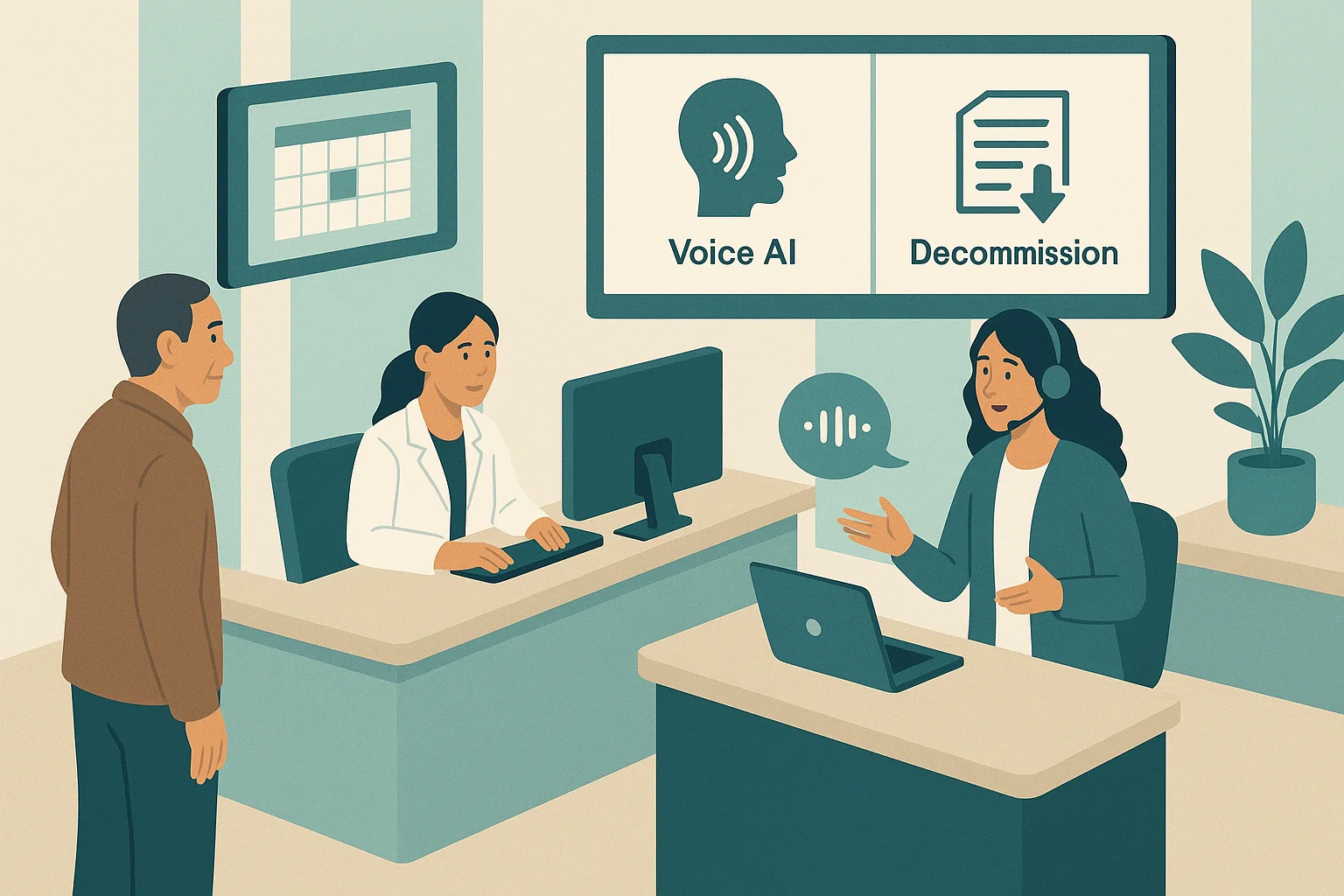
Design escalation logic to surface context (intent, confidence, transcript snippet, identity match) to the receiving human, minimizing repeat questions. Escalation rules should be deterministic and tested; measure handoff resolution time and first‑contact resolution after handoff.
- Push the caller context to the agent desktop with a clear summary and confidence score.
- Test escalation routes: phone queue, nurse line, operator, and emergency transfers (phone bridge).
- Log handoff acceptance and outcome as part of the audit trail.
QA metrics and observability
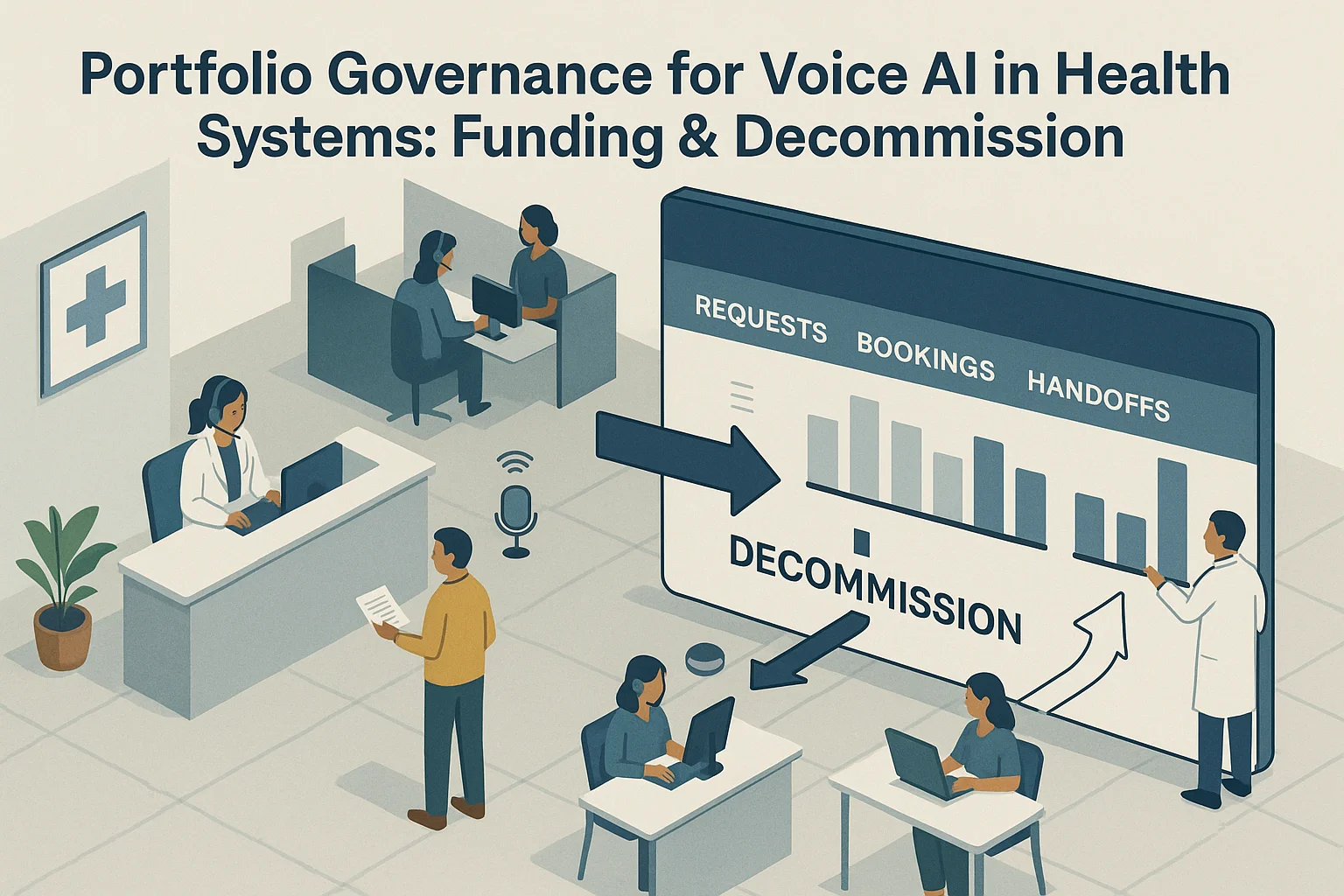
Track automated and human KPIs: automation rate, escalation rate, booking accuracy, false positive/negative identity matches, and time‑to‑resolve. Instrument the system for observability: latency, API errors, transcription quality, and model confidence distribution.
- Use periodic sample audits of recorded interactions to measure accuracy and safety.
- Define SLA and SLO for availability and mean time to remediate critical failures.
- Maintain an auditable change log for prompt and dialog updates.
Audit trails and human review
Maintain immutable audit logs for every decision point, including who made manual overrides, the reason, and timestamps. Ensure logs cover identities, consent artifacts, adapter calls to scheduling APIs, and any data exports.
- Audit logs support compliance, retrospective reviews after incidents, and decommissioning exports.
- Limit access to audit trails and monitor for unusual access patterns.
6. Decommissioning: safe retirement and continuity
Decommissioning is an operational event requiring funding and a checklist—treat it like launch in reverse.
Decommission triggers and planning
Define clear triggers for decommissioning: end of contract, unresolved safety issues, migration to a replacement system, or strategic sunset. Plan a staged shutdown that preserves active appointments, completes in‑flight transactions, and transfers records and audit logs to the health system’s archive.
- Identify active‑state transactions and avoid hard‑cutoff that could orphan patients.
- Schedule downtime windows and inform clinical teams and patients in advance.
- Budget for vendor‑assisted data export and adapter removal.
Data retention, export and legal holds
Map retention obligations and legal holds before any deletion. Export complete audit trails, consent artifacts, call recordings (subject to local law and consent), and scheduling records in a standard format. Verify cross‑border restrictions and subprocessors before transferring archives.
- Preserve a full, time‑stamped export of all interactions, decisions, and handoffs.
- Document the hosting and backup geography of exported records and any subcontractors involved.
- Work with legal and records teams to meet retention and e‑discovery needs.
7. Procurement, vendor model and contract essentials
The vendor model determines who runs risk in operations and decommissioning. Clarify responsibilities in the contract.
Managed service vs custom build
Managed services shift operational tasks to a vendor and can simplify lifecycle management when contracts include monitoring, human oversight, and decommission support. Custom builds give more control but require internal operational capability. Either model must specify ownership of identity validation, adapter maintenance, audit logs, and incident response.
- For managed services, require contractual SLAs on monitoring, incident response, and exportable audit trails.
- For custom builds, ensure internal teams are funded for continuous QA, security patching, and vendor coordination for dependencies.
- Clarify subprocessors, remote support access, and support geography.
Contract checklist
Contracts should state subprocessors, data residency and transfer mechanisms, retention, recording consent responsibilities, exit assistance, and who carries liability for record integrity and patient harm caused by system errors. Include acceptance tests, phased rollouts, and decommission obligations.
- Specify data export formats, retention timelines, and export windows in the SOW.
- Require transparency on model updates and a documented change control process.
- Include a funded decommission task and test for data restoration and record validation.
Related Peak Demand resources
Industry and AI sources reviewed
- Ethics and governance of artificial intelligence for healthWorld Health Organization
- Regulatory considerations on artificial intelligence for healthWorld Health Organization
- OECD AI PrinciplesOrganisation for Economic Co-operation and Development
- Artificial Intelligence Risk Management Framework (AI RMF 1.0)National Institute of Standards and Technology (NIST)
Healthcare privacy, security, clinical-safety, records, and professional obligations vary by jurisdiction and workflow. This article is operational guidance, not legal advice; organizations should confirm applicable requirements with qualified professionals.
Frequently asked questions
Administrative workflows such as appointment booking, changes and cancellations, referral-status intake, approved follow-up, patient-access questions, after-hours overflow, and structured routing are common starting points. Clinical judgment, diagnosis, emergency triage, and prescribing decisions must remain with qualified professionals.
Use the minimum identifiers approved by the organization, validate them against the system of record, avoid exposing unnecessary information, and provide a human-assisted path when verification fails. The system should not infer identity from conversational context alone.
The agent should follow the organization's approved escalation and emergency-routing rules, avoid clinical advice, and transfer or direct the caller to the appropriate human or emergency channel. Those rules must be tested with realistic language and failure cases.
Request identity and privacy controls, scheduling or EHR integration behavior, audit logs, escalation rules, downtime handling, testing evidence, change control, monitoring, and clear separation between administrative automation and clinical decision-making.
Design a safe patient-service workflow before automating it
Peak Demand helps healthcare organizations connect Voice AI to scheduling, intake, patient communication, identity checks, escalation, and reporting with clear operational boundaries.
Schedule a discovery call


