
Portfolio Governance and Data Strategy for Health System Voice AI
A practical guide for healthcare executives and operational leaders to govern Voice AI across patient access channels. Covers portfolio gates, data controls, identity validation, safe escalation, procurement, and measurable run operations.
1. Why a portfolio approach matters
Health systems must manage multiple Voice AI projects (after‑hours booking, pre‑visit intake, reminders, benefit checks). Treating these as a single program risks uncontrolled scope creep, inconsistent safety, and fragmented data controls. A portfolio approach provides gates, consistent controls, and measurable outcomes.
Define discrete capabilities and risk classes
Split Voice AI use cases into discrete capabilities (e.g., appointment booking, administrative inquiries, medication refill requests, care navigation). Assign a risk class to each capability using criteria such as potential for clinical harm, access to personal health information (PHI), and dependency on external systems. Low‑risk examples: appointment reminders. Higher‑risk examples: any dialogue that could influence care decisions.
- Capability inventory: name, purpose, channel (phone/IVR), owner, downstream systems.
- Risk criteria: patient safety impact, PHI exposure, decision automation, regulatory sensitivity.
- Outcome: a prioritized roadmap and per-capability control baseline.
Portfolio gates and lifecycle controls
Use clear gates: concept, risk assessment, pilot, scale, and decommission. Each gate requires documented artefacts: risk assessment, data flow diagram, consent template, EHR/PM integration design, and runbook. Approvals must include clinical, privacy/compliance, IT/architecture, and a designated product owner.
- Gate checklist: clinical safety review, privacy impact assessment, security review, vendor/subprocessor list, test plan.
- Require post‑pilot KPIs (uptime, handoff quality, false escalation rate) before scaling.
- Establish decommission triggers (usage below threshold, repeated safety incidents, vendor change).
2. Operating model: Patient → Voice AI → Validation → Action
A canonical execution path keeps automated actions small, verifiable, and reversible. The model below enforces safety and auditability.
Canonical architecture and responsibilities
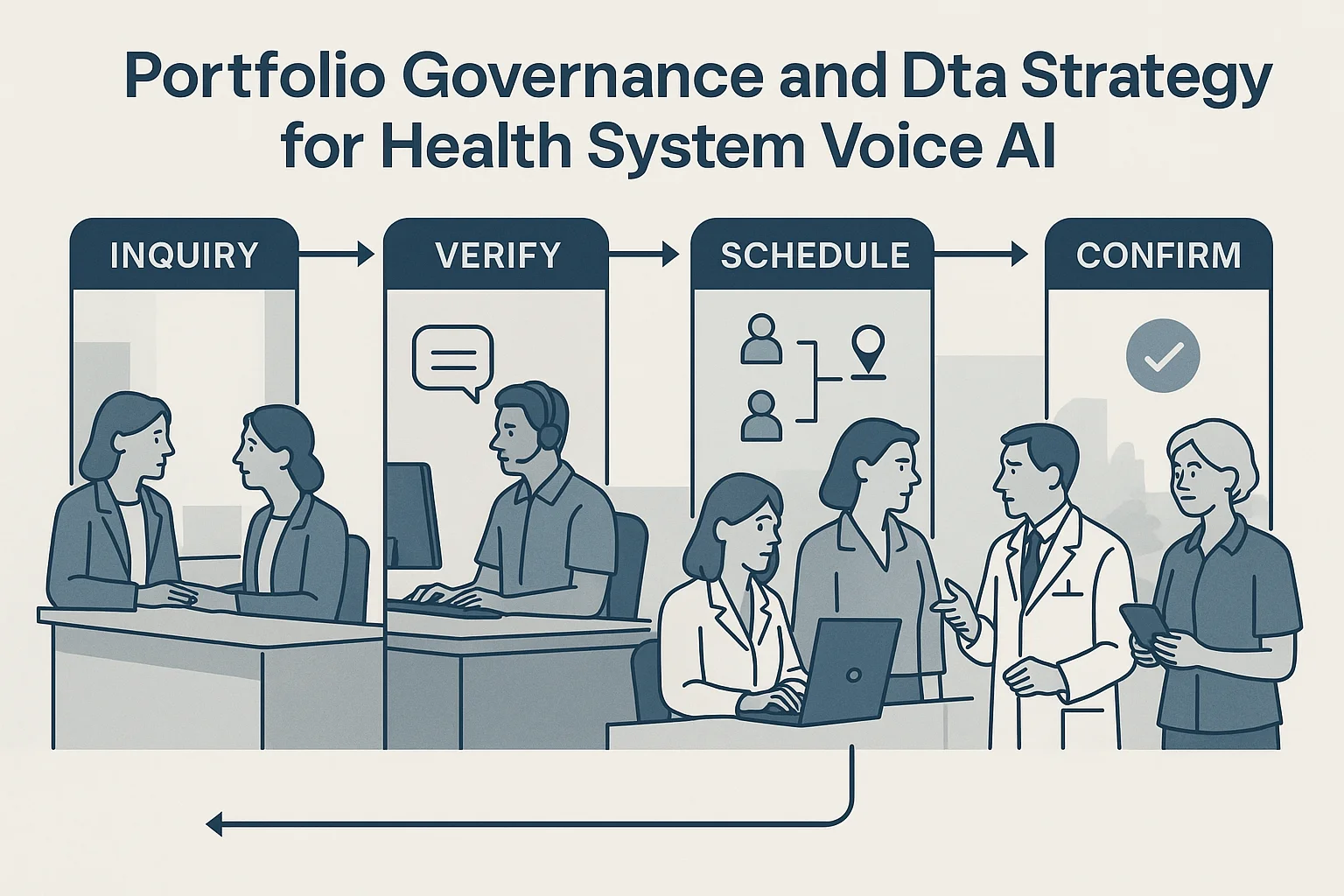
Design the flow: Patient/caller → Voice AI (intent detection, slot filling) → validation & identity controls → approved scheduling or service API → confirmation or human handoff. Separate business logic from speech models using a controlled orchestration layer. This ensures decisions and API calls are auditable and subject to policy checks.
- Orchestration layer: enforces policy, validates slots, executes API calls, records audit trail.
- Approved APIs and adapters: only allow scheduling or EHR updates through vetted connectors with documented scopes.
- Ownership: product team owns intent design; IT owns adapters and secrets; privacy/compliance owns consent and retention.
Failure boundaries and reversible actions
Limit automated actions to ones that can be reversed or confirmed. For example, allow automated appointment offers but require confirmation with an explicit callback or SMS code before finalizing for high‑sensitivity bookings. For any change to a care plan or treatment schedule, require human verification.
- Safe writes: non‑clinical scheduling, contact-detail updates (with verification), status flags; avoid clinical orders or notes writes.
- Use compensating transactions: provisional bookings pending human confirmation or two‑factor confirmation for PHI release.
- Record intent and all state transitions to support audit and rollback.
3. Data strategy and governance controls
Data strategy must link consent, record linkage, retention, provenance, and cross‑system flows. Keep privacy decisions auditable and operationally enforced.
Consent, recording, and provenance
Capture consent consistently: state purpose, retention, recording policy, and onward transfer. Persist a consent object tied to the caller session and record linkage. Tag all generated artifacts (transcripts, intent logs, audit events) with provenance metadata: system, timestamp, operator, and subprocessor list.
- Consent capture: spoken script, opt‑in/opt‑out flags, and link to written policy when possible.
- Provenance tags: session id, model version, adapter id, and subprocessors used for speech‑to‑text or NLP.
- Recording decisions: record only when required and flagged in consent; otherwise store pseudonymized intent logs.
Data flows, residency and onward transfer
Map data flows end‑to‑end: caller device → telephony carrier → speech processing → orchestration → EHR/scheduling API → backups. Explicitly document hosting region, backup region, subprocessors, and transfer mechanisms. Confirm retention and breach notification duties with counsel; design for selectable retention windows per use case.
- Data flow diagrams must identify processor roles, geographic hosting, and whether data is recorded or transitory.
- Use contract clauses and documented subprocessors; maintain an approved processor registry for audit.
- Retention policy: align with clinical records policies, patient expectations, and applicable law — document exceptions and archival procedures.
4. Identity validation and integration controls
Before taking actions that affect appointments or release PHI, verify identity and validate key fields. Integration design must protect EHR/PM systems and limit blast radius.
Identity and field validation patterns
Implement multi‑factor and evidence‑based validation where risk requires it. Options include callback confirmation, known fact verification (DOB, partial PHN), one‑time passcodes (OTP) to a verified phone number, or integration with a patient portal identity service. Deny automated action when identity is uncertain and route to human review.
- Low risk: confirm name and phone for reminders only.
- Medium risk: OTP or known fact match for scheduling that exposes PHI.
- High risk: require portal login or escalation to agent before changes to clinical records.
Integration hygiene and API controls
Connect to EHR/PM/scheduler through controlled adapters and documented API scopes. Implement least privilege credentials, granular audit logging, and circuit breakers that stop writes after anomalous behavior. Maintain a test harness that mirrors production for safe end‑to‑end validation.
- Adapters should validate payloads, enforce schema, and sanitize inputs before EHR writes.
- Implement rate limits, anomaly detection, and an emergency off‑switch for integration failures.
- Require vendor disclosure of subprocessors used for speech recognition or NLP processing.

5. Escalation, handoff, and QA
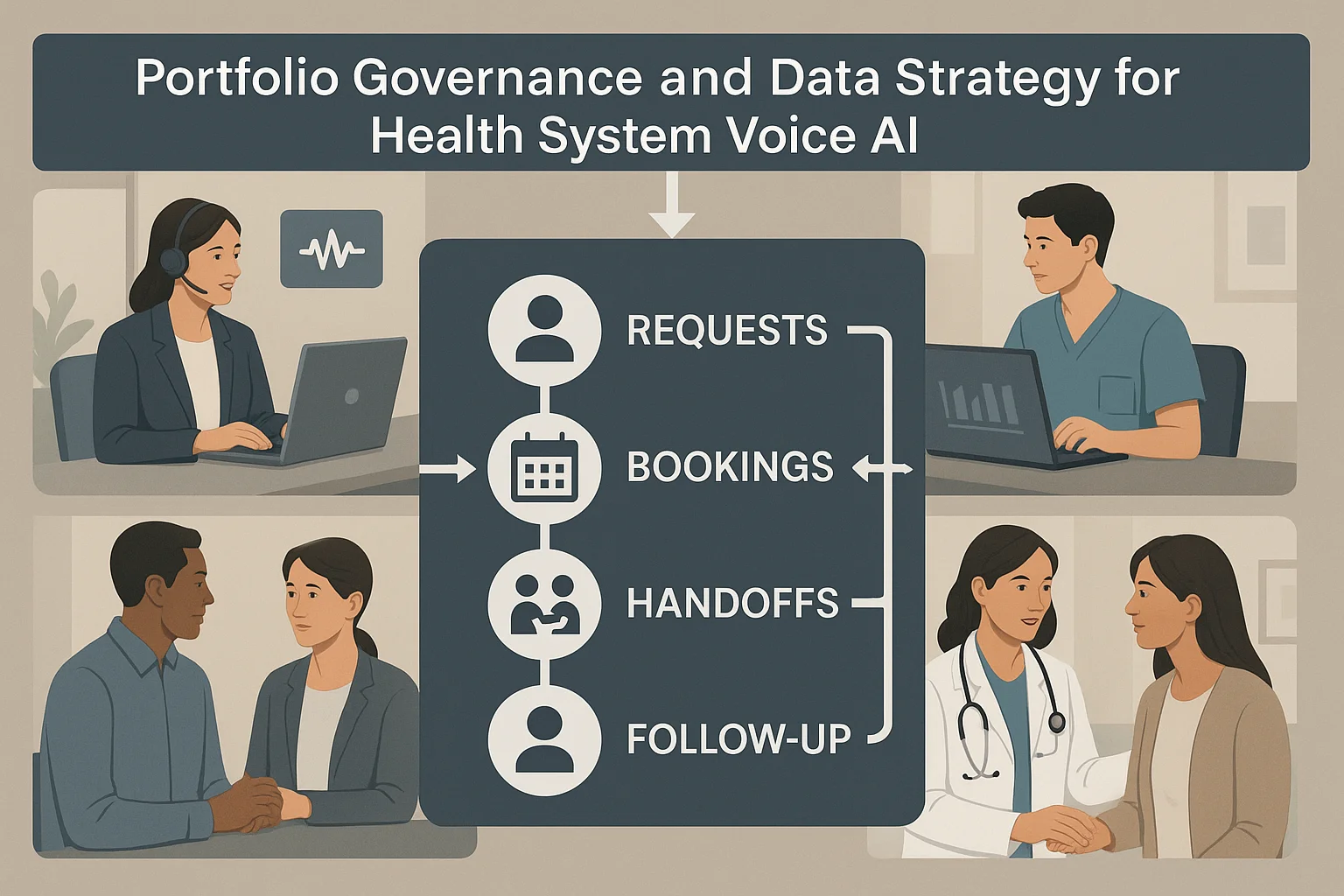
Escalation logic and handoffs are the safety net. Design triggers, handoff quality metrics, and continuous QA processes to catch drift and failures.
Escalation triggers and routing
Define deterministic triggers for escalation: uncertainty thresholds (confidence scores), user statements indicating urgency, identity validation failures, or requests that touch clinical care. Escalation must include context packaging (intent, transcript, validation state, audit id) to reduce cognitive load for the human responder.
- Trigger examples: ambiguous intent, repeated user correction, admission of worsening symptoms, failed identity checks.
- Route by urgency and skill: scheduling agents for booking issues; clinical triage nurses for condition‑related conversations.
- Attach the full provenance packet to the handoff to preserve context.
QA sampling and human‑in‑loop review
Operate a continuous QA program: automated sampling of low‑risk calls and full review of escalations and a regular review of false positives/negatives. Maintain a corrective loop: issues → root cause → intent model or script change → redeploy with regression tests.
- Define QA KPIs: handoff completion time, misrouted rate, identity failure rate, and escalation accuracy.
- Use periodic human review of transcripts and decisions; tune thresholds and retrain or re‑script when drift is detected.
- Keep a searchable audit trail to support incident investigations and regulatory requests.
6. Procurement, SLAs, and observability
Buyers should require evidence and contractual controls. Focus on vendor openness, security practices, observability, and support for regulated operations.
Vendor evidence and contract controls
Require vendors to provide: processor/subprocessor lists, data flow diagrams, service‑level objectives (SLOs), incident response commitments, retention controls, and independent security evidence (SOC 2/ISO statements where applicable). Insist on breach notification timelines, subprocessors’ geographies, and the right to audit critical controls.
- Ask for an RFP appendix with runbook, test plan, and evidence of controlled adapters for EHR integration.
- Contractually require notification of any new subprocessors and limits on onward transfer without consent.
- Retain the right to terminate or suspend if unsafe behavior or repeated incidents occur.
Observability, telemetry and runbooks
Define telemetry that the vendor must surface: intent confidence distributions, handoff counts, API error rates, latency, OTP success rates, and identity validation failures. Agree on runbook procedures for incidents and drills for switchover to human agents.
- Standard dashboards: safety incidents, escalations, average handoff time, and QA sampling outcomes.
- Alerting: automated thresholds that trigger oncall response and temporary circuit breakers.
- Runbooks: post‑incident review requirements, remediation timelines, and communication templates.
7. Implementation checklist and initial KPIs
A concise checklist helps teams avoid common pitfalls. Attach measurable KPIs to monitor operational and safety performance.
Pre‑launch checklist
Before pilot: complete capability inventory and risk class, obtain approvals from clinical and privacy teams, validate data flows and consent scripts, set identity verification rules, and run integration end‑to‑end in a non‑production environment.
- Documented gate approvals and artefacts in portfolio registry.
- Test harness with mirrored scheduling/EHR sandbox.
- QA plan, training scripts, and escalation routing verified.
Initial KPIs to monitor
Start with a short list of operational and safety KPIs during pilot: volume of automated contacts, percentage requiring human handoff, identity verification success rate, escalations per 1,000 calls, and QA‑identified safety incidents. Use these to decide scale‑up or rollback.
- Operational: average call duration, completion rate, API success rate.
- Safety: escalation accuracy, identity failure rate, clinically relevant incident count.
- Quality: user satisfaction surveys, handoff resolution time, QA defect density.
Related Peak Demand resources
Industry and AI sources reviewed
- Artificial Intelligence Risk Management Framework (AI RMF 1.0)National Institute of Standards and Technology (NIST)
- Regulatory considerations on artificial intelligence for healthWorld Health Organization
- Ethics and governance of artificial intelligence for healthWorld Health Organization
- OECD AI PrinciplesOrganisation for Economic Co-operation and Development
Healthcare privacy, security, clinical-safety, records, and professional obligations vary by jurisdiction and workflow. This article is operational guidance, not legal advice; organizations should confirm applicable requirements with qualified professionals.
Frequently asked questions
Administrative workflows such as appointment booking, changes and cancellations, referral-status intake, approved follow-up, patient-access questions, after-hours overflow, and structured routing are common starting points. Clinical judgment, diagnosis, emergency triage, and prescribing decisions must remain with qualified professionals.
Use the minimum identifiers approved by the organization, validate them against the system of record, avoid exposing unnecessary information, and provide a human-assisted path when verification fails. The system should not infer identity from conversational context alone.
The agent should follow the organization's approved escalation and emergency-routing rules, avoid clinical advice, and transfer or direct the caller to the appropriate human or emergency channel. Those rules must be tested with realistic language and failure cases.
Request identity and privacy controls, scheduling or EHR integration behavior, audit logs, escalation rules, downtime handling, testing evidence, change control, monitoring, and clear separation between administrative automation and clinical decision-making.
Design a safe patient-service workflow before automating it
Peak Demand helps healthcare organizations connect Voice AI to scheduling, intake, patient communication, identity checks, escalation, and reporting with clear operational boundaries.
Schedule a discovery call


