
Phased Voice AI Rollout for Manufacturing Service Operations
A practical, phased plan to deploy Voice AI across manufacturing service, warranty intake, and distributor networks—covering QA, containment and escalation quality, ERP/CRM integration, multilingual scale, and operational controls.
1. Why a phased approach matters for manufacturing service
Manufacturing service operations combine complex product identification, parts logistics, warranty adjudication, and regulated safety stakes. A phased rollout controls risk, establishes measurable outcomes, and protects upstream systems while delivering rapid operational value.
Business objectives and operational boundaries
Define concrete outcomes for each phase: reduce live‑agent minutes on standard inquiries (order status, basic troubleshooting), improve first‑contact routing to dealers or field service specialists, decrease time to parts validation, and track warranty intake accuracy. Map which decisions Voice AI may perform (e.g., collect serial number, verify purchase date) and which must remain human-verified (e.g., warranty approvals, safety‑critical engineering decisions).
- Outcomes: containment rate, escalation quality, parts‑validation accuracy, average handle time, cost‑to‑serve per call
- Boundaries: no automated warranty approvals, no unsupervised OT changes, human signoff for safety or engineering exceptions
Simple architecture to keep teams aligned
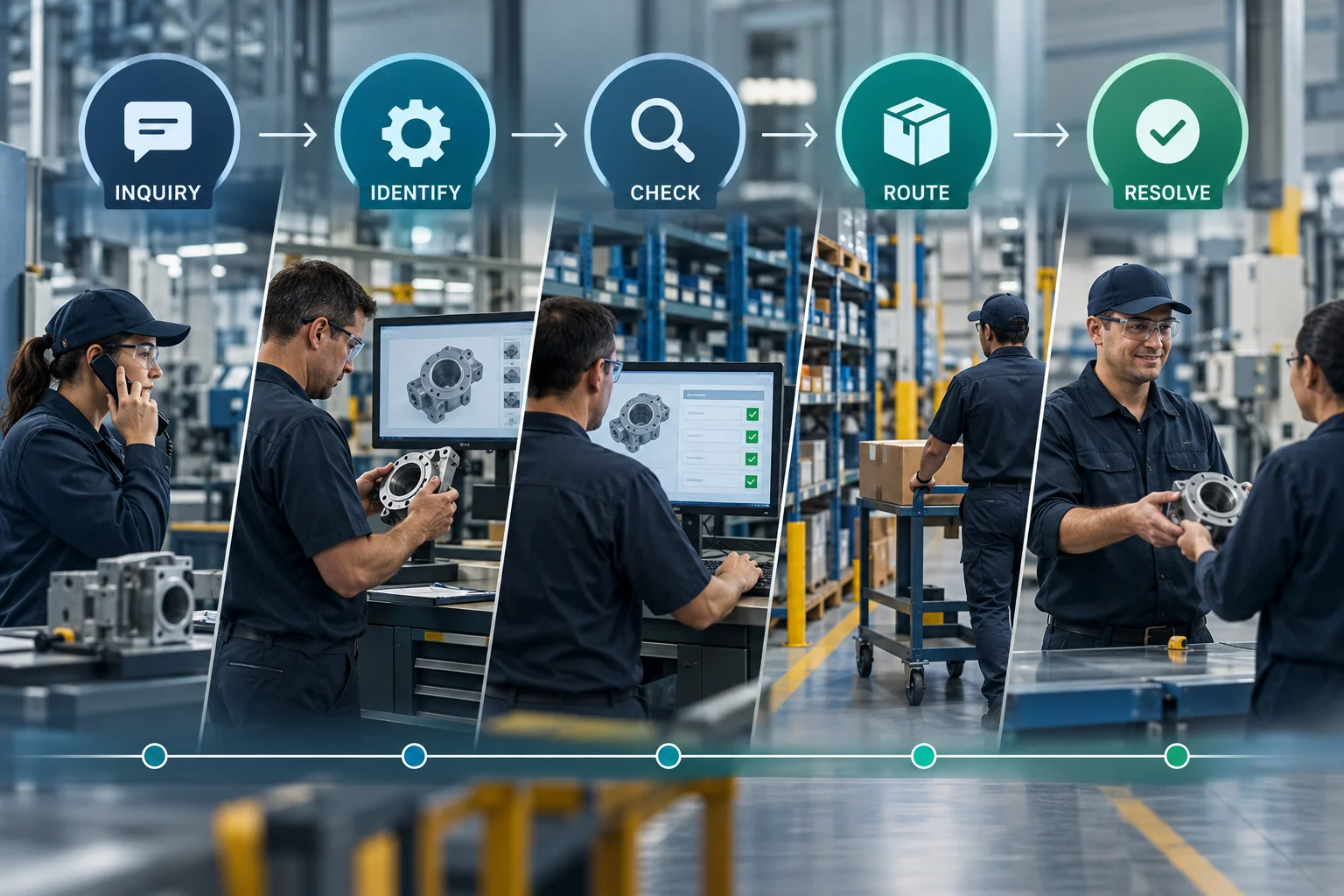
Use a clear caller flow so stakeholders share a common model: Caller → Voice AI (IVR + NLU) → intent & product validation → ERP/CRM/warranty/service API via controlled adapters → case, order, or specialist handoff. Keep adapters small, auditable, and reversible to reduce integration risk.
- Label data flows explicitly: caller metadata, input transcript, validation queries, routing decisions, handoff payloads
- Prefer read‑only validation in early phases (lookup stock, warranty status), promote write operations after gating
2. Phase plan and gating criteria
A four‑phase program—Pilot, Expand, Optimize, Scale—creates measurable gates for safety, quality, and cost outcomes. Each phase should have quantitative and operational exit criteria.
Pilot: narrow scope, measurable gates
Start with a narrow caller segment and 2–3 high-volume intents (order status, parts lookup, basic troubleshooting). Deploy on a subset of sites or a single dealer network. Require read-only ERP/CRM lookups for validation and route anything ambiguous to a trained agent.
- Pilot duration: 4–8 weeks with live traffic and parallel human QA
- Gates to pass Pilot: containment quality ≥ target (e.g., successful self‑service for agreed percent of pilot calls), escalation quality (correct routing) above threshold, no.
- Measurement: link every call to downstream outcome (case created, part shipped, escalated ticket) using correlation IDs
Expand and optimize: introduce writes and multilingual support
After the pilot, expand intents and geographies. Introduce write operations (case creation, scheduling tentative appointments) behind human verification or two‑step confirmations. Add multilingual NLU models and test with native speakers. Begin automated A/B testing of call flows.
- Gate for writes: audit logging, rollback procedures, human review queue for exceptions
- Multilingual rollout: staged by market with per‑language QA and localized prompts
Scale: full dealer/distributor networks and cross‑site analytics
Scale to multi‑site, multi‑dealer operations with centralized observability and localized routing rules. Track dealer performance on parts intake and time‑to‑fulfill and use those metrics to refine routing and SLAs.
- Operationalize orchestration: centralized policy engine governs routing, validation, and escalation
- Use standardized event schemas for cross‑site analytics to compare containment and escalation quality
3. Integrations, parts validation and warranty workflows
Integrations are where Voice AI delivers measurable service outcomes. Design validation-first adapters and explicit human controls for warranty and parts processes.
Integration patterns and controlled adapters
Use read‑only queries for product and warranty validation in early phases. Adapters should be narrow in scope, implement rate limits, maintain audit trails, and expose capability flags (read, create, update) that the orchestration layer checks before issuing changes. Where direct ERP writes are needed, gate them behind human confirmation or a two‑step commit.
- Common adapters: ERP (parts availability), CRM (customer record and case), warranty system (eligibility), scheduling/service management
- Prefer existing business APIs and webhooks; avoid direct database connections or OT interfaces
Warranty intake, validation and human controls
Voice AI should collect serial numbers, purchase dates, and symptom descriptors, then validate eligibility using the warranty API. Any recommendation to approve or deny warranty coverage should be a human‑recommended action with clear evidence presented in the agent UI, not a final automated approval.
- Required controls: evidence capture (audio transcripts, validation logs), audit trail visible to warranty specialists, escalation queue for ambiguous cases
- Do not automate refunds, reworks, or engineering changes without documented human signoff
4. Quality, analytics and continuous optimization
Measure what matters. Containment and escalation quality, tied to ERP/CRM outcomes and cost‑to‑serve, drive decisions and procurement evidence for expansion.
Core metrics and how to measure them
Operationalize containment quality (percentage of calls resolved without human agent), escalation quality (percent of escalations routed correctly), and cost‑to‑serve (telephony + compute + human minutes). Link call events to downstream outcomes: was the part shipped, was the case resolved within SLA, did the field visit close the job?
- Instrument every call with correlation IDs to join telephony, voice AI, CRM/ERP, and fulfillment events
- Use near‑real‑time dashboards for early detection and batch analytics for root‑cause
QA processes and human‑in‑the‑loop governance
Maintain continuous QA with a mix of automated sampling, focused review of failed intents, and full transcript audits for safety‑critical paths. Route a percentage of solved calls for random human audit to validate accuracy.
- QA cadence: daily automated checks, weekly human sampling, monthly trend reviews
- Actions from QA: intent model retraining, call flow tweaks, TTS prompt updates, routing policy changes
Analytics maturity and procurement evidence
Buyers should require vendor access to raw event logs, prebuilt dashboards and an exportable dataset for independent verification of containment, escalation quality, and cost metrics. This data is procurement evidence when comparing proposals and building ROI cases.
- Ask for vendor examples of dashboards, anonymized event schemas, and export formats at RFP stage
- Include measurable SLAs for observability and data access in contracts

5. Multisite, multilingual operations and distributor networks
Manufacturers operate across languages, time zones and dealer ecosystems. A rollout must account for localized language models, routing to local distributors, and consistent data exchange.
Multilingual design and local testing
Localize not only NLU/ASR but also prompts, escalation etiquette, and validation wording. Validate models with native speakers in production-like conditions. Monitor per‑language containment and escalation quality separately to identify regressions.
- Staged language rollouts: one region at a time with dedicated QA reviewers
- Use domain‑specific language packs for product families to improve part identification
Dealer and distributor routing at scale
Central orchestration should enforce routing policies while allowing local overrides for emergency coverage. Record distributor SLAs (response time, parts fulfillment) in the orchestration engine and route calls to the best available partner based on inventory, location, and performance.
- Maintain a dealer capability registry with tags for stock, certifications, and language support
- Tie routing logic to real‑time inventory where possible, falling back to human triage when uncertain

6. Risk, security and OT boundaries
Any connection that touches operational technology, production systems, or sensitive ERP data requires explicit technical and organizational controls. Follow recognized guidance for segmentation, access control, and incident response.
OT segmentation and secure adapters
Avoid direct Voice AI access to OT control systems. Use intermediary services or read‑only adapters that return only the required business data. Enforce least privilege, multi‑factor authentication for management planes, and strict network segmentation between IT and OT.
- Architectural rule: Voice AI ⇄ business system adapters ⇄ OT gateway (if needed), with no lateral OT access
- Maintain separate monitoring and alerting for any adapter that touches OT or plant systems
Cybersecurity and cross‑border data considerations
Identify hosting regions, backup regions, subprocessors, and data transfer mechanisms in procurement documents. Ensure policies for recording consent, retention, and breach notification match your legal obligations; consult qualified counsel. For industry guidance on cybersecurity and manufacturing best practices, align plans with national and cross‑sector resources.
- Document data residency, retention, and access policies during vendor selection
- Define remote‑support controls (jump‑hosts, audited sessions) and disable unnecessary remote access by default
7. Procurement, vendor selection and Peak Demand differentiation
Procurement for Voice AI needs operational evidence, not just marketing claims. Require technical deliverables, QA practices, and integration proof points.
What to require in RFPs and SOWs
Ask for sample event schemas, anonymized logs for the same industry, a security and deployment whitepaper listing hosting and subprocessors, and proof of prior ERP/CRM adapter work. Include acceptance tests for containment and escalation quality and explicit change control for integrations.
- Required artifacts: sample dashboards, adapter interface contracts, test plans, QA cadence, SLA for observability
- Contract language: audit rights, data export at termination, and rollback plans for integrations
Managed service vs. build: responsibilities and SLAs
Decide who owns model updates, call‑flow changes, and integrations. Managed services can operate the stack and deliver SLAs for containment and observability; product teams often prefer hybrid ownership where business logic stays in-house and vendors provide platform services.
- Define who owns training data, who can deploy model updates, and who will operate incident response
- Negotiate SLAs for containment, escalation correctness, and downtime with clear remediation steps
Peak Demand differentiation
Peak Demand delivers custom call flows, ERP and CRM integrations, parts and warranty intake validation, routing to dealers and field service, multilingual support, and accountable human escalation. Our approach emphasizes narrow adapters, auditable evidence, and measurable QA tied to ERP/CRM outcomes—useful procurement evidence when evaluating vendors.
- Custom integrations for Microsoft Dynamics 365 Business Central and common ERPs (see our integration guide)
- Operational governance playbook and measurable dashboards for containment and routing outcomes
Related Peak Demand resources
Industry and AI sources reviewed
- Guide to Operational Technology SecurityNational Institute of Standards and Technology (NIST)
- Cybersecurity Resources for ManufacturersNIST Manufacturing Extension Partnership
- Cross-Sector Cybersecurity Performance GoalsCybersecurity and Infrastructure Security Agency (CISA)
Manufacturing cybersecurity, operational-technology, product, warranty, records, and workplace obligations vary by jurisdiction and operating environment. This article is operational guidance, not legal advice; organizations should confirm applicable requirements with qualified professionals.
Frequently asked questions
Strong starting points include parts and order-status requests, distributor or dealer support, warranty and service intake, appointment scheduling, case creation, basic product information, and routing to technical specialists. Keep engineering judgment, safety decisions, and operational-technology control outside the conversational layer.
Official reference: Cybersecurity Resources for Manufacturers
The workflow should collect structured identifiers such as model, serial number, part number, customer account, asset location, and symptoms, then validate them against ERP, CRM, catalogue, warranty, or service systems. The agent should escalate rather than invent a match when confidence is low.
Official reference: Cybersecurity Resources for Manufacturers
Not by default. Customer-service automation should normally use controlled business-system integrations and tightly governed adapters. Any connection near operational technology requires explicit security architecture, least privilege, monitoring, and separation from safety-critical control functions.
Official reference: Guide to Operational Technology Security
Require workflow mapping, integration ownership, test evidence, fallback behavior, auditability, security boundaries, change control, monitoring, human escalation, and a plan for maintaining product, parts, warranty, and service knowledge after launch.
Official reference: Cybersecurity Resources for Manufacturers
Connect Voice AI to real manufacturing service operations
Peak Demand helps manufacturers automate parts, order, warranty, dealer, distributor, and service requests through controlled integrations, validation, escalation, and reporting.
Schedule a discovery call


