
Outcome‑Linked Operating Model for Health System Voice AI: Contracts, Funding & KPIs
A practical operating model that ties Voice AI commercial terms to measurable patient‑access outcomes. Covers architecture, contracts, funding options, KPIs, procurement controls and safe escalation.
1. Why an outcome‑linked operating model matters
Healthcare buyers need Voice AI to measurably improve access without increasing clinical risk or operational load. An outcome‑linked approach aligns commercial incentives, clarifies responsibilities, and reduces vendor‑buyer disputes by paying for verifiable patient‑facing results rather than opaque system metrics.
Use case and scope
Limit Voice AI to administrative patient‑access tasks: appointment requests and booking, basic eligibility checks, call routing, prescription refill routing, and standard information requests. Exclude diagnosis, triage for emergencies, medication advice, and any clinical decision‑making. Define scope in the contract to avoid misaligned expectations and regulatory exposure.
- Administrative tasks: scheduling, rescheduling, cancellations, waitlist offers, basic demographic updates.
- Routing tasks: transfer to nurse line, escalation to clinical staff, connection with intake teams.
- Excluded tasks: clinical advice, triage, prescription initiation, diagnostic interpretation.
Who should read this
This article targets healthcare executives, clinic operators, patient‑access leaders, IT, privacy and compliance officers, and contact‑centre teams who will approve procurement, integrate Voice AI with scheduling systems, and be accountable for patient outcomes.
- Procurement and legal: contracting and risk allocation.
- Patient access and contact centre: operational KPIs and escalation.
- IT and integration teams: API, EHR/PM integration, identity controls.
2. Core architecture and safety boundaries
An operationally safe Voice AI implementation maps caller intent to an approved downstream action, guarded by identity controls, validation, and clear human‑in‑loop points.
Canonical call flow
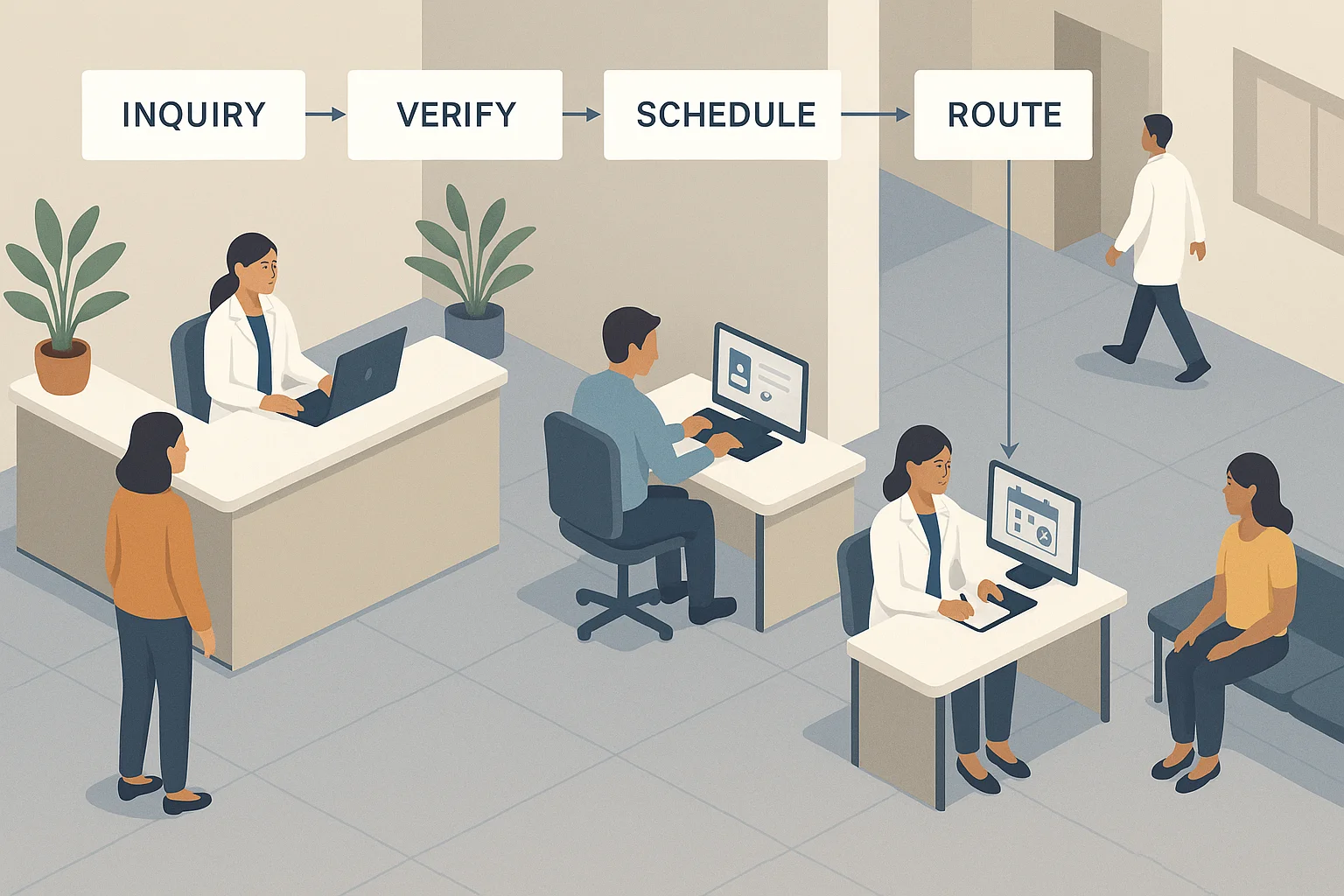
Design the flow as a sequence of modular steps: Caller → Voice AI front end (intent detection, slot filling) → identity & validation layer (caller verification, consent, recording flags) → approved scheduling/service API (authorized write or read-only actions) → confirmation or human handoff. Keep each step auditable with immutable event logs and call recordings where permitted.
- Intent detection must be limited to pre‑approved templates to avoid open responses.
- Identity validation uses multi-factor checks (phone number, date of birth, PIN, appointment token) before any protected-action.
- Scheduling API calls must be idempotent and return a canonical booking reference; Voice AI reads that reference back to confirm.
Safety and clinical boundaries
Voice AI must not perform clinical triage or diagnosis. Escalation triggers should be explicit: any ambiguous clinical content, mentions of chest pain, breathing difficulty, altered mental status, or patient insistence on clinical advice must route immediately to trained clinical staff or emergency services.
- Implement deterministic keyword and confidence thresholds for escalation.
- Log and flag all escalations for rapid quality review.
- Do not allow automated scheduling for calls flagged as clinical urgency.
3. Contract and procurement design: clauses that matter
Commercial documents must translate the operating model into measurable obligations, audit rights, and remediation pathways. Avoid vague service descriptions—use measurable outputs.
Outcome metrics, SLAs and payment triggers
Define payment triggers that are verifiable: e.g., 'payment credit issued when Voice AI completes a verified booking that is accepted by the scheduling system and a confirmation message is sent to the patient.' Separate transient metrics (intent recognition) from outcome metrics (verified booking). Tie bonuses or deductions to outcome windows (e.g., verified booking within 6 hours of call).
- Explicitly define 'verified booking' (API booking ID + confirmation sent).
- Avoid paying for 'voice recognition accuracy' alone; prefer outcomes tied to downstream system state.
- Include minimum safe containment targets and maximum allowed false negatives on escalation.
Data processing, subprocessors and audit rights
Require vendor disclosure of subprocessors, data locations, backup geography, and mechanisms for cross‑border transfers. Insert audit rights (regular security and privacy reports plus on‑site or remote audits) and require a notification period for subprocessor changes.
- Contract should specify hosting region and backup region, remote‑support access controls, and subprocessors list.
- Preserve audit rights over model updates, security testing results, and data deletion/retention proofs.
- Agree on breach notification timelines and responsibilities for notification to regulators and patients when required.
Remediation, liability and change management
Set a graduated remediation plan: incident triage SLA, root‑cause analysis, and corrective action plan. Limit vendor liability to realistic operational damages and require vendor responsibility for faulty automations that directly cause missed bookings or improper escalations, subject to agreed exclusions. Define a model‑update governance process—no unvetted model changes in production without staging, QA, and buyer sign‑off.
- Require a change freeze for model updates during high‑season (e.g., flu season) unless jointly approved.
- Define contractual credits for systemic failures (e.g., repeat failed handoffs over threshold).
- Retain right to roll back vendor changes or request a phased rollout.
4. Funding and pricing options aligned to outcomes
Select a funding model that shares risk and aligns incentives across vendor and health system. Each model has tradeoffs for predictability, alignment and administrative overhead.
Subscription + performance bonus
A predictable monthly retainer covers baseline infrastructure, integration and support. Overlay an outcome‑linked bonus tied to verified bookings, containment rates, or decreased waitlist backlog. This balances vendor cashflow with measurable improvement incentives.
- Retainer covers 24/7 availability, maintenance and platform fees.
- Bonuses require clear measurement rules and independent audit windows.
Per‑completed‑booking (pay‑per‑outcome)
Pay only when the Voice AI completes a defined downstream action (e.g., confirmed appointment ID). This strongly aligns incentives but can disincentivize vendor investment in non‑billable areas (integration or QA) unless a minimum retainer or onboarding fee is included.
- Include minimum monthly guarantees to cover fixed costs during low volumes.
- Negotiate unit price ceilings and volume discounts.
Managed service tiers
A managed service combines operations, monitoring, and change management. Tiers can include different human‑in‑loop ratios, guaranteed escalation SLAs, and reporting granularity. Use managed services when internal staff lacks the capacity to operate the system or when deep EHR integrations are required.
- Define included scope: support hours, integration updates, training, QA sampling.
- Link tier changes to measurable triggers (e.g., scale thresholds or performance degradations).
5. KPIs, audit and governance
Measure outcomes and controls using a small set of primary KPIs and layered quality checks. Operational governance turns metrics into timely corrective action.
Primary and secondary KPIs
Select KPIs that reflect patient access and safety. Primary KPIs tie to commercial outcomes; secondary KPIs track quality and risk.
- Primary: Verified booking completion rate (bookings/eligible calls), containment rate (calls resolved without human escalation when appropriate), time‑to‑book (median), booking confirmation delivery rate.
- Secondary: False escalation rate (unnecessary transfers), missed escalation rate (clinical content not escalated), dropouts during booking flow, call abandonment.
- Report both numerator and denominator definitions and measurement intervals.
Audit, QA and sampling
Implement continuous sampling and event audits: automated logging for every transaction plus manual review of stratified samples (high‑risk escalations, failed bookings, random samples). Define audit cadence, acceptance thresholds, and remediation triggers.
- Automated alerts for KPI deviations beyond tolerance bands.
- Monthly QA reports with line‑level reasons for failures and remediation timelines.
- Retain recordings/interaction logs per agreed retention for investigatory purposes.
Governance forum and escalation path
Create a joint governance committee (vendor + buyer) with weekly operational check‑ins and monthly strategic reviews. Assign a single accountable owner for patient‑access outcomes and a separate technical owner for integrations and security.
- Weekly ops: KPI review, incident triage, action item tracking.
- Monthly strategic: roadmap, change requests, seasonal risk planning.
6. Implementation runbook and operational controls
Operational readiness reduces risk. Use a staged rollout with explicit human‑in‑loop gates, integration validation, and fallback modes.
Phased rollout and safety gates
Pilot with a low‑risk segment (e.g., non‑urgent scheduling for a single clinic), monitor KPIs, then expand by clinic, region or service type. Require defined go/no‑go criteria at each phase based on containment, escalation accuracy, and booking success.
- Phase 0: Integration and end‑to‑end tests in staging with synthetic calls.
- Phase 1: Limited live pilot with human review on all bookings.
- Phase 2: Partial automation with selective sampling and reduced human review.
- Phase 3: Full scoped automation with ongoing QA sampling.
Monitoring, observability and tooling
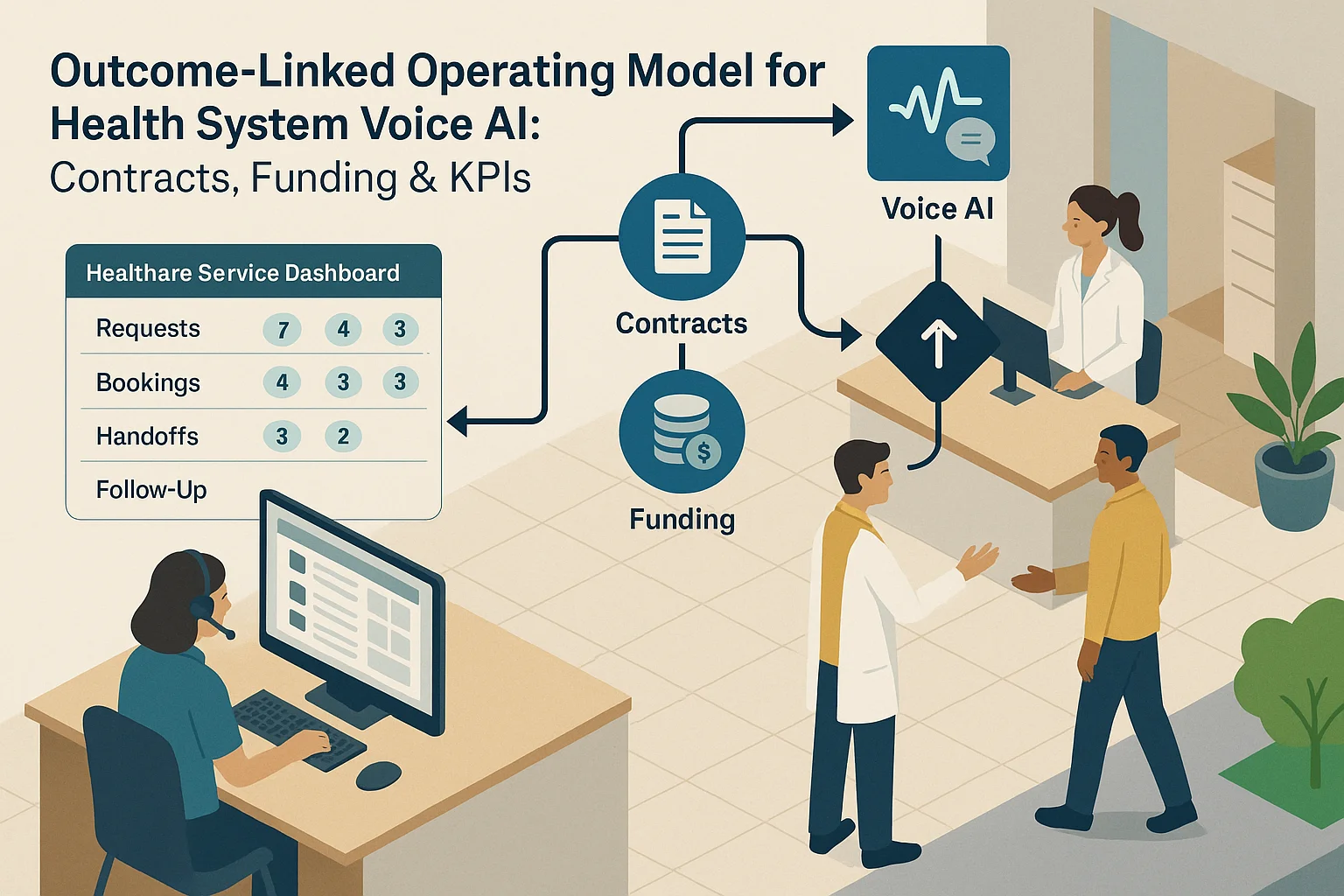
Deploy dashboards for near‑real‑time visibility into primary KPIs, escalation events, and integration errors. Instrument each API call with correlation IDs to trace caller → interaction → scheduling API call → confirmation.
- Correlation IDs enable rapid incident isolation and root‑cause analysis.
- Use synthetic transactions to validate availability and booking idempotency outside business hours.
- Maintain an incident timeline and RCA repository accessible to governance committee.
Human‑in‑loop, training and staffing
Decide the required human review ratio and train staff on new handoff procedures. Human reviewers should have clear playbooks: when to accept an automated booking, when to rebook, and how to document exceptions.
- Train for new failure modes (e.g., incomplete slot filling or duplicate bookings).
- Retain final authority with human staff for ambiguous or clinical queries.
- Periodically retrain staff on Voice AI behaviour after model updates.
Related Peak Demand resources
Industry and AI sources reviewed
- Ethics and governance of artificial intelligence for healthWorld Health Organization
- Artificial Intelligence Risk Management Framework (AI RMF 1.0)National Institute of Standards and Technology (NIST)
- Regulatory considerations on artificial intelligence for healthWorld Health Organization
Healthcare privacy, security, clinical-safety, records, and professional obligations vary by jurisdiction and workflow. This article is operational guidance, not legal advice; organizations should confirm applicable requirements with qualified professionals.
Frequently asked questions
Administrative workflows such as appointment booking, changes and cancellations, referral-status intake, approved follow-up, patient-access questions, after-hours overflow, and structured routing are common starting points. Clinical judgment, diagnosis, emergency triage, and prescribing decisions must remain with qualified professionals.
Use the minimum identifiers approved by the organization, validate them against the system of record, avoid exposing unnecessary information, and provide a human-assisted path when verification fails. The system should not infer identity from conversational context alone.
The agent should follow the organization's approved escalation and emergency-routing rules, avoid clinical advice, and transfer or direct the caller to the appropriate human or emergency channel. Those rules must be tested with realistic language and failure cases.
Request identity and privacy controls, scheduling or EHR integration behavior, audit logs, escalation rules, downtime handling, testing evidence, change control, monitoring, and clear separation between administrative automation and clinical decision-making.
Design a safe patient-service workflow before automating it
Peak Demand helps healthcare organizations connect Voice AI to scheduling, intake, patient communication, identity checks, escalation, and reporting with clear operational boundaries.
Schedule a discovery call


