Observability, SLOs and Failure Recovery for Voice AI in Property Management
Practical guidance for brokerages, property managers and leasing teams to design observable, measurable, and recoverable Voice AI systems that protect leasing workflows, maintenance intake, and tenant experience while keeping human judgment where it matters.
1. Operational architecture: map the call to a business outcome
A clear, minimal architecture reduces ambiguity during failures. Use a canonical flow that every team member can read and test.
Canonical flow (Caller → Actionable Record)
Model the system as this linear flow and instrument at each hop: Caller → Telephony/ASR → Voice AI (NLU + Dialogue) → Identity & consent checks → Orchestration / Business Rules → CRM / Property System → Action (appointment, work order, lead) → Human specialist handoff or confirmation. Each arrow is a testable SLA and a potential failure boundary.
- Instrument call media and transcripts with a stable call ID that travels through all systems.
- Emit events at every logical transition: ASR-complete, intent-detected, identity-validated, API-call-attempted, record-created, human-handoff-initiated.
- Map each event to a business artifact: lead record, booking, maintenance ticket, owner inquiry.
Integration boundaries and adapters
Avoid tight coupling: use small, well-documented adapters for each backend system (CRM, PMS, scheduling, vendor portals). Adapters translate the platform’s canonical data model into the destination schema and handle retries, idempotency, and error classification.
- Define JSON data contracts for leads, bookings, and maintenance cases that include required fields, optional fields, and validation rules.
- Use an idempotency key tied to caller + timestamp + intent to prevent duplicate bookings or work orders from retries.
- Classify API errors into transient (retry with backoff), permanent (surface to agent), and partial-success (record created but downstream enrichment pending).
2. Identity, consent and safe data handling
Voice systems touch personal data and operational decisions. Make identity and consent explicit points in the call flow and observability model.
Practical identity checks
Use multi-signal verification appropriate to the workflow: caller ID and number reputation for basic routing; CRM lookup or PIN for tenant-specific operations; time-based OTP or callback verification for sensitive actions. Capture verification events and their outcomes in the trace.
- For tenant maintenance intake, require property + unit confirmation or CRM profile match before creating an authenticated work order.
- For lead capture, accept minimal contact verification and schedule a follow-up that collects fuller identity data via agent or secure web form.
- Record which identity signals were used (analytics: caller_id_verified, crm_match, otp_verified).
Consent and recordings
Make consent explicit: announce call recording where required, log the consent timestamp and playback the option to opt out. Ensure the consent flag travels with the call ID into the CRM and any recordings storage so that retrieval and deletion requests can be acted on.
- Annotate recordings with retention policy, storage region, and subprocessors used by audio and transcription services.
- Provide a clear path in the orchestration layer to redact or delete recordings per a legal or tenant request, and log deletion actions for.
3. Observability and SLOs that map to leasing and maintenance KPIs
Observability must produce signals the business can act on. Define SLOs that connect engineering metrics to commercial outcomes.
SLO examples tied to business outcomes
Set a small set of measurable SLOs that reflect what teams care about. Express them as error budget policies and measure with user-centric metrics.
- Lead capture SLO: % of inbound prospects with a validated contact and CRM lead created within the call window (target and error budget).
- Booking latency SLO: 95th percentile time from call start to confirmed appointment creation (including calendar checks and agent confirmation).
- Maintenance triage SLO: % of urgent cases escalated to human operator within X minutes after caller described an emergency cue.
Instrumenting traces and correlating events
Implement distributed tracing that ties voice media, transcript, NLU decisions, identity checks, and backend API calls together. Use these traces for alerting and post-incident review.
- Store transcripts and key metadata as links (not inline) in traces to avoid bloating telemetry stores.
- Emit structured errors with error codes the operations team recognizes (ASR_TIMEOUT, NLU_LOW_CONFIDENCE, CRM_409_DUPLICATE).
- Use synthetic call tests for each property listing to validate end-to-end booking flows and capture regressions.
4. Failure modes, deterministic fallbacks and human handoff
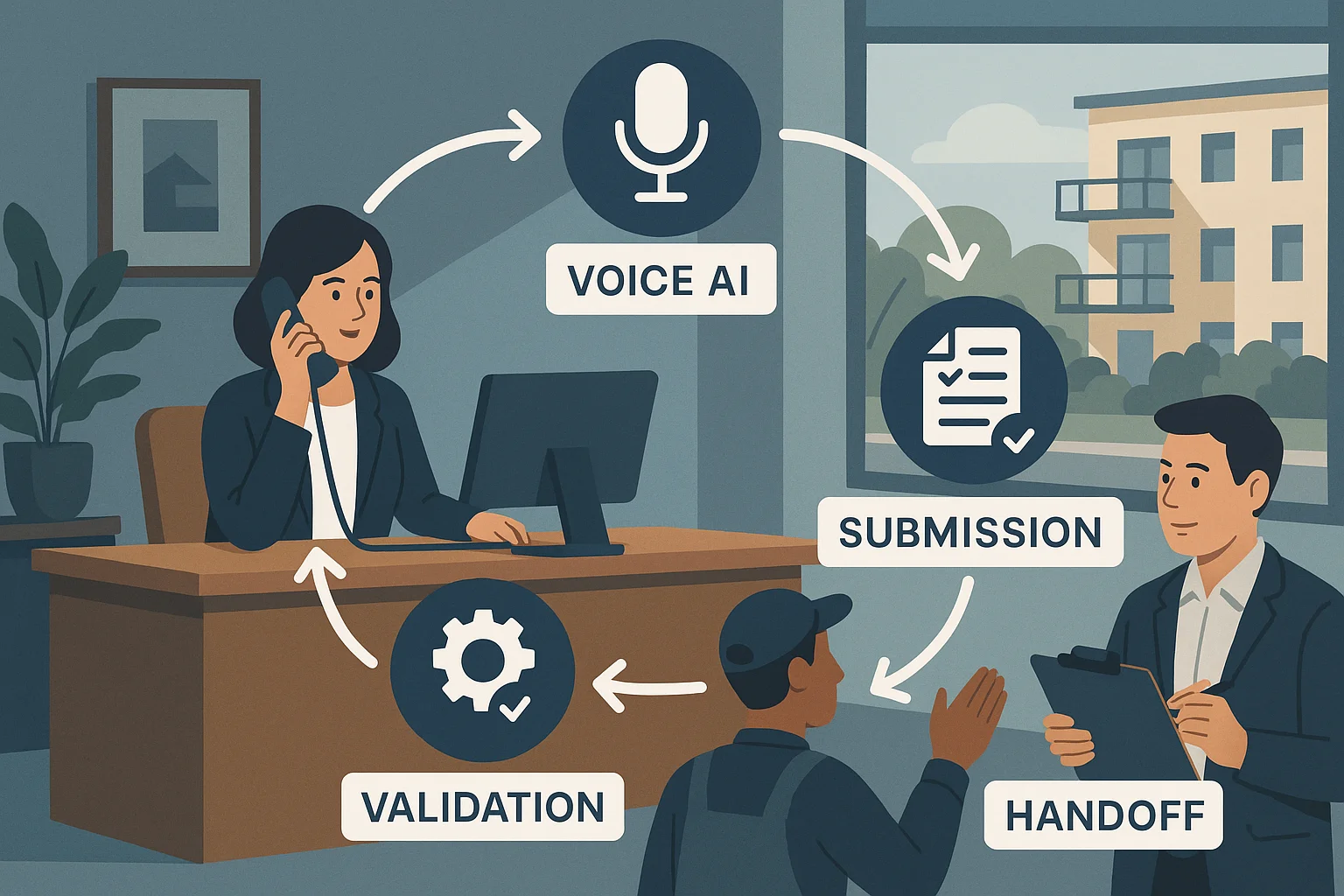
Failures will occur. Define deterministic, auditable fallback behaviors tied to business rules so agents and tenants know what to expect.
Common failure patterns and appropriate responses
Classify failures by impact and prescribe a single fallback path per class.
- ASR / audio noise: if ASR confidence < threshold, prompt for rephrase once; on repeat low confidence, transfer to human agent or schedule callback.
- NLU misclassification: if intent confidence is low or multiple intents detected, offer the caller a short menu and escalate to human if still ambiguous.
- Downstream API failure (CRM/PMS): surface a human confirmation flow that records the caller’s intent and promises manual follow-up; create a durable retry queue for.
Human handoff and audit trail
Handoffs must be predictable and contain context so agents can act without re-taking the call. Create a standardized handoff payload and a visual agent screen.
- Handoff payload includes call transcript excerpt, intent, verification status, property/unit, suggested action, and required compliance flags (e.g., fair housing sensitive).
- Provide agents with a one-click accept/decline action that writes acceptance with timestamp to the trace.
- Log who took the handoff and whether the action completed (booking confirmed, work order created) for SLA measurement.

5. Safe tool use: legal, fair-housing and misrepresentation boundaries
Voice AI should accelerate routine tasks but not replace human judgment in legally sensitive areas. Set explicit 'do not automate' rules.
Do not automate: required human decisions
Never automate decisions that can create legal liability or discriminatory outcomes. Delegate these to trained staff and track the decision path in the system.
- Tenant screening decisions that could affect housing eligibility or contain protected-class implications must be routed for human review.
- Emergency maintenance judgment (e.g., whether a reported issue constitutes an immediate danger) should result in immediate escalation to human triage.
- Any representation that constitutes a binding offer, lease term acceptance, or pricing guarantee must be confirmed and signed by a human actor.
Transparency, claims and vendor responsibility
Be explicit in public-facing language about what the Voice AI can and cannot do. Avoid overstating capabilities, and require vendors to document known failure modes and test coverage.
- Disclose that callers may be speaking to a Voice AI and provide an easy opt-out to a human representative.
- Require vendors to publish test results against representative call sets, and to document limitations (e.g., languages, accents, noisy environments).
- Include contract language that maps failure scenarios to remediation steps and timelines.
6. Procurement, runbook and measurable operating outcomes
Procurement decisions should be operational: require observability, runbook completeness, and measurable outcomes in the SOW.
Vendor evaluation checklist
Ask for concrete evidence, not marketing statements. Evaluate vendors on the following operational criteria.
- Evidence of end-to-end tracing and a published schema for telemetry events and error codes.
- Demonstrated adapters for your CRM/PMS or a clear plan and lead time to build them (with sample data contracts).
- Defined SLOs for lead capture, booking latency, and maintenance triage, with associated alert thresholds and on-call rotations.
- A documented escalation and remediation process with maximum time-to-human-handoff for urgent maintenance.
Runbook essentials and KPIs
Operationalize by codifying responses to common incidents and mapping them to business KPIs to measure impact.
- Runbook entries for ASR outage, NLU model drift, telemetry ingestion failure, and downstream API latency, with clearly assigned owners.
- Post-incident review templates that quantify business impact (missed bookings, delayed maintenance, SLA breaches) and recommended preventive actions.
- Regular synthetic tests and a quarterly model validation exercise that include representative accents, languages, and property-specific scripts.
7. Implementation checklist and next steps
Practical steps to move from design to production with minimal disruption.
Minimum viable implementation checklist
Follow this checklist to deploy a safe, observable Voice AI capable of supporting core property workflows.
- Define canonical data contracts for leads, bookings and work orders; implement idempotency keys.
- Instrument traces that include call ID, transcript link, identity checks and downstream API responses.
- Set three initial SLOs (lead capture %, booking latency p95, urgent-hand-off time) and define alert thresholds.
- Build adapter for primary CRM/PMS and one scheduling calendar with robust retry and error classification.
- Create a human handoff payload and train agents on the acceptance workflow.
Pilot, measure, iterate
Run a time-boxed pilot on a subset of properties or call types, measure against your SLOs, then expand.
- Start with non-binding inbound calls (property inquiries, showing requests) before routing maintenance escalations through the AI.
- Use live monitoring and weekly RCA during the pilot to refine fallbacks and telemetry.
- Scale by adding new adapters (owner portals, vendor dispatch) only after telemetry demonstrates stable error budgets.
Related Peak Demand resources
Industry and AI sources reviewed
- Artificial Intelligence Risk Management Framework (AI RMF 1.0)National Institute of Standards and Technology (NIST)
- Fair Housing Act OverviewU.S. Department of Housing and Urban Development
- Artificial Intelligence and the FTCU.S. Federal Trade Commission
Housing, privacy, anti-discrimination, consumer-protection, records, and licensing obligations vary by jurisdiction and workflow. This article is operational guidance, not legal advice; organizations should confirm applicable requirements with qualified professionals.
Frequently asked questions
Common starting points include lead intake, showing and appointment scheduling, tenant and resident service requests, maintenance routing, listing questions from approved data, after-hours overflow, and structured escalation to leasing or property teams.
Official reference: Artificial Intelligence Risk Management Framework (AI RMF 1.0)
Do not delegate discriminatory screening, legal advice, binding transaction decisions, emergency-maintenance judgment, fair-housing determinations, or decisions that require licensed or authorized professionals. The agent should gather information and route the matter appropriately.
Official reference: Fair Housing Act Overview
Use approved fields and actions, validate identities and property records, limit permissions, log changes, and provide human review for exceptions. The agent should not invent availability, pricing, eligibility, lease terms, or maintenance status.
Official reference: Artificial Intelligence Risk Management Framework (AI RMF 1.0)
Require fair-housing safeguards, integration and data controls, testing, audit logs, escalation paths, emergency-routing rules, monitoring, change control, and clear ownership of listing, property, tenant, and maintenance knowledge.
Official reference: Fair Housing Act Overview
Build a controlled property-service workflow
Peak Demand helps real-estate and property teams connect Voice AI to lead intake, showing requests, resident service, maintenance routing, CRM workflows, and human escalation.
Schedule a discovery call


