
Municipal Voice AI Integration Architecture for Forms and Case Management
A practical, jurisdiction‑neutral operating model for integrating Voice AI with municipal forms and case-management systems. Covers end-to-end workflows, validation, routing, escalation, failure boundaries, procurement clauses, and measurable operating outcomes.
1. Scope, safety boundaries, and the operating model
Define what Voice AI will — and will not — do. Clear boundaries protect residents and municipal staff while keeping operational risk visible and manageable.
Operational scope and high‑level flow
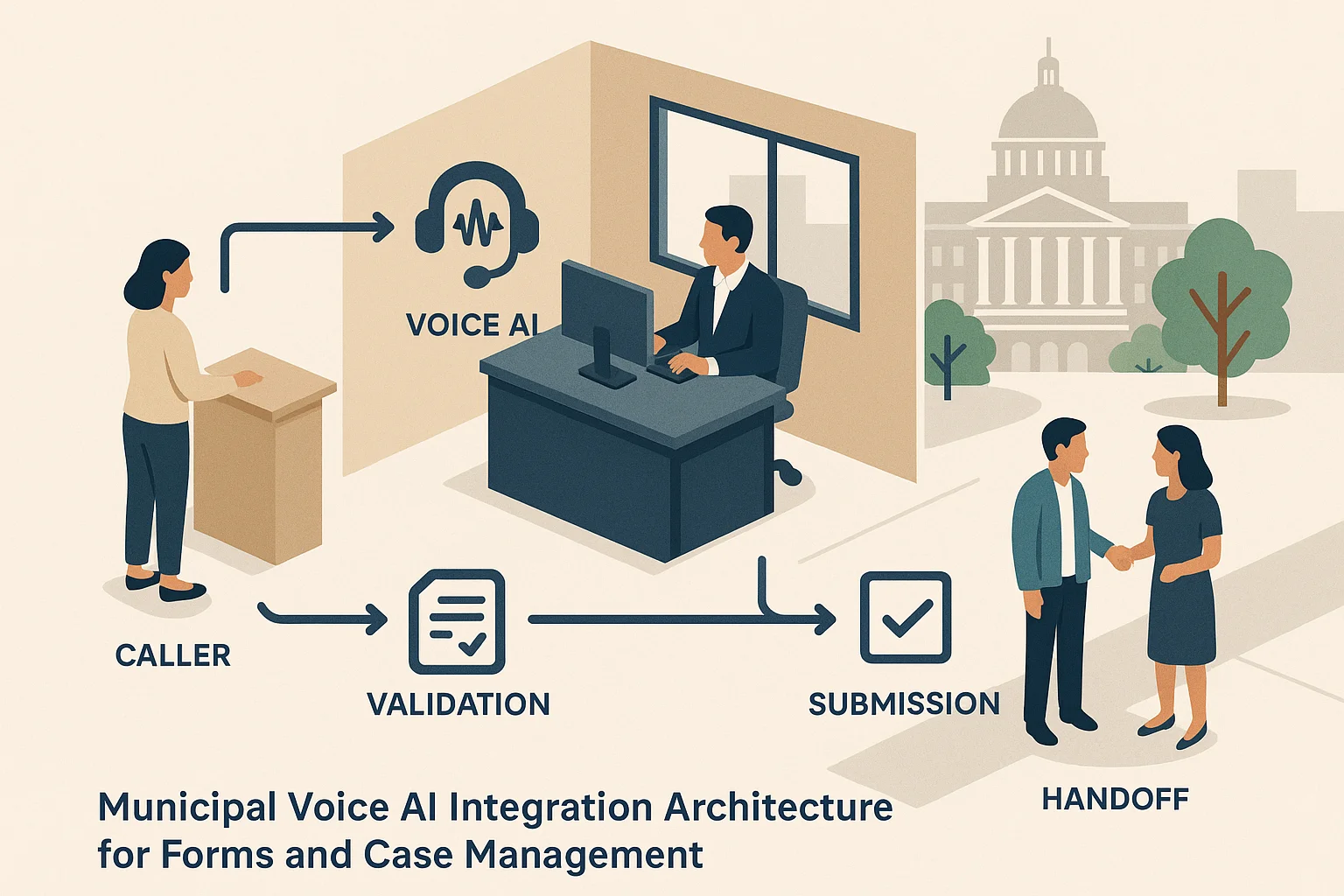
This architecture treats Voice AI as the front door for resident interactions. The logical flow is: Resident → Voice AI (speech capture, NLU) → Logic bridge → Form and field retrieval (dynamic forms) → Field‑level validation and duplicate checks → Municipal case system (create/update) → Confirmation or human handoff. Dynamic forms let the same Voice AI surface different fields per service type (e.g., potholes, noise, tree maintenance) and reduce downstream rework. Peak Demand differentiation: the logic bridge is designed to fetch form schemas in real time, validate every field, and attach a machine‑readable audit trail to every case.
- Front door: capture and transcribe with timestamped audio and metadata.
- Logic bridge: orchestrates context, schema retrieval, validation, and API calls to municipal systems.
- Case system: receives a validated payload or a human‑review flag for manual completion.
Safety boundaries — what must stay with trained staff
Keep emergency response, enforcement, legal interpretation, eligibility determinations, and other high‑discretion decisions with trained human staff. The Voice AI intake should detect potential emergency language and immediately route to established emergency channels or a human operator. This boundary reduces liability and aligns with public expectations for accountable, documented decisions.
- Implement explicit emergency detectors and a fast‑path human escalation.
- Flag any content with legal or enforcement keywords for mandatory human review.
- Do not present the Voice AI output as an authoritative determination in the final record.
2. Architecture components and the MCP role
Break the solution into discrete components with clear ownership. The MCP (Model Context Protocol) appears once here and plays a narrowly defined operational role.
Component map: front end, logic bridge, forms, case system
Key components and responsibilities: (1) Voice front end — telephony/VoIP + STT + accessibility features; (2) Logic bridge — session context, schema retrieval, validation, duplicate detection, and API orchestration; (3) Dynamic forms store — canonical schemas and field definitions; (4) Municipal case system — the authoritative record (CRM/311/CMS). The logic bridge enforces validation and writes either a validated record or a review task.
- Front end captures confidence scores, audio, and metadata for every interaction.
- Dynamic forms store defines required fields, allowed values, and conditional logic.
- Logic bridge applies business rules and issues API requests to the case system.
MCP: Model Context Protocol — concrete role
Model Context Protocol (MCP) is a lightweight, auditable contract that carries the exact model prompt, allowed retrievals, permissible API calls, session variables, and expiration for an interaction. MCP's concrete functions: (a) limits the model’s knowledge of municipal private data by providing only the fields needed for a particular form; (b) timestamps and signs the context for auditability; (c) offers a deterministic way to recreate the prompt context for QA and incident review. Treat MCP as operational metadata, not as a governance standard—it makes every inference reproducible.
- MCP contains schema IDs, redaction rules, and permitted downstream endpoints.
- Store MCP entries with case records for audit and QA sampling.
- Rotate and revoke MCP tokens when a model or integration changes.
3. End‑to‑end workflows: validation, duplicate control, and confirmation
Concrete workflow patterns that minimize rework and ensure cases are actionable on first write.
Intake and deterministic field validation
Validation must occur at the field level before case creation. Convert speech to structured values (dates, addresses, permit numbers) and validate against permitted formats and authoritative sources (address database, permit registry). If confidence is low, the logic bridge should either: (a) ask a short clarification question, or (b) create a review task with the partial record and attach the audio and confidence scores. Log every validation decision and store the associated MCP entry.
- Validate addresses against the municipal address index or geocoding API.
- Use deterministic parsers for dates, times, and numeric fields rather than free‑text extraction where possible.
- Record STT confidence and model confidence for each field for downstream QA.
Duplicate detection and case creation
Apply deterministic and probabilistic duplicate checks using address, date/time window, and complaint type. If a match exceeds a duplicate threshold, link to the existing case and update history rather than creating a new ticket. If ambiguity remains, present options to the human reviewer. Include a canonical confirmation number whenever a new case is created; if linking to an existing case, return the existing confirmation number and state the resolution path to the resident.
- Deterministic rules first (exact address + same category within X days).
- Probabilistic checks for similar free‑text descriptions with human review triggers.
- Always return a confirmation number or existing case ID to the resident.
4. Routing, escalation, and exception handling
Design precise routing rules, human‑in‑loop thresholds, and explicit exception flows so staff can focus on value‑add decisions.
Automated routing and escalation matrix
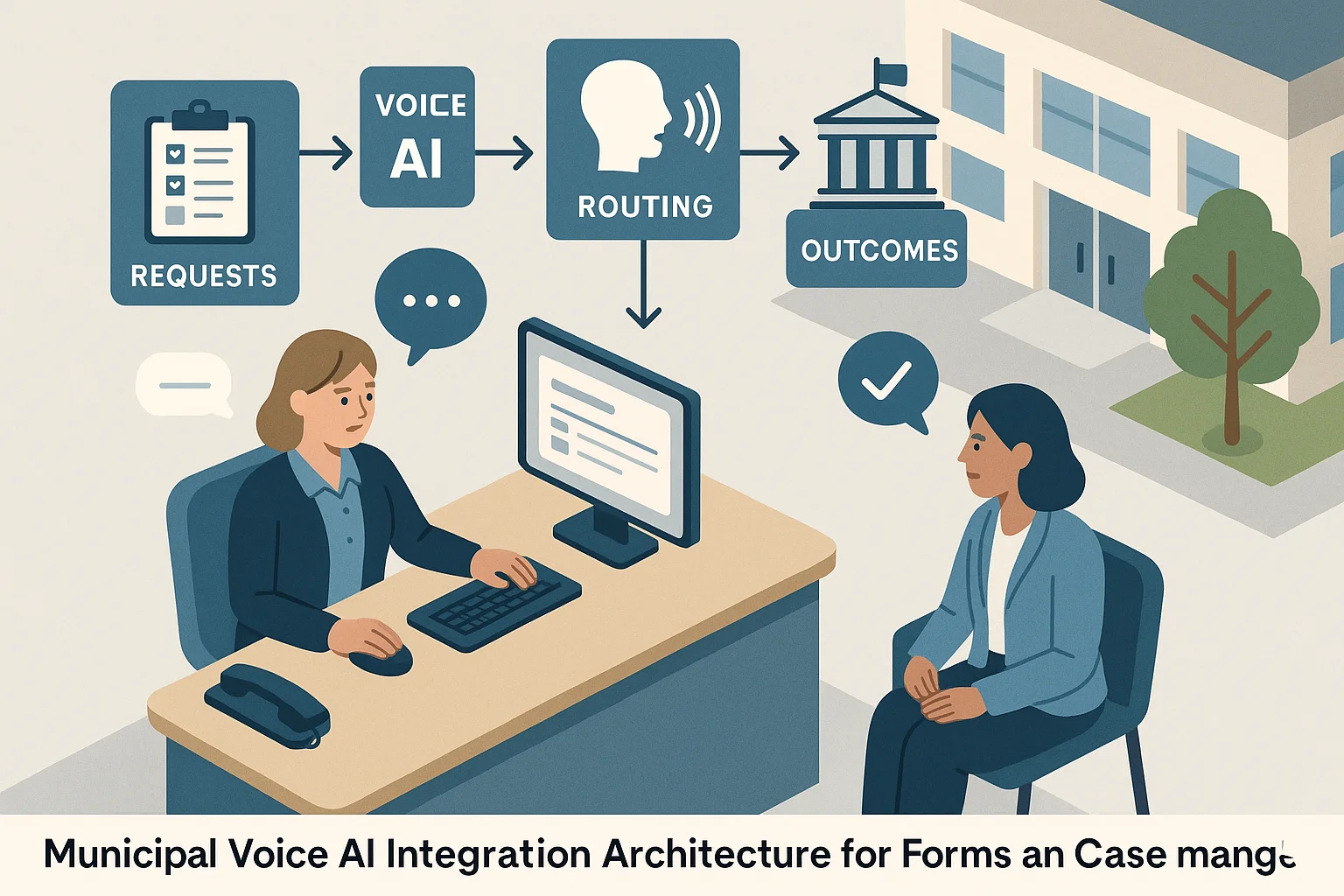
Define routing rules by service type, priority, geography, and agent skill. For high‑priority or low‑confidence calls, escalate immediately to on‑shift staff. Build a routing matrix that includes SLA targets for initial human contact and maximum auto‑handling error budgets. Ensure the logic bridge logs routing rationale so managers can audit why a case went to a particular team.
- Priority classification (e.g., emergency, urgent, routine) must be explicit and defensible.
- Escalate when STT or field confidence falls below thresholds or when legal/enforcement keywords appear.
- Log routing decisions and make them queryable in dashboards.
Exception handling and human review
Exceptions should create a clear review task with audio, transcript, confidence scores, and MCP context. Define SLA for human resolution of exceptions and a feedback loop to update parsers and prompts. For repeated failure modes, trigger a design review of the flow or the underlying form schema.
- Bundle all exception artifacts (audio, transcript, metadata) into a single case task.
- Track time‑to‑resolve for exceptions and categorize failure modes.
- Use exceptions as inputs to model prompt revisions and form schema changes.
5. Operations, QA, and measurable outcomes
Translate architecture into day‑to‑day operations: ownership, QA cadence, observability, and KPIs.
Roles, operating ownership, and SLAs
Assign clear ownership across vendor and municipal teams: vendor — STT quality, uptime, and model maintenance; municipality — form schemas, case system authority, and final decisions. Define SLAs for availability, first‑contact resolution for automated flows, and time‑to‑human‑review for exceptions. Include SLOs for acceptable error rates and an error budget that, when exceeded, triggers rollback to manual intake.
- Create a RACI that lists each component owner for availability, security, and data retention.
- Define a runbook for incidents affecting intake quality or case accuracy.
- Use an error budget to balance innovation vs. operational risk.
QA, sampling, and observability
Implement continuous QA with stratified sampling: sample across service types, geographies, times, and low‑confidence interactions. Metrics to track: validated fields per call, field‑level confidence distribution, duplicate rate, human intervention rate, time to case creation, and resident confirmation receipt rate. Instrument end‑to‑end traces so an incident can be reconstructed from audio to case write.
- Use field‑level KPIs rather than only call‑level metrics.
- Monitor drift in model outputs and validation failures; schedule retraining or prompt updates.
- Expose dashboards for operational managers and an audit export for accountability.
Continuous improvement and feedback loops
Integrate human review corrections into the logic bridge: corrected field values should seed deterministic parsers and influence intent handling. Maintain a prioritized backlog of prompts, schema changes, and integrations arising from exceptions.
- Close the loop from exception outcomes to schema evolution.
- Use A/B testing for prompts and measure effect on validation rates.
- Hold regular cross‑functional reviews of exceptions and KPIs.
6. Procurement, deployment, and data boundary clauses
Practical procurement and deployment language reduces ambiguity around hosting, subprocessors, and breach responsibilities.
Procurement considerations and contract language
Contracts must specify hosting region and backup region, subprocessors (and right to object), remote‑support access procedures, retention limits for audio/transcript, recording consent obligations, breach notification timelines, and SLOs for availability and response. Require auditable logs for model inputs and MCP entries, and include acceptance testing for integration scenarios (exact address validation, duplicate linking, emergency detection).
- Specify hosting region and backup region, and require notification of new subprocessors.
- Include acceptance tests that simulate low‑confidence and emergency scenarios.
- Define breach notification timelines and roles for incident response.
Deployment architecture, data flows, and residency concerns
Document data flows (audio capture → temporary STT buffer → logic bridge → case system) and identify transfer mechanisms (TLS, VPN). Explicitly list data residency requirements, cross‑border transfer mechanisms, backup geography, and processor locations in the procurement schedule. Treat recordings and transcripts as potentially sensitive: collect consent at the start of the call, expose a simple opt‑out route, and define retention windows and archival policies. Organizations should confirm specific legal obligations with qualified counsel.
- Map every data element, its residency location, and any onward transfers to subprocessors.
- Require encryption in transit and at rest, and strict access controls for audio stores.
- Publish retention schedules and expose mechanisms for data deletion requests, subject to legal holds.
Managed service vs. self‑hosted tradeoffs
Managed services speed deployment and provide operational expertise; self‑hosted solutions give tighter control over data residency and subprocessors. Evaluate vendors on support for dynamic forms, API integration maturity, MCP auditable context, QA tooling, and clear SLAs for availability and error budgets.
- Require demonstration of dynamic form retrieval and field‑level validation in procurement pilots.
- Evaluate vendors for API integration experience with municipal CRMs/311 systems.
- Assess the vendor’s ability to attach MCP entries and model inputs to every case.
Related Peak Demand resources
Industry and AI sources reviewed
- Artificial Intelligence Risk Management Framework (AI RMF 1.0)National Institute of Standards and Technology (NIST)
- Cross-Sector Cybersecurity Performance GoalsCybersecurity and Infrastructure Security Agency (CISA)
- Algorithmic Impact AssessmentGovernment of Canada
Privacy, telecommunications, recording-consent, cybersecurity, consumer-protection, employment, and records obligations vary by jurisdiction and use case. This article is operational guidance, not legal advice; organizations should confirm applicable requirements with qualified professionals.
Frequently asked questions
Suitable workflows include structured resident inquiries, service-request intake, permit or program information, appointment scheduling, department routing, status updates from approved systems, and after-hours overflow. Adjudication, enforcement discretion, emergency response, and binding eligibility decisions should remain with authorized staff.
Official reference: Artificial Intelligence Risk Management Framework (AI RMF 1.0)
Use a controlled service catalogue, required fields, department ownership rules, validation, duplicate checks, confirmation numbers, and documented handoff paths. The system should create an auditable record and avoid silently dropping requests when a downstream system is unavailable.
Official reference: Algorithmic Impact Assessment
Municipal deployments should document purpose, affected services, data use, human oversight, complaint and appeal paths, accessibility channels, records handling, monitoring, and the process for approving material changes.
Official reference: Algorithmic Impact Assessment
Require workflow demonstrations, integration and security architecture, testing evidence, auditability, data-location and subcontractor details, incident response, accessibility support, human escalation, exit planning, and clear ownership of ongoing updates.
Official reference: Artificial Intelligence Risk Management Framework (AI RMF 1.0)
Turn Voice AI infrastructure into a managed enterprise operation
Peak Demand designs, integrates, deploys, monitors, and improves Voice AI systems across customer service, enterprise systems, governance, escalation, and reporting.
Schedule a discovery call


