
Model Risk, Data Contracts & Change Control for Health System Voice AI
Practical operational guidance for patient-access teams: how to manage Voice AI model risk, design data contracts, and run disciplined change control for safe scheduling, identity verification, and escalation.
1. Use case and recommended operating model
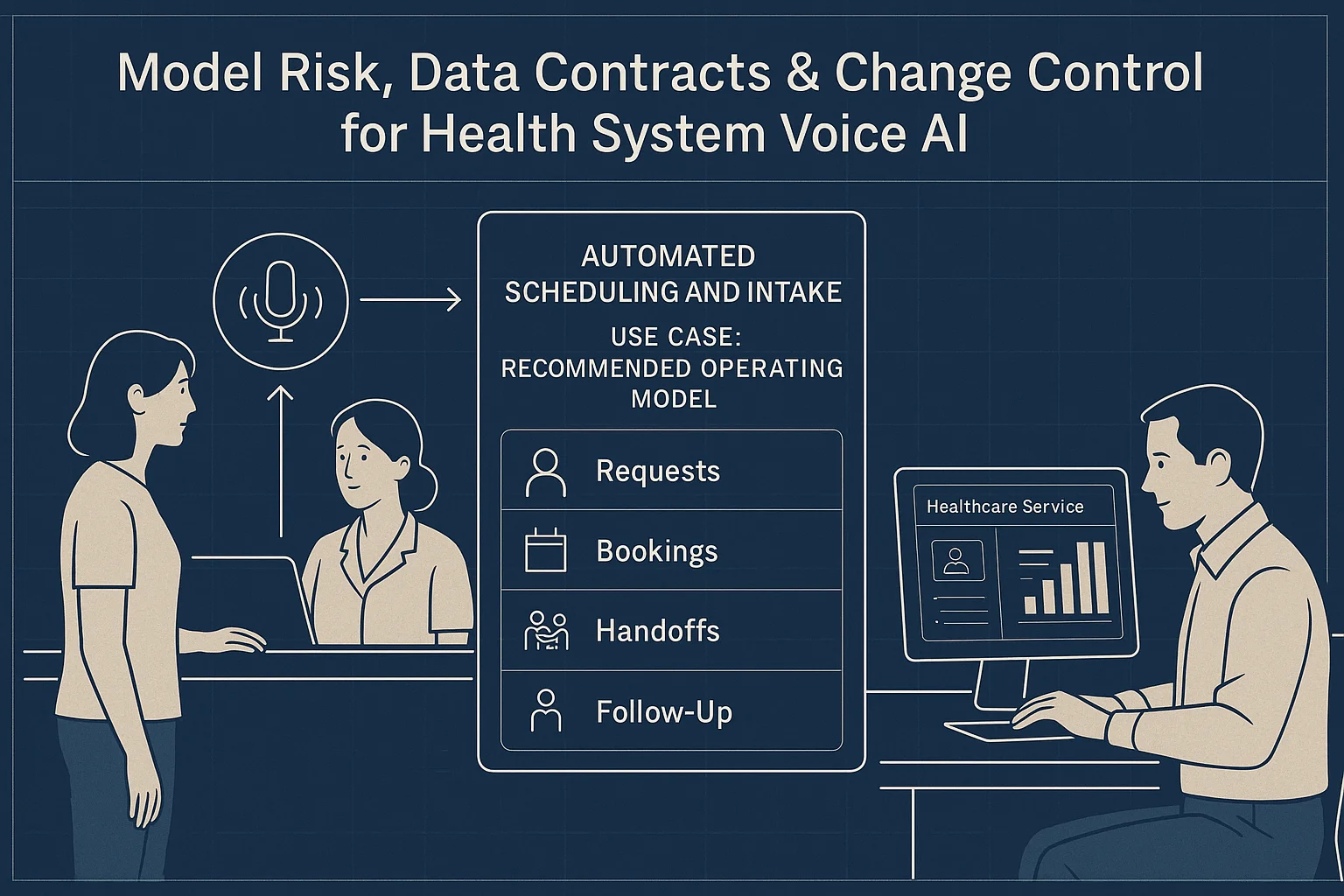
A precise, bounded Voice AI deployment improves patient access and scheduling while preserving safety and compliance. The model below is intentionally administrative: booking, rescheduling, basic intake, identity verification, and routing. It excludes clinical decision-making and emergency triage.
Use case: automated scheduling and intake
Target calls: appointment requests, rescheduling, appointment confirmations, basic pre-registration (collecting demographics and consent to record), and routing to specialty lines. Key operating goals are: reduce avoidable hold times, increase fills for available slots, and ensure auditable consent and identity verification for phone-based actions.
- Scope to administrative tasks only—avoid clinical advice or triage.
- Capture explicit consent for recordings and data processing at call start where required.
- Record audited events for every customer-facing change (appointment booked, rescheduled, cancelled).
Recommended architecture (caller → approval → handoff)
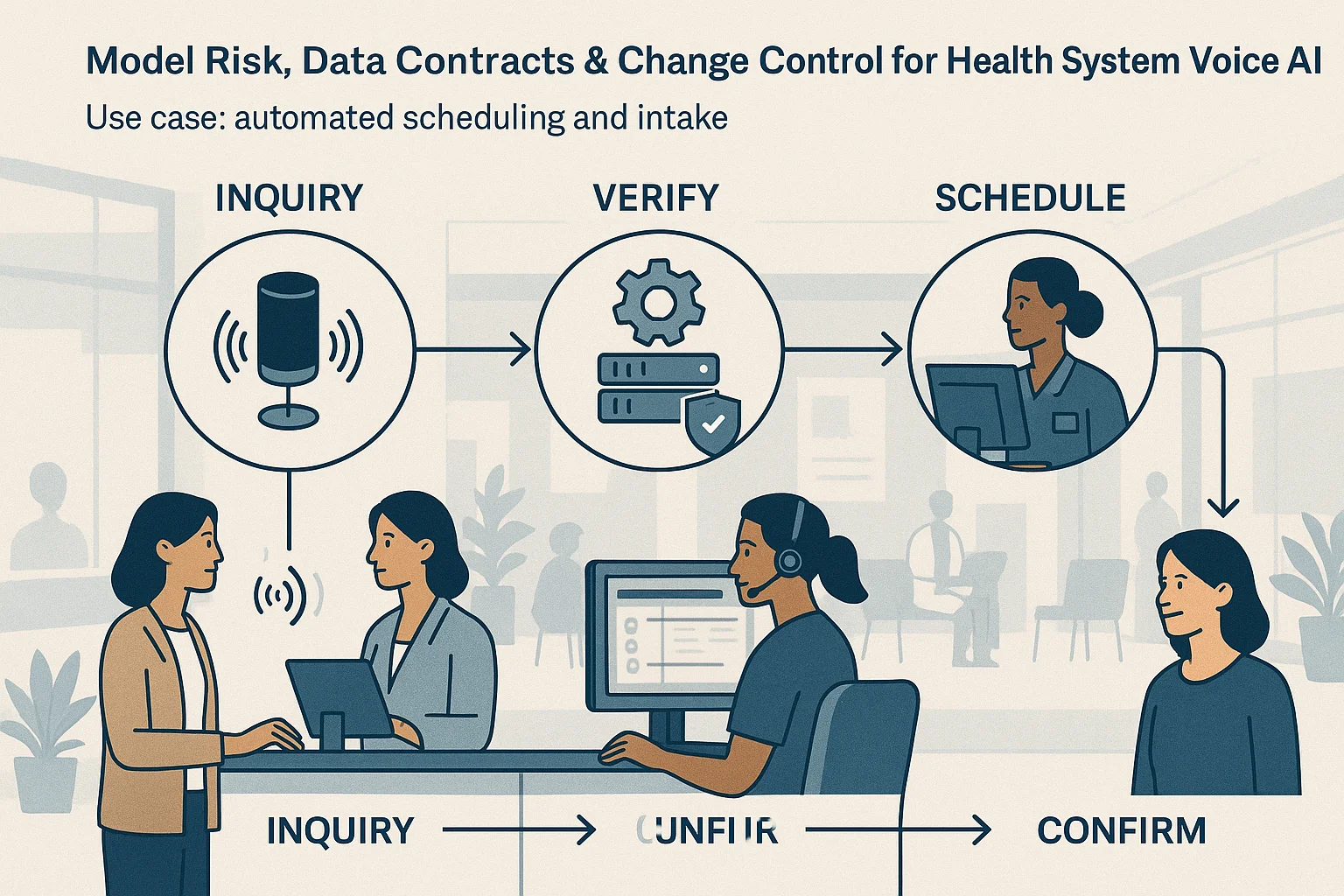
A minimal-safe architecture separates conversational intelligence from authoritative business actions: Caller → Voice AI (NLP + dialog manager) → Identity & field validation layer (match to patient record, MFA where required) → Approved scheduling/service API → Confirmation or human handoff. The Voice AI can collect intent and structured data, but the scheduling API is the source of truth and must enforce authorization, slot availability, and idempotency.
- Voice AI should return structured payloads (patient ID, desired date/time, location, consent flag) rather than performing direct writes.
- Validation layer performs record match, appointment slot lock, and last-mile write via a controlled adapter to EHR/PM or scheduling engine.
- All write actions must generate signed audit events (actor, timestamp, payload hash, version) stored in an immutable or append-only log.
2. Model risk: what to expect and how to contain it
Voice and language models introduce characteristic risks: misinterpretation, hallucination (fabricated facts), and confidence miscalibration. For healthcare patient-access use cases, these risks are operational rather than clinical, but must still be strictly controlled.
Failure modes and safety boundaries
Design the system so model failures remain contained within administrative tasks. Explicitly prohibit models from diagnosing, prescribing, triaging emergencies, or overriding clinical staff. Define a compact escalation surface for anything outside scripted administrative flows: ambiguous intent, low-confidence slots, conflicting patient data, or expressions of urgent clinical need must trigger immediate human review or transfer.
- Design deterministic prompts and limited-domain NLU for scheduling to reduce hallucination.
- Introduce confidence thresholds that require human intervention when not met.
- Implement explicit utterance patterns that immediately map to 'urgent clinical' and force a human transfer.
Mitigations: detection, containment, and feedback
Combine technical detection (confidence scores, semantic anomaly detection) with operational controls (human-in-loop, audit sampling, closed-loop QA). Maintain a prioritized list of failure signatures (e.g., mismatched patient name and date-of-birth, implausible appointment times) and create automated containment actions—re-prompt, escalate, or place on-hold for human callback.
- Run shadow tests against live traffic before authorizing writes—compare model intent to human intent.
- Log model metadata (version, prompt template, confidence) with every structured payload so you can trace and reproduce decisions.
- Use routine review cycles where clinicians and access staff sample transcripts and flag misclassifications for model or rule updates.
3. Data contracts: the foundation for safe integrations
Data contracts are non‑negotiable when Voice AI touches patient records or scheduling systems. They lock expectations between components and form the basis for compliance, observability, and operational stability.
What a data contract must include
A contract is more than a schema. It should declare: canonical field names and types, required and optional attributes, acceptable value ranges, PII classification, consent flags, retention and purge policies, residency and replication geography, permitted processors/subprocessors, and error semantics (e.g., conflict codes, retry windows).
- Explicitly define patient identifiers (what constitutes a canonical match) and the matching algorithm/version used.
- State retention timelines for transient speech transcripts vs. authoritative appointment records.
- Declare whether transcripts may leave hosting region for processing, and specify transfer mechanisms and subprocessors.
Practical implementation pattern
Implement contracts as machine-checkable API schemas plus human-readable policy documents. Use an adapter layer (controlled connector) between the Voice AI and scheduling system that enforces the contract: field validation, residency checks, consent verification, and event signing. Store an immutable call-and-event log tied to the contract version and model version.
- Validate inbound payloads against a versioned JSON schema; reject or quarantine nonconforming records.
- Record contract version, API adapter id, and vendor-subprocessor list with each transaction for auditability.
- Automate periodic contract compliance checks and require a formal change-control request for any contract updates.
4. Change control, model governance and observability
Model and contract changes must be managed like software releases. A lightweight but enforceable control plane prevents surprise model drift and ensures accountability across vendor and internal teams.
Versioning, testing, and rollout strategy
Treat model and prompt changes as releases: code review, staging, and controlled rollouts. Required steps include unit tests for NLU intents, shadow evaluation on production traffic, canary routing to a fixed percentage of calls, and automatic rollback triggers when key metrics degrade.
- Maintain immutable version identifiers for model weights, prompt templates, and adapter code.
- Run shadow runs for a minimum evaluation window that covers peak and off-peak call patterns.
- Define objective rollback criteria (e.g., spike in human escalations, unexpected confidence drop, increased scheduling errors).
Observability and audit trails
Instrument every step: audio capture or summary (per consent), NLU transcripts, structured payloads, confidence scores, adapter validation outcomes, API call responses, and human interventions. Correlate these artifacts to monitor model drift, root causes, and performance against SLAs.
- Store event logs with tamper-evident properties (signed hashes or append-only storage).
- Expose dashboards for operational KPIs (call containment, escalations, booking success rate) and for governance metrics (model versions in production, subprocessor changes).
- Schedule routine audits where legal, privacy, clinical, and access teams review annotated transcript samples.

5. Operational controls: identity, validation and safe escalation
Administrative phone actions require robust identity and validation controls to prevent incorrect modifications to records and to meet privacy obligations.
Identity verification and field validation
Use multi-factor or knowledge-based checks tied to the data contract. The verification layer should perform an authoritative match (patient ID, DOB, last appointment) and apply a risk score. For higher-risk changes (cancellation, reschedule to new provider), require a second verification step or human approval.
- Avoid relying solely on voice biometrics unless you have validated accuracy and legal clarity for the jurisdictions involved.
- Implement session-level tokens so the Voice AI cannot directly perform writes without a validated token from the adapter.
- Log verification outcomes with time and method (MFA, knowledge-based, callback confirmation).
Escalation flows and human handoff
Design crisp escalation channels: immediate warm transfer for urgent or ambiguous calls, queue-based callback for non-urgent human review, and tagged email/SMS notifications for failed transactions. Ensure the human agent sees model context (transcript snippets, confidence scores, decision trace) to speed resolution.
- Provide agents with an 'explain' panel that shows the model’s structured intent, confidence, and any conflicting data.
- Capture agent remediation actions as discrete events for QA and model retraining.
- Set maximum automated-handling time thresholds; exceed the threshold and force handoff.
6. Procurement and contract terms that reduce risk
Procurement is an operational control. Contracts must require transparency and operational commitments that allow health systems to meet regulatory, privacy, and continuity obligations.
Vendor capabilities and vendor selection criteria
Prefer vendors that offer: controlled integration adapters (not unmanaged direct writes), visibility into model and subprocessor changes, audit logs, and configurable residency/retention options. Evaluate the vendor’s ability to support identity verification, field validation, and safe escalation out-of-the-box or via supported connectors.
- Verify the vendor’s standard integration pattern matches your required adapter model—ask for architecture diagrams and sample event logs.
- Request evidence of operational QA practices, model-change processes, and sample runbooks for incident response.
- Confirm whether the vendor supports local hosting or regionally constrained processing if required by policy.
Contract clauses to insist on
Include explicit clauses for: model-change notice periods, subprocessor disclosure, rollback and remediation obligations, audit rights, data residency and deletion commitments, and SLAs for model-related incidents (e.g., elevated error rates). Require end-to-end traceability from call to final write and rights to access logs for inspections.
- Add a clause that model or prompt changes that impact safety must provide a pre-production test window and the right to block or delay.
- Require subprocessors and transfer mechanisms to be disclosed and updated in writing within a defined window.
- Define minimum acceptable audit artifacts and retention windows to satisfy your compliance reviewers.
7. Implementation checklist and KPIs for ongoing assurance
A concise checklist helps translate governance into operations. Pair each checklist item with measurable indicators you will monitor.
Pre-launch checklist
Before go‑live ensure: legal/privacy sign-off on consent language; deployed and tested adapter enforcing the data contract; identity verification flow validated; shadow testing completed; human escalation workflows staffed and rehearsed; and monitoring dashboards in place.
- Confirm call recordings and transcripts meet consent and retention requirements.
- Complete at least one full rehearsal with live staff simulating escalations.
- Document rollback criteria and test the rollback process.
Operational KPIs to track
Key indicators include: automated containment rate (percent of calls fully handled by Voice AI), human escalation rate and reasons, booking success rate post-validation, error and reconciliation incidents, model version drift indicators (confidence & intent distribution changes), and time-to-detect and time-to-remediate for model-related failures.
- Tie QA sampling rates to call volume and risk profile; increase sample rates for higher-risk workflows.
- Monitor long-term trends for intent distribution shifts that could indicate drift or changes in caller behavior.
- Use closed-loop analytics to ensure operational metrics map back to business outcomes (fill rate, patient satisfaction).
Related Peak Demand resources
Industry and AI sources reviewed
- Ethics and governance of artificial intelligence for healthWorld Health Organization
- Artificial Intelligence Risk Management Framework (AI RMF 1.0)National Institute of Standards and Technology (NIST)
- Regulatory considerations on artificial intelligence for healthWorld Health Organization
Healthcare privacy, security, clinical-safety, records, and professional obligations vary by jurisdiction and workflow. This article is operational guidance, not legal advice; organizations should confirm applicable requirements with qualified professionals.
Frequently asked questions
Administrative workflows such as appointment booking, changes and cancellations, referral-status intake, approved follow-up, patient-access questions, after-hours overflow, and structured routing are common starting points. Clinical judgment, diagnosis, emergency triage, and prescribing decisions must remain with qualified professionals.
Use the minimum identifiers approved by the organization, validate them against the system of record, avoid exposing unnecessary information, and provide a human-assisted path when verification fails. The system should not infer identity from conversational context alone.
The agent should follow the organization's approved escalation and emergency-routing rules, avoid clinical advice, and transfer or direct the caller to the appropriate human or emergency channel. Those rules must be tested with realistic language and failure cases.
Request identity and privacy controls, scheduling or EHR integration behavior, audit logs, escalation rules, downtime handling, testing evidence, change control, monitoring, and clear separation between administrative automation and clinical decision-making.
Design a safe patient-service workflow before automating it
Peak Demand helps healthcare organizations connect Voice AI to scheduling, intake, patient communication, identity checks, escalation, and reporting with clear operational boundaries.
Schedule a discovery call


