
Measuring Voice AI Completion Quality in Manufacturing Operations
A practical guide for manufacturing leaders: measure containment, escalation quality, cost-to-serve, and multisite scale when deploying Voice AI for parts, service, warranty, and field support.
1. Why completion quality matters in manufacturing
Manufacturing and distributor service teams need reliable measures of what Voice AI actually accomplishes for customers and technicians. Completion quality links operational savings with risk controls: containment reduces cost‑to‑serve, while high‑quality escalation protects warranty, safety, and revenue.
Business outcomes and operating boundaries
Completion quality distinguishes tidy self‑service (order status, basic troubleshooting, parts lookup) from partial attempts that require rework. For manufacturers, the most valuable outcomes are: accurate parts and order intake, validated warranty eligibility, correct technician dispatches, and minimized repeat calls. Define operational boundaries up front — which decisions are acceptable for automation (e.g., order status, basic diagnostics), and which always require human review (e.g., warranty approval, safety‑critical engineering triage).
- Map voice outcomes to business processes: part order, RMAs, field dispatch, warranty intake, technical escalation.
- Tag actions as automated, assisted (human validation required), or blocked (manual only).
- Align KPIs with functional owners: service operations owns containment, quality owns escalation validation, IT owns integrations and security.
Where completion quality sits in the measurement lifecycle
Completion quality is in the Measurement, Optimization, and Scale stage: measure intent accuracy for each call path, validate product/part identification, track containment rate and the cost delta between resolved vs escalated interactions, and loop results back into models and call flows.
- Measure resolution rate and containment separately from intent accuracy — a resolved but incorrect self‑service outcome is worse than an early escalation.
- Instrument every handoff with deterministic events so you can compute containment quality and handoff failure rates.
- Use data to prioritize call flows for retraining, script changes, or additional human checks.
2. Core metrics: what to measure and how to compute it
Define a compact metric set so teams can act. Avoid vanity metrics; tie measurements directly to costs, SLAs, and risk thresholds.
Essential KPIs
Track these primary measurements for each call flow and across product lines:
- Containment rate: percent of calls fully resolved by Voice AI without human handoff (requires deterministic validation against post‑call events).
- Containment quality: percent of contained calls that were correct — verified by sampling or downstream confirmation (e.g., correct part shipped, no repeat call within.
- Escalation quality: percent of handoffs that include complete context, validated intent, product mapping, and a recommended action—measured by first‑touch resolution post‑handoff.
- Intent accuracy: model classification accuracy against labeled ground truth for each intent type (parts, status, fault, warranty).
- Cost‑to‑serve differential: average service cost for contained vs escalated calls (includes labor, parts, dispatch, and rework).
Practical measurement design
Implement deterministic instrumentation. Each call should emit an immutable event trail: call-id, detected intents, product SKUs or part numbers, validation checks, API lookups and responses, handoff token, and final disposition. These events enable reliable computation of containment quality, latency, and cost attribution.
- Use unique identifiers across telephony, voice AI, and backend systems to reconcile transactions.
- Capture validation status when the Voice AI queries ERP/CRM/warranty APIs (e.g., part exists, warranty eligible) rather than only acoustic intent.
- Define a 'resolution anchor' — an outcome that represents closure (e.g., order number issued, dispatch ticket created).
3. Integration and architecture patterns
Successful measurement depends on reliable integrations. The canonical operating model for manufacturing service looks like: Caller → Voice AI → intent & product validation → ERP/CRM/warranty/service API → case, order, or specialist handoff.
Canonical flow and implementation choices
Implement the flow with controlled adapters that translate Voice AI outputs into backend queries: intent and extracted entities (customer ID, asset serial, part number) are validated via API calls to ERP, CRM, or service management systems before the Voice AI confirms resolution. For manufacturers using Microsoft Business Central and field service, review integration patterns that support deterministic lookups, webhook eventing, and secure tokens.
- Prefer query‑then‑confirm patterns: query ERP/CRM for part existence and pricing before confirming to the caller.
- Keep voice dialogs idempotent and referenceable via transaction IDs for audit and reconciliation.
- Use standard APIs and webhooks where possible; add lightweight adapters for legacy ERP or on‑prem systems.
OT, network, and security boundaries
Voice AI must not be treated as a direct interface to operational technology or plant control systems. Enforce clear segmentation: Voice AI integrates to business systems (ERP, CRM, service) through hardened application layer APIs and adapters. Remote support tools and vendor access should be limited to preapproved channels, with documented subprocessors, hosting regions, backup regions, and retention policies.
- Host voice service connectors in zones separate from OT; use read‑only queries to business systems for validation when possible.
- Require documented subprocessors and cross‑border transfer mechanisms from vendors; include retention, recording consent, and breach notification terms in procurement.
- Limit remote‑support access to specific maintenance windows and documented justification.

4. QA workflows, human‑in‑loop controls, and escalation safety
Quality assurance must be operationalized. Build a QA fabric that couples sampling, automated checks, and human validation for sensitive decisions.
Operational QA and sampling
Define sampling rules that prioritize high‑risk outcomes: warranty claims, safety‑related faults, high‑value parts, and first‑time callers. Combine automated rule checks (e.g., part lookup mismatch) with random and targeted human review. Maintain annotation guidelines and a clear feedback loop into training data and call‑flow scripts.
- Sample 100% of warranty‑eligible outcomes until containment quality is proven acceptable by stakeholders.
- Log annotations and decisions with timestamps and reviewer IDs for auditability.
- Use error taxonomies (intent misclassification, entity error, backend mismatch, confirmation error) to triage fixes.
Escalation controls and warranty/safety boundaries
Escalation is a control point, not a failure state. Ensure every handoff packages verification tokens, API validation results (e.g., warranty eligibility), and a concise summary for the specialist. Explicitly prohibit automated warranty approvals or safety decisions without human sign‑off. Define SLA targets for specialist callbacks and first‑touch resolution.
- Send a machine‑readable event with context (customer ID, asset, suggested action, supporting data) to reduce specialist triage time.
- Require human approval for RMA issuance, warranty exemption, and engineering changes.
- Measure escalation quality by first‑touch resolution and specialist rework rates.

5. Scaling across sites and multilingual operations
Manufacturing supply chains and service networks are global. Scale deliberately: standardize call flows, then localize intent models, lexicons, and parts mappings per site or region.
Multisite deployment patterns
Adopt a template‑and‑variant approach: core call flows and validation logic are standardized, while site variants handle localization of parts catalogs, service partners, and regulatory requirements. Track metrics by site and product family to detect drift and prioritize retraining or business rule updates.
- Use centralized governance for model versions, call flows, and observability, but allow site‑level overrides for catalog entries and routing.
- Maintain a versioned parts catalog per site with canonical identifiers to reconcile cross‑site SKUs.
- Instrument per‑site containment quality so local issues aren't masked by global aggregations.
Multilingual accuracy and parts identification
Language coverage must include domain lexicons (part codes, model names, serial patterns). For multilingual operations, validate entity extraction per language and locale with labeled test sets and real‑world sampling. Use grammar‑aware confirmation prompts for critical entities like part numbers and serials.
- Build language models with explicit training on your product names, abbreviations, and local dialects.
- Confirm noisy extractions using dual‑factor validation: spoken confirmation plus an API match to ERP/parts database.
- Measure multilingual containment quality separately and track repeat contacts by language.
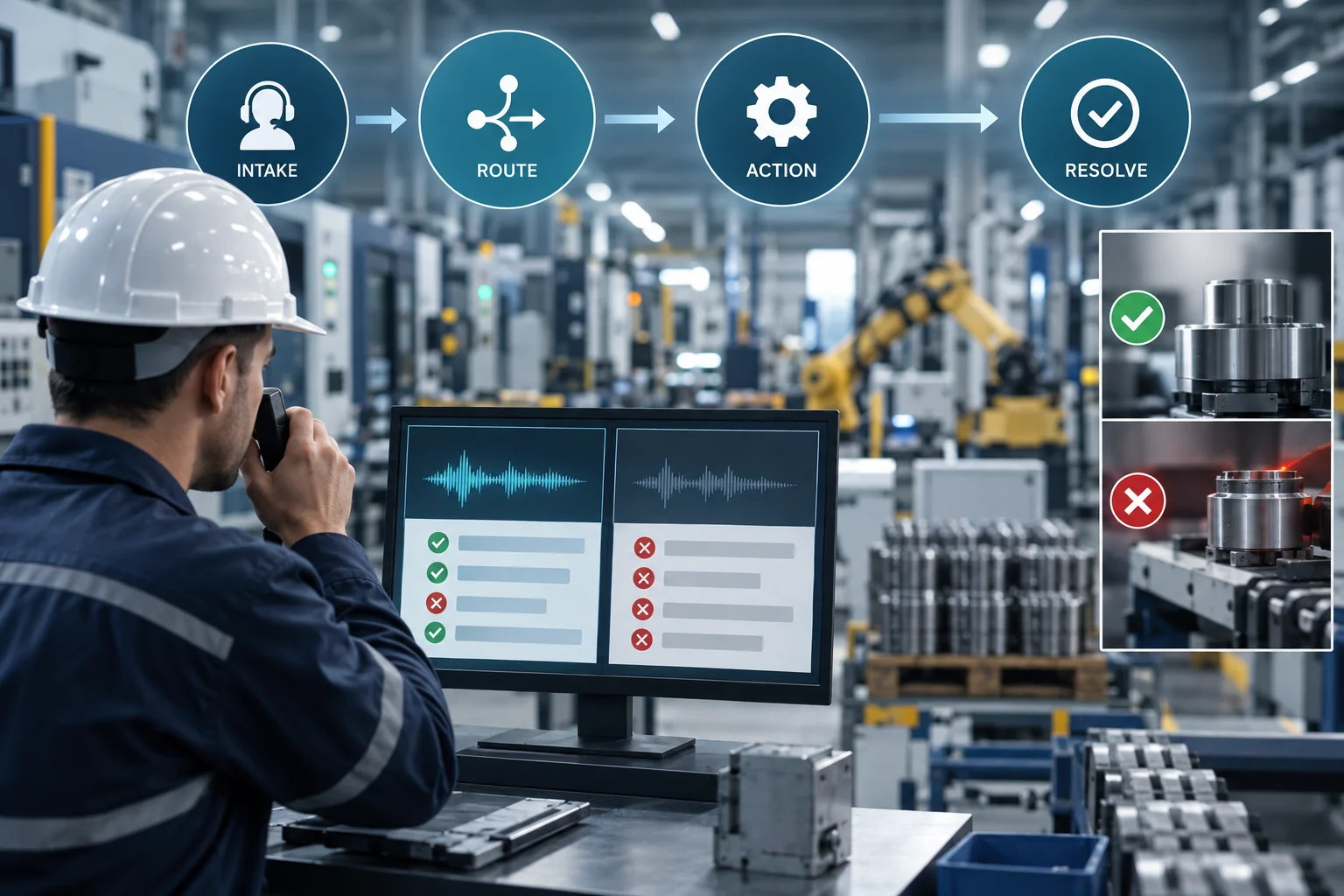
6. Cost‑to‑serve, procurement controls, and continuous optimization
Quantify the economic impact of containment and poor escalations. Procurement and ongoing management must require deliverables for observability, SLAs, and security.
Mapping containment to cost
Compute cost‑to‑serve by modeling average resolution cost for contained interactions versus escalated ones, including labor, parts, dispatch, and rework. Use measured containment quality (correctness) to adjust realized savings. Track repeat contacts and warranty reversals as cost leakage.
- Instrument direct cost components (agent time, technician dispatch) and indirect (delays, warranty adjustments).
- Adjust business cases for containment improvements using conservative estimates of error rates and rework.
- Report both gross containment and net accurate containment to finance and service leadership.
Procurement evidence and vendor deliverables
Require vendors to provide: event‑level observability, schema for validation events, documented adapters for ERP/CRM, proof of multilingual training on your lexicon, subprocessors list, hosting regions and backup regions, retention rules, and documented support access procedures. Include penalties or remediation steps for service degradations that impact safety or warranty outcomes.
- Ask for a measurable onboarding plan with acceptance criteria for containment quality and intent accuracy.
- Insist on human escalation workflows and controls in contract language; prohibit vendor‑only decision rights for warranty and safety cases.
- Require evidence of change management for call‑flow updates and model changes, including rollback capability.
Related Peak Demand resources
Industry and AI sources reviewed
- Guide to Operational Technology SecurityNational Institute of Standards and Technology (NIST)
- Cybersecurity Resources for ManufacturersNIST Manufacturing Extension Partnership
- Cross-Sector Cybersecurity Performance GoalsCybersecurity and Infrastructure Security Agency (CISA)
Manufacturing cybersecurity, operational-technology, product, warranty, records, and workplace obligations vary by jurisdiction and operating environment. This article is operational guidance, not legal advice; organizations should confirm applicable requirements with qualified professionals.
Frequently asked questions
Strong starting points include parts and order-status requests, distributor or dealer support, warranty and service intake, appointment scheduling, case creation, basic product information, and routing to technical specialists. Keep engineering judgment, safety decisions, and operational-technology control outside the conversational layer.
Official reference: Cybersecurity Resources for Manufacturers
The workflow should collect structured identifiers such as model, serial number, part number, customer account, asset location, and symptoms, then validate them against ERP, CRM, catalogue, warranty, or service systems. The agent should escalate rather than invent a match when confidence is low.
Official reference: Cybersecurity Resources for Manufacturers
Not by default. Customer-service automation should normally use controlled business-system integrations and tightly governed adapters. Any connection near operational technology requires explicit security architecture, least privilege, monitoring, and separation from safety-critical control functions.
Official reference: Guide to Operational Technology Security
Require workflow mapping, integration ownership, test evidence, fallback behavior, auditability, security boundaries, change control, monitoring, human escalation, and a plan for maintaining product, parts, warranty, and service knowledge after launch.
Official reference: Cybersecurity Resources for Manufacturers
Connect Voice AI to real manufacturing service operations
Peak Demand helps manufacturers automate parts, order, warranty, dealer, distributor, and service requests through controlled integrations, validation, escalation, and reporting.
Schedule a discovery call


