
Governance & Capital Strategy for Scaling Voice AI in Health Systems
Practical governance, architecture, and procurement guidance for scaling Voice AI in patient access. Covers identity controls, integration patterns, escalation boundaries, data strategy, and measurable outcomes.
1. Use case and operating model — a practical, bounded example
Start with a single, well-scoped patient-access use case. The recommended starter is appointment booking and simple intake for non-urgent administrative workflows (scheduling, rescheduling, cancellations, directions, and insurance eligibility checks). Keep clinical interactions and triage explicitly out of scope.
Operational workflow
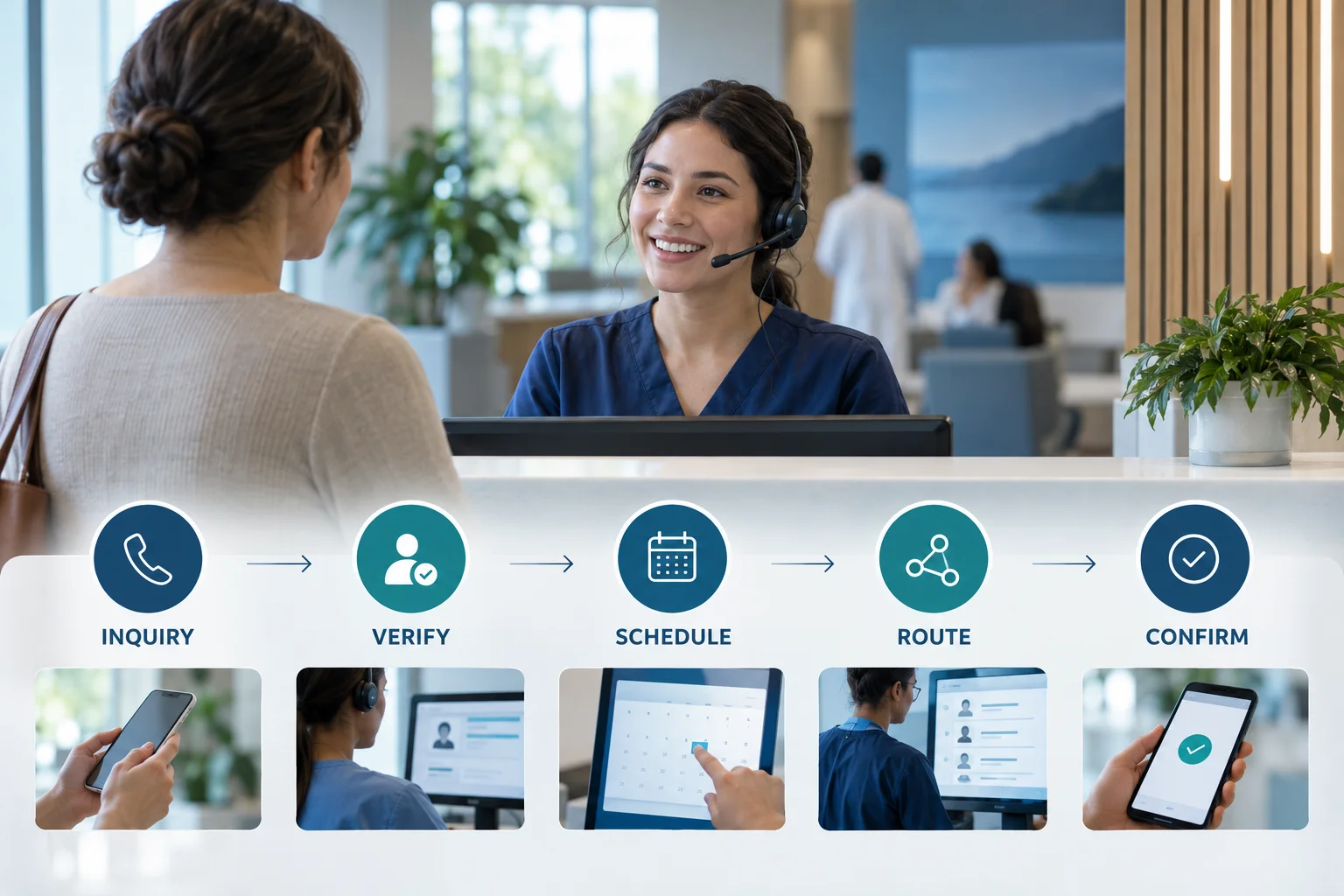
Implement a deterministic operating model with clear control points. A common architecture is: Patient or caller → Voice AI front end → validation and identity controls → approved scheduling or service API (EHR/PM adapter) → confirmation or human handoff. Each arrow is a governance gate: policy, logging, and rollback.
- Voice AI handles authentication questions, captures structured intake, and confirms next steps in scripted language.
- Validation layer enforces identity verification before any protected action (booking, record access, or cancellation).
- Scheduling/service API is the only system allowed to commit changes in the practice management system.
- Human handoff triggers when identity fails, a business-rule exception occurs, or any clinical ambiguity is detected.
Safety boundaries
Never use Voice AI to diagnose, prescribe, triage emergencies, or replace clinical judgement. Define explicit escalation triggers for words and phrases indicating clinical urgency (chest pain, shortness of breath, severe bleeding), and route those calls to trained staff or emergency services. Log the trigger, the system decision, and the handoff timestamp for audit and incident review.
- Maintain a short, auditable list of clinical trigger terms owned jointly by clinical governance and patient access leaders.
- If call recordings are used for QA, capture consent at call start and record consent events in the audit trail.
- Design timeouts and confidence thresholds—low confidence => immediate handoff.
2. Governance baseline: policy, risk, and ethical controls
Define governance before purchase decisions. Governance covers policy (what the agent is allowed to do), risk management (how you measure and accept risk), and ethics (patient safety, fairness, and transparency). Use established AI and health guidance to shape your baseline.
Ethics and regulatory posture
Build a governance charter that maps Voice AI uses to ethical principles: transparency to patients about automated agents, non-maleficence (avoid harm), accountability for outcomes, and documented human oversight. Align the charter with public AI guidance for health systems to ensure your policy is robust and defensible.
- Declare which interactions are automated and provide an easy option to reach a human.
- Document roles: who approves changes to call flows, who owns clinical escalation lists, and who signs off on release notes.
- Maintain accessible records of testing and performance metrics tied to governance approvals.
Risk management: integrate AI RMF principles
Embed a risk-management lifecycle—identify, measure, respond, and monitor. Use an AI risk framework to define acceptable thresholds for performance (intent accuracy, confirmation fidelity), and require controls such as confidence thresholds, human-in-loop fallback, and periodic revalidation.
- Define quantitative guardrails before launch: acceptable call completion rates, escalation rates, and false negative thresholds for urgent terms.
- Require continuous monitoring and incident response plans for model drift or upstream provider changes.
- Map data flows and subprocessors and document transfer mechanisms and retention policies.
3. Architecture and integrations: concrete choices that limit risk
Make architecture decisions that separate sensitive operations, simplify audits, and contain supplier risk. Prefer vetted adapters and a single approved write-path to core clinical systems.
Modular integration pattern
Use an orchestrator layer that exposes only approved, auditable APIs to your scheduling/EHR/PM system. The orchestrator enforces policy (who can write, which fields are writable), sanitises data, and produces an immutable audit log. This pattern prevents Voice AI changes from directly altering patient records without a validated transaction.
- Voice AI -> Orchestration/Validation -> Scheduling API adapter -> EHR/PM commit.
- Adapters implement field-level allowlists; only specific fields (appointment time, patient contact preference, appointment reason codes) are allowed to change.
- Use idempotent APIs and request/response receipts so every attempted change is traceable to a call session ID.
Identity and validation controls
Layer identity verification based on risk. For low-risk actions (general information), use conversational verification. For protected actions (viewing records, authorising cancellations), require stronger validation—two-factor, knowledge-based verification, or voice biometric confirmation where policy allows.
- Define identity levels: anonymous, verified, high-trust (voice biometrics or 2FA).
- Escalate to human review when verification fails or confidence is ambiguous.
- Record verification decisions and outcome metadata in the audit trail.
Related reading and architecture examples
For detailed integration patterns and orchestrator diagrams, review practical architecture guidance and implementation examples to avoid common pitfalls during integration and testing.
- Reference: Healthcare Communication Architecture with Voice AI Integrations (integration patterns and orchestration).
4. Data strategy, privacy, and residency considerations
Data handling must be contractual and operationally specific. Define consent capture, recording retention, subprocessors, and backup geography before procurement and testing.
Consent, recording, and retention
Specify when you will record calls, where consent is captured, and how long recordings and derived transcripts are retained. Implement a consistent consent script and log the consent event with an immutable timestamp in the audit trail.
- Capture explicit consent for recording and for processing personal data during the call if required locally.
- Only retain recordings/transcripts for the minimum necessary time; align retention to policy and risk (shorter for general info, longer for complaint or incident investigations).
- Provide a documented deletion pathway for records subject to access or removal requests, with timelines included in contracts.
Data residency and subprocessors
During vendor selection and contracting, require a clear list of subprocessors, hosting regions (primary and backup), and remote support access models. Distinguish hosting region from backup geography and clarify remote administrative access and audit rights.
- Negotiate subprocessors and transfer mechanisms (standard contractual clauses, encryption-at-rest, and in-transit) as part of procurement.
- Specify the geographies for primary hosting and backups; require notification and approval for any changes.
- Confirm vendor incident notification timelines and breach responsibilities in the service agreement.
Related reading
Peer operational guidance on Voice AI data governance can help shape consent and linkage workflows.
- Reference: Healthcare Voice AI Data Strategy: Consent, Record Linkage, and Governance (operational guide to data governance).

5. Operational controls: QA, escalation, and observability
Operational readiness is a live capability: monitoring, QA, and human oversight. Invest in tooling and processes that make issues visible quickly and make rollbacks simple.
Quality assurance and monitoring
Define pre-launch acceptance tests and continuous production metrics. Track intent accuracy, booking completion rates, false-negative escalation rates (i.e., urgent calls not escalated), and human handoff quality (time to answer, resolution rate). Require vendors to provide real-time dashboards and access to raw, sampled call transcripts for QA.
- Pre-launch: run a pilot with a representative sample of patient calls and measure end-to-end booking success and exception rates.
- Production: instrument observability—latency, error rates, API retries, and model provider updates.
- Keep a regression test suite that runs after any agent script change or upstream model update.
Escalation design and human-in-loop
Design escalation logic to prioritise safety and handoff quality. Escalation triggers should be explicit, tested, and include metadata to help the receiving agent (human or clinical) continue efficiently.
- Pass a structured session summary, confidence score, and identity verification result to the human team at handoff.
- Limit automatic call transfers for clinical concerns—route to trained clinical staff or nurse lines only, never to untrained operators.
- Maintain a review cadence for escalations and incident post-mortems.
Operational guidance and tooling
Use audit trails and change control. Every flow change must have a release ticket, QA sign-off, and rollback plan. Instrument logs with call session IDs and make them queryable for compliance, privacy, and legal reviews.
- Require human-usable, exportable audit logs for every committed scheduling or record change.
- Implement role-based access for logs and recordings with least-privilege principles.
- Use synthetic call monitoring to detect regressions in intent recognition proactively.

6. Procurement, capital strategy, and vendor governance
Adopt a staged capital and contractual approach. Balance upfront integration capital with ongoing operational spend, and codify vendor obligations for security, subprocessors, and auditability.
Buy vs build and staged funding
Plan a phased investment: Discovery & governance (capex for integration design and policy), Pilot (small-scale rollout), Scale (integration to full scheduling/EHR and enterprise monitoring), and Operational optimisation (OPEX for features and QA). Tie funding gates to measurable KPIs and risk acceptance criteria.
- Discovery phase funds governance, identity model, and orchestration design.
- Pilot phase funds integration adapters, test suites, and limited production capacity.
- Scale phase funds broader integrations, redundancy, and enterprise SLA commitments.
Vendor obligations and compliance evidence
Require vendors to provide evidence of security posture, subprocessors, and operational controls. Insist on contractual commitments for audit access, change-notice windows, and transition assistance to avoid vendor lock-in.
- Request a subprocessors list with hosting geographies and remote-support models.
- Include breach notification timelines and data return/deletion clauses.
- Define exit assistance terms and data export formats to facilitate a clean transition.
Managed services and compliance support
Many health systems choose a managed-service model to reduce integration risk and operational overhead. Managed services can supply staffing, monitoring, and rapid rollback capability—ensure the statement of work includes governance tasks and escalation SLAs.
- Consider managed services for after-hours coverage to accelerate safe operational scale (see AI After-Hours Healthcare Call Handling).
- For procurement preparation and RFP-ready compliance materials, review Enterprise Voice AI Compliance (RFP-ready vendor documentation and controls).
- Review buyer expectations for managed services in: Managed Voice AI Services: What Enterprise Buyers Should Expect.
Related Peak Demand resources
Industry and AI sources reviewed
- Ethics and governance of artificial intelligence for healthWorld Health Organization
- OECD AI PrinciplesOrganisation for Economic Co-operation and Development
- Artificial Intelligence Risk Management Framework (AI RMF 1.0)National Institute of Standards and Technology (NIST)
- Regulatory considerations on artificial intelligence for healthWorld Health Organization
Healthcare privacy, security, clinical-safety, records, and professional obligations vary by jurisdiction and workflow. This article is operational guidance, not legal advice; organizations should confirm applicable requirements with qualified professionals.
Frequently asked questions
Administrative workflows such as appointment booking, changes and cancellations, referral-status intake, approved follow-up, patient-access questions, after-hours overflow, and structured routing are common starting points. Clinical judgment, diagnosis, emergency triage, and prescribing decisions must remain with qualified professionals.
Use the minimum identifiers approved by the organization, validate them against the system of record, avoid exposing unnecessary information, and provide a human-assisted path when verification fails. The system should not infer identity from conversational context alone.
The agent should follow the organization's approved escalation and emergency-routing rules, avoid clinical advice, and transfer or direct the caller to the appropriate human or emergency channel. Those rules must be tested with realistic language and failure cases.
Request identity and privacy controls, scheduling or EHR integration behavior, audit logs, escalation rules, downtime handling, testing evidence, change control, monitoring, and clear separation between administrative automation and clinical decision-making.
Design a safe patient-service workflow before automating it
Peak Demand helps healthcare organizations connect Voice AI to scheduling, intake, patient communication, identity checks, escalation, and reporting with clear operational boundaries.
Schedule a discovery call


