
How to Evaluate a Custom Voice AI Agency
A practical buyer’s guide for enterprise leaders evaluating custom Voice AI agencies. Covers architecture, APIs, identity, reliability, observability, failure recovery, governance, and managed‑service scope.
1. Quick decision checklist
Before a full RFP, a short checklist helps teams decide whether to pursue a custom Voice AI agency or standard CCaaS/IVR replacement. Use this to align stakeholders and scope.
When to choose a custom Voice AI agency
Choose a custom agency when your use cases require nonstandard integrations, complex business rules, regulated data handling, bespoke conversational design, or ongoing managed optimization. If your needs are limited to standard IVR menu replacement with a single CRM link, a packaged CCaaS might be faster and cheaper.
- Complex workflows crossing multiple enterprise systems (billing, CRM, OMS, EHR).
- Need for custom logic bridges and adapters to legacy on‑prem APIs.
- Strict governance, auditability, or regulated workflows requiring recorded QA and human oversight.
- Operational model in which the agency will operate as a managed extension of your contact centre with continuous optimization.
Procurement outcomes to require up front
Define measurable outcomes in the procurement stage so proposals can be compared objectively. Favor providers that map their deliverables to measurable operational metrics.
- Functional scope: transactions per call type, callable intents, and handoff conditions.
- Operational metrics: SLOs for availability, end‑to‑end latency, intent accuracy targets, and mean time to human escalation.
- Integration guarantees: supported APIs, data contracts, test harnesses, and change control procedures.
- Governance deliverables: model/tool inventory, risk assessments, and QA playbooks.
2. Reference architecture: verify the flow, not just the voice
A robust evaluation begins with the architecture diagram. Request a clear diagram reflecting the canonical flow and the agency’s responsibilities.
Canonical architecture to validate
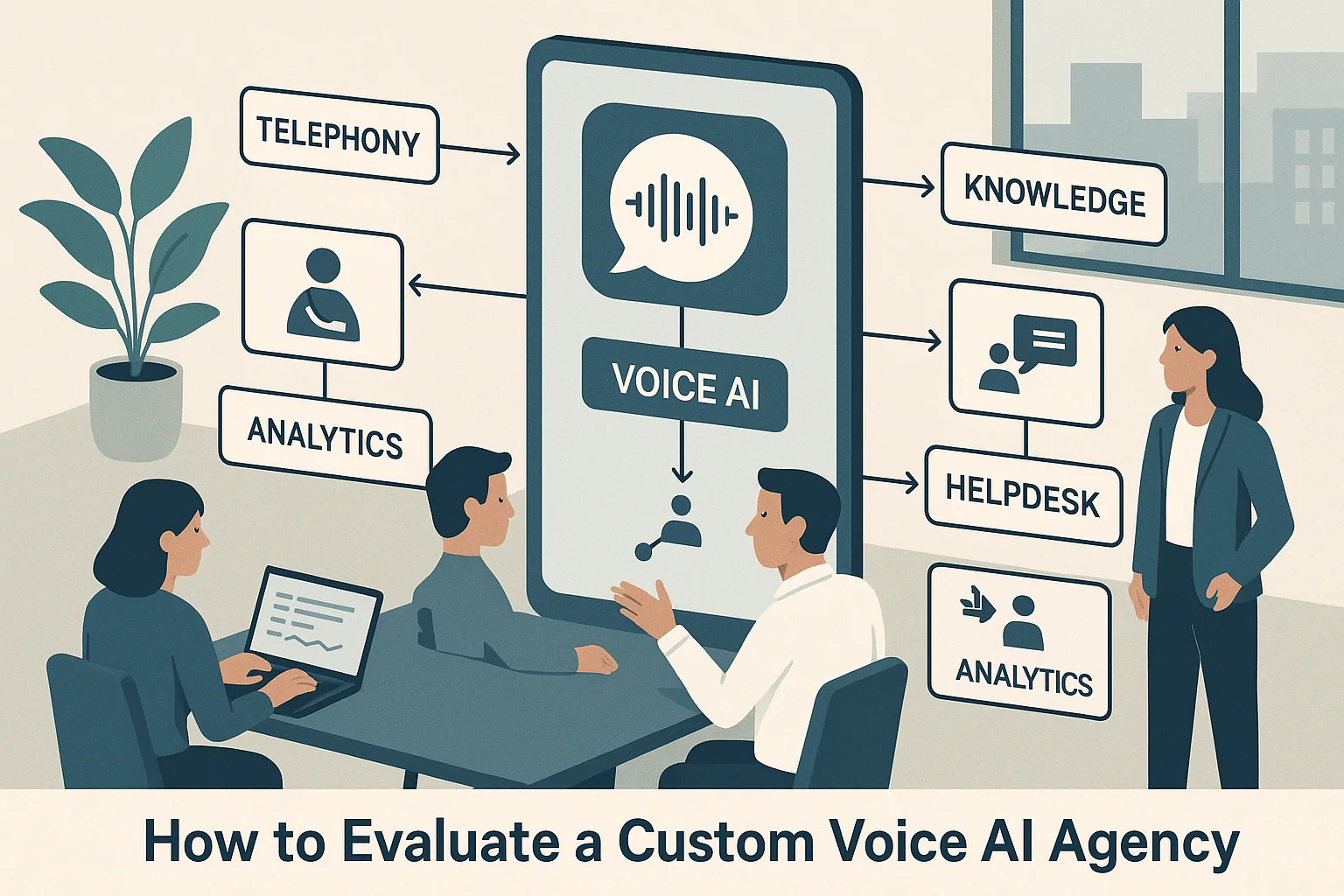
Insist on a diagram that uses the following canonical flow: Caller → Voice AI (ASR, NLU, TTS) → business‑rules layer (session orchestration, policy enforcement) → approved enterprise systems (CRM, billing, ERP) via controlled adapters → response, transaction, or human handoff → QA and analytics pipelines. The agency should show which components they operate, which are customer‑managed, and how control and audit trails are preserved.
- Caller: PSTN/SIP trunking, carrier demarcation, and call metadata capture.
- Voice AI: speech recognition, intent classification, and response generation (note whether generative models are in the loop).
- Business‑rules layer: deterministic state machine or rules engine that enforces policies - this is where high‑risk decisions must be constrained.
- Approved enterprise systems: explicit adapters and API contracts, not screen scraping or unmanaged database access.
- QA/analytics: call recordings, transcripts, QA logs, and dashboards stored under customer retention policies.
APIs and data contracts — demand specifics
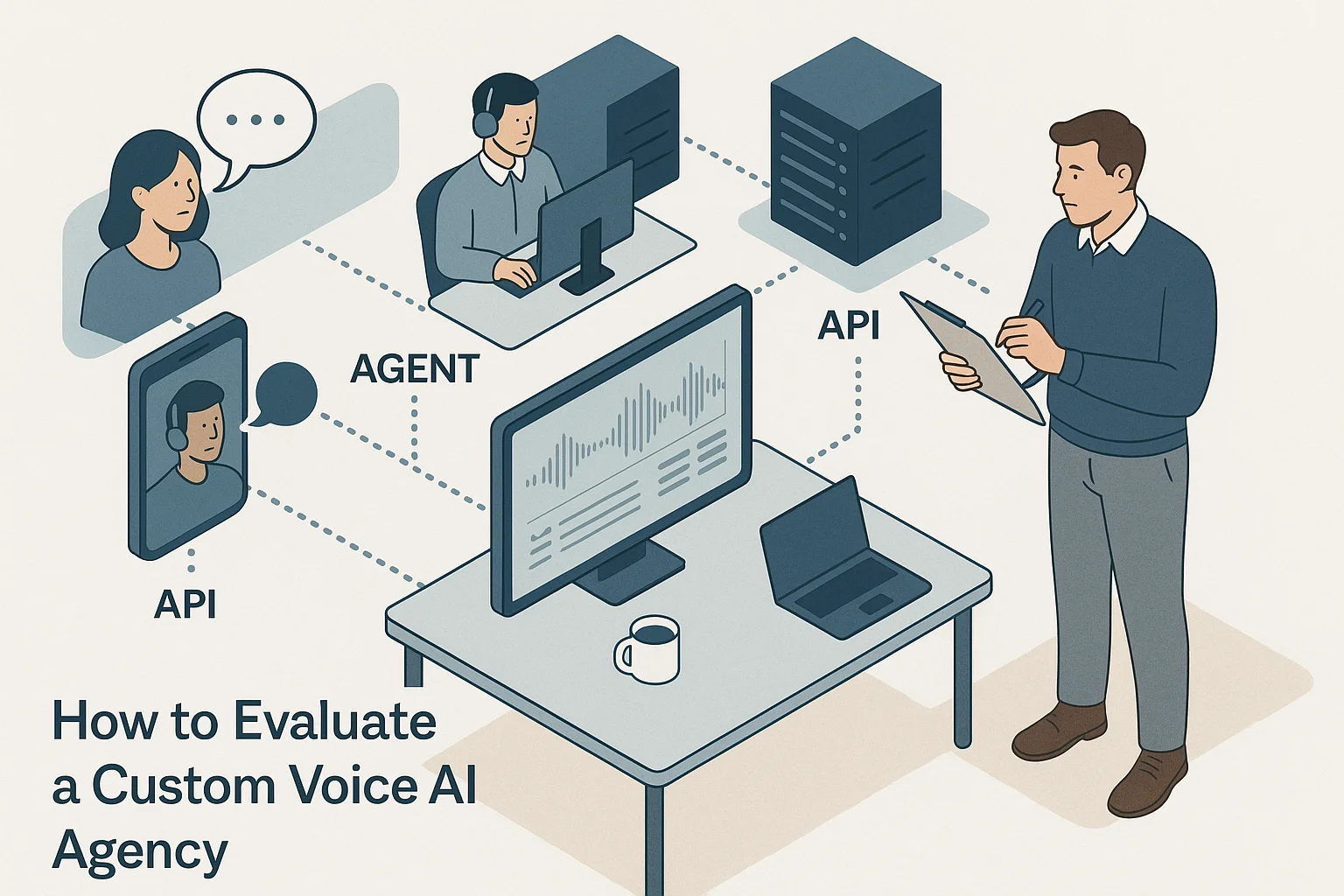
Verbal commitments are insufficient. Require the agency to provide actual API specifications (OpenAPI or similar), sample payloads, schema validation tests, and a versioning policy. Confirm how they will handle breaking changes and rollbacks.
- Provide or request OpenAPI/Swagger definitions for each integration point.
- Require sample JSON payloads with field definitions, enumerations, and error codes.
- Ask for a change‑control process that specifies deprecation windows and rollback procedures.
- Request an automated contract test harness or mock sandbox the agency will operate during integration testing.
3. Identity, access, and data handling
Voice interactions frequently touch sensitive customer data. Validate identity flows and data handling, including transfer paths, subprocessors, and retention.
Identity and authentication
Check how the solution authenticates callers and services. Prefer tokenized, least‑privilege service accounts with auditable key rotation. Avoid designs that require long‑lived credentials embedded in adapters.
- Caller identity: multi‑factor verification where appropriate, out‑of‑band verification for high‑risk transactions.
- Service identity: OAuth 2.0/OIDC for service‑to‑service calls, mutual TLS for on‑prem adapters, and rotating short‑lived credentials.
- Role design: separate roles for orchestration, analytics, and debugging with just‑in‑time access for support personnel.
Data residency, transfer, and subprocessors
Clarify where voice recordings, transcripts, and derivative data live, where backups are stored, and which subprocessors have access. Require the agency to document transfer mechanisms, retention periods, and breach notification procedures. Organizations must confirm obligations with counsel and data protection professionals.
- Hosting region and backup region: specify primary and failover geographies, and whether backups cross borders.
- Subprocessors: list all subprocessors and their roles; require prior notice and approval for changes.
- Onward transfer: document any third‑party services used for model inference or analytics and the legal basis for transfer.
- Retention & deletion: specify retention windows for recordings, transcripts, and QA data; ask for deletion certification for offboarding.
4. Reliability, observability, and failure recovery
Operational resiliency is critical. Define SLOs, monitoring, and explicit failure boundaries so the system fails safe and human agents recover service quickly.
SLOs, monitoring, and observability
Require measurable SLOs and an observability stack that covers telephony, AI pipeline, orchestration, and integrations. Observability should support real‑time dashboards, alerts, and post‑incident analysis.
- SLO examples: availability for inbound voice path, end‑to‑end latency percentiles (P50/P95/P99), intent classification success rate thresholds.
- Instrumentation: distributed tracing from call leg to backend API calls, structured logs with request IDs, and synthetic transaction tests.
- Alerting: actionable alerts mapped to runbooks and escalation paths; avoid noisy alerts without triage ownership.
Failure modes, fallback behaviour, and human escalation
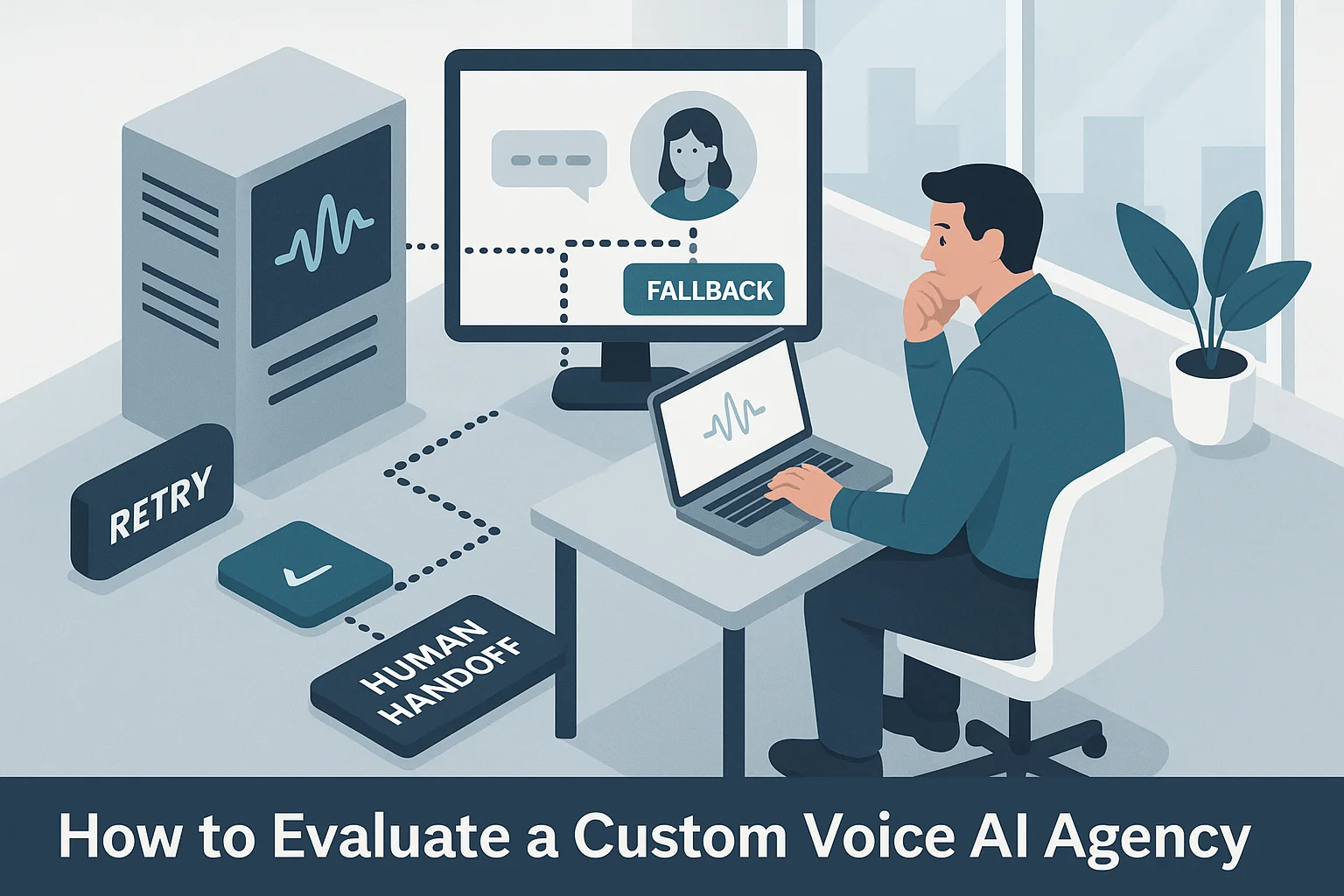
Map common failure modes (ASR errors, downstream API timeouts, model hallucination, carrier jitter) to deterministic fallback actions. Human escalation must be fast, with stateful handoff and audit trails.
- Define clear failure boundaries: e.g., after N ASR retries or a downstream 5xx, transfer to a live agent or outbound callback flow.
- Stateful handoff: pass session context, last successful intent, and relevant transcript snippets to the human agent in the CRM.
- Timeout and retry strategy: backoff rules for downstream APIs and circuit breakers in adapters.
- Post‑incident: capture RCA, remediation, and preventative work items; measure MTTR and trend over time.
5. Governance, safety, and controlled tool use
Voice AI often uses multiple models or tools. Governance must inventory tools, assess risk, and constrain generative outputs for high‑risk actions.
Model and tool governance
Require a documented inventory of models and external tools, including versions, vendors, and intended use cases. The governance plan should include risk assessments and mitigations for each model or tool.
- Inventory: record model purpose, provider, version, training data class (if known), and inference locality.
- Risk assessment: identify where models make consequential decisions and put deterministic rules around those paths.
- Change management: require approval workflows for replacing or updating models and tools.
Testing, QA, and human‑in‑loop controls
Operational QA must be continuous. Use production‑like testing, adversarial scenarios, and human‑in‑loop controls for high‑risk intents. Capture measurable QA metrics and use them to drive optimization.
- Pre‑production tests: intent coverage, edge case and adversarial tests, and performance benchmarks.
- Production validation: sampling, realtime QA scoring, and escalation thresholds that trigger human review.
- Human‑in‑loop: configurable gating for high‑risk transactions and a documented escalation playbook.
- Safety boundaries: keep high‑risk decisions off automated paths and under explicit human approval.
6. Managed service scope and vendor responsibilities
A managed Voice AI agency is inherently operational. Clarify responsibilities for integrations, optimization, security, and support.
Define operational boundaries
Contracts must map who owns each component: telephony, ASR/NLU/TTS, orchestration, adapters to enterprise systems, logs/recordings, and QA. The agency should commit to runbooks and continuous improvement cycles.
- Ownership matrix: clear RACI for every major component and integration point.
- Optimization: scheduled tuning cycles, A/B experiments for flows, and measurable KPIs for improvement.
- QA and audit: regular QA sampling, annotated transcripts, and quarterly governance reviews.
Security, support access, and subprocessors
The managed‑service contract should list subprocessors, remote‑support access methods, and security controls such as dedicated VPCs, segmentation, and access logs. Include clauses for offboarding and data return.
- Subprocessor list and approval process for changes.
- Remote support: limited‑time, audited access with JIT credentials, and IP allowlists where possible.
- Offboarding: defined data handover, proof of deletion, and transition assistance.
7. Procurement evaluation and scoring
Use a scored evaluation to compare vendors objectively. Weight technical, operational, governance, and commercial criteria according to your risk profile.
Sample RFP criteria and weights
A sample scoring approach helps. Adjust weights for your organization’s priorities (e.g., regulatory risk vs. cost).
- Architecture & integration (25%): clarity of diagrams, API specs, sandbox availability, and ownership matrix.
- Security & data handling (20%): identity model, subprocessors, data residency options, and breach procedures.
- Reliability & observability (20%): SLOs, tracing, alerting, and synthetic tests.
- Governance & QA (20%): model inventory, testing plans, human‑in‑loop policy, and audit readiness.
- Commercial & support (15%): pricing model, SLAs, transition terms, and optimization cadence.
Red flags and negotiation points
Watch for vague answers and negotiate firm deliverables. Some frequent red flags indicate a higher operational risk.
- No API specs or refusal to operate a sandbox.
- Undefined subprocessors or refusal to list them.
- No SLOs or only marketing‑style availability claims.
- No documented human handoff or stateful transfer to agents.
- Refusal to provide an exit plan, data export, or deletion certification.
Related Peak Demand resources
Industry and AI sources reviewed
- Artificial Intelligence Risk Management Framework (AI RMF 1.0)National Institute of Standards and Technology (NIST)
- OECD AI PrinciplesOrganisation for Economic Co-operation and Development
- AI Risk Management Framework: Generative AI ProfileNational Institute of Standards and Technology (NIST)
Privacy, telecommunications, recording-consent, cybersecurity, consumer-protection, employment, and records obligations vary by jurisdiction and use case. This article is operational guidance, not legal advice; organizations should confirm applicable requirements with qualified professionals.
Frequently asked questions
A serious managed service should include discovery, workflow design, telephony, integrations, validation rules, testing, monitoring, human escalation, incident handling, change control, analytics, and ongoing optimization. The value is the complete operating system around the model, not access to a model alone.
Official reference: Artificial Intelligence Risk Management Framework (AI RMF 1.0)
The operating model should assign clear owners for telephony, prompts, knowledge, APIs, credentials, incident response, analytics, approvals, and release management. Enterprise buyers should avoid deployments where those responsibilities are ambiguous or split across vendors without accountability.
Official reference: Artificial Intelligence Risk Management Framework (AI RMF 1.0)
Evaluate the complete workflow under realistic volume, latency, interruption, transfer, integration, and failure conditions. Measure task completion, escalation quality, unsupported responses, system errors, recovery behavior, and how quickly operators can detect and correct problems.
Official reference: Artificial Intelligence Risk Management Framework (AI RMF 1.0)
Ask for documented use-case boundaries, data handling, access controls, model and prompt change management, evaluation procedures, audit logs, human-oversight rules, incident response, subcontractor dependencies, and a process for reviewing material system changes.
Official reference: Artificial Intelligence Risk Management Framework (AI RMF 1.0)
Turn Voice AI infrastructure into a managed enterprise operation
Peak Demand designs, integrates, deploys, monitors, and improves Voice AI systems across customer service, enterprise systems, governance, escalation, and reporting.
Schedule a discovery call


