
Enterprise Predictive Operations for Voice AI: Workforce Forecasting & Orchestration
A practical buyer and architecture guide for enterprise Voice AI: forecasting signals, orchestration policies, integration ownership, governance controls, and procurement guardrails for contact-centre automation.
1. Executive decision framework
Enterprise leaders evaluating Voice AI for contact-centre automation face three linked decisions: architecture (how components connect), operating model (build vs managed vs hybrid), and governance (what controls must be in place). This section gives a compact decision framework to align stakeholders across CX, operations, IT, security, procurement, and transformation.
Who should lead and what stakeholders matter
Lead with operations and CX: they own customer outcomes and daily schedules. IT owns integration and observability, security and privacy own data controls and remote support, procurement manages contracting and exit terms, and transformation drives KPIs and change management. Short decision rule: if an integration or data flow touches approved enterprise systems (CRM, billing, order management, ERP), require IT and security sign‑off and include the system owner in technical acceptance testing (TAT).
- Operations/CX: SLA definitions, staffing models, human escalation policies.
- IT: API ownership, adapter lifecycle, monitoring and incident response.
- Security/Privacy: encryption, access control, subprocessors, remote-support constraints.
- Procurement: SLRs, exit‑transfer artifacts, third‑party audit evidence.
Buy vs build vs hybrid: a practical rubric
Decide by integration complexity, control needs, and internal capability. Buy (managed service) if you require rapid deployment, mature vendor orchestration, and a clear runbook for scale. Build if you need full control over adapters, business logic, and data residency, and have engineering capacity to maintain connectors and QA. Hybrid if you want vendor-run operations but with in‑house ownership of critical business rules and auditing. In contracts, codify which party owns adapters, business‑rules code, observability dashboards, and QA data retention.
- Procurement checklist: ownership of adapters, API specs, playbooks for handoff, and exportable conversational logs.
- Operational checklist: who runs daily tuning, who approves business-rule changes, and who verifies QA passes before production changes.
2. Canonical architecture and integration patterns
Successful enterprise Voice AI deployments use a consistent, auditable pipeline. Defining the canonical architecture clarifies failure boundaries and integration ownership.
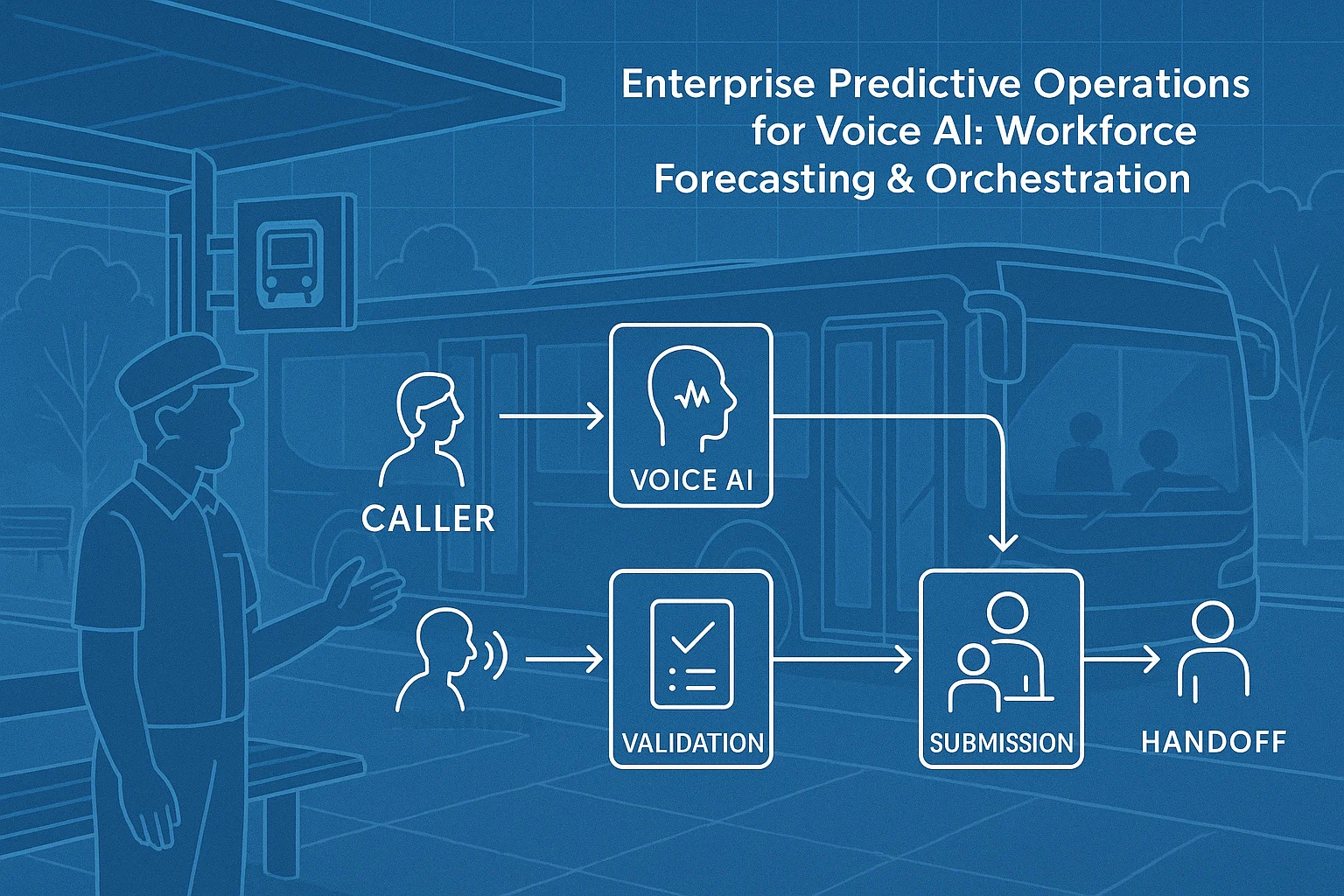
Canonical pipeline: Caller → Voice AI → Business‑rules layer → Enterprise systems → Outcome
Design the system as a sequence that separates conversational intelligence (NLP, ASR/TTS, NLU) from decisioning and stateful business logic. The business‑rules layer (also called orchestration or logic bridge) enforces policies, guards access to enterprise systems, and makes deterministic decisions (e.g., authentication success, charge authorization, appointment booking). Final outcomes are either a system transaction, a spoken response, or a human handoff. This separation keeps high‑risk actions under explicit controls and allows teams to swap model components without re‑validating business rules.
- Voice AI: inference engine handling ASR/NLU and response generation.
- Business‑rules layer: policy enforcement, rate limits, identity confirmation, transaction brokering.
- Enterprise systems integrations: CRM, billing, OMS, fraud systems accessible via approved APIs/adapters.
- Handoff: supervised transfer to human agent with session context and suggested dispositions.
Adapters, API contracts, and ownership
Adapters translate the business‑rules layer to enterprise APIs. Treat adapters as versioned deliverables with acceptance criteria: authentication method, retry/backoff behaviour, idempotency, schema contracts, and data minimization rules. Assign ownership—vendor, client, or shared—and require an adapter runbook and CI for changes. Ensure the contract specifies where logs and recordings are retained, what subset of conversational data is forwarded to enterprise systems, and how errors are surfaced to orchestration.
- Require API contract tests as part of TAT and continuous deployment.
- Define error semantics (400 vs 409 vs 500) and mapping to orchestration recovery policies.
- Document data retention and redaction rules per integration.
3. Predictive forecasting: signals, models, and validation
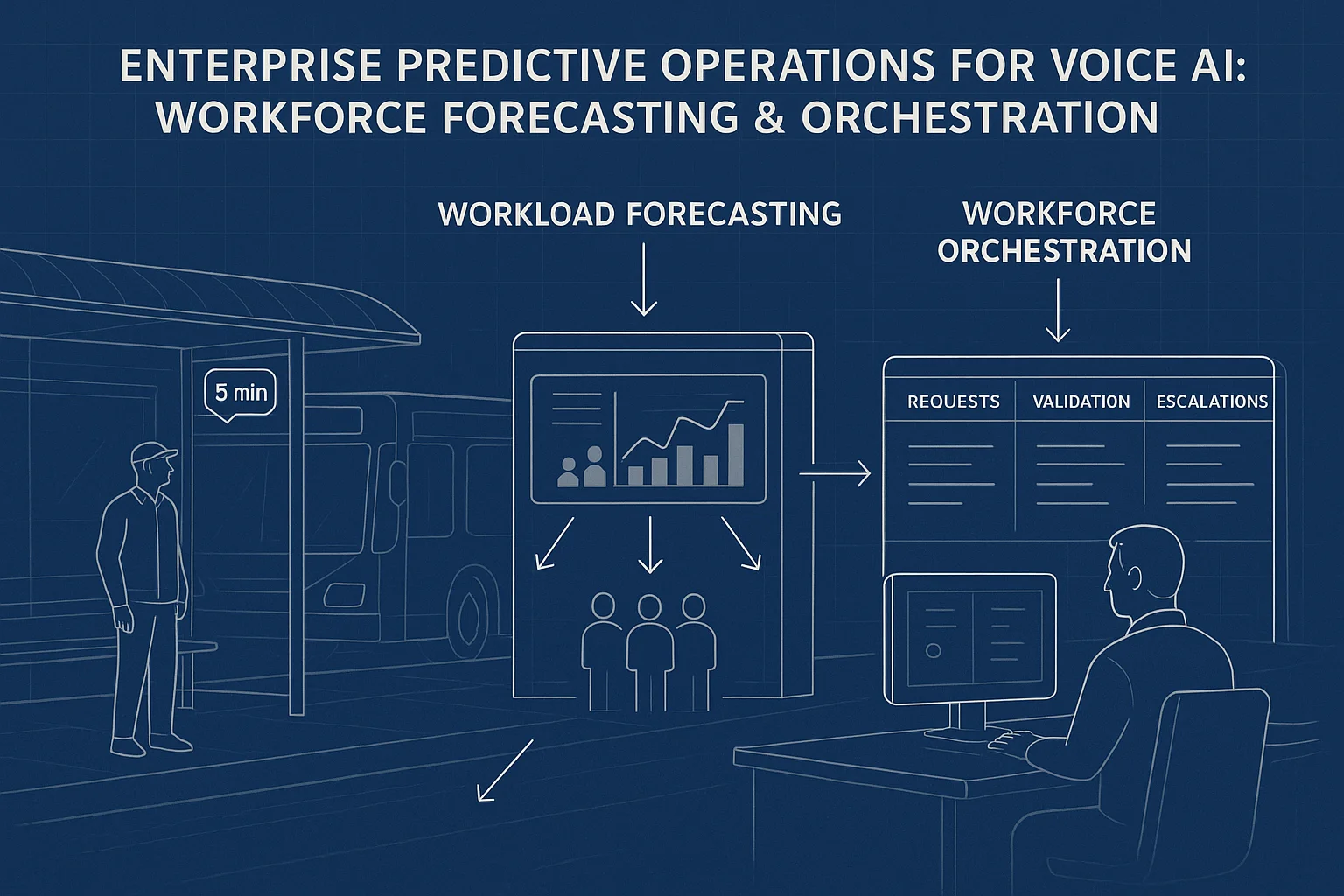
Forecasting call volumes and complexity is the foundation of workforce orchestration. Enterprise-grade forecasting combines multiple signals, explicit seasonality, and closed-loop validation from QA systems.
Signal sources and modelling approach
Use layered signals: telephony platform metrics (call volume, ACD queue depth, wait times), CRM events (campaigns, billing cycles), digital channels (chat/web traffic), historical occupancy, and external calendars (holidays, promotions). For intent-level forecasting, enrich historical voice transcripts with intent labels from QA to project complexity. Use ensemble models (time series + causal regressors) and keep a pragmatic cadence: short‑term (0–72 hours) for shift planning, medium‑term (1–12 weeks) for hiring and vendor capacity, and long‑term for transformation investments.
- Short‑term: queue-level predictions for intraday reallocation and overflow triggers.
- Medium‑term: staffing and contractor scheduling informed by forecast confidence bands.
- Long‑term: capacity planning for adapters, licencing, and peak hardware or cloud provisioning.
Validation, drift detection, and closed‑loop QA
Forecasts must be validated against observed outcomes and QA-derived measures (intent misclassification rates, escalation frequency). Instrument model drift detection: if predicted complexity diverges from observed complexity beyond a threshold, route more calls to human agents until retraining and root‑cause analysis complete. Maintain a testset of labelled calls refreshed weekly and use that to compute precision/recall for critical intents.
- Define acceptable forecast error bands and tie them to operational actions (e.g., >10% forecast shortfall = trigger overflow to human pool).
- Use QA sampling to measure real-world intent accuracy and to reweight models when class distributions shift.
4. Workforce orchestration and policy controls
Orchestration converts forecasts into staffing, routing, and overflow actions. Policies must be codified, auditable, and reversible. This section outlines concrete orchestration constructs and failure boundaries.
Scheduling, skill‑based routing, and overflow
Map forecast outputs to shift templates using occupancy targets and shrinkage assumptions. Integrate skill‑based routing with the business‑rules layer so that human agents receive prepopulated session context. Define overflow policies explicitly: soft overflow (longer wait, callback offer), hard overflow (automated transfer to human pool), and capacity-based overflow triggers (queue-depth, NLU confidence, or intent risk). Ensure front-line supervisors have a rapid override UI to adjust routing in real time.
- Automate callback offers when predicted wait exceeds threshold and confirm business rules for sensitive flows.
- Use NLU confidence and risk tags to force handoff for high‑risk intents (billing disputes, legal, clinical).
- Log all overrides and manual routing changes for post‑incident audit.
Operational KPIs and service levels
Define SLOs for both automated and human-mediated outcomes: containment rate, average handle time (AHT) for humans, automation error rate, escalation rate, and post-call customer satisfaction (CSAT). For forecasting and orchestration, include forecast accuracy, intraday adherence, and time to recover from forecast deviation. Link financial and operational KPIs to vendor compensation where appropriate, but avoid perverse incentives (e.g., rewarding containment without quality checks).
- Example SLOs: automation containment ≥ X% (with QA sample ≥ Y% pass rate), escalation rate ≤ Z% for low-risk intents.
- Require vendor reports on intraday adherence and root‑cause analyses for misses.
5. Managed services, responsibilities, and procurement controls
If you select a managed Voice AI provider, clarify the scope of responsibilities down to adapters, runbooks, observability, and exit artifacts. Avoid vague “fully managed” statements—contracts must specify deliverables, SLAs, and audit rights.
Scope matrix and shared‑responsibility model
Use a scope matrix that lists components and assigns responsibility: conversational models, business‑rules code, adapters, telephony stack, storage of recordings, QA pipeline, monitoring dashboards, and support tiers. Require the vendor to deliver: adapter source or exportable template, runbooks, onboarding documentation for integrations, and an audit log schema. For hybrid models, insist on a clear demarcation: the vendor may operate the stack but the enterprise retains approval rights for business‑rules changes and access to raw logs for independent QA.
- Contract items: access to test environment, API specs, data export cadence, and backup/restore procedures.
- Operational artifacts: runbooks, RTO/RPO for key services, incident escalation matrix.
Service levels, observability, and vendor KPIs
Specify SLOs for availability, transaction success, orchestration latency, and mean time to remediate (MTTR). Require dashboards or API access for critical metrics (queue depth, automation containment, NLU confidence distribution, adapter errors). Insist on alerting thresholds, playbooks for incidents, and penetration test evidence annually. Include data portability clauses: conversational logs, adapter configs, and business‑rules exports in a machine-readable format to enable vendor exit without operational disruption.
- Operational KPIs: availability ≥ 99.9% for production orchestration layer, orchestration latency < 200ms for API calls, timely error-rate reporting.
- Exit deliverables: conversation logs (redacted as needed), adapter code/config, business‑rules exports, and test vectors.
6. Governance, QA, and observability
Governance must be practical and auditable. Use role-based controls, human oversight for high-risk decisions, change control, and continuous QA to maintain safety and accuracy.
Risk management and human oversight
Adopt a risk‑tiered approach: low‑risk transactional intents can be automated with lightweight oversight; medium to high‑risk intents require stronger controls and a defined human-in-loop or human-in-call policy. Enforce change control for business rules and model updates, require pre‑production testing, and maintain an audit trail of approvals. Where regulatory risk exists, consult legal and privacy teams to determine required documentation and evidentiary records.
- Classify intents by impact (financial, safety, legal, privacy) and attach required controls (e.g., mandatory human confirmation).
- Mandate approval gates for business‑rules changes and record the approver, timestamp, and test results.
QA, testing, and observability
Continuous QA requires production sampling, labelled testsets, and synthetic stress tests that simulate peak volumes. Build observability across layers: telephony metrics, orchestration logs, adapter error traces, model inference latencies, and QA outcomes. Define alert escalation paths keyed to customer experience KPIs (e.g., rising escalation rate, sustained low NLU confidence). Ensure retention policies for logs and recordings align with privacy requirements and contractual obligations.
- QA pipeline: sample rate, labelling cadence, and feedback loop to retraining or rules tuning.
- Observability: unified dashboard with drilldowns from customer journey to adapter errors and model confidence.
Related Peak Demand resources
Industry and AI sources reviewed
- Artificial Intelligence Risk Management Framework (AI RMF 1.0)National Institute of Standards and Technology (NIST)
- OECD AI PrinciplesOrganisation for Economic Co-operation and Development
- AI Risk Management Framework: Generative AI ProfileNational Institute of Standards and Technology (NIST)
Privacy, telecommunications, recording-consent, cybersecurity, consumer-protection, employment, and records obligations vary by jurisdiction and use case. This article is operational guidance, not legal advice; organizations should confirm applicable requirements with qualified professionals.
Frequently asked questions
A serious managed service should include discovery, workflow design, telephony, integrations, validation rules, testing, monitoring, human escalation, incident handling, change control, analytics, and ongoing optimization. The value is the complete operating system around the model, not access to a model alone.
Official reference: Artificial Intelligence Risk Management Framework (AI RMF 1.0)
The operating model should assign clear owners for telephony, prompts, knowledge, APIs, credentials, incident response, analytics, approvals, and release management. Enterprise buyers should avoid deployments where those responsibilities are ambiguous or split across vendors without accountability.
Official reference: Artificial Intelligence Risk Management Framework (AI RMF 1.0)
Evaluate the complete workflow under realistic volume, latency, interruption, transfer, integration, and failure conditions. Measure task completion, escalation quality, unsupported responses, system errors, recovery behavior, and how quickly operators can detect and correct problems.
Official reference: Artificial Intelligence Risk Management Framework (AI RMF 1.0)
Ask for documented use-case boundaries, data handling, access controls, model and prompt change management, evaluation procedures, audit logs, human-oversight rules, incident response, subcontractor dependencies, and a process for reviewing material system changes.
Official reference: Artificial Intelligence Risk Management Framework (AI RMF 1.0)
Need deeper enterprise Voice AI integration?
For custom APIs, SIP and telephony architecture, multi-system workflows, QA, observability, and enterprise deployment, Peak Demand commonly evaluates platforms such as Retell AI as part of a managed architecture.
Explore Retell for Enterprise Voice AIPeak Demand may earn a commission from this link.


