
Enterprise Data Architecture and Governance for Voice AI in Health Systems
Practical architecture, data governance, identity controls, and operating model guidance for safe, auditable Voice AI in patient access and contact-centre workflows.
1. Use case and operating boundary
Define a narrow, operational Voice AI use case to reduce risk and make measurable operational improvements. Example: automated patient access for appointment booking, check-in status, and simple administrative intake without clinical triage.
Core workflow (decision-useful pattern)
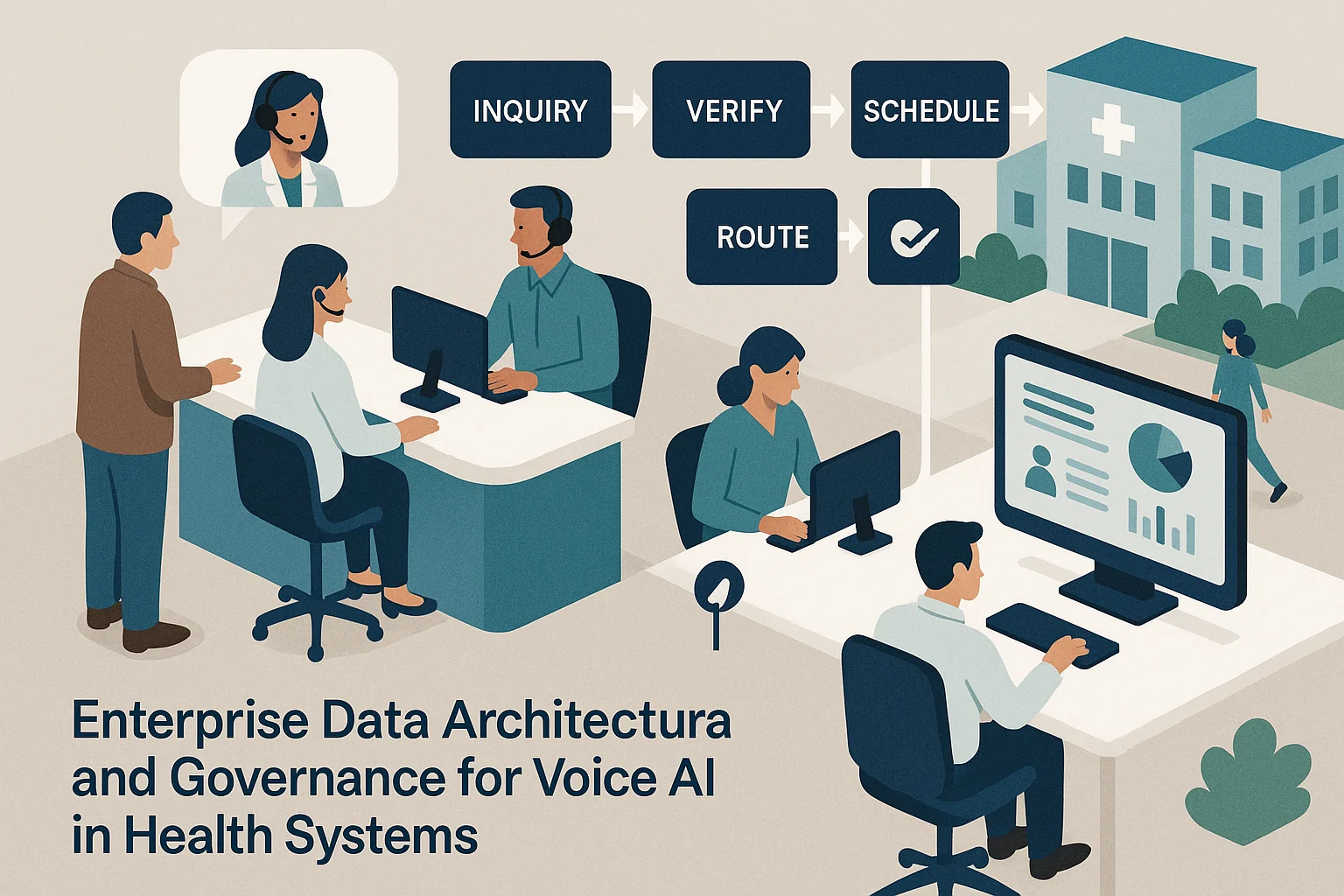
A practical, enterprise-ready pattern keeps responsibilities explicit and auditable. The canonical flow: Caller or patient → Voice AI (NLP intent recognition limited to administrative intents) → identity and field validation layer → approved scheduling or service API (EHR/PM via controlled adapter) → confirmation to caller or human handoff to contact-centre staff. Implement this flow with role-based adapters so only pre-authorized calls trigger writes to clinical or scheduling systems.
- Intent classification limited to sign-up, scheduling, rescheduling, cancellations, and administrative inquiries.
- Field validation: required fields verified by the agent (name, date of birth/identifier, consent flag) before any persistent update.
- Safe escalation rules: ambiguous, conflicting, or time-critical cases route to a human with a summarized transcript and suggested next steps.
Clear failure and safety boundaries
Design explicit failure states and user-facing messages. The Voice AI must never attempt diagnosis, prescribe, triage emergencies, or provide clinical advice. If the caller indicates symptoms, severe pain, or emergency language, the system must immediately escalate to human staff or instruct the caller to call emergency services. Log the decision path for every escalation.
- Predefined keywords and confidence thresholds trigger immediate human handoff.
- For any low-confidence intent classification or missing identity confirmation, the agent asks to transfer to a human.
- Record and timestamp all escalations and the rationale for compliance and review.
2. Architecture and integrations
Choose architecture patterns that separate conversational intelligence from enterprise systems and make integrations explicit, auditable, and reversible.
Logical layers and adapters
Use clearly separated layers: Telephony/edge, Voice AI conversational layer, validation & identity layer, controlled adapter layer for EHR/PM/scheduling, and orchestration/queue for human handoff. The controlled adapter is the only component that can write to downstream systems; it enforces RBAC, data mapping, idempotency, and transaction semantics.
- Telephony/edge handles audio capture, DTMF fallbacks, and local consent prompts.
- Conversational layer performs intent extraction and slot filling but writes only to the validation layer.
- Validation & identity layer verifies caller identity and consent, then calls the adapter for approved actions.
- Adapters communicate with EHR/PM/scheduling using approved APIs and maintain audit logs of every transaction.
Integration maturity and examples
Map integration choices to risk and value. Start with read-only integrations (status checks, eligibility) then move to limited, scoped writes (appointment scheduling) with rate limits and governance. Where real-time scheduling writes are required, implement optimistic locking, conflict detection, and rollback paths so duplicate or conflicting bookings are preventable.
- Phase 1: Read-only lookups for patient status and provider availability.
- Phase 2: Scoped writes for bookings and administrative updates with adapter-controlled transactions.
- Phase 3: Expanded integrations after demonstrated QA, SLA, and auditability.
3. Data governance, residency & privacy controls
Treat every data flow as a regulatory and operational decision. Document where data resides, who can access it, and what transfers are permitted.
Data residency and processors
At design time, list hosting region, backup region, subprocessors, and cross-border transfer mechanisms (e.g., contractual and technical safeguards). Avoid blanket statements about legal requirements — instead, map obligations to jurisdictions and confirm with counsel. Ensure remote-support access, on-call vendor access, and subprocessors are documented and auditable.
- Designate primary hosting region for production workloads and a separate backup region.
- List all subprocessors used for speech-to-text, LLMs, telephony, and storage; require subprocessors to meet your security baseline in contracts.
- Document mechanisms for cross-border transfer and encryption in transit and at rest.
Consent, recordings, and retention
Explicitly collect and record consent for call recording and for any use of call data in model training or analytics. Implement granular retention policies: transient conversational state may be short-lived, whereas audit logs and escalation transcripts are retained longer for compliance. Document retention periods and deletion procedures.
- Consent prompts at call start and verification before recording or retention.
- Separate policy for PII/PHI and non-identifiable logs; policy must be enforced by the adapter and storage layer.
- Provide documented deletion and export procedures to support data subject requests and audits.
4. Identity, validation and auditability
Identity verification and field validation are the operational gates before any system change. Design multi-step checks and fallback options.
Identity verification patterns
Use layered identity checks: caller-provided identifiers (MRN, DOB), knowledge-based questions where appropriate, SMS/voice OTP for high-risk actions, and optionally third-party verification for sensitive workflows. Record verification steps and confidence scores. If confidence is below threshold, require human verification.
- Low-risk: name and DOB confirmation for appointment reminders.
- Medium-risk: OTP or confirmation of recent interaction for booking or rescheduling.
- High-risk: multi-factor verification or human validation before any change to clinical records.
Audit trails and immutable logs
Every action that changes state — booking, cancellation, demographic update — must include an immutable audit record: who initiated the action (agent or human), identity verification evidence, adapter transaction ID, pre- and post-state, and timestamps. Store transcripts and confidence metadata linked to the audit record for QA and compliance reviews.
- Use append-only logging for audit trails with tamper-evident controls.
- Correlate telephony session IDs, transcription segments, and adapter transactions for complete provenance.
- Keep separate secure storage for audit logs with strict access controls and retention policy.

5. Governance, risk management and QA
Operationalize AI governance with clear roles, regular risk reviews, and measurable QA metrics. Use established frameworks and ethical guidance as part of governance.
Risk management and control mapping
Apply a risk-management lifecycle: identify assets, assess harms (privacy, safety, operational), design mitigations, and monitor. Use NIST AI RMF concepts to map risks, controls, and residual risk acceptance. Maintain an AI inventory, version control for conversational models, and documented rollback criteria.
- Maintain an AI asset inventory showing models, datasets, hosting, and subprocessors.
- Define acceptance thresholds for classification confidence and escalation triggers.
- Schedule periodic model validation and drift detection and maintain rollback plans.
Ethics and external guidance
Incorporate WHO and OECD guidance where applicable: establish ethics review for use cases that touch sensitive health information, document limitations (no clinical diagnosis), and maintain transparency with patients about automation and human oversight.
- Ethics review board (or existing clinical governance) approves agent intents and escalation rules.
- Public-facing disclosures on automated call handling, recording, and escalation policies.
- Regular audits to ensure the system adheres to ethical constraints and documented use boundaries.
Quality assurance and observability
Define operational KPIs (escalation rate, resolution time, booking error rate, identity verification failure rate) and instrument observability across the stack. Use synthetic and live A/B testing for new conversational flows, and retain human-in-the-loop QA for initial production windows.
- Alerting on sudden increases in escalation or error rates.
- Routine review of sampled transcripts with human evaluators and documented remediation.
- Performance SLAs for integration adapters and recovery time objectives for failover.
6. Procurement, vendor selection and operating model
Procurement should focus on evidence: integration ownership, QA scope, observability, security posture, and clear SLAs. Structure vendor scope to reflect shared responsibilities.
Managed vs. build choices
Decide early whether to buy managed Voice AI services or build a custom stack. Managed services accelerate delivery but require contractual clarity about subprocessors, data flows, and support access. Custom builds offer control over adapters and identity flows but require internal capacity for ongoing governance and reliability.
- Managed service expectations: documented subprocessors, RFP-ready evidence, and clear handoff for incident response.
- Custom build expectations: internal ownership of adapters, identity verification, and audit log storage.
- Hybrid: managed conversational layer with in-house adapters to EHR/PM to retain control over writes.
Contract clauses and evidence to request
Ask vendors for specific evidence: architecture diagrams, subprocessor list, data residency options, access controls, audit-log format, and runbooks for escalations and breaches. Require obligations for prompt notification of subprocessors and security incidents, and define service levels for adapter availability and human-handoff latency.
- Request documented test results for identity verification workflows and false positive/negative rates.
- Require change-notice periods for model or system updates that affect production behavior.
- Include audit rights and data-subject support procedures in contracts.
Operational responsibilities and Peak Demand differentiation
Operational contracts should clearly assign responsibilities: who owns the telephony layer, who maintains adapter mappings, who performs QA sampling, and who manages escalation. Peak Demand implements custom Voice AI integrations with controlled adapters for scheduling and intake, identity verification options, field validation, safe escalation logic, immutable audit trails, and human-review workflows — all designed to fit enterprise governance and procurement evidence requirements.
- Clearly defined handoff: agent suggests booking and adapter executes with audit trail.
- Human review windows and post-launch governance support to tune escalation thresholds.
- Vendor and client responsibilities listed in runbook and SLO schedules.
Related Peak Demand resources
Industry and AI sources reviewed
- Ethics and governance of artificial intelligence for healthWorld Health Organization
- Regulatory considerations on artificial intelligence for healthWorld Health Organization
- Artificial Intelligence Risk Management Framework (AI RMF 1.0)National Institute of Standards and Technology (NIST)
- OECD AI PrinciplesOrganisation for Economic Co-operation and Development
Healthcare privacy, security, clinical-safety, records, and professional obligations vary by jurisdiction and workflow. This article is operational guidance, not legal advice; organizations should confirm applicable requirements with qualified professionals.
Frequently asked questions
Administrative workflows such as appointment booking, changes and cancellations, referral-status intake, approved follow-up, patient-access questions, after-hours overflow, and structured routing are common starting points. Clinical judgment, diagnosis, emergency triage, and prescribing decisions must remain with qualified professionals.
Use the minimum identifiers approved by the organization, validate them against the system of record, avoid exposing unnecessary information, and provide a human-assisted path when verification fails. The system should not infer identity from conversational context alone.
The agent should follow the organization's approved escalation and emergency-routing rules, avoid clinical advice, and transfer or direct the caller to the appropriate human or emergency channel. Those rules must be tested with realistic language and failure cases.
Request identity and privacy controls, scheduling or EHR integration behavior, audit logs, escalation rules, downtime handling, testing evidence, change control, monitoring, and clear separation between administrative automation and clinical decision-making.
Design a safe patient-service workflow before automating it
Peak Demand helps healthcare organizations connect Voice AI to scheduling, intake, patient communication, identity checks, escalation, and reporting with clear operational boundaries.
Schedule a discovery call


