
Enterprise Change & Capability Roadmap for Scaling Hybrid Voice AI in Health Systems
A practical, jurisdiction‑neutral guide for healthcare leaders to plan, procure, and scale hybrid Voice AI for patient access. Covers a safe operating model, integrations, governance, procurement, and measurable outcomes.
1. Why a hybrid Voice AI programme — decision context and objectives
Health systems pursue Voice AI to improve patient access, reduce avoidable hold times, and reallocate staff to higher‑value work. The right programme balances automation speed with clinical safety and regulatory controls.
Business goals and measurable outcomes
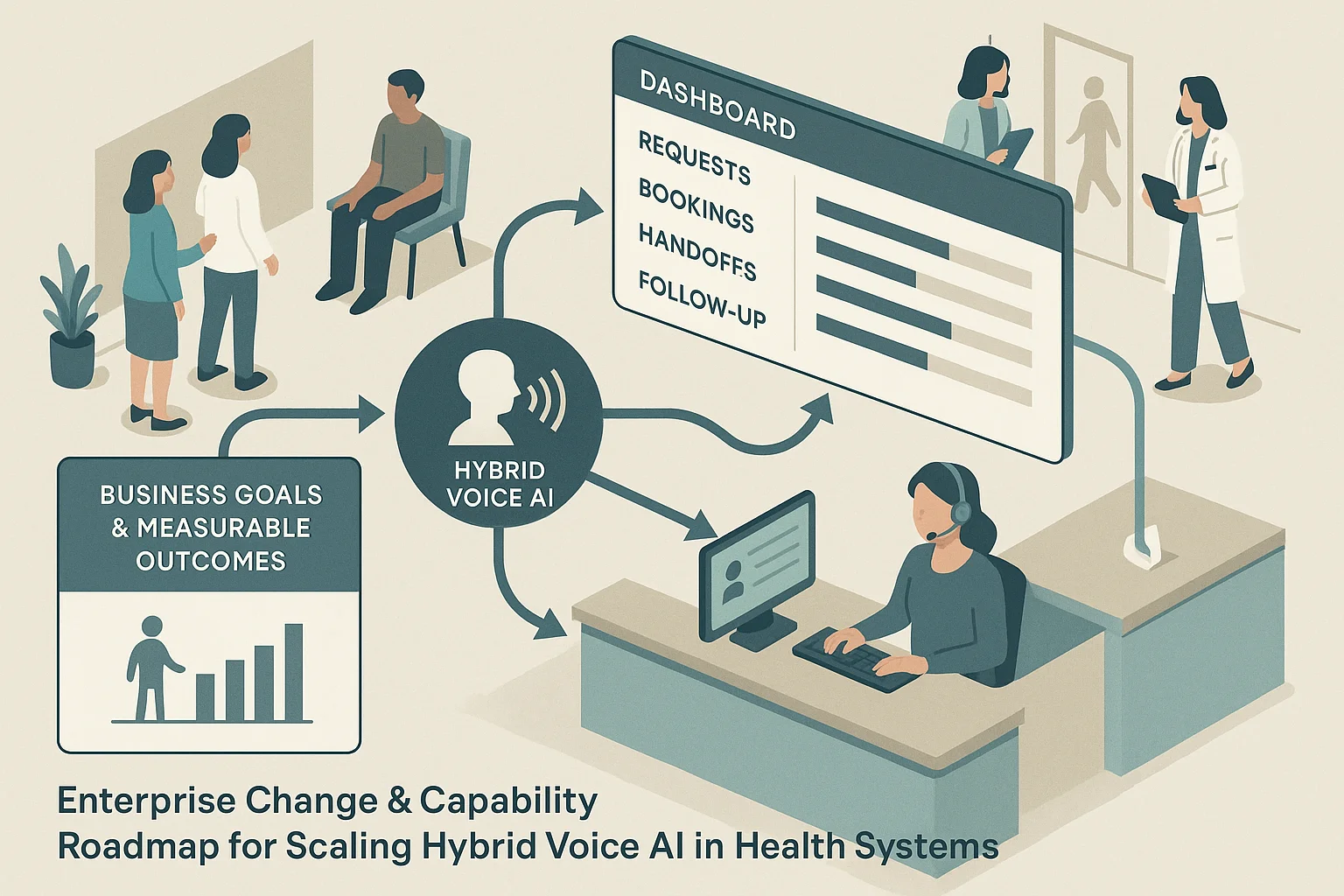
Start with a concise set of business outcomes tied to operational metrics: reduced average patient wait time for scheduling, percentage of calls fully handled by automation for administrative tasks, reduction in abandoned calls, first‑contact resolution for appointment changes, and time‑to‑confirm for bookings. Avoid framing goals as clinical improvement or cost guarantees; instead focus on access, throughput, and handoff quality. Use baseline telemetry from contact centre systems and scheduling platforms to set realistic targets and guardrails.
- Example outcomes: % routine appointment requests handled end-to-end by Voice AI; % of escalations handled within target SLA; hold time reduction for live agents.
- Measure both automation accuracy (intent/slot success) and downstream business success (confirmed booking via scheduling API).
Why hybrid (automation + human review) is the practical choice
A hybrid model combines automated intent handling for high‑volume administrative tasks (appointment requests, reschedules, basic eligibility checks) with explicit, fast human handoffs for clinical questions, ambiguous intents, or identity failures. This preserves patient safety, creates clear liability boundaries, and enables incremental deployment of automation where outcomes are easily validated.
- Automation handles predictable, low-risk tasks and captures structured data for downstream systems.
- Human teams manage exceptions, complex scheduling rules, and clinical judgment tasks that must remain outside automated scope.
2. Practical operating model and call flow
Translate strategy into an operational flow that enforces safety and integrates with scheduling and patient records.
Canonical caller flow (operational blueprint)
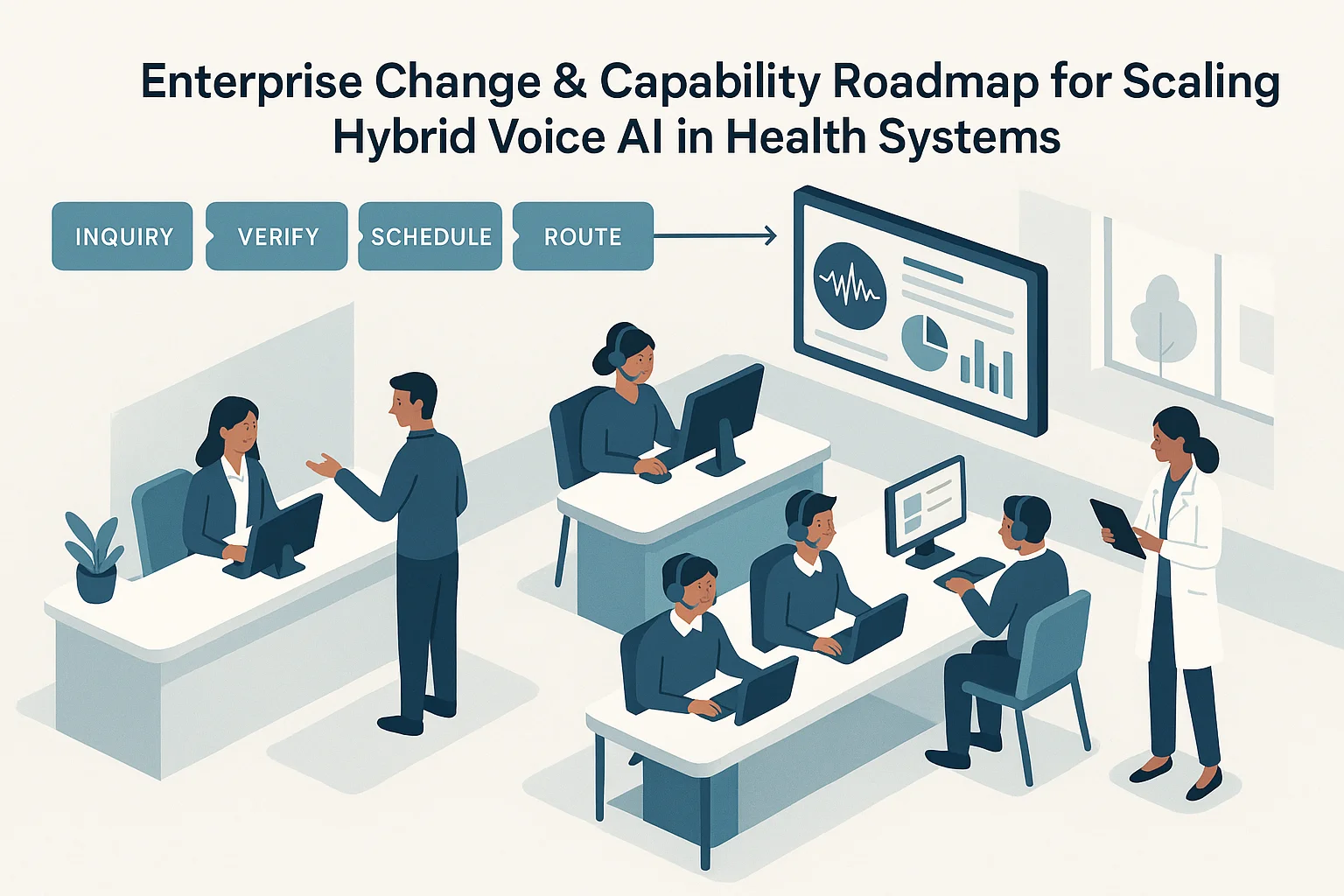
Define a single, auditable call flow to reduce operational risk and simplify integrations. A practical blueprint: Patient/caller → Voice AI (IVR + NLU) → identity & consent validation → business-system validation and scheduling API → confirmation to caller and recording metadata → human escalation if rules trigger. Treat each node as a controlled boundary with specific inputs, outputs, and logged events.
- Identity & consent validation: verify caller with two or more factors where required (phone number + DOB, known token, SMS code) before accessing or.
- Business-system validation: adapter calls to scheduling/EHR verify availability, eligibility, and clinic‑specific constraints before confirming.
- Handoff: structured handoffs include call context, transcript/snapshot, and a simple ‘reason code’ for the agent to avoid repeated questioning.
Technical components and responsibilities
Design each component with owner and failure-mode controls. Typical components: telephony gateway, Voice AI orchestration, identity validation module, controlled adapters to EHR/scheduling APIs, escalation/handoff bridge to contact‑centre platform, and an audit & observability layer. Map who owns each (in-house, managed service, or vendor) and the integration contract—this avoids gaps in incident response and compliance.
- Service accounts with least privilege for scheduling APIs; separate accounts for read vs write operations.
- Recording policy and consent management must be implemented at the telephony gateway with explicit recording flags and retention policies.
3. Integration design and data controls
Integrations are the highest operational risk in Voice AI programmes. Keep them simple, auditable, and minimal‑privilege.
Scheduling and EHR adapters
Use purpose‑built, tested adapters rather than general-purpose automation when connecting to scheduling or practice management systems. Adapters encapsulate business rules (clinic hours, complex provider constraints), transaction idempotency, and retry logic. Design adapters to expose a small, well-documented API surface: availability query, tentative booking, confirm booking, cancel/reschedule, and status lookup.
- Prefer synchronous availability checks for booking flows; use transactional locking or optimistic concurrency to avoid double-bookings.
- Log request/response pairs with correlation IDs to enable audit trails and post‑incident reconciliation.
Identity, consent, and PHI handling
Implement explicit identity verification and recording-consent flows before any PHI is accessed or written. Define what counts as PHI in your jurisdiction and confirm retention/recording consent. Keep sensitive data out of any long-term analytic stores unless explicitly necessary and governed.
- Design identity checks proportional to task risk: simple confirmations for appointment reminders, stronger multifactor verification for booking changes.
- Mask or redact PHI in transcripts used for analytics; maintain a secure audit trail for any unredacted records and limit access.
Data residency, transfers, and subprocessors
Decide hosting and backup regions explicitly, document subprocessors, and specify transfer mechanisms (e.g., standard contractual clauses) in procurement. Different jurisdictions have varied obligations; organisations should confirm applicable obligations with qualified legal advisors. Implement controls for cross-border transfers, remote-support access, backup geography, and explicit retention schedules.
- Specify hosting region, backup region, and subprocessors in vendor contracts.
- Document access paths for remote support and ensure emergency access is logged and time-limited.
4. Governance, safety boundaries and regulatory alignment
Operationalise governance to keep clinical functions separate from administrative automation, and to meet ethical and regulatory expectations.
Clinical boundary rules and escalation
Explicitly state that Voice AI does not diagnose, prescribe, triage medical emergencies, or replace clinical judgment. Implement deterministic escalation triggers: keywords or intents indicating chest pain, breathing issues, suicidal ideation, or any ambiguous symptom description; identity failure; or API failure. Ensure escalations queue to trained staff with required clinical training and that Voice AI logs context for rapid triage.
- Escalate immediately on emergency indicators and read a scripted instruction to call emergency services if caller safety is at risk.
- Use interaction confidence thresholds to trigger human review rather than relying solely on intent matching.
Risk management and continuous monitoring
Embed a risk management lifecycle: identify risks, implement controls, test effectiveness, monitor in production, and adjust controls. Use metrics for model performance drift, intent accuracy, false escalation rates, and downstream business success. Align monitoring and incident response with recognised risk frameworks and maintain a documented audit trail for decisions and model changes.
- Define thresholds for retraining or human-in-loop review based on NIST AI RMF guidance.
- Schedule periodic audits of model outputs, escalation cases, and adapter failures.
Ethics, transparency and governance committees
Establish a cross-functional governance forum including clinical leads, privacy/compliance, IT security, operations, and patient access. The committee approves scope, risk tolerances, escalation protocols, and consent language. Document decisions and maintain a public‑facing summary of automation scope for transparency where appropriate.
- Maintain documented decision logs for scope changes and new use cases.
- Include patient-access representatives to surface usability and equity concerns.

5. Phased implementation roadmap and capability build
A staged delivery reduces risk and builds operational confidence. Each phase has precise acceptance criteria tied to safety and measurable outcomes.
Phase 0–Discovery & risk assessment
Map high-volume call types, system interfaces, compliance constraints, and clinical boundaries. Run a lightweight risk assessment aligned to the organisation's risk appetite. Produce a minimal viable scope that can be automated safely (for example: appointment booking, rescheduling, and basic eligibility checks).
- Deliverables: call-type inventory, systems map, risk register, pilot success criteria.
Phase 1–Pilot with narrow scope
Launch a controlled pilot for a single clinic or service line. Use real‑time human‑in‑loop monitoring, short retention for recordings, and strict escalation SLAs. The pilot should validate integrations, intent accuracy, and business-system transaction integrity.
- Acceptance criteria: % of calls fully automated for the pilot scope, escalation rate within expected tolerance, no unresolved booking errors after reconciliation.
Phase 2–Controlled scale and optimisation
Expand to multiple clinics and add use cases only after satisfying performance and safety metrics. Introduce scheduled retraining, model‑performance dashboards, and automated alerts for drift or adapter failures. Operationalise role‑based access and change control for model updates.
- Formalise change management, incident response, and quarterly governance reviews.
6. Procurement, vendor evaluation and Peak Demand differentiation
Procurement should match technical responsibilities to contractual obligations—avoid gaps in integration, security, and governance.
Key procurement criteria
Evaluate vendors and partners for: proven integrations to your EHR/scheduling systems, clear ownership of adapters, documented subprocessors, security practices, audit logging, support SLAs for escalation flow, and the ability to restrict model scope. Ensure contracts address hosting regions, backup geography, remote-support access, breach duties, and data retention.
- Require vendor documentation of adapter test suites, API contract stability, and rollback mechanisms.
- Demand evidence of operational readiness: runbooks, incident response, and performance observability.
Managed vs build decisions
Use a capability‑based perspective rather than a binary build/buy view. Managed services can accelerate deployment and carry integration responsibility, while custom builds give tighter control over identity and data. Evaluate integration ownership: who is responsible for transactional correctness when multiple systems are involved? See Peak Demand’s guidance on tradeoffs in build vs buy.
- Match procurement pricing and SLAs to integration ownership to avoid finger-pointing during outages.
Peak Demand differentiators (where to expect specialised help)
Peak Demand typically provides custom Voice AI solutions including scheduling and intake integrations, identity verification modules, field validation for bookings, safe escalation logic, immutable audit trails, and human review workflows. Our approach emphasises adapters that encapsulate clinic business rules and controlled orchestration to avoid cross-system failures. For procurement detail and buyer expectations, review our vendor evaluation and managed-service guidance.
- We supply hardened adapters to common scheduling APIs, configurable escalation logic, and observability integrations with contact‑centre platforms.
- We emphasise separation of clinical scope and administrative automation, with documented handoff artefacts for human teams.
Related Peak Demand resources
Industry and AI sources reviewed
- Artificial Intelligence Risk Management Framework (AI RMF 1.0)National Institute of Standards and Technology (NIST)
- Ethics and governance of artificial intelligence for healthWorld Health Organization
- Regulatory considerations on artificial intelligence for healthWorld Health Organization
- OECD AI PrinciplesOrganisation for Economic Co-operation and Development
Healthcare privacy, security, clinical-safety, records, and professional obligations vary by jurisdiction and workflow. This article is operational guidance, not legal advice; organizations should confirm applicable requirements with qualified professionals.
Frequently asked questions
Administrative workflows such as appointment booking, changes and cancellations, referral-status intake, approved follow-up, patient-access questions, after-hours overflow, and structured routing are common starting points. Clinical judgment, diagnosis, emergency triage, and prescribing decisions must remain with qualified professionals.
Use the minimum identifiers approved by the organization, validate them against the system of record, avoid exposing unnecessary information, and provide a human-assisted path when verification fails. The system should not infer identity from conversational context alone.
The agent should follow the organization's approved escalation and emergency-routing rules, avoid clinical advice, and transfer or direct the caller to the appropriate human or emergency channel. Those rules must be tested with realistic language and failure cases.
Request identity and privacy controls, scheduling or EHR integration behavior, audit logs, escalation rules, downtime handling, testing evidence, change control, monitoring, and clear separation between administrative automation and clinical decision-making.
Design a safe patient-service workflow before automating it
Peak Demand helps healthcare organizations connect Voice AI to scheduling, intake, patient communication, identity checks, escalation, and reporting with clear operational boundaries.
Schedule a discovery call


