
Enterprise AI Catalog and Approval Pathways for Voice AI in Health Systems
A practical guide for healthcare leaders to build an enterprise Voice AI catalog, risk-aware approval pathways, and safe operational boundaries for intake, scheduling, and escalation.
1. Why an enterprise Voice AI catalog matters
Healthcare organizations must manage many Voice AI use cases—appointment booking, rescheduling, benefit checks, reminders, and basic admin requests. Treat each capability as a catalog item that requires approval before production use.
Purpose and scope of a catalog
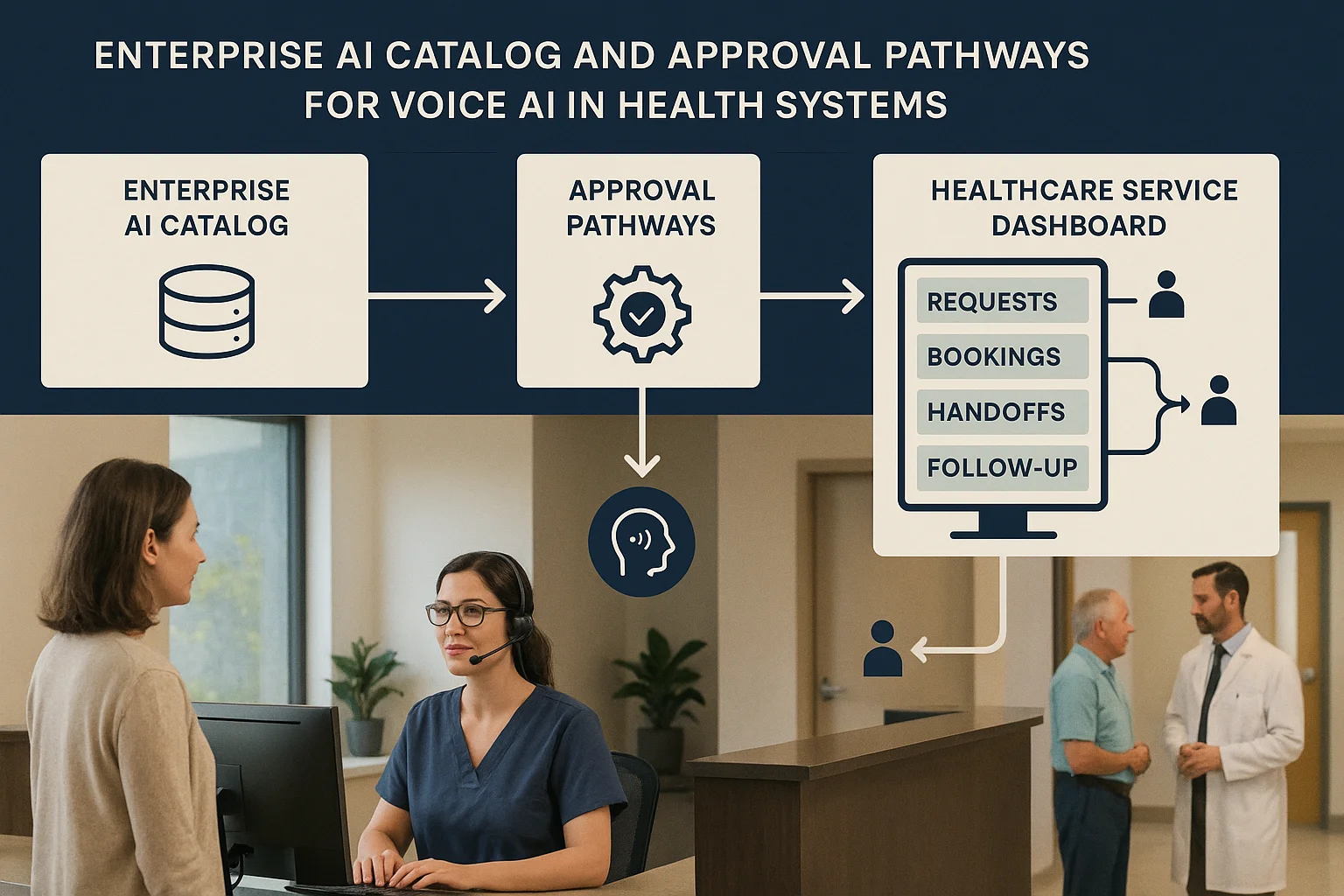
An enterprise Voice AI catalog is a concise register of approved voice capabilities, with one line per capability describing intent, permitted actions, data elements used, downstream systems, required controls, and acceptable failure modes. The catalog replaces ad-hoc deployments with repeatable governance and ensures clinical and legal stakeholders can review scope before a capability is activated.
- Record: name, intent, caller eligibility, allowed API calls, and retention policy.
- Label: risk tier (low/medium/high) and approval status (draft/approved/retired).
- Owner: assign a business owner (patient access, contact centre lead) and a technical owner (integration or platform team).
Why catalogue items reduce enterprise risk
Cataloging forces early decisions about data flows, identity controls, and escalation points. It also makes it possible to measure outcomes by capability—e.g., failed bookings handed to staff, confirmation rates, or misrouted calls—so governance can prioritise fixes and retraining.
- Predefined fallbacks ensure a capability never silently performs an unapproved action.
- Cataloged capabilities let compliance run narrow audits rather than large, costly program reviews.
2. A practical Voice AI use case: scheduling and intake
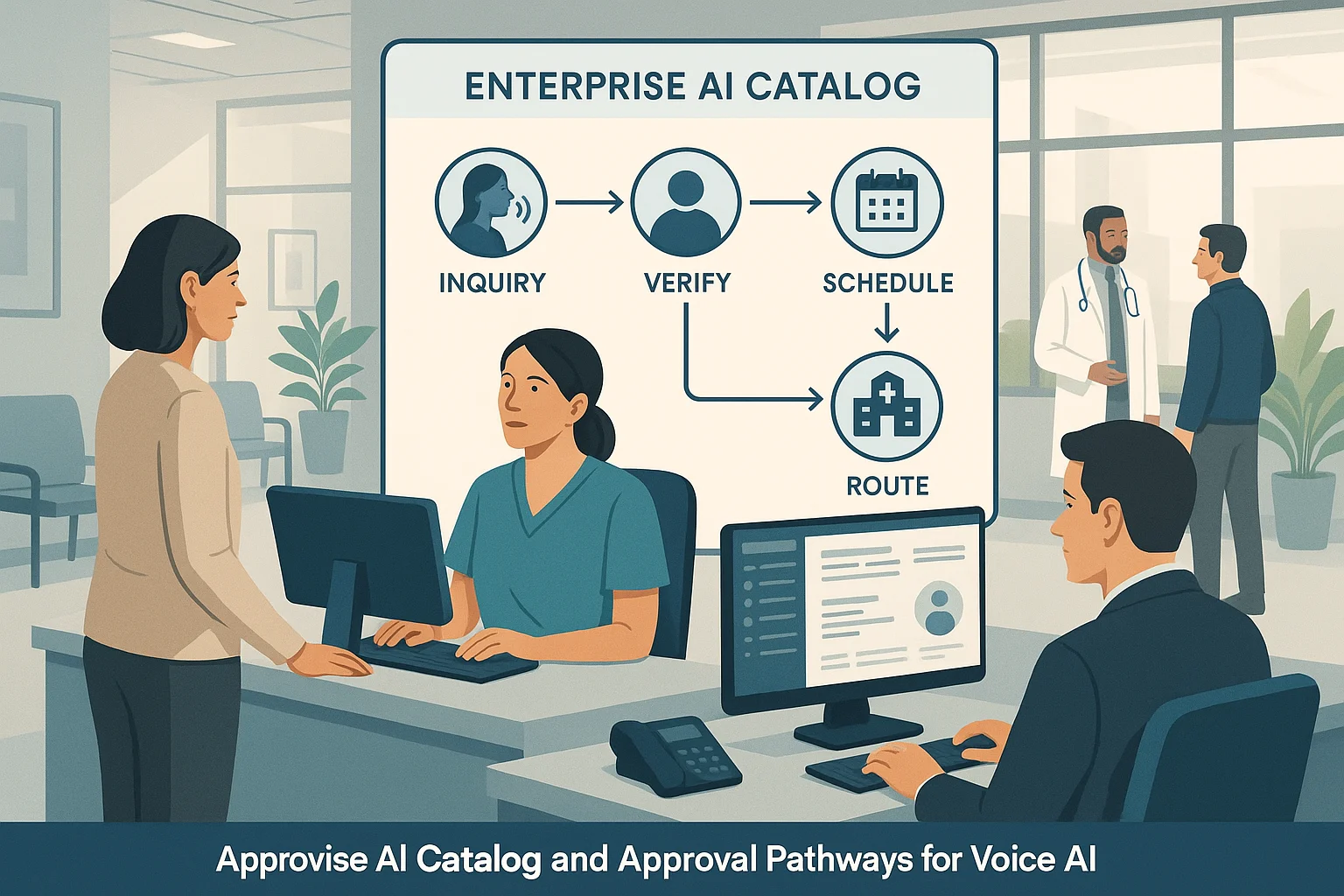
Scheduling and intake are high-volume, operationally valuable use cases that must include identity, availability validation, and safe human handoff.
Operational workflow (caller to confirmation)
Design the workflow to keep clinical and high-risk decisions out of automated scope. A minimal safe workflow is: Caller or patient initiates call → Voice AI captures intent and identity cues → identity validation (token, DOB, callback verification) → availability lookup via approved scheduling API → provisional booking with confirmation prompt → either completed booking or structured escalation to staff.
- Enforce immediate escalation for ambiguous intent, urgent language, or requests outside permitted scope.
- Use provisional bookings with a confirmation step to avoid unvalidated appointments.
- Store only the minimum data required for booking and avoid recording or retaining sensitive clinical details.
Boundary controls: what Voice AI must not do
Define forbidden actions explicitly. Voice AI should never: diagnose, triage emergencies, prescribe, change clinical orders, or make clinical eligibility judgments. Any utterance indicating urgent or clinical deterioration must trigger a defined escalation to trained staff.
- Block intents containing clinical terms that imply triage; map them to escalation scripts.
- Use conservative intent detection thresholds to reduce false acceptance of complex clinical questions.
3. Approval pathways and risk tiers
Approval pathways are the process rules and gates that move a catalog item from draft to production. Use a risk-tier model to make reviews predictable and resourced.
Risk tiers and required approvals
Classify catalog items into at least three tiers: Low (administrative, no PHI), Medium (requires limited PHI or changes bookings), High (identity verification, access to PHI, or any clinical-touch). Each tier requires increasingly formal review: Low—product owner signoff; Medium—privacy and IT review; High—clinical governance, legal, privacy, and formal security assessment.
- Define acceptance criteria for each tier (e.g., test pass-rate, fallback coverage, auditability).
- Require documented failure-mode remediation plans for Medium and High items.
Approval gates and testing
Approval gates should include threat modelling, integration tests against staging APIs, human-in-the-loop (HITL) scenario testing, and a pilot phase with narrow caller segments. Use canary releases and percentage-based rollouts for Medium items; require full manual signoff for High items.
- Require test data and scenario sets that include boundary and failure cases.
- Maintain a rollback plan and service-level objectives for escalation response times.
4. Architecture, integrations and reliability
Design an architecture that enforces controls at clear integration boundaries and provides observability for operational teams.
Recommended architecture pattern
Adopt a simple, enforceable flow: Caller → Voice AI front-end → identity and field validation layer (adapter) → approved scheduling/EHR API → confirmation or escalation. Keep the adapter layer as the control point for logging, permission enforcement, data minimisation, and retries.
- Adapters translate voice intents to business APIs and enforce allowed actions per catalog item.
- Adapters hold credentials securely and log only the metadata necessary for audits.
- Plan hosting regions, backup regions, and subprocessors; document cross-border transfers and retention policies for each catalog item.
Integration ownership and reliability
Explicitly assign ownership for each integration: platform provider (Voice AI), integration owner (IT), and business owner. Define escalation SLAs for integration failures, and use health checks and synthetic transactions to detect silent failures (e.g., a nightly scripted booking attempt).
- Separate observability: call-level telemetry in the Voice AI platform, API-level metrics in the adapter, and business metrics in scheduling systems.
- Deploy canaries and circuit breakers to prevent cascading failures into EHR/PM systems.
Related Peak Demand resources
For architecture and integration patterns, see Peak Demand’s guidance on building reliable Voice AI integrations and routing systems. These materials explain common adapter designs and how to stabilise queues and handoffs.
- Healthcare Communication Architecture with Voice AI Integrations — for adapter and routing patterns.
- Hospital Voice AI Call Center Automation & Routing Systems — for enterprise-grade deployment and routing.

5. Safety, governance and compliance controls
Implement controls that make Voice AI auditable, safe, and aligned with broader AI governance expectations—particularly where health and patient data are involved.
Ethics and regulatory alignment
Align governance with established AI ethics and risk frameworks. Use ethics review for High-tier items and align policies to transparency and human oversight principles. Where local regulation applies, confirm obligations with counsel and privacy officers.
- Document decision-making rationale and maintain artefacts to support audits.
- Provide transparent caller messaging on what the Voice AI will and will not do.
Operational safety controls
Implement these concrete operational controls: identity verification (knowledge-token, callback confirmation, SMS/OTP where permitted), field validation against authoritative APIs (patient IDs, clinic availability), robust escalation triggers, mandatory audit trails, and routine human-review sampling.
- Record intent confidence and make it available to staff during handoff.
- Keep recorded audio and transcripts under explicit retention and consent policies; separate storage for PII and keep access controls tight.
- Use human review on a percentage of calls, increased for new models or after configuration changes.
Escalation logic and handoffs
Escalation should be deterministic: any ambiguous intent, low confidence in identity, or a caller-stated clinical issue triggers an immediate, logged handoff to a human. Hand-off packets should contain only the minimum context necessary and the model confidence score; never inject clinical advice into the packet.
- Design handoff scripts and SLAs for response times and required staff qualifications.
- Use human-in-the-loop review to correct intent mappings and reduce repeat escalations over time.
6. Procurement, vendor evaluation and managed services
Procurement must test beyond marketing claims. Insist on operational evidence and contractual clarity for data flows, subprocessors and support access.
What to require in RFPs and contracts
Ask vendors for architecture diagrams, a list of subprocessors, hosting regions and backup geography, typical retention windows for recordings, and their approach to identity verification. Require evidence of SLAs for integration uptime, escalation response, and incident remediation. Clarify who owns adapters and custom mappings—this avoids operational ambiguity during incidents.
- Contractually require notification of subprocessors and material changes to data flows.
- Define support and on-call responsibilities for outages affecting scheduling/EHR APIs.
Evaluating managed services vs. in-house builds
For enterprise buyers, managed services reduce operational overhead but must still deliver transparency. Require managed-service vendors to provide telemetry access, audit logs, and the ability to export data for independent review. Where Peak Demand provides managed services, we emphasise custom Voice AI, secure integrations for scheduling and intake, identity verification, safe escalation, and explicit audit trails.
- Demand a test period, synthetic transaction evidence, and demonstration of incident playbooks.
- Confirm remote-support access patterns and subprocessors before deployment.
Further reading on vendor evaluation
Peak Demand’s operational buyer guides explain what to expect from managed Voice AI services and how healthcare organisations evaluate vendors against operational and governance requirements.
- How Healthcare Organizations Evaluate AI Vendors — procurement and evaluation criteria.
- Managed Voice AI Services: What Enterprise Buyers Should Expect — practical managed-service deliverables.
Related Peak Demand resources
Industry and AI sources reviewed
- Artificial Intelligence Risk Management Framework (AI RMF 1.0)National Institute of Standards and Technology (NIST)
- Ethics and governance of artificial intelligence for healthWorld Health Organization
- Regulatory considerations on artificial intelligence for healthWorld Health Organization
- OECD AI PrinciplesOrganisation for Economic Co-operation and Development
Healthcare privacy, security, clinical-safety, records, and professional obligations vary by jurisdiction and workflow. This article is operational guidance, not legal advice; organizations should confirm applicable requirements with qualified professionals.
Frequently asked questions
Administrative workflows such as appointment booking, changes and cancellations, referral-status intake, approved follow-up, patient-access questions, after-hours overflow, and structured routing are common starting points. Clinical judgment, diagnosis, emergency triage, and prescribing decisions must remain with qualified professionals.
Use the minimum identifiers approved by the organization, validate them against the system of record, avoid exposing unnecessary information, and provide a human-assisted path when verification fails. The system should not infer identity from conversational context alone.
The agent should follow the organization's approved escalation and emergency-routing rules, avoid clinical advice, and transfer or direct the caller to the appropriate human or emergency channel. Those rules must be tested with realistic language and failure cases.
Request identity and privacy controls, scheduling or EHR integration behavior, audit logs, escalation rules, downtime handling, testing evidence, change control, monitoring, and clear separation between administrative automation and clinical decision-making.
Design a safe patient-service workflow before automating it
Peak Demand helps healthcare organizations connect Voice AI to scheduling, intake, patient communication, identity checks, escalation, and reporting with clear operational boundaries.
Schedule a discovery call


