
Decommissioning Legacy Telephony: A Governance Playbook for Voice AI in Health Systems
A decision-ready playbook for replacing legacy telephony with governed Voice AI in health systems. Practical architecture, controls, procurement checks, and safe escalation.
1. Why decommission legacy telephony now
Legacy PBX and IVR estates become brittle, costly, and operationally opaque for modern patient access strategies. Decommissioning should be driven by a governance program that protects patient safety, privacy, and continuity of access.
Business and operational drivers
Health systems choose Voice AI to reduce manual triage load, simplify after-hours coverage, and improve scheduling throughput. But the business case must include non-financial goals—measurable improvements in containment (self-serve where appropriate), reduced time‑to‑answer for critical queues, and predictable escalation quality. Replace legacy telephony only with explicit migration metrics: percent of calls handled autonomously within defined non-clinical scope, escalation success rate, and audit-complete handoffs.
- Define measurable migration KPIs before cutover (containment, escalation handoff quality, appointment confirmation rate).
- Map legacy call types to new operating categories: administrative, scheduling, medication refills (administrative), clinical advice, emergency (clinical).
- Ensure continuity for critical paths (ambulatory scheduling, urgent callbacks, nurse lines) during and after cutover.
Risks of an unmanaged rip-and-replace
Removing legacy telephony without governance risks service gaps, improper clinical handoffs, privacy breaches, and audit failures. Common failure modes include misrouted urgent calls, missing consent or recording notifications, incomplete EHR/PM linkages, and opaque subprocessors handling patient audio.
- Unvetted vendor subprocessors may store or process voice data across borders—assess transfer mechanisms and retention policies.
- Poor escalation logic creates delays or forces staff to do duplicative work (fixing AI-captured data).
- Lack of audit trails hinders incident investigation and quality assurance.
2. Governance fundamentals and safety boundaries
A governance-first approach defines roles, policy controls, and clinical boundaries before any technical cutover. Governance must be measurable, auditable, and resourced.
Policy, roles and human oversight
Establish a cross-functional steering committee—patient access, clinical governance, privacy/compliance, IT, and contact centre leaders. Assign a program owner and named approvers for: scope of automation, escalation criteria, identity verification policy, data retention, and rollout phasing. Define human-in-the-loop (HITL) thresholds: the set of call intents that always route to a clinician or trained staff, and the sampling rates for post-call human review.
- Document who can change intent logic, escalation thresholds, or scheduling API connectors.
- Require named clinical sign-off on any content or prompts that could influence care-seeking behaviour.
- Implement continuous QA with daily or weekly human review of escalations and sampled autonomous calls.
Clear clinical/non-clinical boundaries
Define and enforce operational boundaries: administrative tasks (scheduling, directions, intake) are suitable for automation in controlled scopes. Clinical activities—diagnosis, triage of emergencies, prescribing—must not be automated. Where patient language suggests clinical risk, the system should escalate immediately and clearly without asking for further clinical prompts.
- Maintain a conservative escalation policy: ambiguous or symptom-descriptive language triggers escalation.
- Log all triage handoffs with timestamped context and who received the call.
- Train staff to expect partial information from AI handoffs and to confirm critical details immediately.
3. Technical operating model: architecture and controls
Translate governance into a simple, auditable operating model that ties caller identity, validation, scheduling APIs, and escalation together.
Canonical patient-call flow
Adopt a single canonical flow for patient calls to avoid split‑path complexity: Patient or caller → Voice AI (intent capture & NLP) → identity validation & field-level verification → approved scheduling/service API → confirmation or human handoff. Keep each step auditable and reversible.
- Use short, explicit prompts for identity fields; verify with multi-factor or challenge questions where policy requires.
- Only write to scheduling/EHR/PM systems via approved, authenticated APIs with role-limited service accounts.
- Persist structured call metadata and a non-reversible hash of audio for audit; store recordings only where consent and policy permit.
Identity, validation and audit controls
Identity verification must be risk‑proportionate: basic caller confirmation for standard scheduling, stronger verification for protected services (e.g., medication pickup). Implement field validation (format checks, cross-check against demographic fields in the EHR/PM), challenge-response for suspicious matches, and an auditable trail linking the call to the scheduling transaction.
- Log ID proofing steps, verification outcomes, and the identity of any human reviewer.
- Enforce least-privilege API access; use scopes that separate read-only demographic queries from write scheduling permissions.
- Keep a configurable retention policy for recordings and structured transcripts; capture consent state in the transaction.

4. Implementation controls, QA and observability
Testing and live monitoring are essential to safe operations. Define QA gates and observability requirements that map to your KPIs and governance obligations.
Staged rollout and acceptance tests
Use progressive exposure: vendor sandbox → internal staff-only trials → pilot with low-risk clinics → incremental scaling. Acceptance tests should simulate real caller language, false positives/negatives for intent detection, escalation timing, and API failure modes.
- Run synthetic and live-call tests to validate identity flows and scheduling writes in a non-production environment.
- Define acceptance criteria for intent accuracy only in scoped non-clinical domains; require human sign-off for each expansion of scope.
- Test and document rollback steps for each release, including cutover back to legacy telephony or operator consoles.
Monitoring, observability and QA sampling
Implement dashboards for containment, escalation rates, handoff completeness, API errors, and time-to-resolution. Set up automated alerts for spikes in escalations, failed scheduling writes, and repeated automation failures for specific intents.
- Operationalize human review sampling on autonomous calls and all escalations for a defined period after any change.
- Log correlation IDs across Voice AI, middleware, and scheduling API for end-to-end traceability.
- Include quarterly governance reviews to assess drift, false escalation patterns, and vendor performance.
Escalation design and handoffs
Design escalation so staff receive concise, structured context and a confidence score, with a link to the recording/transcript. Handoffs must prioritise patient safety: for suspected emergencies, the AI must not perform further triage and must transfer immediately.
- Use structured handoff packets: reason for call, captured fields, verification status, confidence, and last AI prompt.
- Measure handoff quality: percent of escalations with complete packets and median staff handling time.
- Train operators to confirm identity and critical clinical facts and to document any corrective updates to the record.

5. Procurement, contracts and vendor evaluation
Contracts must reflect the governance model: vendor obligations on subprocessors, data flows, transparency, and support for audits.
RFP and technical requirements
Include explicit RFP language requiring: integration patterns, acceptance testing support, deployment region and backup region, subprocessor lists, remote-support processes, logging granularity, and human-review tooling. Require vendors to describe how they implement identity proofing, orchestration adapters, and audit log retention.
- Ask for a runbook demonstrating failure scenarios and rollback steps.
- Require explicit statement of what the Voice AI will and will not do (scope exclusions).
- Request sample compliance and architecture documentation; include references to how they support enterprise QA and governance.
Contractual controls and SLAs
Negotiate SLAs for uptime, API write success rates, escalation latency, and support response. Include rights to audit, subprocessors change notification, and data export formats to enable migration if you switch vendors.
- Define consequential remediation steps for repeated handoff failures or privacy incidents.
- Require data export and portability formats for recordings, structured transcripts, and audit logs.
- Include security requirements (authentication, encryption in transit and at rest) and clear incident notification timelines.
Managed services and scope clarity
Be explicit about managed-service boundaries. Who owns intent tuning, prompt updates, field validation rules, and orchestration adapters? Clarify change control: minor updates (prompt copy) vs. major workflow changes (new scheduling connector).
- Map ownership for each component: Voice AI model, middleware, scheduling adapters, monitoring dashboards, human-review workflows.
- Ensure the vendor can support incremental updates and has a documented rollback process.
- Require transparency on whether the vendor’s managed instance is multi-tenant and how tenant isolation is maintained.
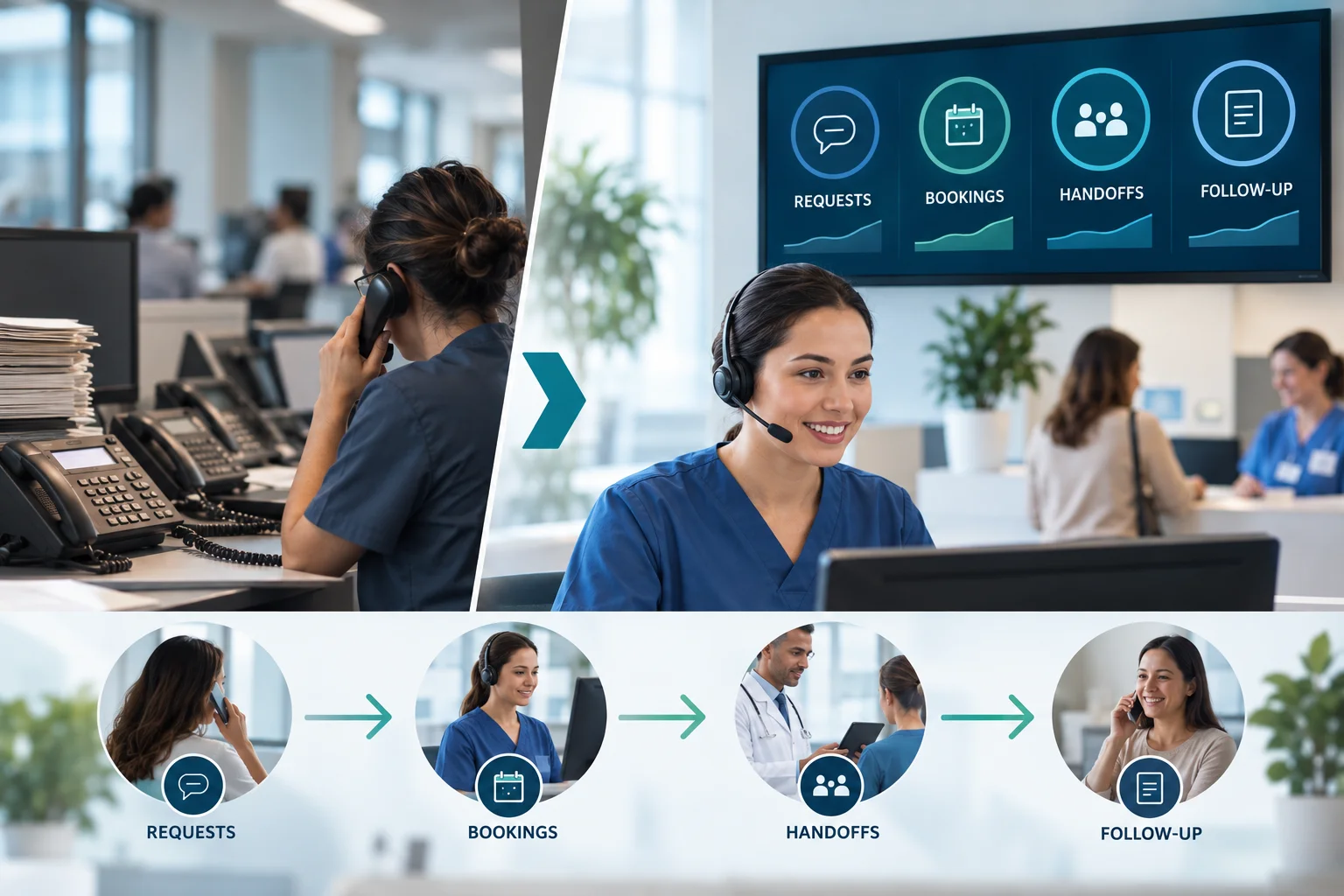
6. Decommission checklist and cutover playbook
A practical, stepwise cutover reduces operational risk. Treat decommissioning as reversible until the new system proves steady-state performance.
Pre-cutover readiness
Confirm all governance gates: clinical sign-offs, privacy approvals, signed vendor contracts, completed acceptance tests, and staff training. Validate identity rules, escalation workflows, and monitoring dashboards.
- Complete a scheduled pilot with at least one clinic and validate KPIs for several weeks.
- Ensure operator consoles have clear paths to take calls mid-hand-off and that staff training is documented.
- Publish a public patient communication plan (voicemail announcements, website notices) for the transition window.
Cutover and fallback operations
Execute the cutover in phases and retain the legacy telephony in hot-standby. Monitor early metrics closely and keep rollback triggers pre-defined (e.g., sustained increase in escalations or API error rates).
- Begin with low-risk hours or specific clinics, escalate to more traffic only after stability is demonstrated.
- Enable immediate fallback routing to human operators or legacy IVR if handoff completeness or scheduling writes degrade.
- Maintain a 24/7 incident line during the first weeks of live traffic and schedule daily governance reviews until steady state.
Post-cutover review and full decommission
After a stable period, conduct a formal review: audit logs, incident reports, QA sampling, and staff feedback. Only retire legacy systems once regulatory, contractual, and operational artefacts are archived and accessible.
- Export all required records from the legacy system and verify retention policies.
- Perform a security and privacy audit of the new environment and remediate any gaps.
- Document lessons learned and incorporate them into ongoing governance cycles.
Related Peak Demand resources
Industry and AI sources reviewed
- Ethics and governance of artificial intelligence for healthWorld Health Organization
- Artificial Intelligence Risk Management Framework (AI RMF 1.0)National Institute of Standards and Technology (NIST)
- Regulatory considerations on artificial intelligence for healthWorld Health Organization
Healthcare privacy, security, clinical-safety, records, and professional obligations vary by jurisdiction and workflow. This article is operational guidance, not legal advice; organizations should confirm applicable requirements with qualified professionals.
Frequently asked questions
Administrative workflows such as appointment booking, changes and cancellations, referral-status intake, approved follow-up, patient-access questions, after-hours overflow, and structured routing are common starting points. Clinical judgment, diagnosis, emergency triage, and prescribing decisions must remain with qualified professionals.
Use the minimum identifiers approved by the organization, validate them against the system of record, avoid exposing unnecessary information, and provide a human-assisted path when verification fails. The system should not infer identity from conversational context alone.
The agent should follow the organization's approved escalation and emergency-routing rules, avoid clinical advice, and transfer or direct the caller to the appropriate human or emergency channel. Those rules must be tested with realistic language and failure cases.
Request identity and privacy controls, scheduling or EHR integration behavior, audit logs, escalation rules, downtime handling, testing evidence, change control, monitoring, and clear separation between administrative automation and clinical decision-making.
Design a safe patient-service workflow before automating it
Peak Demand helps healthcare organizations connect Voice AI to scheduling, intake, patient communication, identity checks, escalation, and reporting with clear operational boundaries.
Schedule a discovery call


