Consent-Aware Patient Identity & EHR Reconciliation for Voice AI in Health Systems
Practical guidance for deploying Voice AI that verifies patient identity, captures consent, and reconciles requests with EHR/scheduling systems—while preserving safety, auditability, and regulatory boundaries.
1. Why consent-aware identity matters for Voice AI
Voice AI promises improved access and reduced friction for appointment booking, routine inquiries, and after‑hours intake. But these benefits depend on reliably linking the caller to the correct patient record and ensuring the caller has lawful authority to request changes. This section explains the operational risks and the high-level controls that reduce them.
Operational risks in absence of robust identity controls
Common failures without layered identity and consent controls include wrong‑patient bookings, unauthorized record access, duplicate chart creation, and untraceable schedule changes. These errors create patient safety exposure, privacy incidents, and audit challenges. For patient‑access leaders and IT, the probability of such failures rises when Voice AI is given direct write access to scheduling or EHR records without effective pre‑write validation.
- Misbooked appointments tied to the wrong medical record (fragmentation and safety risk).
- Unauthorized changes to sensitive fields (billing, contact data, clinical notes).
- Loss of a clear audit trail linking the caller, consent, and action taken.
- Regulatory exposure when consent capture and processor locations are ambiguous.
A deterministic operating model reduces risk
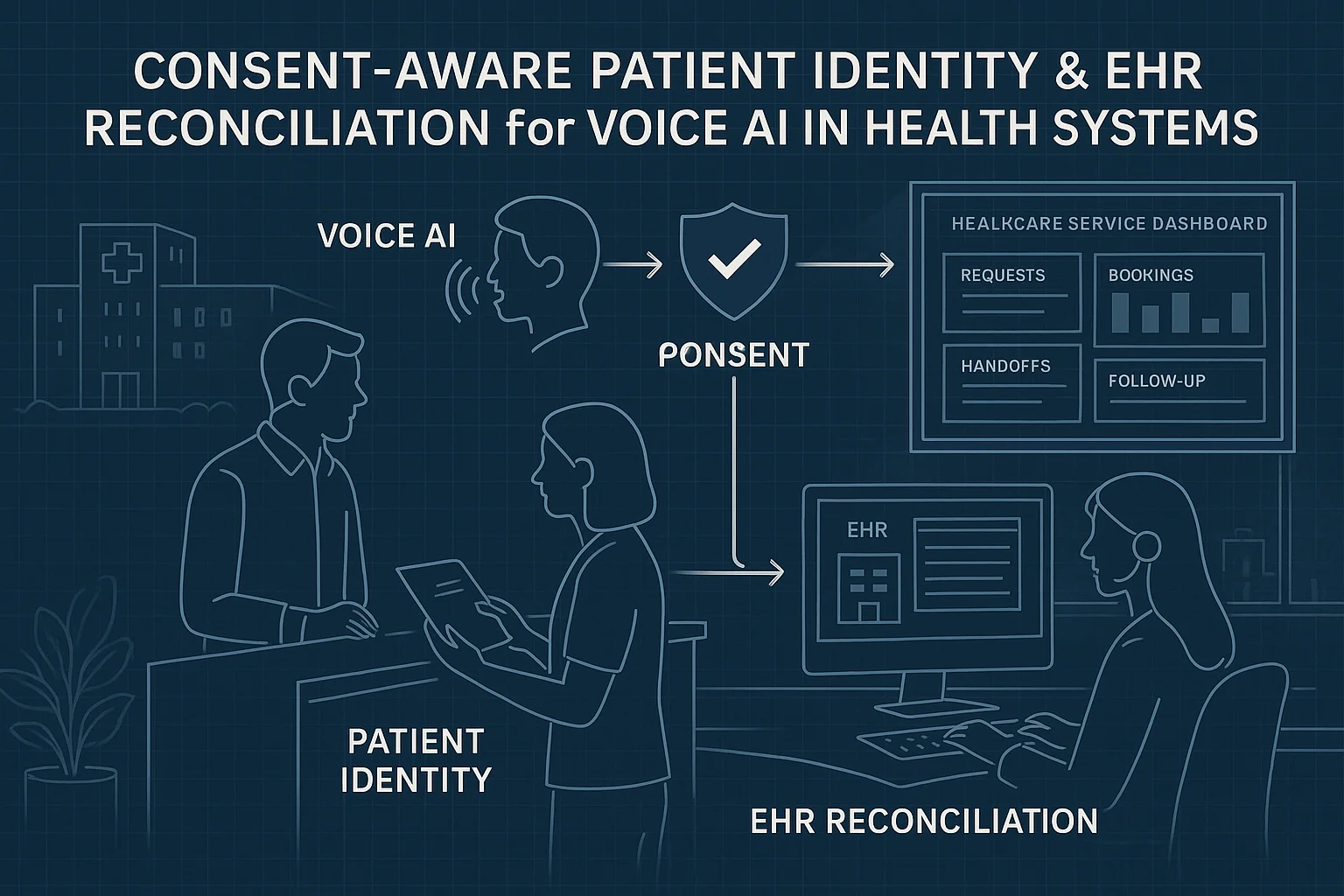
Adopt a deterministic flow that limits automated actions to low‑risk, reversible operations and requires stronger validation for higher-risk changes. A recommended pattern: Caller or patient → Voice AI session (NLP + IVR) → identity & consent controls (evidence checks, session tokens) → controlled scheduling/EHR API adapter (pre‑write validation) → confirmation, recording, and human handoff if needed. This model keeps the logic simple for audits and procurement and defines clear guardrails for automation.
- Classify actions by risk: read-only, booking/administrative, and record-modifying clinical or billing changes.
- Only allow booking/administrative actions after session-scoped, auditable consent is captured.
- Require human authorization or multi-factor checks for any clinical or billing edits.
2. Identity verification: practical flows and choices
Identity verification must be resilient, privacy-preserving, and proportionate to the risk of the requested action. The following flows describe progressively stronger verification levels and the controls required at each level.
Level A — Low friction checks for low‑risk actions
Use Level A for read-only inquiries (hours, directions) and simple appointment status checks. These flows prioritize patient experience and rely on low-risk evidence such as caller phone number match, simple knowledge checks, or callback verification.
- Match incoming caller ID to phone numbers on file; if matched, grant read-only access or allow messaging.
- If caller ID mismatches, offer callback to a number on record (session token expires after callback attempt).
- Log the session token, matched evidence, and the action allowed (read-only).
Level B — Administrative actions and bookings
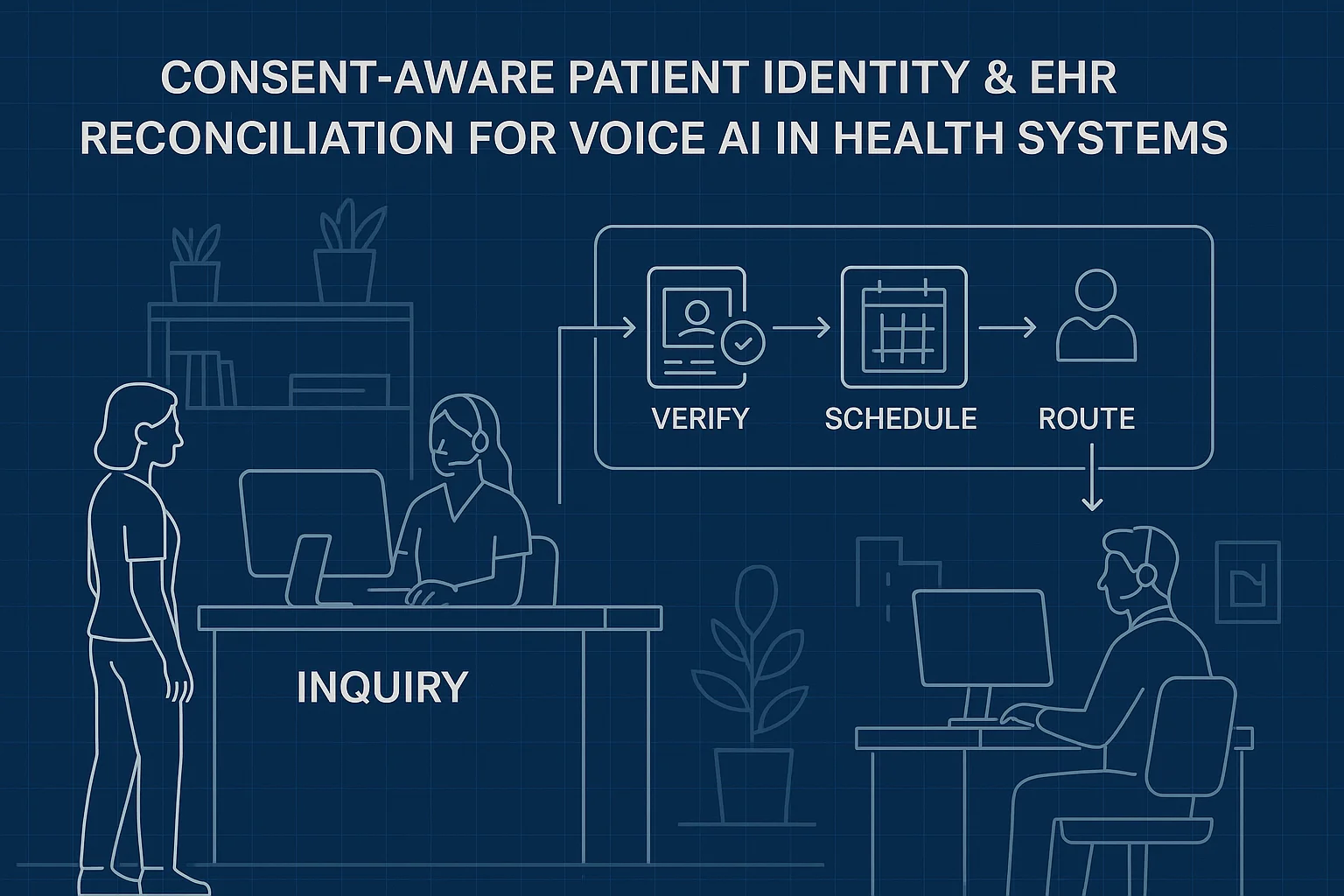
Level B is for booking, rescheduling, cancellations, and limited demographic updates. Combine two or more evidence points: caller ID, knowledge-based questions, short PINs, or one-time passcodes (OTP) delivered to a verified channel.
- Require at least two independent evidence elements before permitting booking or demographic edits.
- Capture affirmative, session‑scoped consent before the system writes to scheduling APIs; include timestamp, agent (AI or human), and scope of consent.
- If any evidence check fails, route to a human agent and record the reason for escalation.
3. Consent capture, session tokens, and auditability
Consent must be explicit, auditable, and scoped to the requested action. Implement session tokens and retention rules to tie consent to subsequent API operations and to support incident response.
Explicit, scoped consent templates
Design short, plain-language consent prompts that state the identity-verified person, the specific action (for example: “book an appointment for [patient name] on [date/time]”), and retention/recording terms. Store both the consent transcript and a structured consent record (actor, scope, timestamp, method of verification).
- Use affirmative language: do not rely on inferred or passive consent.
- Require the caller to confirm key details before proceeding (patient name spelling, DOB, requested service).
- Record the audio transcript and a structured consent token that travels with the session.
Session tokens and timeboxing actions
Issue short‑lived session tokens after identity verification and consent capture. The token must be presented to downstream scheduling or EHR adapters and must enforce a narrow scope: permitted endpoints, allowed operations, and expiry. Tokens should expire on logout, after a single write operation, or after a short time window (configurable by risk class).
- Tokens link the caller identity, consent record, and permitted API actions.
- Downstream adapters must validate token integrity and scope before executing writes.
- Keep tokens single-use for record-modifying operations where feasible.
4. EHR and scheduling integration patterns
Integrations must be designed to avoid race conditions, duplicate records, and unauthorized writes. Use controlled adapters, pre‑write validation, and reconciliation workflows to preserve record integrity.
Controlled adapter pattern
Isolate EHR or practice-management system access behind a purpose-built adapter that validates session tokens, applies business rules, and exposes a limited set of operations. Adapters mediate all writes, perform idempotency checks, and return structured reconciliation results for human reconciliation if confidence is low.
- Adapter tasks: token validation, record match scoring, duplicate detection, idempotency enforcement, and structured response payloads.
- Keep a read‑only shadow copy where the Voice AI can display candidate matches without performing writes.
- Use strict schema contracts and test harnesses during procurement to validate adapter behavior against common failure modes.
Record matching and reconciliation
Record matching should be probabilistic but auditable. Produce a small set of candidate records and a confidence score. Define reconciliation rules: automatic commit above a high confidence threshold, require human confirmation at medium confidence, and deny automated action at low confidence.
- Surface normalized identifiers (medical record number, DOB, last visit date), masked where appropriate, to the verification flow.
- Log the match algorithm version and parameters used in each decision to support post‑hoc review.
- If automatic commit occurs, append a reconciliation note and retain the audio and consent artifacts.
Interfacing with scheduling and call-confirmation
For appointment bookings, the adapter should validate provider availability via scheduling API, reserve a tentative slot, capture consent, then commit the booking as a transaction. Always confirm back to the caller with clear next steps (confirmation number, rescheduling policy, how to contact human staff).
- Implement tentative locks or soft holds to prevent double-booking during IVR interaction.
- Return human-readable confirmations and machine-readable receipts that the call can email or SMS if consented.
- Ensure adapters surface failure reasons to the Voice AI so it can prompt for escalation when needed.

5. Safety, governance, and failure boundaries
Healthcare Voice AI must operate within strict safety boundaries. Define policies for clinical scope, human oversight, observability, and incident response.
Clinical boundaries and escalation rules
Explicitly forbid Voice AI from performing triage, diagnosis, prescribing, or making clinical decisions. Use keyword spotting and confidence thresholds to detect clinical content and immediately transfer the call to a trained clinician or operator. Document the escalation path and response SLAs.
- Detect phrases indicating urgency (chest pain, difficulty breathing) and escalate automatically.
- When caller intent is ambiguous or model confidence is low, route to human handlers rather than guessing.
- Maintain scripted handoff prompts to ensure continuity and transfer of context.
Observability and periodic assurance
Implement operational observability: session telemetry, match-confidence distributions, false-match incidents, escalation rates, and human override frequency. Use these metrics in governance reviews and to tune verification thresholds.
- Track KPIs by clinic, by vendor model version, and by action risk class.
- Schedule quarterly model‑performance and safety reviews with representation from clinical, privacy, IT, and patient-access teams.
- Use live call sampling and red-team exercises to identify edge cases and failure modes.
Data residency, subprocessors, and legal duties
Clarify where session artifacts are stored, which subprocessors process them, and how cross‑border transfers are handled. Document backup geographies, remote‑support access, retention, and recording-of-consent obligations in vendor contracts. Organizations must validate these details against local legal counsel.
- List hosting region and backup region for session and audit data in procurement documents.
- Require vendors to disclose subprocessors and remote-support access methods for audits.
- Clarify breach notification timelines and responsibilities in the event of incidents.
6. Procurement, deployment and measurable outcomes
Select vendors and define pilots with operational test-cases, clear SLAs, and governance artefacts. This final section offers procurement criteria, pilot design, and measurement guidance.
Procurement checklist for Voice AI with identity & EHR reconciliation
Procure systems that expose adapters, test harnesses, and audit logs. Require documentation on identity flows, token semantics, and integration patterns. Confirm the vendor’s capacity to customize verification thresholds and to produce reproducible reconciliation logs.
- Require an integration test plan against your EHR/scheduling sandbox with sample mismatch scenarios.
- Ask for documented adapter contracts, including idempotency behavior and error handling.
- Insist on role-based access controls for audit artifacts and a clear subprocessors list.
Pilot design and success criteria
Run a time-boxed pilot focused on a limited action set (e.g., appointment booking for a single clinic). Define quantitative and qualitative success metrics: successful verified bookings, mistaken-match rate, escalation rate, average time to resolution, and patient satisfaction. Include human-in-the-loop checks and a correction workflow during the pilot.
- Start with low-risk booking flows and progressively expand as confidence increases.
- Set explicit thresholds for automatic commit confidence and for when human review is required.
- Use sampled call review to validate that consent prompts are understood and recorded correctly.
Operational handoff and long-term governance
Transition from pilot to steady-state with a documented governance board, change-control procedures for model or threshold updates, and scheduled audits. Define incident escalation and patient-complaint handling tied to the audit trail.
- Create a cross-functional governance group including patient access, privacy, and clinical leadership.
- Require vendor support SLAs for adapter failures and data‑integrity incidents.
- Maintain a continuous improvement loop informed by observability metrics and patient feedback.
Related Peak Demand resources
Industry and AI sources reviewed
- Ethics and governance of artificial intelligence for healthWorld Health Organization
- Artificial Intelligence Risk Management Framework (AI RMF 1.0)National Institute of Standards and Technology (NIST)
- Regulatory considerations on artificial intelligence for healthWorld Health Organization
- OECD AI PrinciplesOrganisation for Economic Co-operation and Development
Healthcare privacy, security, clinical-safety, records, and professional obligations vary by jurisdiction and workflow. This article is operational guidance, not legal advice; organizations should confirm applicable requirements with qualified professionals.
Frequently asked questions
Administrative workflows such as appointment booking, changes and cancellations, referral-status intake, approved follow-up, patient-access questions, after-hours overflow, and structured routing are common starting points. Clinical judgment, diagnosis, emergency triage, and prescribing decisions must remain with qualified professionals.
Use the minimum identifiers approved by the organization, validate them against the system of record, avoid exposing unnecessary information, and provide a human-assisted path when verification fails. The system should not infer identity from conversational context alone.
The agent should follow the organization's approved escalation and emergency-routing rules, avoid clinical advice, and transfer or direct the caller to the appropriate human or emergency channel. Those rules must be tested with realistic language and failure cases.
Request identity and privacy controls, scheduling or EHR integration behavior, audit logs, escalation rules, downtime handling, testing evidence, change control, monitoring, and clear separation between administrative automation and clinical decision-making.
Design a safe patient-service workflow before automating it
Peak Demand helps healthcare organizations connect Voice AI to scheduling, intake, patient communication, identity checks, escalation, and reporting with clear operational boundaries.
Schedule a discovery call


