
Clinical Model Lifecycle and Validation for Enterprise Voice AI in Health Systems
A practical, operational guide for healthcare leaders on model lifecycle, validation, integrations, and safe escalation when deploying Voice AI for patient access, scheduling and after‑hours intake.
1. Scope and clinical boundary
Before selecting models or vendors, define what your Voice AI will and will not do. This section clarifies administrative versus clinical responsibilities, so teams can set safe operating boundaries.
Administrative use cases vs clinical care
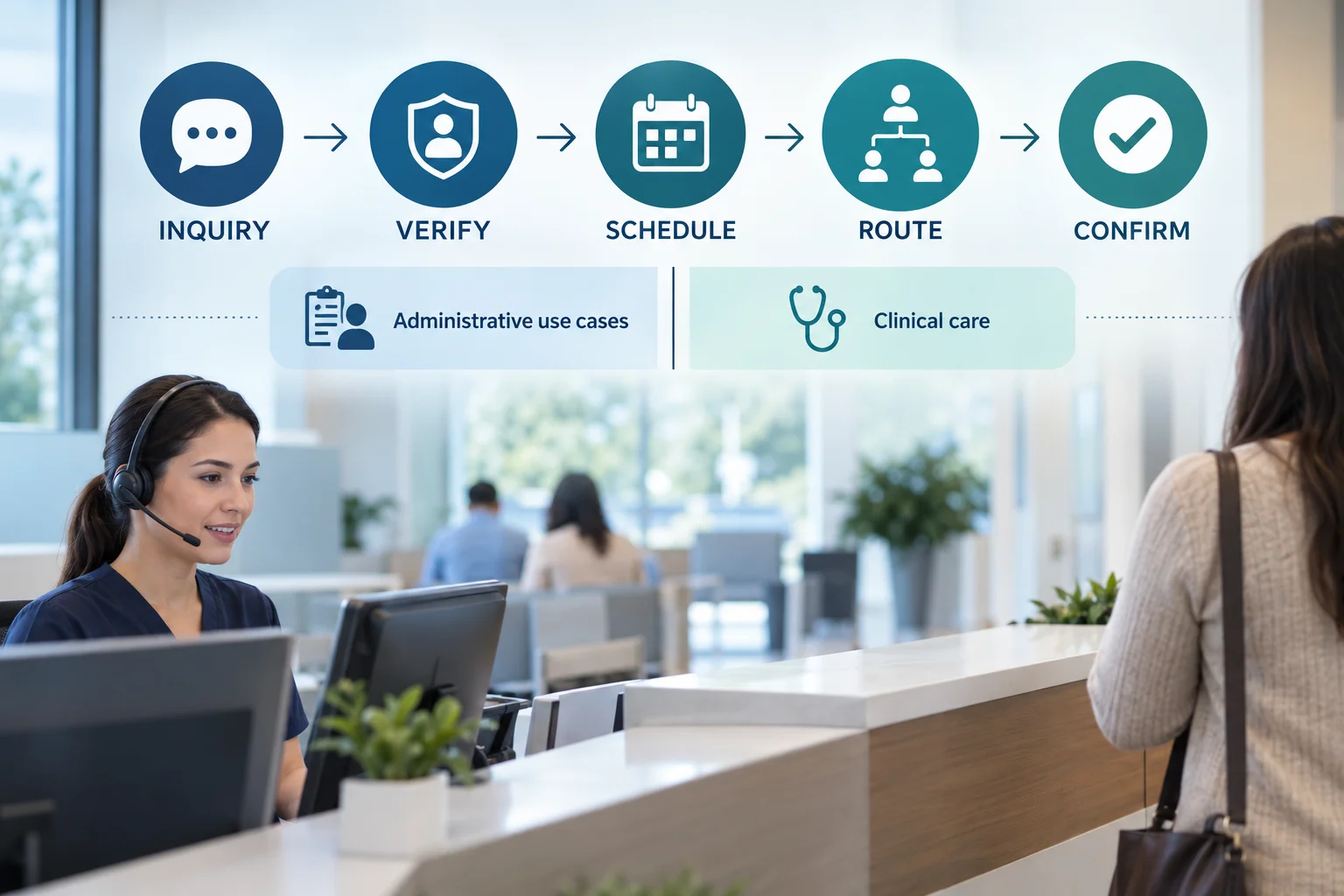
Voice AI delivers greatest operational value when focused on administrative and access workflows: appointment booking and confirmation, routine intake questionnaires, insurance and demographic verification, reminders, and triage-to-human for urgent cases. Explicitly exclude diagnosis, treatment recommendations, clinical triage of emergencies, and independent clinical decision-making from model responsibilities. Include clear prompts that escalate any ambiguous, symptomatic, or urgent language to trained staff.
- Allowed: appointment requests, date/time negotiation, contact details confirmation, simple pre-visit questions.
- Not allowed: interpreting symptoms to determine diagnosis, deciding clinical urgency, or changing treatment plans.
Workflow boundary: a canonical operating flow
Use a single, auditable flow to enforce boundaries: Patient or caller → Voice AI → identity and consent controls → validation layer (business rules and confidence checks) → approved scheduling or service API (PM/EHR adapter) → confirmation to caller or human handoff. This pattern keeps the model out of direct clinical writes and routes ambiguous or risky cases to clinicians.
- Place identity and consent controls upstream of any PII return or scheduling action.
- Keep all writes to clinical systems through a controlled adapter that enforces business rules and logging.
2. Practical use case: after‑hours scheduling and intake
An operational example shows how the lifecycle and safeguards map to real workflows. After‑hours coverage is a common, high‑value starting point for Voice AI in health systems.
Call handling and intent capture
Voice AI answers calls, captures caller intent using constrained grammars or classification models, and extracts structured slots (patient name, DOB, reason for call). Use intent models tuned to your specialty and local phrasing; prefer constrained prompts and menu-driven fallbacks for high‑risk or unclear utterances.
- Prefer short, explicit prompts (e.g., “Do you want to make, change, or cancel an appointment?”) rather than open-ended symptom queries.
- If caller language suggests urgency (chest pain, severe bleeding), escalate immediately to human triage and provide verbal guidance to seek emergency care.
Identity verification and consent in voice flows
Enforce identity checks before showing or writing protected data. Options include callback confirmation, knowledge-based questions, or tokenized one-time passcodes delivered by SMS. Capture verbal consent for recording and for sharing details with the scheduling system; persist consent records linked to the call ID.
- Do not proceed to appointment writes without passing identity and consent gates.
- Log token identifiers, consent time, and the adapter user account used for any downstream API ops.
Final action: scheduling adapter or human handoff
When confidence thresholds and business rules are met, the orchestration layer invokes the approved scheduling API or service adapter (EHR/PM or central call center queue). If thresholds fail, route to a human operator with a pre-populated workspace that contains captured slots, confidence scores, and reason for escalation.
- Use an adapter that enforces blackout periods, eligibility rules, and record linkage to avoid duplicate or improper writes.
- Provide the human operator with the voice transcription, summary, and an editable intake card to speed resolution.
3. Architecture and integrations
A reliable enterprise deployment requires clear separation of concerns: the voice model layer, orchestration and validation layer, secure adapters to business systems, and monitoring/audit infrastructure.
Recommended deployment architecture
Implement a tiered architecture: Edge voice gateway (SIP/Telephony) → Speech-to-text and intent model layer → Orchestration and validation layer (business rules, identity, consent) → Approved scheduling/service API via a controlled adapter → Confirmation/record and human queue. Keep the orchestration and adapters inside your security perimeter or a dedicated managed tenancy where you control subprocessors and data flows.
- Separate transcription and ephemeral model outputs from persistent clinical records; persist only what is necessary.
- Control adapters with service accounts, scoped tokens, and immutable audit trails of API calls and responses.
Integration patterns and EHR/PM considerations
Integrate scheduling via well-defined APIs or middleware. Avoid direct model writes to clinical notes or problem lists. Use idempotent operations, record linkage keys, and reconciliation processes to manage race conditions and duplicate requests.
- Use appointment APIs that support request/confirm/cancel with request IDs and conflict responses.
- Implement reconciliation jobs that reconcile voice-initiated actions against EHR records daily.
Security, data residency and subprocessors
Decide hosting region, backup geography, and subprocessors before procurement. Define remote-support access, log retention, recording consent policy, and breach-notification responsibilities contractually. When using managed vendors, require transparency on subprocessors and data export mechanisms.
- Document: hosting region, backup region, subprocessors, transfer mechanisms, retention periods for recordings and transcripts.
- Confirm contractual obligations for breach notification timelines and support for regulatory inquiries in applicable jurisdictions.
4. Model lifecycle and validation program
Model decisions are important, but the operational lifecycle — development, pre-production validation, staged deployment, and continuous monitoring — determines safety and reliability.
Development and pre‑production validation
Create test suites that mirror real caller language, including accents and background noise. Validate intent classification, slot extraction, and end‑to‑end orchestration using scenario-based acceptance tests. Include negative tests that model ambiguous, off‑task, or urgent utterances to verify escalation behaviors.
- Define acceptance metrics: intent accuracy at business‑relevant thresholds, false‑negative rate for urgent language, slot extraction accuracy for key fields.
- Use human-in-the-loop review for initial batches until model and orchestration confidence are stable.
Approval gates and clinical safety review
Require a multidisciplinary approval gate before production: operations, clinical leadership, privacy/compliance, and IT/security must sign off on workflows that interact with patients. Approval should verify that clinical boundaries are enforced and that escalation pathways meet staffing SLAs.
- Maintain checklists for clinical safety, data protection, and integration testing as part of the release artifact.
- Document who has authority to pause or roll back the system and under what conditions.
Continuous validation and drift detection
Monitor production for model drift, unusual failure modes, and changes in caller behavior. Sample conversations for human review, track confidence distributions, and alert when key metrics cross thresholds. Periodically retrain or retune models with de‑identified, consented data sets that reflect current operational vocabulary.
- Automate sampling: e.g., review 2–5% of calls for the first 6 months, then adjust based on stability.
- Track metrics: escalation rate, human rework rate, successful appointment completion, and false negatives for urgency.

5. Safe escalation, human‑in‑loop and failure modes
Escalation is the safety net. It must be timely, information‑rich, and measurable. Poorly designed handoffs create risk and erode trust.
Designing escalation triggers
Use multiple parallel triggers: low confidence scores, presence of high‑risk keywords, failed identity checks, or conflict with scheduling rules. When any trigger fires, pause automated action and route to a human queue with priority flags.
- Define explicit thresholds and document rationale; low confidence alone should not be the sole trigger for critical escalations.
- Ensure the human queue receives structured context (captured slots, confidence scores, timestamp, and call transcript).
Handoff quality and SLAs
Measure time-to-answer, first-contact resolution after escalation, and post-handoff correction rates. Set practical SLAs with staffing that align to the escalation volume you expect, and design overflow strategies for spikes (e.g., voicemail-to-nurse, callback within agreed window).
- Track: average time-to-human, % escalations resolved on first human contact, and rework rate (human-initiated changes to voice-scheduled appointments).
- Include service-level triggers that automatically increase sample review rates when SLA thresholds are missed.
Failure mode planning
Plan for common failure modes: speech recognition errors with noisy lines, incorrect slot mapping, API conflicts (double bookings), and legal/consent disputes. Maintain a runbook for each failure class that includes immediate mitigations and notification paths.
- Have an emergency rollback path that can disable automated writes and route all calls to human operators.
- Keep a reconciliation process to detect and correct duplicated or missed bookings.

6. Procurement and contractual controls
Procurement should focus on operational risk controls, not just model accuracy numbers. Contracts must specify responsibilities for security, subprocessors, and observability.
Build vs buy and vendor evaluation
Select build or buy based on integration complexity, desired control, and time-to-value. If vendor-managed, require documented adapters to your scheduling systems, transparent subprocessors, and defined support SLAs. Use technical acceptance criteria that include integration tests, sample audit logs, and dataflow maps.
- Link to Peak Demand guidance: Build vs Buy in Healthcare Voice AI: https://blog.peakdemand.ca/post/build-vs-buy-in-healthcare-voice-ai
- Ask for reproducible integration test cases, not just claims about accuracy.
Contractual must-haves
Contracts should cover data residency, retention, subprocessors, breach notifications, audit rights, and rollback procedures. Specify observability requirements: application logs, transcript retention, and access controls for audit reviewers. Clarify liability boundaries and responsibilities for patient harm escalations where applicable.
- Define retention windows for recordings and transcripts and the legal basis for retaining identifiable data in each jurisdiction.
- Require the right to audit subprocessors and to terminate relationships if controls fail.
Security and managed service expectations
Priorities for managed vendors include hardened adapters, least-privilege service accounts, encrypted transport, and demonstrable monitoring. Peak Demand guidance on enterprise security patterns is a baseline for procurement conversations.
- Review: Voice AI Security for Enterprise & Regulated Industries: https://peakdemand.ca/voice-ai-security
- If after-hours coverage is in scope, assess the vendor’s experience with 24/7 healthcare answering and escalation: https://peakdemand.ca/ai-after-hours-healthcare-call-handling-24-7-medical-answering-hospitals-clinics
Related Peak Demand resources
Industry and AI sources reviewed
- Artificial Intelligence Risk Management Framework (AI RMF 1.0)National Institute of Standards and Technology (NIST)
- Ethics and governance of artificial intelligence for healthWorld Health Organization
- Regulatory considerations on artificial intelligence for healthWorld Health Organization
Healthcare privacy, security, clinical-safety, records, and professional obligations vary by jurisdiction and workflow. This article is operational guidance, not legal advice; organizations should confirm applicable requirements with qualified professionals.
Frequently asked questions
Administrative workflows such as appointment booking, changes and cancellations, referral-status intake, approved follow-up, patient-access questions, after-hours overflow, and structured routing are common starting points. Clinical judgment, diagnosis, emergency triage, and prescribing decisions must remain with qualified professionals.
Use the minimum identifiers approved by the organization, validate them against the system of record, avoid exposing unnecessary information, and provide a human-assisted path when verification fails. The system should not infer identity from conversational context alone.
The agent should follow the organization's approved escalation and emergency-routing rules, avoid clinical advice, and transfer or direct the caller to the appropriate human or emergency channel. Those rules must be tested with realistic language and failure cases.
Request identity and privacy controls, scheduling or EHR integration behavior, audit logs, escalation rules, downtime handling, testing evidence, change control, monitoring, and clear separation between administrative automation and clinical decision-making.
Design a safe patient-service workflow before automating it
Peak Demand helps healthcare organizations connect Voice AI to scheduling, intake, patient communication, identity checks, escalation, and reporting with clear operational boundaries.
Schedule a discovery call


