
Auditability and Records for Real‑Estate Voice AI: Retention, Oversight & Escalation
Concrete operating guidance for brokerages, property managers and leasing teams: what Voice AI systems must record, how long to keep records, handoff and escalation rules, and the controls you need to prove decisions and defend disputes.
1. Why auditability is operationally critical in real‑estate Voice AI
Auditability is not an abstract compliance checkbox for brokerages and property managers — it’s the operational record you need to resolve disputes, comply with sector‑specific obligations, and manage reputational risk. This section explains what auditability buys you and where to focus.
Regulatory, reputational and dispute‑resolution drivers
Voice interactions become evidence in tenant disputes, lease negotiations, service claims and regulatory inquiries. For real estate teams that take parking‑lot, leasing or maintenance calls, a complete record establishes what was said, who confirmed identity, what the system automated, and when a human took over. Build records with the expectation that internal audits, third‑party reviews, or legal discovery may require an ordered, time‑stamped trail.
- Dispute resolution: transcripts + identity logs + handoff tickets
- Reputation management: rapid proof of notices, representations and agent statements
- Operational continuity: QA sampling and incident root‑cause analysis
Operational gaps that commonly fail audits
Two recurring weaknesses are incomplete metadata (no confidence scores, no model version) and undocumented human interventions. If a Voice AI overwrites a CRM field without an auditable change log, you lose provenance. Similarly, if maintenance triage lacks a recorded escalation reason, you cannot prove why a technician was dispatched.
- Missing confidence/intent logs
- No prompt or model version tied to transcript
- Unlogged human overrides or deletions
2. Core records: what to capture and why
Define the minimal, required and optional records for all Voice AI call flows. Capturing the right artifacts upfront reduces downstream forensic cost and speeds operational decision‑making.
Required evidence for every call
At a minimum, store: the raw audio file (or secure audio hash), a time‑stamped transcript, intent classification output and confidence score, caller identity verification logs (method and result), consent/notice flags, actions taken (CRM updates, appointment created), and any human handoff ticket ID. Store an immutable link between transcript, audio and the CRM or property system record.
- Raw audio or verifiable audio hash
- Machine and human-verified transcripts
- Intent labels, confidence scores, and policy tags (e.g., 'maintenance', 'lead')
- Identity verification method and result, plus consent flag
- Action log: CRM updates, appointments, case numbers, human agent ID
Operationally useful optional records
Supplement core evidence with QA annotations, redaction logs (if PII was masked), model and prompt identifiers, A/B test labels, and automated triage reasoning. These items improve root‑cause analysis, bias testing and vendor oversight.
- QA annotations and sampling records
- Prompt and model version identifiers
- Redaction and deletion audit trail
- Triage explanation logs (why the model routed a case)
3. Retention policies and technical implementation choices
Retention must balance legal exposure, operational needs and privacy. Policies should be explicit, evidence‑driven, and tied to lifecycle events in leasing and maintenance processes.
Retention tiers tied to business purpose
Design retention around clear business triggers: short‑term (QA and operational troubleshooting), medium‑term (customer lifecycle, active tenancy, campaign records), and long‑term (financial disputes, litigation holds). For each tier, document who can extend retention, under what authority (e.g., legal hold), and how records move between tiers.
- Short: QA, fraud monitoring, service delivery (keep minimal time necessary)
- Medium: active lease or lead nurture lifecycle
- Long: litigation holds, regulatory investigations (extended only on documented grounds)
Storage, integrity and backup architecture
Use encrypted storage for audio and transcripts, with access controlled by role. Implement write‑once/read‑many (WORM) or append‑only logs for critical audit trails, maintain cryptographic hashes to verify integrity, and keep separate backup geography for disaster recovery. Explicitly document backup region, subprocessors processing backups, and remote‑support access rules.
- Encryption at rest and in transit; role‑based access controls and key management
- Immutable logs or append‑only storage for audit trails
- Backup region and subprocessors documented in procurement records
- Hashing and periodic integrity checks
4. Human oversight, handoff and safe escalation
Voice AI should speed routine work, not remove human judgment from sensitive decisions. Define deterministic handoff points and log every human interaction with the record.
Deterministic handoff rules and patterns
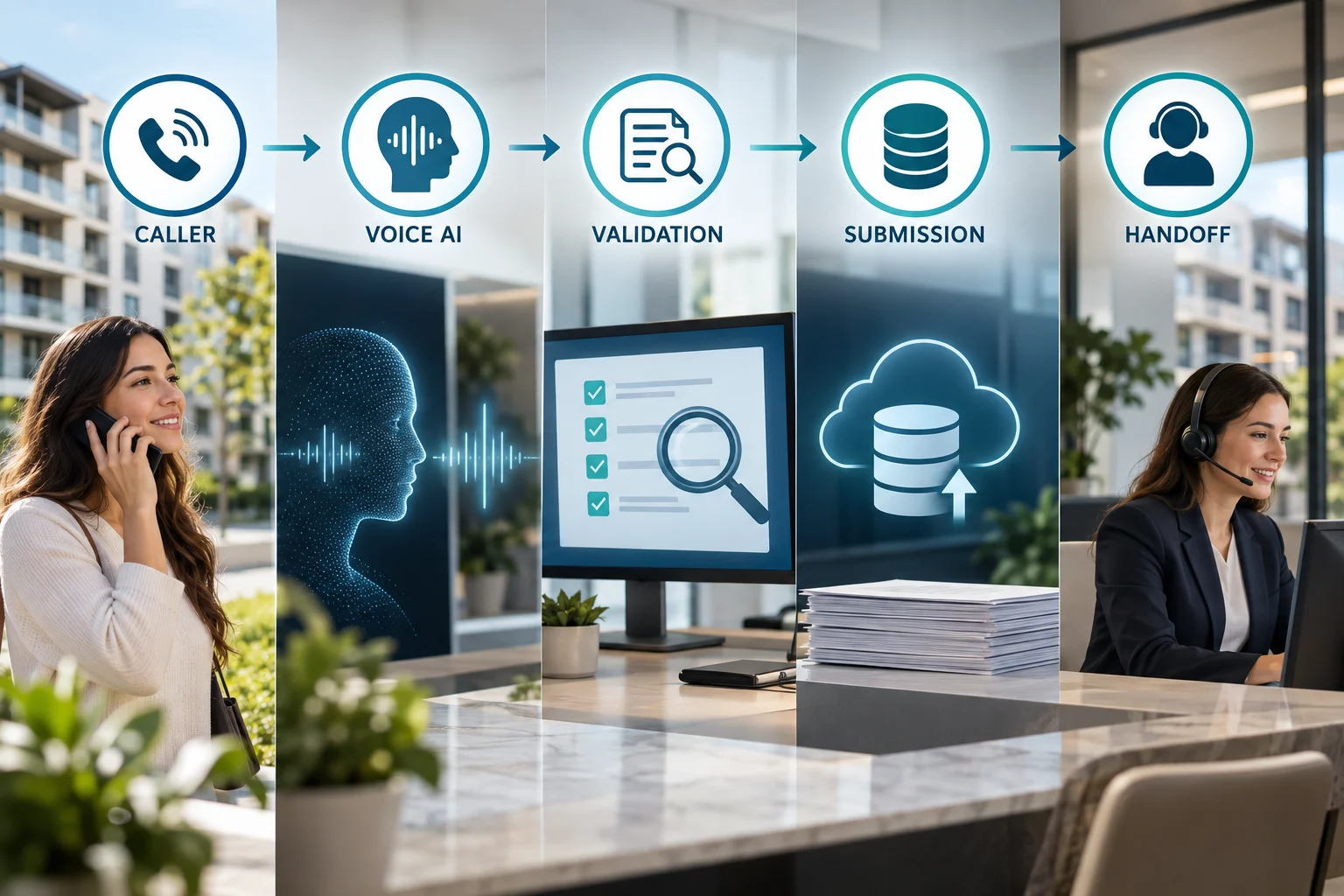
Use explicit, auditable rules for real‑time handoff. Typical triggers include: low confidence in intent classification, caller request to speak to a human, presence of emergency keywords (e.g., 'flood', 'smoke', 'can't breathe'), or requests that could generate legal exposure (lease negotiation, binding offers). Ensure the Voice AI logs the trigger, the agent receiving the handoff, and a timestamped acceptance back into the CRM or ticketing system. Embed the canonical Caller → Voice AI → intent & identity checks → CRM or property system → appointment/maintenance case/lead record → specialist handoff architecture into both operational runbooks and vendor contracts.
- Confidence threshold routed to agent if below set value
- Keyword list for emergency or safety words that immediately escalate
- Caller request for agent forces immediate human queueing
- Record the accepting agent ID, time, and subsequent CRM action
Escalation workflows for maintenance and leasing
Design separate escalation flows for leasing and maintenance to reflect different risk profiles. Maintenance triage should include a rapid safety check (explicitly not a substitute for emergency services) and a mandatory human review when the issue could be safety critical. Leasing escalations should route to trained leasing agents when the call touches fair‑housing decision points, pricing negotiations, or legal terms.
- Maintenance: automated gather-and-triage → immediate safety keywords → human triage
- Leasing: automated qualification → price/term triggers → human leasing specialist
- Log escalation reasons to the record for later audits and QA

5. Audit trails, observability and change control
Auditability requires both granular telemetry and disciplined governance for changes to models, prompts and policies. Without versioned change control, you cannot prove what the system said at a particular time.
Immutable audit trails and observability
Store a chronological, tamper‑evident audit trail that includes: timestamps, model and prompt identifiers, intent output, confidence scores, human overrides, CRM events, and user‑level access logs. Integrate monitoring dashboards that surface anomalies (sudden drops in confidence, spike in escalations, unusual handoff rates) so ops teams can act before issues reach customers.
- Append-only event logs with cryptographic integrity checks
- Model and prompt identifier linked to each interaction
- Access logs for staff and vendor technicians
- Operational dashboards for handoff, escalation, and accuracy metrics
Change control: model, prompt and policy governance
Establish a change-control board that approves model updates, prompt edits and policy changes. Require pre‑deployment testing, canary rollouts, rollback plans and post‑deployment audits. Record approvals and test artifacts so you can reconstruct the system state for a given date.
- Pre-deployment tests and QA sampling
- Canary deployment with KPI gates
- Documented approval and rollback procedures
- Permanent record tying model/prompt version to calendar date

6. Procurement and evidence to require from vendors
Procurement should demand operational, security and governance evidence — not marketing claims. Insist on artifacts and contractual commitments that let you prove control in audits.
Minimum vendor evidence and contractual clauses
Require a current list of subprocessors, documented data flows, deletion and export procedures, incident response commitments, and access to logs for agreed‑upon audits. Contractual commitments should include: ability to produce activity logs, defined SLAs for human handoff, documented backup geography, and explicit data‑deletion processes.
- Subprocessor list and data‑flow diagrams
- Log access and regular audit windows
- Incident response times and notification obligations
- Data deletion and export procedures, plus backup geography documentation
Operational SLAs and QA deliverables
Define SLAs for time to human handoff, escalation acknowledgement, system availability, and mean time to recovery. Require periodic QA reports, sampling results and bias/fairness testing focused on fair‑housing exposures. Include a right to independent audits for high‑risk deployments.
- Time-to-human-handoff SLA and escalation acknowledgement SLA
- Availability and recovery SLA
- Quarterly QA reports and bias testing focused on leasing decisions
- Right to independent third‑party audit for high‑risk flows
7. Measuring audits, failures and continuous improvement
Operational improvement is a cycle: measure, audit, remediate and repeat. Build practical metrics and review cadences to keep the Voice AI aligned with business risk tolerances.
Key operational metrics to track
Track measurable KPIs that reflect both service quality and risk: percent of calls escalated, median time to human handoff, percent of transcripts sampled for QA, incidence rate of potential fair‑housing flags, and time to resolve disputes. Use these metrics to set gates for model changes.
- Escalation rate and time to human handoff
- QA sample coverage and error rates
- Fair‑housing flag incidence and false positive rates
- Average time to close maintenance tickets originated by Voice AI
Post‑incident review and corrective action
For every incident that affects operations or compliance, run a documented post‑incident review that reconstructs the call, identifies root causes (data, model, prompt, integration), and prescribes remediation including policy updates, retraining or workflow changes. Record all corrective actions and monitor their effectiveness in subsequent audits.
- Reconstruct sequence: audio → transcript → intent → action → handoff
- Classify root cause and assign remediation owner
- Track remediation effectiveness in follow-up audits
Related Peak Demand resources
Industry and AI sources reviewed
- Artificial Intelligence Risk Management Framework (AI RMF 1.0)National Institute of Standards and Technology (NIST)
- Fair Housing Act OverviewU.S. Department of Housing and Urban Development
- Artificial Intelligence and the FTCU.S. Federal Trade Commission
Housing, privacy, anti-discrimination, consumer-protection, records, and licensing obligations vary by jurisdiction and workflow. This article is operational guidance, not legal advice; organizations should confirm applicable requirements with qualified professionals.
Frequently asked questions
Common starting points include lead intake, showing and appointment scheduling, tenant and resident service requests, maintenance routing, listing questions from approved data, after-hours overflow, and structured escalation to leasing or property teams.
Official reference: Artificial Intelligence Risk Management Framework (AI RMF 1.0)
Do not delegate discriminatory screening, legal advice, binding transaction decisions, emergency-maintenance judgment, fair-housing determinations, or decisions that require licensed or authorized professionals. The agent should gather information and route the matter appropriately.
Official reference: Fair Housing Act Overview
Use approved fields and actions, validate identities and property records, limit permissions, log changes, and provide human review for exceptions. The agent should not invent availability, pricing, eligibility, lease terms, or maintenance status.
Official reference: Artificial Intelligence Risk Management Framework (AI RMF 1.0)
Require fair-housing safeguards, integration and data controls, testing, audit logs, escalation paths, emergency-routing rules, monitoring, change control, and clear ownership of listing, property, tenant, and maintenance knowledge.
Official reference: Fair Housing Act Overview
Build a controlled property-service workflow
Peak Demand helps real-estate and property teams connect Voice AI to lead intake, showing requests, resident service, maintenance routing, CRM workflows, and human escalation.
Schedule a discovery call


