
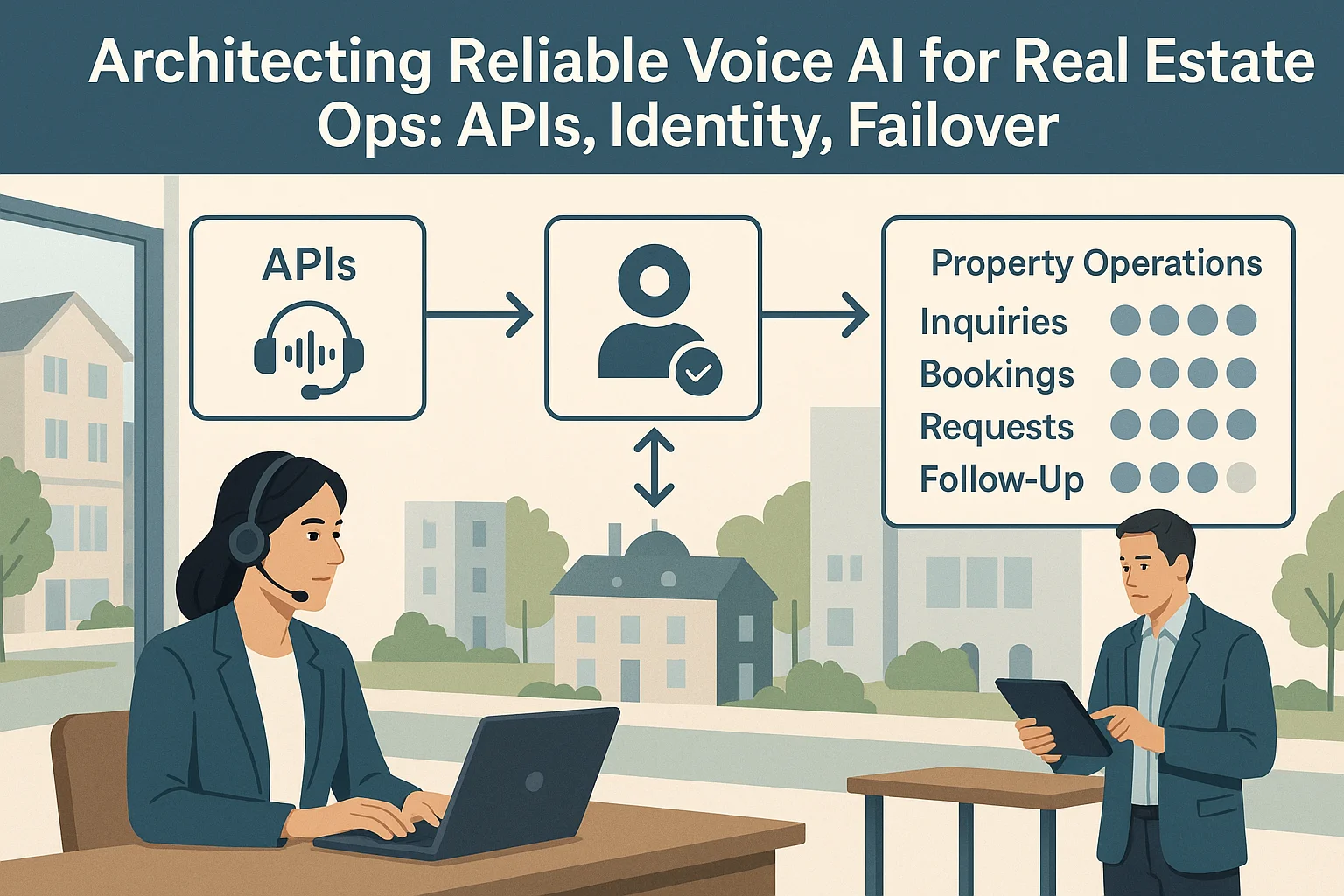
Architecting Reliable Voice AI for Real Estate Ops: APIs, Identity, Failover
A practical, architecture-first guide for brokerages, property managers and leasing teams on designing Voice AI systems that integrate with CRM/PMS, verify identity, survive failures, and hand off to humans safely.
1 — Scope and operational model
This section defines the operational boundary for Voice AI in real estate: what to automate, what to gate for human review, and the canonical call flow used throughout this guide.
Operational boundary: intake, routing, triage — not final judgment
Design Voice AI to capture intent and structured data (lead, tenant, or maintenance request), route or schedule actions in the CRM/PMS, and escalate to a human when judgment, legal interpretation, or emergency decisions are required. Examples of safe automation: scheduling showings, capturing move-in timelines, opening a maintenance ticket with reported symptoms. Examples that must remain human-controlled: fair-housing screening decisions, emergency-safety triage with life-safety implications, and binding lease negotiation.
- Automate: intent capture, availability checks, basic identity verification (call-back or OTP), appointment booking, ticket creation.
- Gate for humans: emergency judgment, discrimination-prone screening, legal or lending advice, binding contract actions.
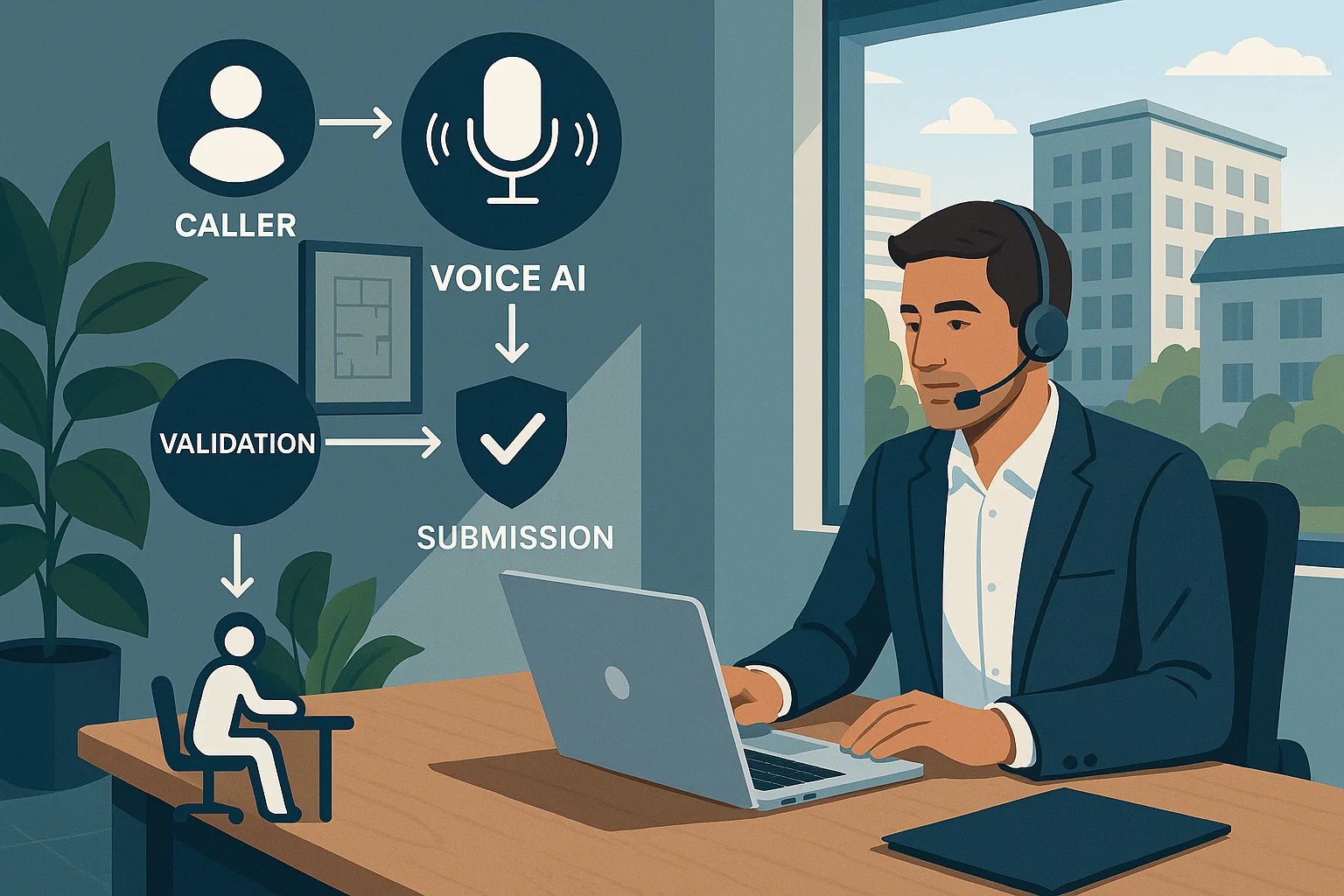
Canonical call flow (Caller → Voice AI → Systems → Handoff)
Use a single canonical flow as the basis for architecture and runbooks. Caller connects to Voice AI, which performs speech-to-intent classification and identity checks, emits structured events to the integration layer, and either executes approved actions in the CRM or routes the caller to a human agent. Maintain state across the call using an immutable call identifier and link back to CRM objects (lead_id, ticket_id, showing_id) for reconciliation.
- Call ID: global identifier persisted end-to-end for logs and post-call audit.
- Intent extraction → canonical object (lead/maintenance/appointment) → precommit verification → write to CRM/PMS via API.
- If verification fails or an exception is raised, immediately queue human handoff with context snapshot.
2 — System architecture and API contracts
Operational reliability begins with API-first design. Define clear contracts, idempotency, and failure semantics between Voice AI, orchestration, and downstream property systems.
Define three canonical payloads
Create standardized JSON payloads for the three most common outcomes: lead_intake, maintenance_request, and appointment_booking. Each payload should include provenance (call_id, capture_timestamp, agent_or_model_version), minimal required fields, optional verification attributes, and a status field with allowed transitions.
- lead_intake: fields — caller_phone, property_id, intent_score, contact_consent, preferred_contact_window, lead_source, verification_level.
- maintenance_request: fields — unit_id, symptom_code, severity_hint, photos_link (if MMS/URL), reporter_identity, occupancy_status.
- appointment_booking: fields — property_id, timeslot_id, proposed_time, organizer_contact, confirmation_token.
API behaviors and reliability patterns
Specify API expectations in procurement and integration docs: synchronous 200/202 semantics, idempotency-keys, and retry windows. Adopt event-driven webhooks for asynchronous status updates and provide a polling fallback. Implement consumer-side circuit breakers and back-pressure signals to prevent cascading failures.
- Idempotency: require idempotency-key headers for create operations to avoid duplicate leads or tickets.
- Acknowledgement model: Voice AI should accept a request with 202 and publish an event to a confirmed channel once the CRM acknowledges persistence.
- Retries: exponential backoff with capped retries and dead-lettering to a human operations queue after N attempts.
Integration adapters: keep business logic in orchestration
Avoid embedding property-system-specific logic inside the Voice AI model. Build lightweight adapters or orchestration layer that map canonical payloads to CRM/PMS-specific fields. This separation reduces blast radius when systems change and simplifies testing.
- Adapters translate canonical fields to system-specific schema and handle versioning.
- Orchestration layer enforces business rules (e.g., blackout times, showing rules) before committing changes.
3 — Identity, verification, and privacy controls
Identity verification must be risk-based, auditable, and limited to the minimum necessary. Treat identity as an operation attribute in the data contract, not a binary trust decision.
Verification levels and gating
Define verification levels (none, nominal, strong) and map allowed actions per level. For example, booking a showing may require nominal verification (phone match and OTP), whereas owner account changes require strong verification (multi-factor callback and human confirmation). Record verification events as auditable attributes in the payload.
- Nominal: caller ID match OR confirmed property attribute (e.g., last 4 of lease).
- Strong: OTP or short in-call knowledge check plus manual confirmation before making account-level changes.
Privacy and data transfer considerations
Document hosting region, backup region, subprocessors, cross-border transfer mechanisms, retention policy, and recording consent in vendor agreements. Be explicit about who can access recordings and metadata, how long they are retained, and procedures for data subject requests. Organizations should confirm obligations with qualified advisors for applicable jurisdictions.
- Retention: define retention windows for raw audio, transcripts, and derived data separately.
- Onward transfer: list subprocessors and transfer mechanisms (e.g., standard contractual clauses) in contract annexes.
Regulatory and fairness boundaries
Design identity and screening workflows to avoid discriminatory outcomes. Use human review flags for any profile attributes that can drive protected-class decisions. When using automated candidate qualification, publish accuracy metrics and human override rates in governance documents.
- Never automate fair-housing screening decisions; route those workflows to trained staff.
- Log model decisions and allow humans to correct or overrule intake outcomes.
4 — Reliability, failover, and human takeover
Operational continuity is the product of layered defenses: infrastructure redundancy, graded degradation strategies, and immediate human handoff paths with context.
Multi-region deployment and telephony failover
Host primary Voice AI and orchestration in a specified primary region with a warm-standby in a backup region. For PSTN connectivity, provision dual carriers and automatic number routing to a secondary provider on carrier failures. Test cross-region failovers at least quarterly.
- Warm standby: keep state-synchronization windows and transaction logs replicating to backup region.
- Telephony redundancy: dual SIP trunks and automated DNS failover for inbound numbers.
Graceful degradation and fallback modes
When the AI stack is degraded, fall back to deterministic IVR menus or immediate human queueing. Prioritize preserving the caller experience: if intent confidence is below a threshold, escalate to a human agent rather than risking incorrect actions in the CRM.
- Confidence gating: set an intent-confidence floor; below it, invoke human queue with context snapshot.
- Local IVR fallback: present essential menu options (emergency maintenance, leave a voicemail, agent transfer).
Human-in-loop handoff mechanics
Handoffs must include a context bundle: transcript, intent labels, captured payload, verification level, and direct callback token. Provide agents with a one-click accept and a single-click takeover that pauses any automatic follow-up actions to avoid duplication.
- Context bundle: store with call_id and attach to CRM objects for auditability.
- Agent takeover: implement a short lock to prevent concurrent modifications while human handles the case.

5 — Observability, QA sampling, and safe tool use
Continuous measurement and human review prevent drift and operational risk. Define SLOs and sample for quality with a regime that mixes deterministic checks and random audits.
Key metrics and SLOs
Instrument metrics across the stack: call success rate, end-to-end latency for critical writes, intent accuracy, human takeover rate, duplicate-create rate, and mean time to human answer on escalations. Set SLOs (for example: 99.5% critical-write success over 30 days; mean escalation response under 90 seconds) and require vendor reports.
- Observability: distributed tracing (call_id across services), structured logs, and time-series metrics.
- QA: monthly accuracy targets and human review percentages; threshold-based alerts.
Sampling, audits, and explainability
Sample calls for manual QA and regulatory audit. Keep model-versioned transcripts and explainability artifacts tied to decisions that affected outcomes (e.g., why an appointment was scheduled at a given time). Preserve a chain of custody for post-incident review.
- Model-version tagging with each transaction for rollback and investigation.
- Human QA: tiered sampling combining lowest-confidence decisions and random samples.
Safe tool use: clear prohibition list
Define and enforce a prohibition list: no automation of legal advice, discrimination-prone screening, emergency medical or life-safety judgments, or binding financial commitments. For any action that could materially affect tenancy or safety, require explicit human confirmation recorded in the CRM.
- Prohibit automated eviction or eligibility decisions that could trigger disparate impact.
- Emergency maintenance calls: model flags and immediate human escalation; never authorize technical judgment-only remediation autonomously.
6 — Procurement, SLOs, and operational contracts
Translate architecture into procurement requirements. The contract should assign ownership, define data handling, and require runbooks and observability access.
Contract must-haves
Include explicit clauses for data residency and subprocessors, service levels tied to measured SLOs, runbook and playbook delivery, incident response timelines, and vendor obligations to provide anonymized QA exports. Require support for idempotency keys, webhooks, and dual-region disaster recovery.
- Data annex: hosting region, backup region, subprocessors, retention, and deletion procedures.
- SLA: measurable SLOs, penalties or credits for missed targets, and scheduled failover tests.
Integration ownership and operational roles
Agree on a RACI for integrations: who owns adapters, who maintains mapping logic, and who is responsible for schema changes. Define a joint change-control cadence and a staging environment that mirrors production for integration testing.
- RACI: vendor owns Voice AI endpoint; client owns CRM adapters or a shared orchestration layer depending on procurement.
- Change control: versioned API and backward compatibility windows for at least one release cycle.
Acceptance criteria and runbooks
Define acceptance criteria that include technical tests (idempotency, retries, webhook delivery), operational tests (human takeover scenarios, failover drills), and QA thresholds (intent accuracy, false-positive rates). Require vendor-delivered runbooks for the most likely incidents.
- Acceptance tests: automated integration tests plus two joint live failover drills.
- Runbooks: include escalation contacts, play-by-play actions, and postmortem obligations.
Related Peak Demand resources
Industry and AI sources reviewed
- Fair Housing Act OverviewU.S. Department of Housing and Urban Development
- Artificial Intelligence Risk Management Framework (AI RMF 1.0)National Institute of Standards and Technology (NIST)
- Artificial Intelligence and the FTCU.S. Federal Trade Commission
Housing, privacy, anti-discrimination, consumer-protection, records, and licensing obligations vary by jurisdiction and workflow. This article is operational guidance, not legal advice; organizations should confirm applicable requirements with qualified professionals.
Frequently asked questions
Common starting points include lead intake, showing and appointment scheduling, tenant and resident service requests, maintenance routing, listing questions from approved data, after-hours overflow, and structured escalation to leasing or property teams.
Official reference: Artificial Intelligence Risk Management Framework (AI RMF 1.0)
Do not delegate discriminatory screening, legal advice, binding transaction decisions, emergency-maintenance judgment, fair-housing determinations, or decisions that require licensed or authorized professionals. The agent should gather information and route the matter appropriately.
Official reference: Fair Housing Act Overview
Use approved fields and actions, validate identities and property records, limit permissions, log changes, and provide human review for exceptions. The agent should not invent availability, pricing, eligibility, lease terms, or maintenance status.
Official reference: Artificial Intelligence Risk Management Framework (AI RMF 1.0)
Require fair-housing safeguards, integration and data controls, testing, audit logs, escalation paths, emergency-routing rules, monitoring, change control, and clear ownership of listing, property, tenant, and maintenance knowledge.
Official reference: Fair Housing Act Overview
Build a controlled property-service workflow
Peak Demand helps real-estate and property teams connect Voice AI to lead intake, showing requests, resident service, maintenance routing, CRM workflows, and human escalation.
Schedule a discovery call


