
Strategic Operating Model for Patient Access: Voice AI, Staffing & Risk
An operational guide for healthcare leaders designing Voice AI for patient access. Covers architecture, identity controls, safe escalation, procurement choices, staffing models, data and governance boundaries.
1. Why a formal operating model matters now
Voice AI projects fail when technical novelty outpaces process, staffing and risk controls. Healthcare patient access adds regulated data, safety boundaries and complex scheduling rules—so an explicit operating model is the only practical path to reliable outcomes.
Lost assumptions drive failures
Common pilot failures are not technological alone: missed use-case definitions, unclear ownership for EHR writes, absent identity checks, and undefined escalation rules create gaps that staff patch with ad hoc processes. That increases risk, creates auditability gaps, and harms patient experience.
- Define who owns the integration between Voice AI and the scheduling or practice-management system.
- Define fallback behaviour when the Voice AI cannot verify identity or map an appointment type.
- Set human roles for review and remediation before full production rollout.
Business outcomes that matter
Measure outcomes that matter to operations and compliance, not just call handling. Examples: rate of successful verified bookings, percent of calls escalated to humans for clinical-safety reasons, average time-to-confirmation, and the volume of reconciliations generated by failed writes.
- Operational KPIs: verified booking rate, time-to-schedule, escalation rate.
- Quality KPIs: transcription accuracy for required fields, human QA pass-rate.
- Risk KPIs: number of identity mismatches, audit-flagged write failures.
2. Canonical architecture: a minimal safe path
An explicit architectural flow aligns teams and vendors. Use this canonical pattern as the starting point for procurement, integration and staffing decisions.
Core flow (operational map)
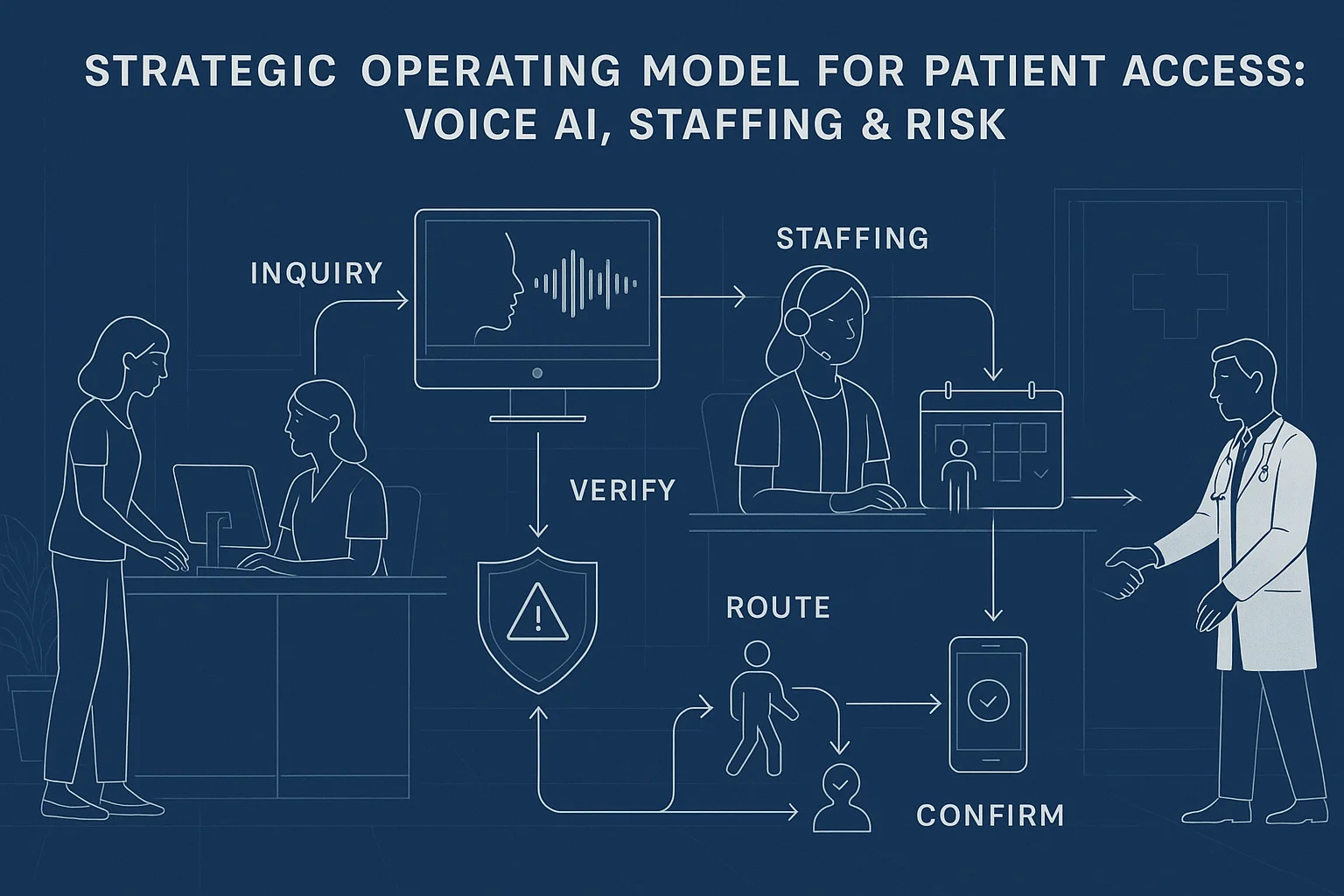
Patient or caller → Voice AI front end (IVR/ASR/NLU) → identity & validation controls → permitted action decision → approved scheduling or service API call → confirmation message or human handoff. Every step needs defined owners, SLAs, error-handling and logging.
- Voice AI front end: captures intent and structured fields (name, DOB, appointment reason).
- Identity & validation: match against EHR/PM records using deterministic and probabilistic checks.
- Approved action decision: write operations allowed only when validation gates pass.
- Human handoff: deterministic trigger for any ambiguous, clinical, or identity-failed call.
Integration choices and adapters
Integrate via approved APIs or controlled adapters that encapsulate business rules. Where an EHR lacks modern APIs, use an integration layer or RPA with strict throttling and auditable transaction queues. Define retry policies and reconciliation workflows for failed writes.
- Prefer API-first integrations with tokenized service accounts and scoped permissions.
- Use an orchestration layer to centralize retry logic, idempotency, and audit trails.
- Avoid direct database writes from Voice AI—use the clinic’s sanctioned service endpoints or middle-tier adapter.
3. Identity, validation and safety controls
Before permitting any action that changes a patient’s record or books an appointment, the system must prove sufficient identity and validate the requested service against business rules and clinical boundaries.
Identity gates and acceptable evidence
Combine deterministic data matches (exact DOB, patient ID) with risk-based attributes (recent visit date, phone number on record). For higher-risk actions—cancelations, sharing test results—require multi-factor or human verification. Document what evidence is sufficient for each action class.
- Low-risk actions (general scheduling): two matching attributes (name + DOB) and voiceprint optional.
- Higher-risk actions (change-of-record, sending results): in-person, secure portal, or live-rep confirmation.
- Maintain a decision matrix mapping action class to required verification level.
Field validation and appointment logic
Validate appointment types, coverage constraints, clinician availability and required pre-authorization before committing a booking. Maintain a ruleset in the orchestration layer so business changes do not require Voice AI retraining.
- Use canonical codes for appointment types and map local scheduling taxonomy at the adapter layer.
- Block or escalate bookings that could cause unsafe scheduling (e.g., same-day urgent clinical needs routed to non-clinical schedules).
- Log all rejected bookings with reason codes for downstream review and training.
Clinical safety boundary
Voice AI must not perform clinical triage, diagnose, prescribe, or substitute clinical judgment. Implement deterministic escalation: any mention of new or worsening symptoms, chest pain, breathing difficulty, suicidal ideation or other red flags triggers immediate human handoff and, where appropriate, instructions to call emergency services.
- Create red-flag lexicons and NG/NLU rules that escalate to clinicians or safety dispatch.
- Log and timestamp every escalation; include the audio or transcript in a secured audit trail.
- Train staff on the exact handoff script and their responsibilities when the system escalates.
4. Human-in-the-loop, escalation and staffing models
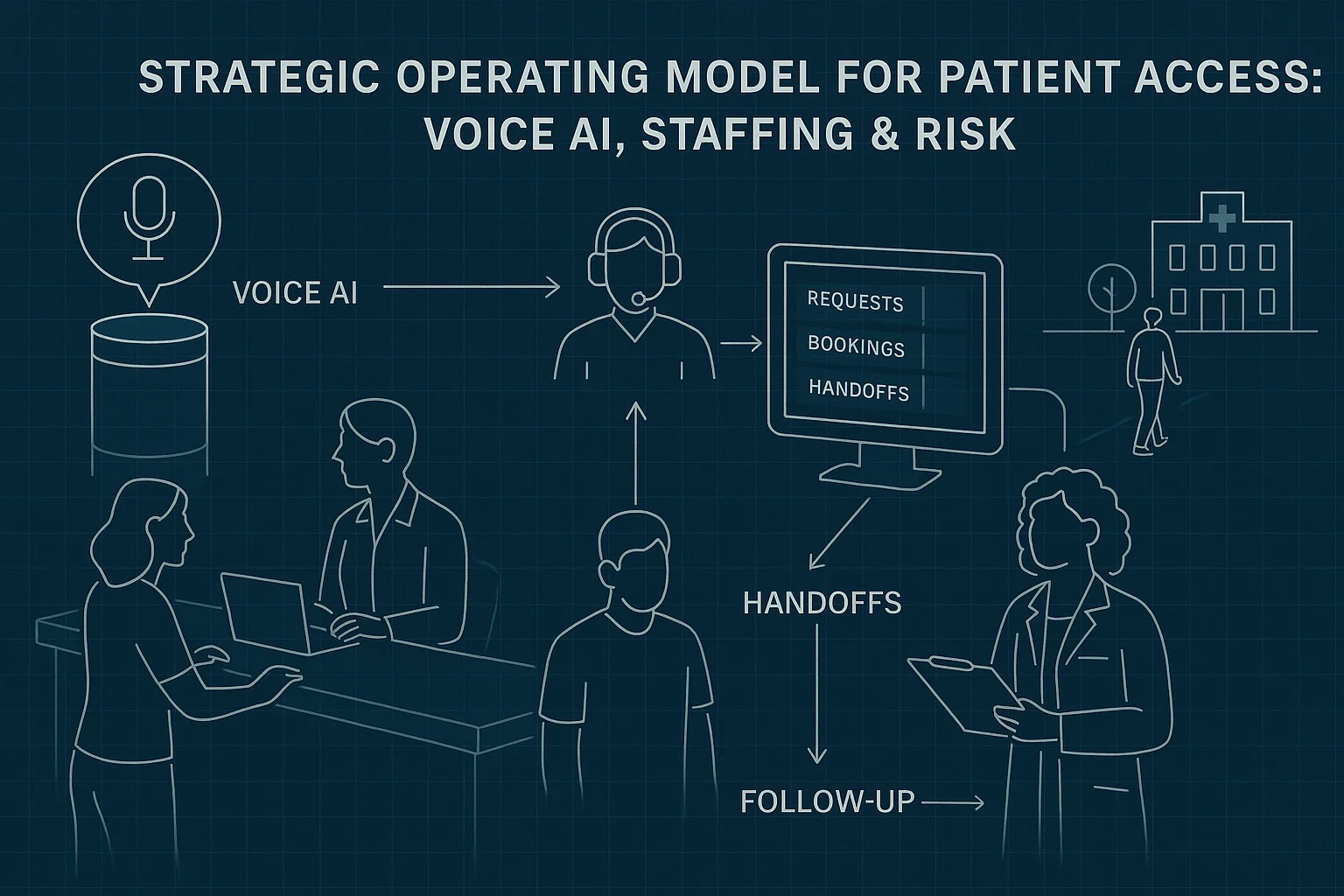
Voice AI succeeds when human roles are clearly defined: which tasks are automated, which are assisted, and who resolves exceptions. Design staffing to absorb early-stage escalation volumes and to manage ongoing QA.
Tiered staffing design
Adopt a three-tier model: Level 1 (Automated) handles routine, verified bookings; Level 2 (Human intake) resolves verification failures and complex scheduling; Level 3 (Clinical/Compliance) handles clinical escalations and dispute resolution. Assign SLAs for each tier and capacity buffers for launch and seasonal peaks.
- Staff Level 2 with cross-trained access coordinators who can validate identity and complete bookings.
- Keep a small Level 3 roster (clinicians or triage nurses) on-call for safety escalations.
- Measure contact rates from Voice AI to Level 2 to size staffing appropriately.
Human review and auditability
Ensure a human-review queue with replayable audio, time-stamped transcripts, and metadata (verification evidence, decision path). Use periodic sampling for QA and root-cause analysis—tracks errors back to NLU failures, ruleset gaps, or adapter problems.
- Retention of audio/transcripts must meet legal and privacy obligations; document retention policies and access controls.
- QA should measure both safety (escalation appropriateness) and operational accuracy (booking correctness).
- Feed QA findings into both model improvement and ruleset updates.
5. Data, deployment and compliance considerations
Architectural choices drive privacy, security and legal obligations. Be explicit about hosting regions, subprocessors, recording consent, and breach responsibilities in procurement documents.
Deployment topology and data residency
Specify production hosting region, secondary backup region, and where backups and logs live. Document any remote-support access paths and subprocessors involved in speech-to-text, model inference, transcription, or storage. Confirm contractual transfer mechanisms for cross-border processing and list retention periods for recordings and transcripts.
- Include an annex in contracts listing hosting region(s), subprocessors, and backup geography.
- Define controls for remote-support access (time-bound, logged, role-based).
- Separate PII storage from operational telemetry when possible; minimize retention of full audio when transcripts suffice.
Consent, recording and patient rights
Ensure callers are informed and, where required, explicitly consent to recording and automated processing. Provide clear routes to opt out to human-only handling. Implement record-level flags to prevent automated processing of sensitive callers (e.g., requests for mental-health counseling) and document how to handle access requests and deletions.
- Script the consent prompt and record the consent event in the audit trail before processing.
- Map local patient-rights processes (access, correction, deletion) into the operational playbook.
- When uncertain about legal obligations in a territory, require legal review and conservative defaults (human-handling).
6. Procurement, testing and go-live controls
Procure for accountability and observability. A vendor may supply models and adapters, but contracts must assign ownership for integrations, observability, and remediation.
Contract and procurement checklist
Include clear deliverables: integration adapter ownership, API contracts, event model for logging, replayable audio retention, defined subprocessors, escalation SLAs, and a remediation plan for systemic errors. Require runbooks for common failure modes and a documented rollback plan.
- Demand a services annex listing integration points, data flows and subprocessors.
- Require observable metrics: latency, success/failure rates, verification pass rates, escalation counts.
- Specify remediation windows for failed writes and a reconciliation process owner.
Testing, ramp and measurable gates
Use staged deployment: sandbox → supervised pilot (human shadow) → limited production with percentage routing → full production. Define go/no-go criteria for each stage based on KPIs and risk thresholds.
- Pilot stage must include representative patient cohorts and peak-hour traffic tests.
- Gate metrics include verification accuracy, escalations per 1,000 calls, and write-failure rate.
- Require a post-launch review at 30 and 90 days with agreed corrective actions.
Peak Demand differentiation
Peak Demand implements custom Voice AI with scheduling and intake integrations, identity verification and field validation, safe escalation, auditable trails and configurable human review queues. Our approach centralizes connectors and rulesets in an orchestration layer so clinics retain control over scheduling rules and verification thresholds while vendors manage model performance and observability.
- We deliver adapters that map local appointment taxonomies to canonical codes for safer automation.
- We implement replayable audit trails and human-review tooling alongside integration ownership.
- We operationalize escalation SLAs and provide remediation runbooks as contract deliverables.
7. Governance, risk management and ethical guardrails
Operational governance ensures Voice AI remains safe, compliant and aligned with organisational values. Use established AI governance frameworks and health-specific ethical guidance to structure oversight.
Governance structure and roles
Create a cross-functional governance group—clinical lead, privacy/compliance, IT, patient access, and vendor representative. The group reviews incident reports, approves ruleset changes, and signs off on model retraining that affects patient-facing behaviour.
- Define a change control process for rules and model updates with explicit testing requirements.
- Maintain a register of high-risk actions and periodic reviews of incidents.
- Ensure clinicians remain accountable for clinical-safety policy decisions.
Risk management and continuous monitoring
Apply a risk-management lifecycle: identify risks, implement controls, monitor performance, and remediate issues. Instrument for observable signals such as sudden rises in escalations, verification failures, or anomalous API error patterns.
- Use monitoring to detect regressions in NLU confidence and route volume shifts that may indicate model drift.
- Keep incident response playbooks that include notification trees, patient-notification triggers, and regulatory reporting thresholds.
- Perform periodic third-party reviews and penetration testing of integration adapters and orchestration layers.
Ethics and patient-centred design
Follow health-specific ethical guidance: be transparent about automation, preserve human oversight, and protect privacy and autonomy. Engage patient-representative feedback during pilot design and include accessible alternatives for those who opt out.
- Publish a concise patient-facing explanation of how Voice AI is used and how to request human-only handling.
- Include patient feedback loops to measure satisfaction, comprehension and trust.
- Keep conservative defaults for ambiguous or high-risk use-cases.
Related Peak Demand resources
Industry and AI sources reviewed
- Ethics and governance of artificial intelligence for healthWorld Health Organization
- Artificial Intelligence Risk Management Framework (AI RMF 1.0)National Institute of Standards and Technology (NIST)
- Regulatory considerations on artificial intelligence for healthWorld Health Organization
- OECD AI PrinciplesOrganisation for Economic Co-operation and Development
Healthcare privacy, security, clinical-safety, records, and professional obligations vary by jurisdiction and workflow. This article is operational guidance, not legal advice; organizations should confirm applicable requirements with qualified professionals.
Frequently asked questions
Administrative workflows such as appointment booking, changes and cancellations, referral-status intake, approved follow-up, patient-access questions, after-hours overflow, and structured routing are common starting points. Clinical judgment, diagnosis, emergency triage, and prescribing decisions must remain with qualified professionals.
Use the minimum identifiers approved by the organization, validate them against the system of record, avoid exposing unnecessary information, and provide a human-assisted path when verification fails. The system should not infer identity from conversational context alone.
The agent should follow the organization's approved escalation and emergency-routing rules, avoid clinical advice, and transfer or direct the caller to the appropriate human or emergency channel. Those rules must be tested with realistic language and failure cases.
Request identity and privacy controls, scheduling or EHR integration behavior, audit logs, escalation rules, downtime handling, testing evidence, change control, monitoring, and clear separation between administrative automation and clinical decision-making.
Design a safe patient-service workflow before automating it
Peak Demand helps healthcare organizations connect Voice AI to scheduling, intake, patient communication, identity checks, escalation, and reporting with clear operational boundaries.
Schedule a discovery call


