
Predictive Capacity Governance for Healthcare Voice AI: Clinical Risk & Access
A practical operating model and governance playbook for deploying Voice AI to manage patient access and predictive capacity without replacing clinical judgment. Covers identity, safe escalation, integrations, procurement, and measurable operating controls.
1. Why governance matters for Voice AI in patient access
Voice AI can reduce wait times, increase booking throughput, and extend after-hours coverage. But in regulated healthcare settings the value depends on how safely it handles identity, appointment intent, and clinical boundaries. Good governance converts model capability into predictable capacity without expanding clinical risk.
Scope and safety boundary
Limit Voice AI to administrative and access tasks: appointment scheduling, simple eligibility checks, referral verification, reminders, message triage for non-urgent matters, and routine pre-visit intake. Explicitly exclude diagnosis, triage of emergencies, prescribing, or any action that substitutes clinical judgment. Build escalation logic that routes ambiguous, urgent, or safety-related calls to trained clinicians or a qualified contact-centre agent.
- Operational rule: If symptom keywords map to potential emergencies or clinical judgement is required, trigger immediate escalation.
- Record and surface the reason for escalation in the handoff payload (caller summary, confidence score, time stamps).
- Define and enforce acceptable automation scope in contracts and runbooks.
Operating model (simple flow)
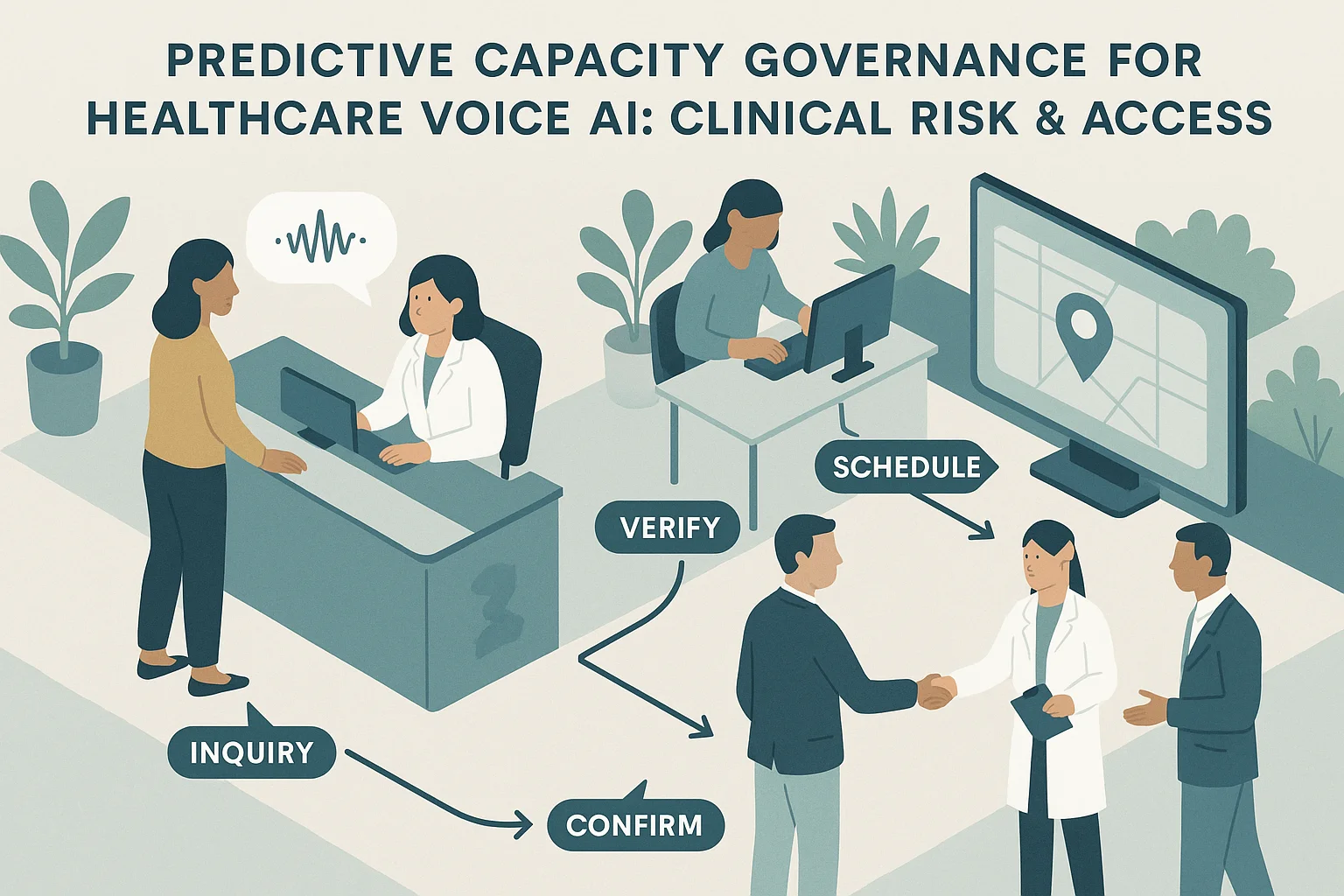
Use a deterministic orchestration path that assigns clear responsibility at each stage. A recommended pattern is: Patient/caller → Voice AI (intent parsing, basic verification) → validation & identity controls (match to patient record) → approved scheduling or service API (create or modify booking) → confirmation or human handoff (if needed). This keeps the AI layer as an orchestrator with verifiable handoffs.
- Keep business-system adapters thin and documented (what fields written, idempotency, error codes).
- Carry a ledger-style audit trail for each interaction: transcript snippet, decision points, identity checks, API calls, and final action.
- Place human review points around high-impact actions (first-time bookings, changes to high-risk clinics, manual override).
2. Risk mapping and governance controls
Operational governance requires a practical risk map, concrete controls, and measurable thresholds. Adopt predictable controls before scaling.
Risk identification and prioritization
Map risks across safety, privacy, security, access equity, and business continuity. Prioritize risks that would cause immediate patient harm (misrouted emergency calls, identity errors), legal exposure (unauthorised data disclosure), or operational collapse (mass failed bookings during peak hours). Use a cross-functional risk register owned by patient access or clinical operations.
- Classify each risk by likelihood, impact, and detectability, and set risk tolerance with clinical leadership.
- Set measurable indicators (e.g., escalation rate, identity-mismatch rate, API error rate) tied to remediation SLAs.
- Review and update the register after every major change (model update, integration change, policy shift).
Controls: human oversight and escalation
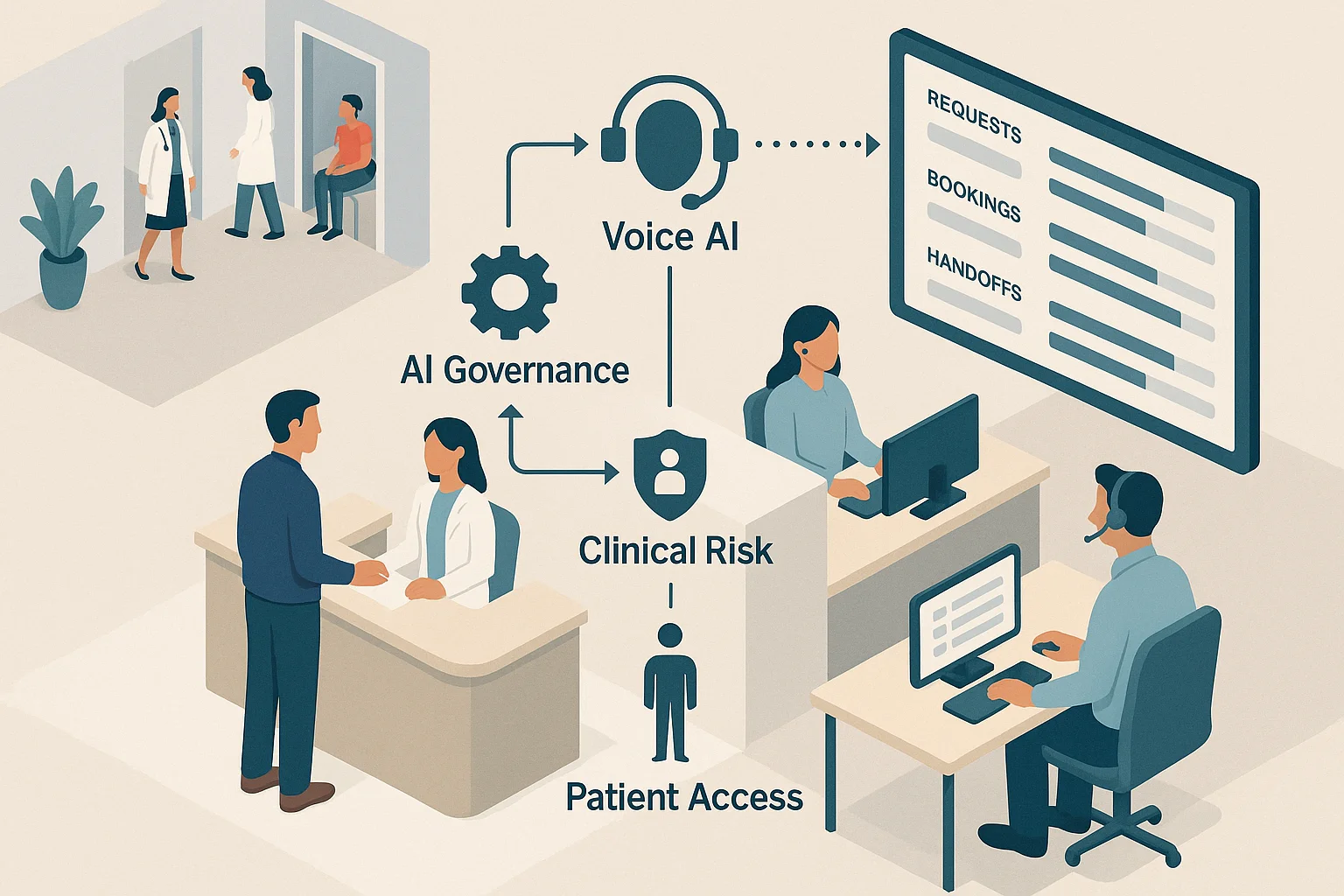
Define the human-in-loop model for every automated action: who can override, how handoffs occur, and what information is presented to the agent. A single escalation flow should include confidence thresholds, explicit reason codes, and automated tickets in the contact-centre system.
- Set confidence thresholds for autonomous booking; below threshold, the system creates a warm handoff with context.
- Use dual-review for changes to high-risk appointments (e.g., surgical bookings, anesthesia consults).
- Log all overrides and use them as training data for both models and operational process improvements.
3. Identity, consent, and data residency considerations
Patient identity and consent are the foundation of safe patient access. Design identity flows to reduce false matches and to make consent explicit and auditable.
Verified identity and field validation
Combine low-friction checks (date of birth, partial health-id, appointment code) with higher-assurance methods for higher-risk actions (two-factor verification, one-time token via SMS/email, or knowledge-based prompts that are not secrets). Keep identity levels mapped to actions (e.g., booking vs. record disclosure).
- Define identity assurance levels and allowed actions per level.
- Fail closed for actions requiring higher assurance — escalate to human verification rather than proceed insecurely.
- Persist only the minimum identity attributes required for the operation, and record verification evidence in the audit trail.
Consent, recording, and data residency
Make consent explicit within the voice flow for call recording and data processing. Surface key retention and onward transfer elements to callers and log consent with timestamps. In governance documents, detail hosting region, backup region, subprocessors, remote-support access, and retention policy decisions so legal and compliance teams can assess obligations.
- Record consent decisions as discrete, auditable fields tied to the interaction record.
- Document subprocessors and cross-border transfer mechanisms in contracts and privacy notices.
- Ensure calls requiring local residency or special controls are routed to compliant infrastructure; confirm obligations with qualified advisors.
4. Integration architecture and auditability
Reliable integrations turn Voice AI into dependable capacity. Treat external systems as sources of truth and enforce controlled adapters with observable behavior.
Approved APIs and field-level contracts
Only integrate through approved scheduling or EHR APIs with well-defined contracts: allowed write operations, idempotency keys, rate limits, error semantics, and rollback behavior. Implement middleware adapters that translate between the Voice AI orchestration layer and downstream systems, applying validation and business rules upstream.
- Keep integration contracts in source control and enforce schema validation.
- Use orchestration queues for retries and backpressure; never allow the Voice AI to assume success without API acknowledgement.
- Map audit log entries to API transaction IDs for forensic tracing.
Audit trails, observability, and QA
A robust audit trail records the call transcript, intent decisions, identity checks, API calls, confidence scores, and manual overrides. Pair detailed logs with summary dashboards for operational KPIs and a sampling-based QA program for quality assurance.
- Store immutable interaction records for the agreed retention period; provide access controls and exportability for review.
- Instrument monitoring for escalation rates, API error spikes, identity mismatches, and time-to-resolution.
- Run regular random audits of handoffs and sampled transcripts as part of continuous improvement.
5. Operationalizing predictive capacity
Predictive capacity is valuable when it informs staffing, scheduling thresholds, and escalation capacity. Operationalize predictions through deterministic rules and tight feedback loops.
Forecasting and staffing orchestration
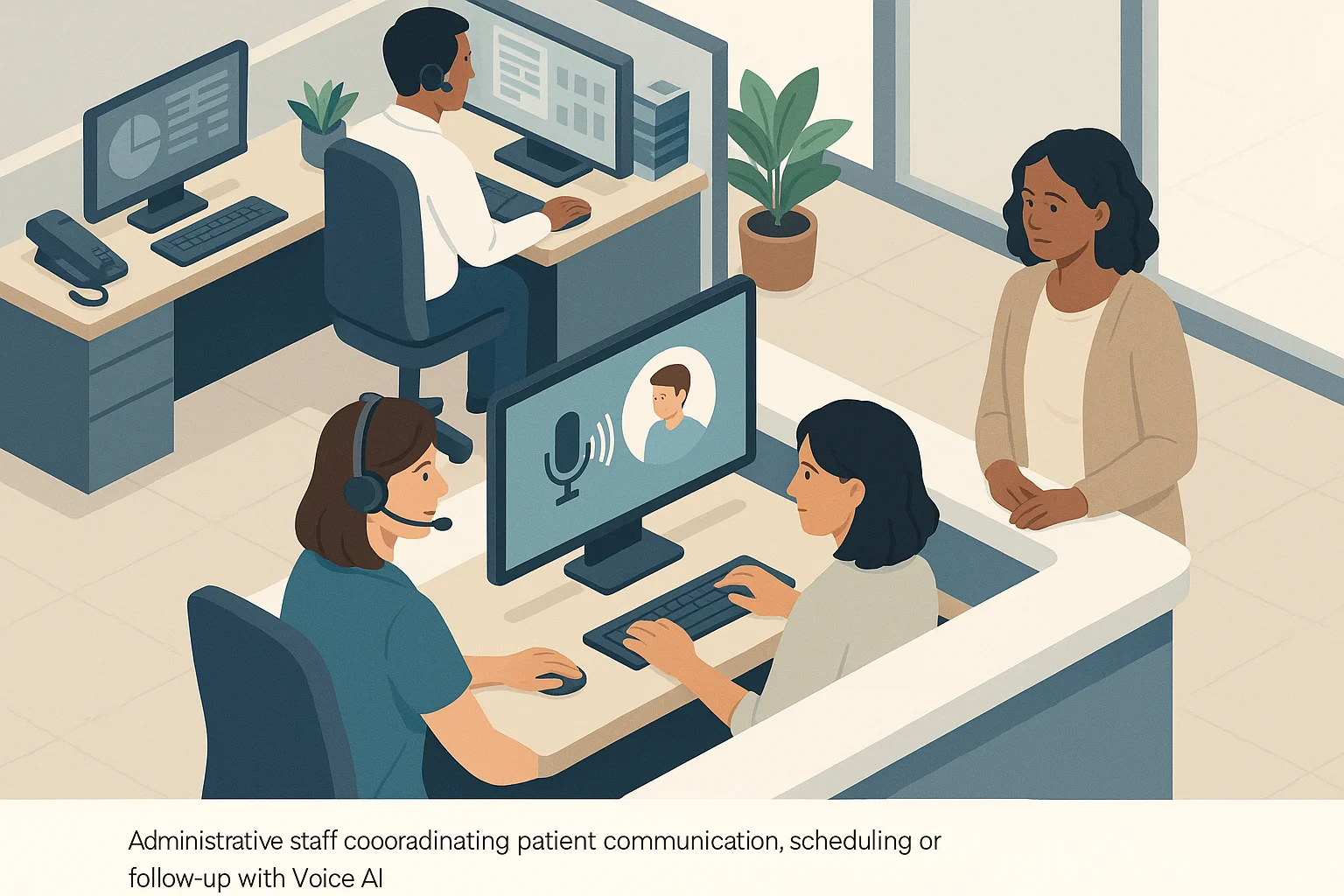
Use short-horizon demand signals from Voice AI interactions (call arrival patterns, intent mix, expected booking volume) and integrate them with workforce management systems. Predictive outputs should be translated into discrete actions: open additional booking windows, deploy overflow agents, or activate callback queues.
- Publish real-time indicators (e.g., queue depth, booking velocity, escalation rate) to capacity controllers.
- Define response playbooks for predefined thresholds (e.g., >X escalations per hour triggers supervisory review).
- Use conservative safety margins — treat model predictions as inputs to human decisions, not as automatic directives.
QA metrics and acceptable thresholds
Establish KPIs that reflect both access and safety: successful autonomous bookings, escalation accuracy, identity-mismatch rate, handoff quality score, and time-to-human-response. Tie remediation SLAs to each KPI and instrument alerts for systematic deviations.
- Track both false negatives (calls not escalated when they should be) and false positives (unnecessary escalations) and tune thresholds with clinicians.
- Report QA findings regularly to governance committees and update policies based on outcomes.
- Retain a labeled dataset of failed interactions for periodic model and rule retraining.
6. Procurement, deployment checklist, and failure boundaries
Buy and deploy Voice AI with documents and contractual obligations aligned to governance requirements. Build an incident and rollback playbook before go-live.
RFP and contract essentials
Require vendors to publish architecture diagrams, subprocessor lists, support-region details, audit-log schemas, identity verification options, and a transparent maintenance window schedule. Specify operational SLOs, data residency choices, breach notification timelines, and human-oversight obligations in the contract.
- Ask for sample audit entries and a runbook for common failure modes.
- Require evidence of regular third-party security assessments and explain how findings are remediated.
- Include clauses for model updates: testing windows, change logs, rollback procedures, and governance sign-off.
Deployment, incident playbook, and fail-safe modes
Pilot in a bounded environment with clear failure boundaries: set conservative automation thresholds, schedule supervised hours, and test escalation handoffs end-to-end. Define fail-safe modes where the system either degrades to information-only interactions or routes all calls to humans.
- Run a staged rollout: shadow mode → supervised autonomous mode → scaled autonomous mode.
- Define rapid rollback triggers (e.g., sudden spike in escalations, identity-mismatch trend, API outage).
- Maintain a clear communication protocol for incidents (internal roles, patient notification, regulator contact where applicable).
Related Peak Demand resources
Industry and AI sources reviewed
- Artificial Intelligence Risk Management Framework (AI RMF 1.0)National Institute of Standards and Technology (NIST)
- Ethics and governance of artificial intelligence for healthWorld Health Organization
- Regulatory considerations on artificial intelligence for healthWorld Health Organization
- OECD AI PrinciplesOrganisation for Economic Co-operation and Development
Healthcare privacy, security, clinical-safety, records, and professional obligations vary by jurisdiction and workflow. This article is operational guidance, not legal advice; organizations should confirm applicable requirements with qualified professionals.
Frequently asked questions
Administrative workflows such as appointment booking, changes and cancellations, referral-status intake, approved follow-up, patient-access questions, after-hours overflow, and structured routing are common starting points. Clinical judgment, diagnosis, emergency triage, and prescribing decisions must remain with qualified professionals.
Use the minimum identifiers approved by the organization, validate them against the system of record, avoid exposing unnecessary information, and provide a human-assisted path when verification fails. The system should not infer identity from conversational context alone.
The agent should follow the organization's approved escalation and emergency-routing rules, avoid clinical advice, and transfer or direct the caller to the appropriate human or emergency channel. Those rules must be tested with realistic language and failure cases.
Request identity and privacy controls, scheduling or EHR integration behavior, audit logs, escalation rules, downtime handling, testing evidence, change control, monitoring, and clear separation between administrative automation and clinical decision-making.
Design a safe patient-service workflow before automating it
Peak Demand helps healthcare organizations connect Voice AI to scheduling, intake, patient communication, identity checks, escalation, and reporting with clear operational boundaries.
Schedule a discovery call


